
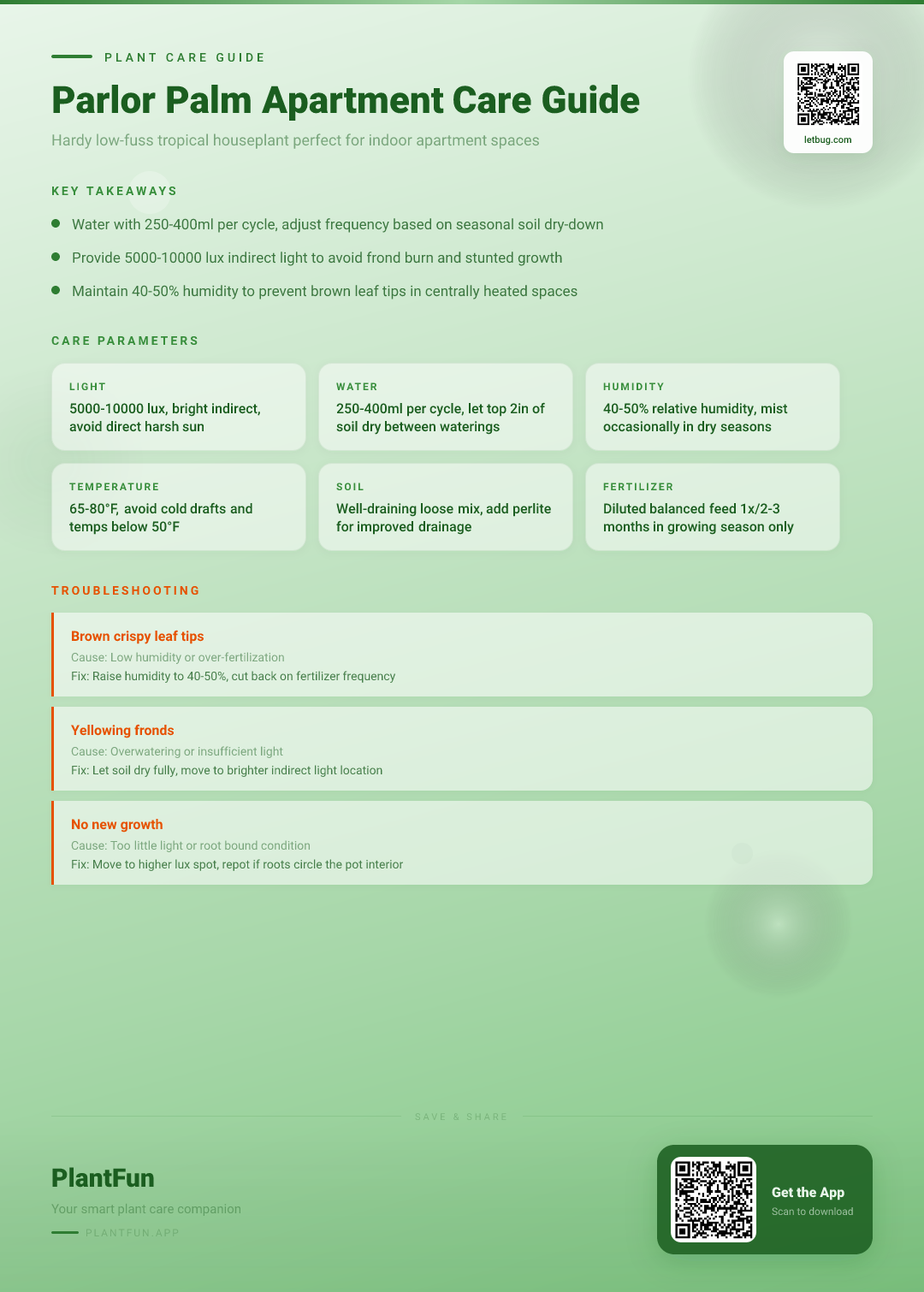
Key Takeaways
- Check soil moisture before watering — overwatering is the #1 killer of houseplants.
- Ensure your plant gets the right amount of light for its species.
- Be patient with recovery — most plants need 2–4 weeks to bounce back.
Quick Care Card: Essential thresholds for light, water, humidity, and temperature
| Feature | Threshold |
|---|---|
| Light | 5,000–10,000 lux (bright indirect) |
| Water | Top 2 inches of soil dry-down |
| Humidity | 40–50% ambient level |
| Temperature | 65–80°F (18–27°C) |
| Soil | Well-draining, peat-based mix |
| Fertilizer | Balanced 10-10-10, dilute strength |
| Toxicity | Non-toxic to cats and dogs (ASPCA, 2026) |
TL;DR: The 60-second summary for busy apartment dwellers
To keep your Chamaedorea elegans thriving, mimic its native rainforest understory. Position it in bright, indirect light, and water only when the top 2 inches of soil feel dry. Avoid deep-cleaning your apartment with harsh chemicals nearby, and keep it away from direct heater vents. Because it is non-toxic (ASPCA, 2026), it is a safe choice for pet owners. If you see brown tips, you are likely dealing with either low humidity or mineral salt buildup from over-fertilizing.
Why the Parlor Palm is the ultimate apartment survivor
When I first started my indoor plant journey, I made the mistake of buying high-maintenance ferns that withered within a month. The Parlor Palm was the first plant that taught me that ‘low light’ doesn’t mean ‘no light.’ It is a slow-growing, resilient species that thrives in the sedentary conditions of modern apartments where light is often limited by nearby buildings or north-facing windows.
Decoding your home environment: Assessing lux and airflow
Most apartment dwellers overestimate their light levels. While the Parlor Palm is a classic among low light plants for apartments, it still requires enough photons to drive photosynthesis. A ‘dim corner’ is usually insufficient. Aim for 5,000–10,000 lux—the amount of light found near a window that doesn’t receive direct scorching sun (NC State Extension, 2026).
Watering strategy: Managing 250-400ml cycles based on seasonal dry-down
I treat my palm with a measured approach rather than a calendar schedule. I use a soil moisture probe or simply stick my finger 2 inches into the medium; if it’s moist, I wait. When dry, I provide 250–400ml of filtered water, ensuring the pot has drainage holes to prevent root rot.
Lighting the way: Reaching 5,000-10,000 lux without burning fronds
Direct sun is the enemy of the delicate Chamaedorea elegans. If your palm is closer than 1 foot from a south-facing window, use a sheer curtain. If the fronds turn pale or develop bleached patches, move the plant 2–3 feet back from the glass.
Maintaining 40-50% humidity in centrally heated living spaces
Apartment heating systems, especially in winter, plummet local humidity below 30%. I combat this by placing my palm near a humidifier or on a pebble tray. Consistent humidity prevents the structural tissue damage often misidentified as simple dryness (NC State Extension, 2026).
Soil science: Creating the perfect drainage mix for sedentary root systems
Use a mix of 60% high-quality potting soil, 20% perlite, and 20% coco coir. This combination ensures the roots have access to oxygen, which is vital because these plants do not appreciate sitting in heavy, saturated substrates that impede respiration.
Step-by-Step: The Seasonal Care Calendar (Winter vs. Summer protocols)
- Spring/Summer: Growth phase. Increase water slightly, ensure soil is never fully desiccated, and apply fertilizer once a month at half-strength.
- Autumn/Winter: Dormancy phase. Reduce water frequency by 30%. Move the plant away from drafty windows or heating vents.
Common Mistakes: Why over-fertilizing leads to salt-burned leaf tips
- Mistake: Feeding every two weeks.
- What happens: Mineral salts accumulate in the soil, causing brown, crispy margins.
- Instead: Fertilize only during active growth, and flush the soil with clean water every three months to leach out salts.
FAQ
- Why is my Parlor Palm getting brown crispy tips? Usually, this is a symptom of low humidity or chemical buildup from tap water. Try using distilled water or a humidity tray.
- Can I keep my Parlor Palm in a bedroom with no windows? No. Even the most shade-tolerant palms need ambient light to maintain health. A room with no windows is not a suitable environment for long-term growth.
- How do I know if I’m watering my palm too much? Watch for yellowing lower fronds that feel limp. Overwatering triggers root rot, which inhibits the plant’s ability to take up nutrients.
Troubleshooting Guide
Yellowing Fronds
Symptom: Lower fronds are turning yellow and drooping.
Likely cause: Overwatering or poor drainage.
Fix:
- Check the soil moisture; if saturated, repot in fresh, well-draining soil.
- Ensure the pot has functional drainage holes.
Brown Leaf Tips
Symptom: Crispy, brown tips on otherwise green foliage.
Likely cause: Low humidity or salt accumulation.
Fix:
- Increase ambient humidity to 40–50%.
- Flush the pot with distilled water to remove excess fertilizer salts.
Stunted Growth
Symptom: The plant looks healthy but produces no new growth for months.
Likely cause: Insufficient light or root-bound conditions.
Fix:
- Move to a spot with more bright, indirect light.
- Check if roots are circling the base; repot in a container only 1-2 inches larger.
References
- Lee, H., Kim, N., & Hwang, S. (2022). First report of tomato spotted wilt virus infecting parlor palm (Chamaedorea elegans) with leaf mosaic and ring spot disease in Korea. Journal of Plant Pathology. https://doi.org/10.1007/s42161-021-00980-5. Accessed 2026-03-19.
- Reinert, J., & Neel, P. (1977). Tumid Spider Mite Control on Parlor Palm Grown in Containers. HortScience. https://doi.org/10.21273/hortsci.12.4.339b. Accessed 2026-03-19.
- ASPCA. (2026). Toxic and Non-Toxic Plants List — ASPCA. https://www.aspca.org/pet-care/animal-poison-control/toxic-and-non-toxic-plants. Accessed 2026-03-19.
- NC State Extension. (2026). The Complete Parlor Palm — NC State Extension Gardener Plant Toolbox. https://plants.ces.ncsu.edu/plants/palm-care/. Accessed 2026-03-19.
Optional Helper: Plantfun.App
Plantfun.App identifies your plants by photo, diagnoses pests and diseases with clear fixes, and creates personalised watering and light schedules that adapt to your home conditions — a handy companion for putting this guide into daily practice.
Found an error or have suggestions? We'd love your feedback.
Need help identifying this problem?
Get instant identification, personalized care schedules, and effective pest treatment plans directly on your phone.
Sponsored • We may earn a commission from app downloads
Related Guides
Chamaedorea Elegans in Low-Light Apartments: 5 Steps to Stop Browning Leaf Tips
Stop the heartbreak of crispy, brown Parlor Palm leaves. Get precise water volumes, humidity hacks, and light thresholds to keep your palm thriving indoors.
Care GuideParlor Palm Care for Low-Light Apartments: The 5-Step Guide to Thriving Greenery
Revitalize your Parlor Palm with precise light and water metrics. Learn the 5-step maintenance routine that guarantees resilient, deep-green growth every time.
Care GuideThe Budget Parlor Palm Care Checklist for Resilient Growth in Small Urban Apartments
Skip overpriced plant supplies and get your parlor palm thriving on a tight budget. This scenario-specific checklist has exact light, water, and humidity rules for small urban apartments, no guesswork required.
Safety GuideParlor Palm in Low-Light Playrooms: Non-Toxic Care & Placement Guide for Pet & Child Safety
Keep your playroom green and safe for toddlers and cats with this parlor palm care guide. Get exact light, water, and placement tips to avoid toxic exposure and keep your plant lush long-term.