
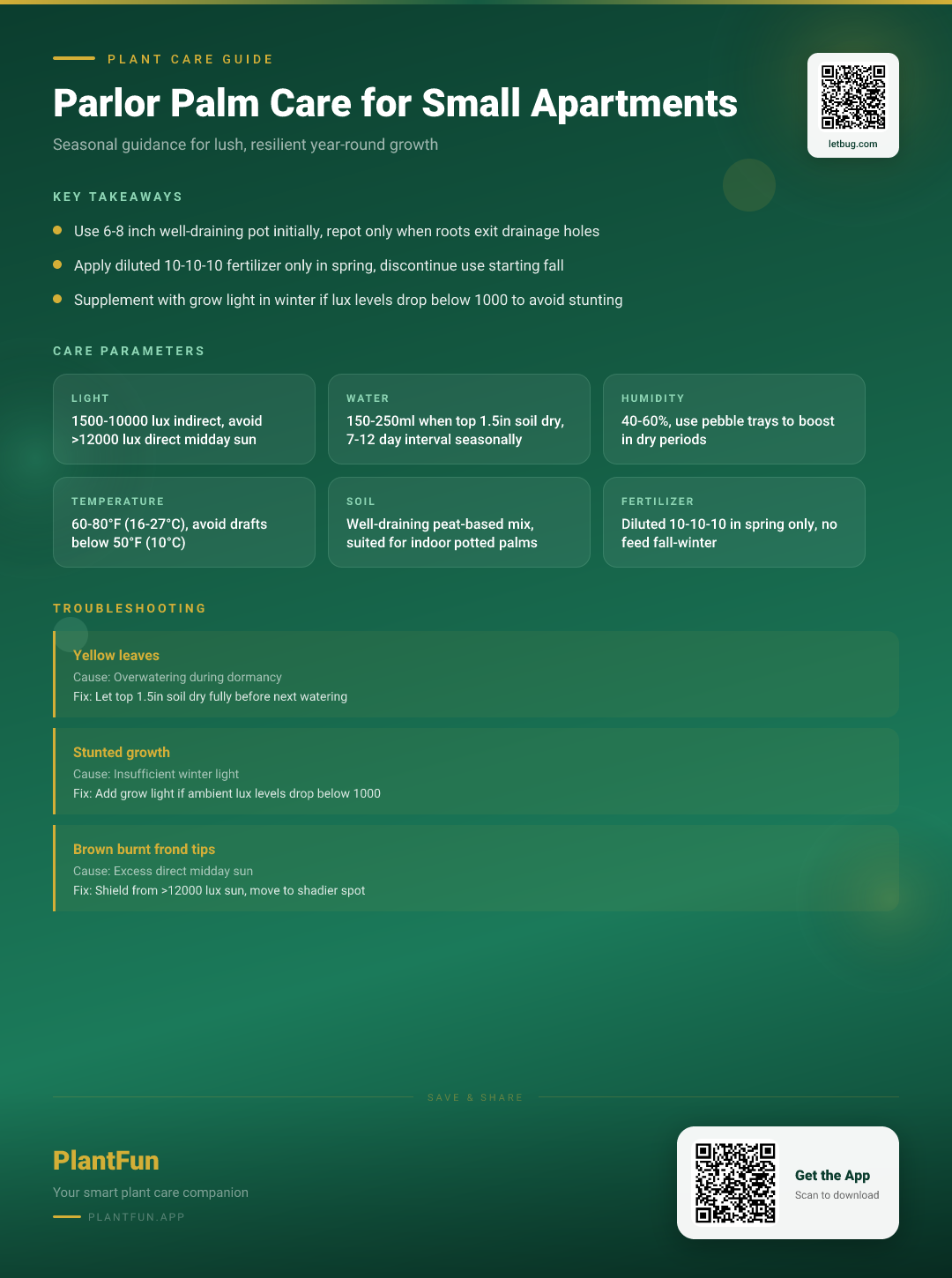
Key Takeaways
- Check soil moisture before watering — overwatering is the #1 killer of houseplants.
- Ensure your plant gets the right amount of light for its species.
- Be patient with recovery — most plants need 2–4 weeks to bounce back.
Quick Care Card
| Parameter | Exact Measurable Threshold |
|---|---|
| Light | 1,500–10,000 lux (bright indirect to low indirect light) |
| Water | 150–250ml when the top 1.5 inches of soil are completely dry |
| Humidity | 40–60% relative humidity |
| Temperature | 60–80°F / 16–27°C |
| Soil | Peat-based well-draining mix (2 parts peat, 1 part perlite) |
| Fertilizer | Half-strength 10-10-10 once per spring, no fertilizing fall/winter |
| Toxicity | Non-toxic to cats, dogs, and humans (ASPCA, 2026) |
Why Parlor Palms Thrive (Or Struggle) In Typical Small Apartments
Parlor palms (Chamaedorea elegans) are naturally understory tropical plants, so they are uniquely suited to the low light common in small apartments, even north-facing windows. But three common apartment constraints often lead to stunted growth or yellow fronds:
- Low natural light: While parlor palms tolerate levels as low as 1,500 lux, consistent light below 1,000 lux will slow growth and weaken fronds
- Dry forced HVAC air: Winter heating and summer AC drop humidity below 30%, leading to crispy parlor palm brown tips
- Limited shelf/floor space: Crowding your palm near drafty windows or heating vents disrupts its preferred temperature and humidity ranges
Myth vs Reality: You don’t need a bright south-facing window to grow a healthy parlor palm. They outperform most tropical plants in low-light small apartment setups.
Step-by-Step Initial Setup for Your Apartment Parlor Palm
Follow these steps to set your palm up for success on day one:
- Spot selection: Place your palm 1–3 feet from a north or east-facing window, at least 2 feet away from all HVAC vents and drafty exterior doors to meet parlor palm light requirements without temperature stress
- Pot sizing: Use a 6–8 inch pot with drainage holes, no larger than 2 inches wider than the root ball to save space and reduce overwatering risk
- Soil mix: Fill the pot with a well-draining peat-based mix (2 parts peat moss, 1 part perlite, per our houseplant soil mix guide)
- First watering: Pour 200ml of filtered water slowly over the soil until it drains out the bottom of the pot
Spring Parlor Palm Care Routine (March-May)
Spring is the only active growth period for most indoor parlor palms, so follow these exact steps:
- Repot only if needed: Check for roots growing out of the drainage holes. If present, repot into a pot 1 size larger, no more than 2 inches wider to save apartment space (follow our full parlor palm repotting guide for step-by-step instructions)
- Fertilize once: Mix half-strength 10-10-10 liquid fertilizer into 200ml of water, apply once in mid-spring. Do not fertilize more often, as parlor palms have very low nutrient needs
- Adjust watering: As light levels rise, check soil moisture every 6 days, watering 150–250ml when the top 1.5 inches are dry to answer the common question of how often to water parlor palm in growing season
Summer Parlor Palm Care Routine (June-August)
Summer brings higher light and humidity fluctuations, so adjust your routine as follows:
- Shield from direct sun: Use a sheer curtain if your palm is within 2 feet of a south or west-facing window. Light levels over 12,000 lux will burn fronds and cause brown spots
- Parlor palm summer watering: Water every 7–9 days, 200–250ml per watering, only when the top 1.5 inches of soil are dry
- Boost humidity: Set up a pebble tray under the pot to raise local humidity to 40–60% if your AC runs frequently
- Spider mite prevention: Wipe the top and bottom of fronds weekly with a damp microfiber cloth. Regular wiping and adequate humidity reduces tumid spider mite risk, per published container palm care research (Reinert & Neel, 1977). For more tips, see our spider mite prevention for indoor plants guide.
Fall Parlor Palm Care Routine (September-November)
As light levels drop and your palm enters dormancy, scale back care:
- Stop fertilizing completely: New growth will slow significantly, so extra nutrients will build up in soil and burn roots
- Reduce watering: Cut back to watering every 10–12 days, only when the top 1.5 inches of soil are completely dry
- Prepare for heating season: Move your palm at least 2 feet away from any heating vents that will be used in winter, as dry forced air is the top cause of parlor palm brown tips
- Trim yellow fronds: Use clean, sharp scissors to cut off any yellowing lower fronds at the base. This is normal seasonal shedding, so don’t panic if you’re wondering why is my parlor palm turning yellow in fall
Winter Parlor Palm Care Routine (December-February)
Parlor palm winter care focuses on protecting your plant from cold and low light stress:
- Avoid cold drafts: Keep your palm away from exterior doors and drafty windows where temperatures drop below 50°F / 10°C, as cold exposure will kill fronds quickly
- Supplement light if needed: Use a lux meter app to test light levels near your palm. If levels drop below 1,000 lux, use a full-spectrum grow light for 6 hours per day. Our small apartment grow light guide has budget-friendly, compact options that fit on shelves.
- Avoid overwatering: Water only when the top 2 inches of soil are completely dry, typically every 14–18 days. Overwatering in winter is the top cause of root rot and yellow fronds
2-Minute Weekly Parlor Palm Care Checklist
Print this checklist and keep it near your plant for quick, low-effort maintenance:
- 30 sec: Stick your finger 1.5 inches into the soil. If completely dry, water 150–250ml of filtered water
- 30 sec: Inspect the top and bottom of 3–4 fronds for tiny red or brown spider mite spots
- 30 sec: Wipe dusty fronds with a damp microfiber cloth to improve light absorption
- 30 sec: Confirm your palm is not directly in front of an HVAC vent or drafty window
Common Apartment Parlor Palm Mistakes to Avoid
- Mistake: Overwatering on a fixed schedule instead of checking soil moisture What happens: Root rot, widespread yellow fronds, and plant death within 2–3 weeks Instead: Always use the finger test to check soil moisture before watering, and dump any excess water that collects in the saucer within 10 minutes
- Mistake: Placing your palm directly on top of or in front of a heating vent in winter What happens: Humidity drops below 30% near the plant, leading to crispy brown tips and dry fronds Instead: Keep your palm at least 2 feet away from vents, and use a pebble tray to boost local humidity
- Mistake: Repotting every year to “help it grow” What happens: Parlor palm growth rate indoors is very slow, so extra soil holds excess moisture and causes root rot, and larger pots take up unnecessary apartment space Instead: Repot only every 2–3 years, and only when roots are growing out of the drainage holes
- Mistake: Placing your palm in direct midday sun to give it “more light” What happens: Sunburn on fronds, which appear as pale brown or white patches that never heal Instead: Use a sheer curtain to filter direct sun, or move your palm 3+ feet away from south/west facing windows
- Mistake: Fertilizing every month to encourage faster growth What happens: Salt build-up in soil burns root tips, leading to brown tips and stunted growth Instead: Fertilize only once per spring, at half the recommended strength on the fertilizer label
FAQ
Can I keep my parlor palm in a windowless apartment?
Yes, parlor palms are well suited to low light environments, so they will thrive in a windowless apartment as long as you provide a full-spectrum grow light that delivers 1,500–2,500 lux for 6–8 hours per day. This answers the common question of can parlor palms live in low light apartments, as they are one of the most tolerant tropical palm species for artificial light setups.
Why is my parlor palm getting brown tips even if I water it regularly?
The most common cause is dry air from forced HVAC systems dropping humidity below 40% near the plant. Other causes include chlorine/fluoride in tap water, or overfertilizing leading to salt build-up in soil. To fix, use a pebble tray to boost humidity to 40–60%, switch to filtered or rainwater for watering, and leach the soil with 3x the pot volume of water twice per year to remove excess salt.
How often do I need to repot my parlor palm in a small apartment?
Parlor palm growth rate indoors is very slow, so you only need to repot every 2–3 years, and only when you see roots growing out of the drainage holes of the current pot. When repotting, only move up to a pot 1–2 inches larger than the current one to save valuable apartment floor and shelf space, and avoid overwatering risk.
Final Care Reminders for Long-Term Resilient Growth
Parlor palms are one of the most low-maintenance tropical plants for small apartments, and with consistent care following this guide, they can live for 10+ years in your space. Stick to the seasonal routine, use the 2-minute weekly checklist to avoid common mistakes, and adjust care to match your apartment’s unique light, temperature, and humidity conditions for lush, resilient growth year-round.
References
- ASPCA. (2026). Toxic and Non-Toxic Plants List — ASPCA. https://www.aspca.org/pet-care/animal-poison-control/toxic-and-non-toxic-plants. Accessed 2026-03-05.
- Lee, H.; Kim, N.; Hwang, S. (2022). First report of tomato spotted wilt virus infecting parlor palm (Chamaedorea elegans) with leaf mosaic and ring spot disease in Korea. Journal of Plant Pathology. https://doi.org/10.1007/s42161-021-00980-5. Accessed 2026-03-05.
- Reinert, J.; Neel, P. (1977). Tumid Spider Mite Control on Parlor Palm Grown in Containers. HortScience. https://doi.org/10.21273/hortsci.12.4.339b. Accessed 2026-03-05.
Optional Helper: Plantfun.App
Plantfun.App identifies your plants by photo, diagnoses pests and diseases with clear fixes, and creates personalised watering and light schedules that adapt to your home conditions — a handy companion for putting this guide into daily practice.
Found an error or have suggestions? We'd love your feedback.
Need help identifying this problem?
Get instant identification, personalized care schedules, and effective pest treatment plans directly on your phone.
Sponsored • We may earn a commission from app downloads
Related Guides
The Budget Parlor Palm Care Checklist for Resilient Growth in Small Urban Apartments
Skip overpriced plant supplies and get your parlor palm thriving on a tight budget. This scenario-specific checklist has exact light, water, and humidity rules for small urban apartments, no guesswork required.
Care GuideThe Complete Parlor Palm Care Checklist for Resilient Growth in Small Urban Apartments
Grow lush, full Parlor Palm fronds even in low-light small urban apartments. Get a free printable checklist, exact light, water, humidity thresholds, plus fixes for common yellowing leaves.
Care GuideThe Complete Parlor Palm Care Guide for 1-Bedroom Apartments: Budget Tips for Resilient Growth
Skip expensive plant gadgets and grow a lush, full Parlor Palm in your standard apartment. Get exact light levels, watering amounts, and a free printable checklist to avoid common care mistakes.
Safety GuideParlor Palm in Low-Light Playrooms: Non-Toxic Care & Placement Guide for Pet & Child Safety
Keep your playroom green and safe for toddlers and cats with this parlor palm care guide. Get exact light, water, and placement tips to avoid toxic exposure and keep your plant lush long-term.