
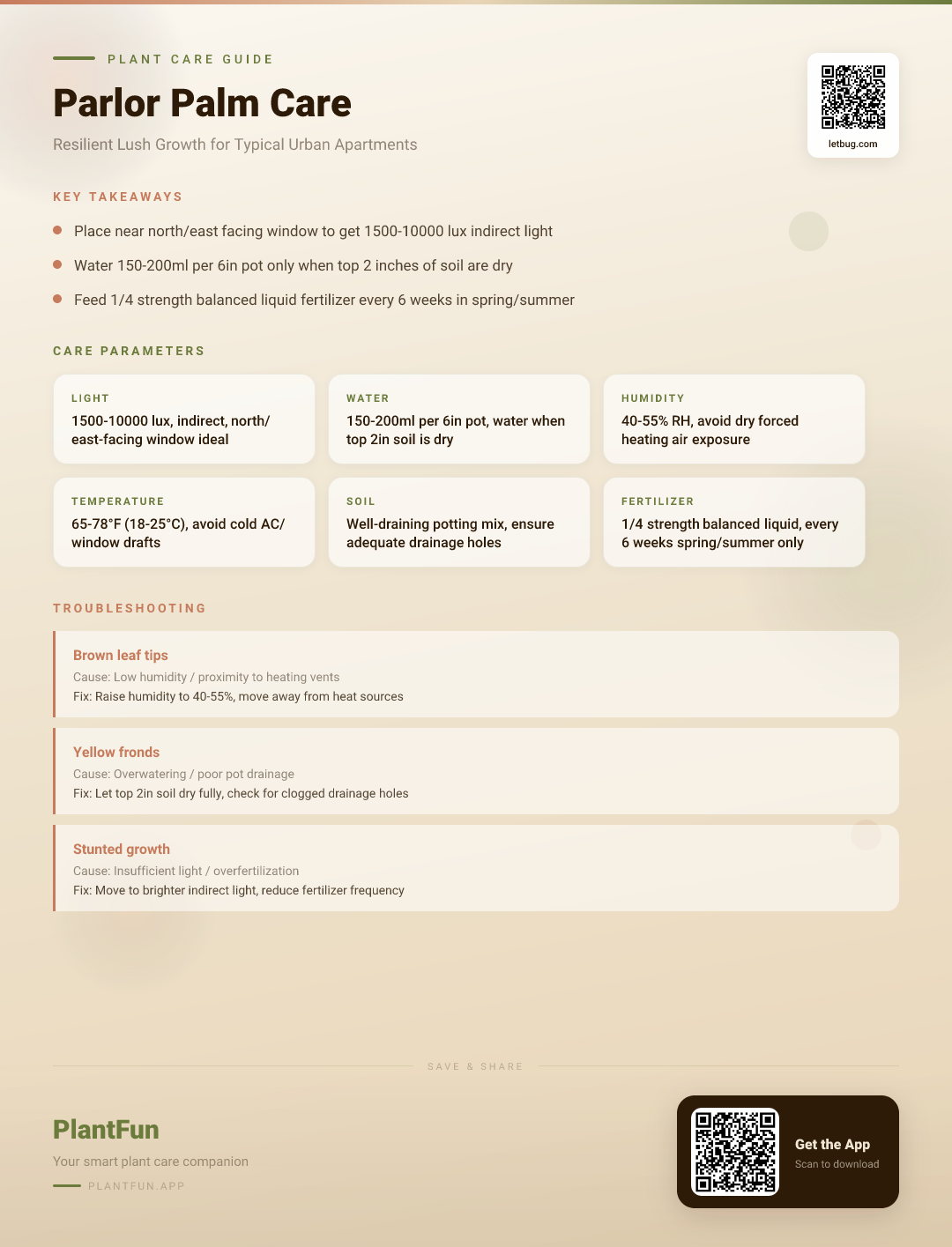
Key Takeaways
- Check soil moisture before watering — overwatering is the #1 killer of houseplants.
- Ensure your plant gets the right amount of light for its species.
- Be patient with recovery — most plants need 2–4 weeks to bounce back.
Quick Care Card
| Care Parameter | Measurable Target |
|---|---|
| Light | 1,500–10,000 lux (no direct midday sun) |
| Water | 150–200ml per 6in pot when top 2 inches of soil are dry (every 9–14 days, season-dependent) |
| Humidity | 40–55% relative humidity |
| Temperature | 65–78°F (18–25°C), no swings larger than 10°F in 24 hours |
| Soil | 2 parts peat moss + 1 part perlite + 1 part fine orchid bark (well-draining) |
| Fertilizer | 1/4 strength balanced 10-10-10 liquid fertilizer every 6 weeks, spring and summer only |
| Toxicity | Non-toxic to cats, dogs, and humans (ASPCA, 2026) |
Why Parlor Palms Struggle in Standard Apartments
Chamaedorea elegans, commonly called the parlor palm, is native to the shaded, humid understory of Central American rainforests, where it evolved to thrive in stable, consistent conditions (NC State Extension, 2026). Most generic Parlor Palm care guides ignore the unique stressors of 600–800 sq ft urban rental apartments that derail healthy growth:
- Low ambient light: Most areas of urban apartments 3+ feet from windows get less than 1,500 lux, which is too low for steady growth
- Dry forced air: Winter heating systems drop indoor humidity to 20–30%, 50% lower than the parlor palm’s preferred range
- Frequent temperature swings: Drafty windows, AC units, and heating vents can cause 15°F temperature shifts in just a few hours, shocking the plant’s delicate root system
Myth vs Reality: Many generic guides claim parlor palms are “indestructible” and require zero care. In reality, they tolerate neglect better than most palm species, but small, consistent adjustments to match apartment conditions are required for resilient growth, not just survival. This guide is specifically tailored for Parlor Palm care for apartments, so you can skip the guesswork.
First Step: Diagnose Your Parlor Palm’s Current Health
Before adjusting your care routine, identify existing stress signs to address first. These are the 5 most common early warning signals for apartment-grown parlor palms:
Brown Leaf Tips
Symptom: Dry, crispy brown tips on otherwise green fronds, with a clear yellow line between brown and healthy tissue.
Likely cause: Low humidity, overfertilization, or high fluoride/chlorine in tap water.
Fix:
- Test your indoor humidity with a cheap hygrometer to confirm it’s above 40%
- Flush the soil with 3x the pot volume of filtered water to remove excess fertilizer salt buildup
- Switch to filtered, rain, or distilled water for all future watering
Pale Yellow Lower Fronds
Symptom: Older, lower fronds turn uniform pale yellow and feel soft to the touch.
Likely cause: Overwatering or root rot from poor drainage.
Fix:
- Check if the top 2 inches of soil are wet; if yes, hold off on watering until completely dry
- Gently remove the plant from its pot to check for mushy, brown roots; trim any rotten roots and repot in fresh, well-draining soil if needed
Stunted Growth (No New Fronds for >3 Months)
Symptom: No new, unfurling fronds appear during the spring and summer growing season, and existing fronds stay the same size.
Likely cause: Insufficient light, nutrient deficiency, or root bound conditions.
Fix:
- Move the plant 1–2 feet closer to a north or east-facing window to increase light levels
- Apply a single dose of 1/4 strength balanced liquid fertilizer
- Check if roots are growing out of the drainage holes; repot to a 2-inch larger pot if root bound
Crispy, Curling Young Fronds
Symptom: Newly unfurled fronds are crispy, curl at the edges, and die shortly after opening.
Likely cause: Exposure to hot or cold drafts from HVAC systems or drafty windows.
Fix:
- Move the plant at least 3 feet away from heating vents, AC units, and exterior windows that are opened frequently
- Increase local humidity around the plant with a pebble tray or grouping with other houseplants
Mottled Yellow/White Ring Spots on Leaves
Symptom: Irregular yellow or white ring-shaped spots appear on otherwise healthy fronds, spreading over time.
Likely cause: Tomato spotted wilt virus, a rare but documented infection for parlor palms (Lee et al., 2022)
Fix:
- Isolate the plant from other houseplants immediately to prevent spread
- Remove all infected fronds with clean, sharp shears; dispose of infected material in the trash, not compost
- If spots continue to spread, discard the plant to avoid infecting other species
Step 1: Light Requirements for Apartment Parlor Palms
Parlor palms thrive in a narrow light range of 1,500–10,000 lux, calibrated for understory growth (NC State Extension, 2026). This makes them perfect for Parlor Palm low light care in small apartments, as long as you follow these placement rules:
- North-facing windows: Place 1–2 feet directly in front of the window; this delivers consistent 1,500–3,000 lux year-round with no risk of sun scorch
- East-facing windows: Place 2–3 feet away from the window; the soft morning sun delivers 3,000–8,000 lux, which is ideal for fast growth
- West/south-facing windows: Place at least 5 feet away, or behind a sheer curtain; direct midday sun from these windows exceeds 15,000 lux, which will burn fronds and cause permanent damage
Quick test: Hold your hand 6 inches above the plant’s fronds at midday. If you see a sharp, defined shadow, light levels are too high (above 10,000 lux). If you see no shadow at all, light levels are too low (below 1,500 lux).
Step 2: Exact Watering Schedule & Measurement Rules
Wondering how often to water Parlor Palm in an apartment? Follow these measurable rules to avoid overwatering, the top cause of parlor palm death:
- For a standard 6-inch nursery pot: Water with 150–200ml of filtered water only when the top 2 inches of soil are completely dry
- Seasonal adjustment: Water every 9–11 days in summer (Parlor Palm summer watering), and every 12–14 days in fall and winter
Quick test: Stick your index finger 2 inches deep into the soil (past the top layer of moss or mulch). If the soil feels completely dry to the touch, it’s time to water. If there’s any moisture, wait 2–3 days and test again.
Parlor Palm overwatering signs: Mushy yellow fronds, soft, brown roots, and white mold growing on the top of the soil. If you see these signs, hold off on watering for at least 7 days, and flush the soil to remove excess moisture. Underwatering signs: Drooping fronds, crispy brown edges on all leaves, and soil that pulls away from the edges of the pot. If you see these signs, water with 200ml of filtered water, and mist the fronds lightly to rehydrate them.
Step 3: Humidity & Temperature Thresholds for Steady Growth
Parlor Palm humidity requirements fall between 40–55% relative humidity, with an ideal temperature range of 65–78°F (18–25°C) (NC State Extension, 2026). These levels are easy to maintain in apartments with these simple adjustments:
- Winter heating adjustment: Place the plant on a pebble tray filled with water (make sure the bottom of the pot is not sitting in the water) to raise local humidity by 10–15%. Avoid placing the plant within 3 feet of heating vents, which can drop humidity to below 30% in just a few hours.
- Summer AC adjustment: Keep the plant at least 3 feet away from window AC units and central AC vents. Cold drafts below 60°F can shock the plant and cause leaf drop.
- Avoid placing the plant directly on windowsills in winter: The temperature near single-pane windows can drop 10–15°F overnight, which is well below the parlor palm’s minimum tolerance.
Step 4: Renter-Friendly Soil, Potting & Fertilizer Tips
These tips are designed for renters who can’t drill drainage holes in decorative pots, or who don’t want to make permanent modifications to their space:
- Soil recipe: Mix 2 parts peat moss, 1 part perlite, and 1 part fine orchid bark for a well-draining mix that retains just enough moisture for the parlor palm’s shallow root system.
- No-drill drainage hack: Add a 1-inch layer of lava rock or pebbles to the bottom of your decorative cache pot before placing the nursery pot inside. This catches excess water and prevents the root ball from sitting in saturated soil. Empty any excess water from the cache pot 10–15 minutes after every watering.
- Parlor Palm fertilizer schedule: Apply 1/4 strength balanced 10-10-10 liquid fertilizer every 6 weeks only during the spring and summer growing season (March to September in the northern hemisphere). Never fertilize in fall or winter, when growth slows significantly, as this causes salt buildup that leads to brown leaf tips (NC State Extension, 2026).
Safety note: Parlor palms are non-toxic to cats, dogs, and humans, so they’re safe to place in homes with pets and small children (ASPCA, 2026).
Seasonal Care Calendar for Apartment Parlor Palms (Northern Hemisphere)
This calendar is tailored to the light, temperature, and humidity shifts common in urban apartments, to make Parlor Palm care for beginners simple and consistent:
- January–February (Winter): Water every 12–14 days, no fertilizer, move 6 inches away from cold exterior windows, add a pebble tray to boost humidity for Parlor Palm winter care.
- March–April (Early Spring): Water every 10–12 days, apply first fertilizer dose at the end of March, gradually move the plant closer to a window to take advantage of increasing spring light.
- May–August (Summer): Water every 9–11 days, apply fertilizer every 6 weeks, move the plant 1–2 feet away from west/south windows to avoid midday sun scorch, keep away from AC vents.
- September–October (Early Fall): Water every 10–12 days, apply last fertilizer dose in mid-September, gradually reduce watering as daylight hours shorten.
- November–December (Late Fall/Winter): Water every 12–14 days, no fertilizer, keep at least 3 feet away from heating vents, avoid placing near drafty windows.
5 Common Apartment Parlor Palm Care Mistakes to Avoid
These are the most frequent missteps that cause stunted growth or leaf damage for apartment-grown parlor palms, with simple fixes:
- Mistake: Placing the plant within 2 feet of heating vents, AC units, or drafty windows. What happens: Rapid temperature swings and humidity drops cause brown tips and leaf drop within 1 week. Instead: Keep the plant at least 3 feet away from all HVAC outlets and frequently opened exterior windows.
- Mistake: Overfertilizing, especially in the winter months. What happens: Salt buildup in the soil burns the delicate root tips, leading to persistent Parlor Palm brown tips and stunted growth for 6+ months. Instead: Only fertilize at 1/4 strength every 6 weeks from March to September, and skip fertilization entirely in fall and winter.
- Mistake: Trimming partially green, damaged fronds. What happens: Green fronds still produce energy for the plant via photosynthesis, so cutting them reduces overall growth rate and can stress the plant further. Instead: Only trim fully brown, dead fronds at the base with clean, sharp shears to avoid damaging healthy tissue.
- Mistake: Letting the plant sit in standing water for hours after watering. What happens: Saturated soil cuts off oxygen to the roots, leading to root rot, the number one cause of parlor palm death in apartments. Instead: Empty the cache pot of excess water 10–15 minutes after every watering to prevent root saturation.
- Mistake: Repotting more than once every 3 years. What happens: Parlor palms have delicate, shallow root systems that hate disturbance, so repotting too often causes stunted growth for 6+ months. Instead: Only repot when roots are visibly growing out of the drainage holes, and only increase the pot size by a maximum of 2 inches to avoid overpotting.
Voice Search FAQ 1: Why are the tips of my parlor palm turning brown in my apartment?
The top causes of Parlor Palm brown tips in apartments are low humidity (below 40% RH), overfertilization leading to salt buildup, high fluoride or chlorine in tap water, or placement near heating/AC vents (why is my Parlor Palm turning brown). Start by testing your indoor humidity with a cheap hygrometer, then flush your plant’s soil with 3x the pot volume of filtered water to remove excess salt, and switch to filtered water for all future watering. If you keep the plant near a heating vent, move it at least 3 feet away to reduce drying.
Voice Search FAQ 2: Can I keep a parlor palm in my low-light apartment bedroom?
Yes! Parlor palms are ideal for low-light bedrooms, as they tolerate light levels as low as 1,500 lux, which is typical of north-facing bedrooms or rooms far from windows (Parlor Palm low light care, NC State Extension, 2026). Just confirm you get a faint, blurry shadow when you hold your hand above the plant at midday; if there’s no shadow at all, add a low-wattage grow light 1 foot above the plant for 6 hours a day to support steady growth. This makes them perfect for small apartment Parlor Palm care where space and light are limited.
Voice Search FAQ 3: How often do I need to water my parlor palm in the winter?
In the winter, you only need to water your parlor palm every 12–14 days, or only when the top 2 inches of soil are completely dry (how often to water Parlor Palm, Parlor Palm winter care). Growth slows significantly in cold, low-light winter months, so the plant uses far less water than it does in summer. Overwatering is the most common winter issue, so always test the soil moisture with your finger before watering to avoid root rot.
References
- NC State Extension. (2026). The Complete Parlor Palm — NC State Extension Gardener Plant Toolbox. https://plants.ces.ncsu.edu/plants/palm-care/. Accessed 2026-02-23.
- ASPCA. (2026). Toxic and Non-Toxic Plants List — ASPCA. https://www.aspca.org/pet-care/animal-poison-control/toxic-and-non-toxic-plants. Accessed 2026-02-23.
- Lee, H.; Kim, N.; Hwang, S. (2022). First report of tomato spotted wilt virus infecting parlor palm (Chamaedorea elegans) with leaf mosaic and ring spot disease in Korea. Journal of Plant Pathology. https://doi.org/10.1007/s42161-021-00980-5. Accessed 2026-02-23.
- Reinert, J.; Neel, P. (1977). Tumid Spider Mite Control on Parlor Palm Grown in Containers1. HortScience. https://doi.org/10.21273/hortsci.12.4.339b. Accessed 2026-02-23.
Optional Helper: Plantfun.App
Plantfun.App identifies your plants by photo, diagnoses pests and diseases with clear fixes, and creates personalised watering and light schedules that adapt to your home conditions — a handy companion for putting this guide into daily practice.
Found an error or have suggestions? We'd love your feedback.
Need help identifying this problem?
Get instant identification, personalized care schedules, and effective pest treatment plans directly on your phone.
Sponsored • We may earn a commission from app downloads
Related Guides
The Complete Parlor Palm Care Guide for 1-Bedroom Apartments: Budget Tips for Resilient Growth
Skip expensive plant gadgets and grow a lush, full Parlor Palm in your standard apartment. Get exact light levels, watering amounts, and a free printable checklist to avoid common care mistakes.
Care GuideParlor Palm in Small Urban Apartments: The Only Resilient Growth Care Checklist You’ll Ever Need
Grow a lush, thriving parlor palm even in a tiny, low-light urban apartment. Get our 8-step checklist with exact light, water, and humidity parameters to avoid yellow leaves and stunted growth for good.
Care GuideThe Budget Parlor Palm Care Checklist for Resilient Growth in Small Urban Apartments
Skip overpriced plant supplies and get your parlor palm thriving on a tight budget. This scenario-specific checklist has exact light, water, and humidity rules for small urban apartments, no guesswork required.
Safety GuideParlor Palm Care Guide for Low-Light Playrooms: Pet & Child Safe Placement Tips
Stop choosing between houseplants and household safety. Get exact parlor palm care parameters, 5 kid/pet-proof placement hacks, and non-toxic substitution tips for your low-light playroom.