
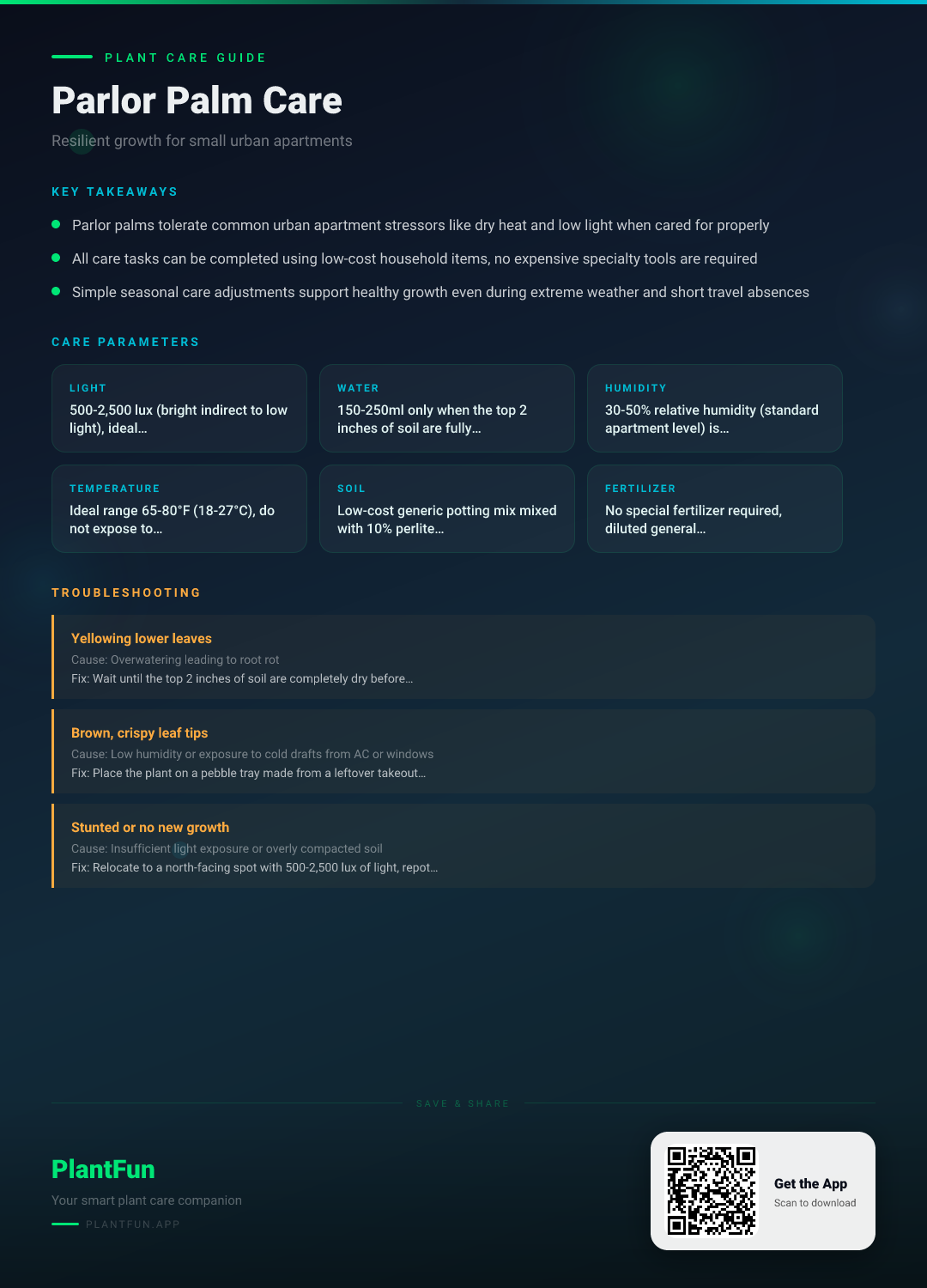
Key Takeaways
- Check soil moisture before watering — overwatering is the #1 killer of houseplants.
- Ensure your plant gets the right amount of light for its species.
- Be patient with recovery — most plants need 2–4 weeks to bounce back.
Quick Care Card
| Parameter | Measurable Threshold for Small Urban Apartments |
|---|---|
| Light | 1000-5000 lux (bright indirect light, no more than 2 hours of direct morning sun) |
| Water | Only water when the top 2 inches of soil are completely dry |
| Humidity | 35-50% relative humidity |
| Temperature | 65-80°F (18-27°C), no sudden fluctuations more than 10°F |
| Soil | Peat-based potting mix with 10% perlite for drainage |
| Fertilizer | Dilute 10-10-10 NPK at half label strength, once monthly only March-September |
| Toxicity | Non-toxic to cats, dogs, and humans (ASPCA, 2026) |
Why Parlor Palms Thrive (Or Fail) in Typical Small Urban Apartments
Native to the dappled, warm understory of Central American rainforests, Parlor Palms evolved to tolerate low light, consistent temperatures, and moderate humidity (NC State Extension, 2026). This makes them uniquely well-suited to small apartment living, but common urban stressors often throw their care off balance: low natural light from north-facing windows, dry forced-air heat in winter, drafty window sills, and inconsistent watering from busy work schedules. A common myth claims Parlor Palms need tropical 60%+ humidity to grow, but they are far more adaptable than most guides suggest: they thrive in the standard 35-50% humidity found in most heated and cooled apartments, as long as you follow targeted care for your space. For more tips on adapting houseplants to low-light spaces, check our guide to low-light houseplants for small apartments.
Step-by-Step Parlor Palm Care Checklist for Daily/Weekly Upkeep
This free printable Parlor Palm care checklist uses science-backed, measurable thresholds so even Parlor Palm care for beginners is simple. Print it out and tape it near your plant to avoid guesswork:
Daily Checks
- Confirm no direct midday sun is hitting the fronds
- Quick visual scan for yellow/brown tips or pest webbing
Weekly Checks
- Test soil moisture by sticking your index finger 2 inches deep; water only if completely dry (answers how often to water Parlor Palm)
- Measure light with a cheap lux meter to confirm it falls within 1000-5000 lux (matches Parlor Palm light requirements)
- Check humidity with a hygrometer to hit the 35-50% Parlor Palm humidity level target
- Wipe fronds with a damp microfiber cloth to remove dust buildup
Monthly Checks (Growing Season: March-September Only)
- Apply dilute 10-10-10 fertilizer at half the label recommended strength
- Inspect drainage holes for root growth to assess if repotting is needed
How to Tell If Your Parlor Palm Is Happy: 3 Clear Signs of Resilient Growth
You don’t need a horticulture degree to confirm your small apartment Parlor Palm is thriving. Look for these three easy-to-spot markers of Parlor Palm resilient growth tips:
- New frond unfurling every 2-3 months in growing season: New fronds are pale lime green at first, darkening to deep green as they mature over 2-3 weeks.
- Uniform deep green color across all mature fronds: No splotches, bleaching, or uneven discoloration across leaf surfaces.
- Minimal tip damage: Less than 10% of total foliage has brown or yellow tips, and no full fronds are dying off unexpectedly.
Seasonal Care Calendar for Parlor Palms in Apartments
Adjust your care routine with seasonal changes to avoid stress and keep growth consistent:
Winter (October-February: Parlor Palm Winter Care)
- Reduce watering frequency by 50%: only water when the top 3 inches of soil are completely dry, as growth slows significantly in cooler months
- Pause all fertilizer applications entirely to avoid chemical buildup in soil
- Add 1-2 extra mistings per week to combat dry forced-air heat
- Move the plant at least 3 feet away from drafty windows and heating vents
Summer (June-August: Parlor Palm Summer Watering)
- Increase watering to every 5-7 days, always verifying soil dryness before watering to avoid overwatering
- Apply dilute 10-10-10 fertilizer once per month to support new growth
- Add a sheer curtain to south-facing windows to block harsh midday direct sun that can scorch fronds
- Mist 2-3 times per week if humidity drops below 35%
The 5 Most Common Parlor Palm Care Mistakes Apartment Dwellers Make
Each mistake includes a 24-hour quick fix to reverse damage before it becomes permanent:
- Mistake: Overwatering on a fixed schedule instead of checking soil moisture first What happens: Root rot, yellowing lower leaves, drooping fronds Instead: Only water when the top 2 inches of soil are bone dry 24-hour quick fix: Tip the pot to drain excess standing water from the saucer, place near a small fan for 2 hours to dry out the top layer of soil
- Mistake: Placing directly near heating/cooling vents or drafty window sills What happens: Sudden temperature fluctuations cause brown leaf tips and widespread leaf drop Instead: Keep your Parlor Palm in small apartment spots that stay within 65-80°F consistently, at least 2 feet away from vents and drafty openings 24-hour quick fix: Move to a temperature-stable spot, trim fully brown fronds with sterile pruning shears to redirect energy to healthy growth
- Mistake: Exposing to more than 2 hours of direct midday sun What happens: Scorched, bleached fronds that turn brown and die off Instead: Keep light levels within 1000-5000 lux, use a sheer curtain for south-facing windows 24-hour quick fix: Move to a shadier spot, prune fully scorched fronds to prevent pest infestation in damaged tissue
- Mistake: Repotting too frequently, or using a pot that is more than 1 inch larger than the root ball What happens: Excess soil holds unnecessary water, leading to root rot and stunted growth Instead: Follow our guide for how to repot Parlor Palm: repot only every 2-3 years, when roots emerge from drainage holes, using a pot only 1 inch larger than the existing root ball 24-hour quick fix: If you recently repotted into an oversized pot, gently remove excess soil around the root ball and transfer to a correctly sized pot with drainage holes
- Mistake: Skipping frond dusting for more than 2 weeks What happens: Dust blocks light absorption, slowing growth and making the plant more susceptible to spider mite infestations Instead: Wipe fronds with a damp microfiber cloth once per week 24-hour quick fix: Wipe all fronds with a damp cloth, then rinse gently in the shower with lukewarm water to remove caked-on dust
Frequently Asked Questions
Why is my Parlor Palm turning yellow?
Yellow tip leaves are most commonly caused by dry air, overfertilization, or fluoride/chlorine buildup from tap water (NC State Extension, 2026). Two easy Parlor Palm brown tips fix options: first, switch to filtered or rainwater for watering to avoid chemical buildup in soil. Second, mist fronds 2-3 times per week or set up a pebble tray to boost humidity by 5-10% around the plant.
Can I keep my Parlor Palm in a windowless apartment office?
Yes, Parlor Palms can grow in low light as long as you provide a minimum of 1000 lux of light from an LED grow light set to a 12-hour daily schedule (NC State Extension, 2026). Position the grow light 12-18 inches above the top of the fronds for best results. For grow light recommendations, see our tested list of budget LED grow lights for apartments.
How often should I repot my Parlor Palm in a small apartment?
Repot only every 2-3 years, and only when you see white or brown roots growing out of the drainage holes at the bottom of the pot (NC State Extension, 2026). Use a well-draining peat-based potting mix with 10% perlite, and choose a pot only 1 inch larger than the existing root ball to avoid overwatering risk. For more repotting tips, check our step-by-step houseplant repotting guide.
Troubleshooting Guide for Common Parlor Palm Symptoms
Brown Fronds
Symptom: Entire fronds turn dark brown and crispy, starting from the tips and spreading inward.
Likely cause: Prolonged exposure to dry air, underwatering, or placement near heating vents.
Fix:
- Water thoroughly until water drains out the bottom of the pot, if the top 3 inches of soil are dry
- Mist all fronds with lukewarm filtered water, and set up a pebble tray to boost humidity
Drooping Leaves
Symptom: Fronds wilt and hang downward, even when the soil is moist.
Likely cause: Overwatering leading to early root rot, or sudden temperature drops from drafts.
Fix:
- Drain any excess standing water from the saucer under the pot, and let the top 2 inches of soil dry completely before watering again
- Move the plant to a spot with consistent 65-80°F temperatures, away from drafty windows or AC vents
Stunted Growth
Symptom: No new fronds unfurl for more than 6 months during the growing season.
Likely cause: Insufficient light levels below 1000 lux, nutrient deficiency, or being root-bound.
Fix:
- Measure light levels with a lux meter, and move to a brighter spot or add a grow light if levels are too low
- Apply dilute 10-10-10 fertilizer once monthly during growing season, or repot if roots are growing out of drainage holes
Spider Mite Infestation
Symptom: Tiny fine webbing on the undersides of fronds, with small yellow speckles on leaf surfaces.
Likely cause: Low humidity levels below 30%, which creates ideal conditions for spider mites (Reinert & Neel, 1977)
Fix:
- Wipe all fronds with a damp cloth to remove webbing and mites, then spray with a dilute neem oil solution
- Boost humidity to above 35% to prevent future infestations
Mealybug Infestation
Symptom: White cotton-like clusters on the base of fronds and leaf joints, with sticky honeydew residue on foliage.
Likely cause: Cross-contamination from other infested houseplants, or high humidity without proper air circulation.
Fix:
- Dab all mealybug clusters with a cotton swab dipped in 70% isopropyl alcohol to kill them on contact
- Isolate the plant from other houseplants for 2 weeks to prevent spread, and wipe fronds weekly to remove any remaining pests
Bonus: Low-Effort Hack for Boosting Humidity Without a Humidifier
This simple pebble tray setup adds 5-10% relative humidity around your Parlor Palm for 3-4 days between refills, no special tools required, perfect for small apartment Parlor Palm care:
- Grab a shallow tray (1-2 inches deep) that is 2 inches wider than the base of your Parlor Palm’s pot
- Fill the tray halfway with clean, small pebbles or decorative river rocks
- Pour filtered water into the tray until it covers the bottom half of the pebbles, making sure the water level is below the top of the pebbles (so the pot’s drainage holes never sit directly in water, which causes root rot)
- Place your Parlor Palm’s pot on top of the pebbles
- Refill the water every 3-4 days as it evaporates
References
- ASPCA. (2026). Toxic and Non-Toxic Plants List — ASPCA. https://www.aspca.org/pet-care/animal-poison-control/toxic-and-non-toxic-plants. Accessed 2026-03-01.
- Lee, H.; Kim, N.; Hwang, S. (2022). First report of tomato spotted wilt virus infecting parlor palm (Chamaedorea elegans) with leaf mosaic and ring spot disease in Korea. Journal of Plant Pathology. https://doi.org/10.1007/s42161-021-00980-5. Accessed 2026-03-01.
- Reinert, J.; Neel, P. (1977). Tumid Spider Mite Control on Parlor Palm Grown in Containers. HortScience. https://doi.org/10.21273/hortsci.12.4.339b. Accessed 2026-03-01.
- NC State Extension. (2026). The Complete Parlor Palm — NC State Extension Gardener Plant Toolbox. https://plants.ces.ncsu.edu/plants/palm-care/. Accessed 2026-03-01.
Optional Helper: Plantfun.App
Plantfun.App identifies your plants by photo, diagnoses pests and diseases with clear fixes, and creates personalised watering and light schedules that adapt to your home conditions — a handy companion for putting this guide into daily practice.
Found an error or have suggestions? We'd love your feedback.
Need help identifying this problem?
Get instant identification, personalized care schedules, and effective pest treatment plans directly on your phone.
Sponsored • We may earn a commission from app downloads
Related Guides
The Complete Parlor Palm Care Guide for Small Apartments: Seasonal Tips for Resilient Growth
Keep your parlor palm lush year-round in a small apartment. Get exact light, water, and humidity thresholds, plus a free seasonal care checklist to avoid yellow leaves and stunted growth.
Care GuideThe Complete Parlor Palm Care Guide for 1-Bedroom Apartments: Budget Tips for Resilient Growth
Skip expensive plant gadgets and grow a lush, full Parlor Palm in your standard apartment. Get exact light levels, watering amounts, and a free printable checklist to avoid common care mistakes.
Care GuideThe Budget Parlor Palm Care Checklist for Resilient Growth in Small Urban Apartments
Skip overpriced plant supplies and get your parlor palm thriving on a tight budget. This scenario-specific checklist has exact light, water, and humidity rules for small urban apartments, no guesswork required.
Safety GuideParlor Palm in Low-Light Playrooms: Non-Toxic Care & Placement Guide for Pet & Child Safety
Keep your playroom green and safe for toddlers and cats with this parlor palm care guide. Get exact light, water, and placement tips to avoid toxic exposure and keep your plant lush long-term.