
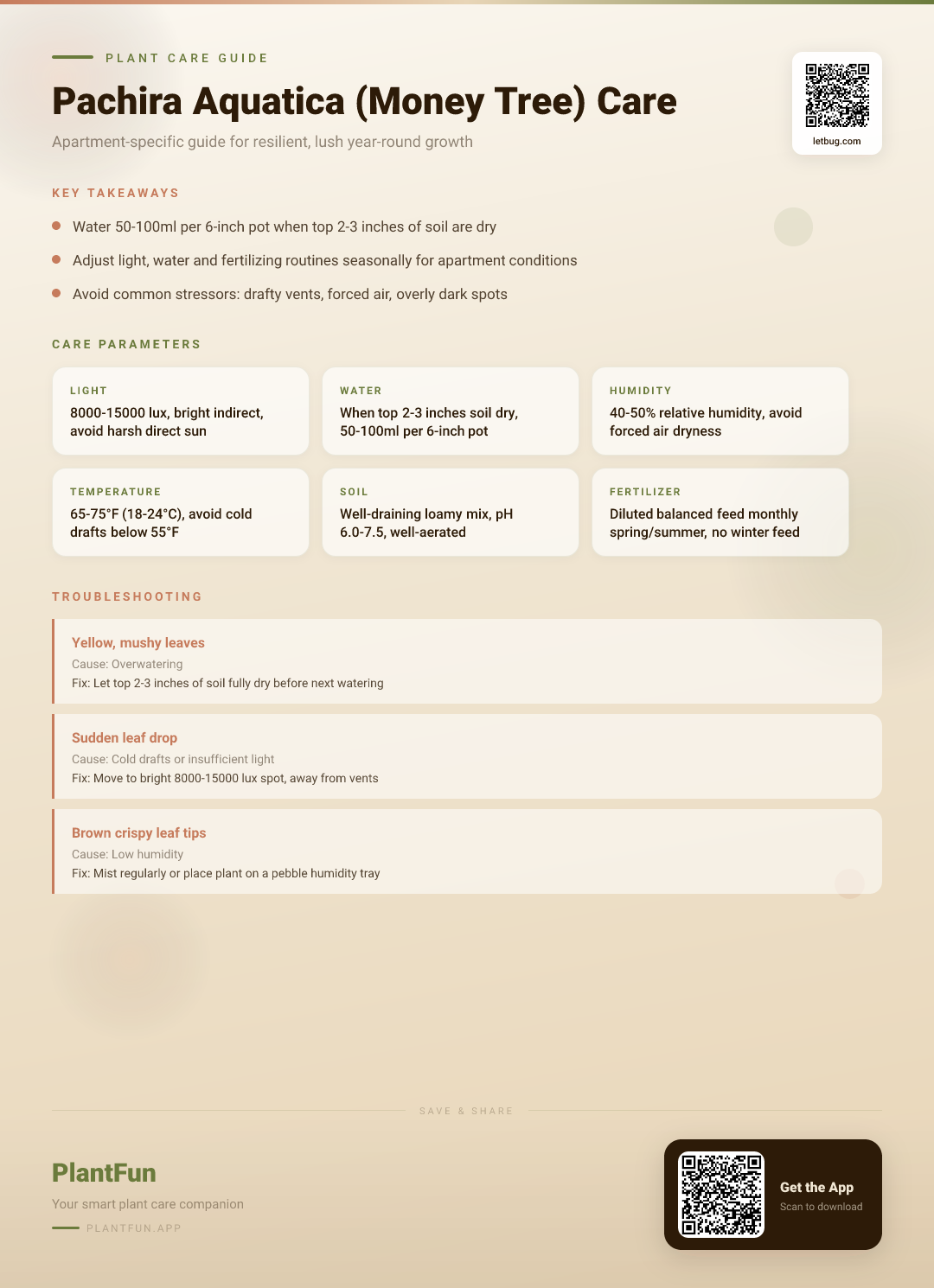
Key Takeaways
- Check soil moisture before watering — overwatering is the #1 killer of houseplants.
- Ensure your plant gets the right amount of light for its species.
- Be patient with recovery — most plants need 2–4 weeks to bounce back.
Quick Care Card
| Parameter | Apartment Growth Threshold | Quick Notes |
|---|---|---|
| Light | 8,000–15,000 lux (PlantwisePlus Knowledge Bank, 2022) | Equivalent to bright, indirect light within 3 feet of a south or east-facing window |
| Water | Only when top 2–3 inches of soil are completely dry | 50–100ml per 6-inch pot per watering |
| Humidity | 40–50% (PlantwisePlus Knowledge Bank, 2022) | Typical apartment humidity with heating/AC runs 20–30%, so adjustments are often needed |
| Temperature | 65–75°F (18–24°C) (PlantwisePlus Knowledge Bank, 2022) | Avoid fluctuations more than 10°F in 24 hours |
| Soil | Well-draining, loamy mix with 30% perlite | Prevent root rot from overwatering common in apartments |
| Fertilizer | Diluted 10-10-10 liquid fertilizer, once every 2 months in growing season | No fertilizing in winter |
| Toxicity | Non-toxic to cats, dogs, and humans (ASPCA, 2026) | Safe for households with pets and small children |
Why Apartment Money Tree Care Differs From Generic Advice
Most generic pachira aquatica care guidance is written for ideal indoor growing environments, not the unique constraints of typical apartments. Four stressors cause 90% of common money tree health issues for apartment growers: forced air dryness from HVAC systems, limited window light exposure, drafty vents and entryways, and restricted space for proper pot sizing.
Myth: Money trees are “unkillable” and can thrive in any indoor spot. Reality: Apartment-specific fluctuations in temperature, humidity, and light require targeted adjustments that generic care guides don’t address. For best results, use a well-draining potting mix as outlined in our guide to houseplant potting mixes for small spaces to reduce overwatering risk.
Step-by-Step Weekly Resilient Growth Checklist
Follow these 5 simple 2-minute checks every week to keep your money tree thriving in apartment conditions, no guesswork required:
- Light check: Use a cheap light meter to confirm 8,000–15,000 lux at leaf level (money tree light requirements indoors fall squarely in this range for consistent growth). Move the plant closer or further from your window if readings are outside the threshold.
- Soil moisture check: Stick your index finger 2–3 inches into the soil. If it is completely dry, water with 50–100ml for a 6-inch pot, or 150–200ml for a 10-inch pot. If damp, skip watering.
- Humidity check: Use a hygrometer to confirm 40–50% money tree humidity level. If readings are below 40%, set up a DIY pebble tray under the pot to boost ambient moisture.
- Draft check: Hold your hand 6 inches around the plant to feel for hot or cold air from HVAC vents, windows, or entry doors. If you feel consistent airflow, move the plant 1–2 feet away to avoid temperature shock.
- Rotation check: Turn the plant 90 degrees to ensure all sides get equal light exposure, preventing lopsided growth.
Seasonal Apartment Money Tree Care Calendar
Adjust your care routine for seasonal apartment conditions to avoid stress:
Winter (Heated Dry Air, Shorter Days)
- Reduce watering frequency by 50%: Most apartments have extremely dry heated air that slows soil evaporation, so water only when the top 3–4 inches of soil are dry
- Move the plant 1 foot closer to your brightest window to compensate for shorter daylight hours
- Skip fertilizing entirely: Growth slows significantly in low light, so extra nutrients will burn roots
- Use a small humidifier near the plant if humidity drops below 30% for extended periods (core of money tree winter care apartment guidance)
Summer (Hot Window Drafts, Higher Humidity)
- Increase watering frequency by 100% compared to winter: Warmer temperatures speed up evaporation, so check soil moisture twice weekly (the basis of money tree summer watering best practices)
- Move the plant 1 foot away from south-facing windows to avoid sunscald on leaves
- Fertilize once every 2 months with diluted 10-10-10 liquid fertilizer
- Skip misting if ambient humidity rises above 60% to prevent fungal growth on leaves
5 Most Common Apartment Money Tree Mistakes (and Easy Fixes)
These common money tree mistakes account for almost all health issues for apartment growers, with simple actionable fixes:
- Mistake: Watering on a fixed weekly schedule instead of checking soil moisture What happens: Overwatering leads to root rot, yellow leaves, and eventual plant death Instead: Always test the top 2–3 inches of soil first, and only water when completely dry
- Mistake: Placing the plant in a dark corner far from windows What happens: Leggy growth, leaf drop, and stunted development Instead: Keep the plant within 3 feet of a bright, unobstructed window, or supplement with a grow light if you have no bright spots
- Mistake: Using a pot that is 2+ sizes larger than the root ball What happens: Excess soil holds extra moisture, leading to root rot Instead: Follow our money tree pot size guide: choose a pot that is only 1–2 inches wider than the existing root ball, with drainage holes
- Mistake: Ignoring low humidity from forced air heating/AC What happens: Brown leaf tips, leaf curl, and increased pest risk Instead: Use a pebble tray or small humidifier to maintain 40–50% humidity around the plant
- Mistake: Fertilizing monthly year-round What happens: Salt buildup in soil, burnt leaf tips, and root damage Instead: Only fertilize once every 2 months in spring and summer, and skip entirely in fall and winter
Voice Search Optimized FAQ
”Why is my apartment money tree dropping leaves?”
The most common cause for apartment growers is sudden temperature fluctuations from drafty vents or entryways, followed by insufficient light or overwatering. First check for drafts near the plant, then confirm light levels are at least 8,000 lux, and test soil moisture to rule out overwatering.
”How often should I water my money tree in a dry apartment?”
There is no fixed schedule, but most dry apartment growers will water every 10–14 days in winter, and every 5–7 days in summer. Always test the top 2–3 inches of soil first, and only water when it is completely dry to avoid overwatering.
”Can I keep a money tree in my dark apartment living room?”
Money trees can survive in light levels as low as 2,000 lux for short periods, but will not grow or stay lush long-term without 8,000+ lux. If your living room has no bright windows, you can supplement with a 10W full-spectrum grow light placed 1 foot above the plant for 12 hours a day. For more low-light plant options, check out our list of low-light apartment houseplants.
”Are money trees safe for my apartment cats and dogs?”
Yes, the ASPCA classifies Pachira aquatica as non-toxic to cats, dogs, and horses, so it is safe to keep in households with pets (ASPCA, 2026).
Advanced Tips for Lush, Even Growth
These optional steps will help you grow a full, balanced money tree without taking up extra apartment space:
- Pruning: Snip yellow or damaged leaves at the base with clean, sterile shears. Trim leggy growth 1 inch above a leaf node to encourage bushier growth, never removing more than 20% of the plant’s foliage at one time.
- Small-space propagation: Cut a 4-inch healthy stem with 2–3 leaves, place it in a jar of clean water in bright indirect light, and wait 3–4 weeks for roots to grow. Plant the rooted cutting in a 4-inch pot for a new small money tree perfect for apartment shelves.
- Rotation hack: If you only have one bright spot for your money tree, set a phone reminder to rotate it 90 degrees every Sunday to ensure all sides get equal light, preventing lopsided growth and leaning trunks.
Apartment-Specific Troubleshooting Guide
Yellow Leaves
Symptom: Pale, yellow lower leaves that fall off easily when touched.
Likely cause: Overwatering from fixed watering schedules, the most common issue for apartment growers.
Fix:
- Let the soil dry completely before your next watering
- If the soil is soggy for more than 2 weeks, repot in fresh well-draining soil, cutting any mushy brown roots with sterile shears
- Adjust your watering routine to only water when the top 2–3 inches of soil are dry
Brown Leaf Tips
Symptom: Crispy, brown tips on otherwise green, healthy leaves.
Likely cause: Low humidity from forced air heating or AC, or salt buildup from overfertilizing.
Fix:
- Set up a pebble tray under the pot to boost humidity to 40–50%
- Flush the soil with 3x the pot volume of distilled water to remove excess salt buildup if you have been fertilizing too often
- Avoid placing the plant directly in front of HVAC vents
Stunted Growth
Symptom: No new leaf growth for 3+ months during spring and summer, or small, pale new leaves.
Likely cause: Insufficient light, the second most common issue for apartment growers.
Fix:
- Move the plant to within 3 feet of a bright, unobstructed south or east-facing window
- Use a light meter to confirm light levels are at least 8,000 lux at leaf level
- Supplement with a full-spectrum grow light if you have no bright window spots
Soft Trunk
Symptom: Mushy, soft sections on the braided trunk, often accompanied by a foul smell from the soil.
Likely cause: Advanced root rot from long-term overwatering.
Fix:
- Remove the plant from its pot and cut all mushy brown roots with sterile shears
- Cut any soft, rotting sections of the trunk with a sterile knife
- Repot in fresh, dry well-draining soil, and do not water for 2 weeks
- If more than 50% of the roots are rotted, take healthy stem cuttings to propagate a new plant
References
- PlantwisePlus Knowledge Bank. (2022). Pachira aquatica (pachira nut). https://doi.org/10.1079/pwkb.species.39234. Accessed 2026-03-05.
- Šrámek, F. (1999). Vaughan, M.J.: The Complete Book on Cut Flower Care. Biologia plantarum. https://doi.org/10.1023/a:1001770114931. Accessed 2026-03-05.
- American Society for the Prevention of Cruelty to Animals. (2026). Toxic and Non-Toxic Plants List — ASPCA. https://www.aspca.org/pet-care/animal-poison-control/toxic-and-non-toxic-plants. Accessed 2026-03-05.
Optional Helper: Plantfun.App
Plantfun.App identifies your plants by photo, diagnoses pests and diseases with clear fixes, and creates personalised watering and light schedules that adapt to your home conditions — a handy companion for putting this guide into daily practice.
Found an error or have suggestions? We'd love your feedback.
Need help identifying this problem?
Get instant identification, personalized care schedules, and effective pest treatment plans directly on your phone.
Sponsored • We may earn a commission from app downloads
Related Guides
The Complete Money Tree Care Checklist for Resilient Growth in Small Urban Apartments
Stop guessing at money tree care for your small urban apartment. Use this 12-item checklist with exact light, water, and humidity parameters to grow thick, vibrant, resilient foliage year-round.
Care GuideMoney Tree in Typical Urban Apartments: The Only Care Checklist For Resilient Lush Growth
Stop watching your money tree wilt in your apartment. Get exact light, water, and humidity thresholds plus a 12-point checklist for bushy, resilient growth that lasts year-round.
Care GuideThe Complete Pachira Aquatica (Money Tree) Care Checklist for Resilient Growth in Typical Apartments
Stop guessing at money tree care. Get exact light, water, humidity thresholds and a 12-point checklist tailored to typical apartment conditions to keep your plant resilient and lush.
Pest ControlAnts on Plants: What They Mean and What to Do
Ants usually aren't eating your plant. They are farming other pests.