
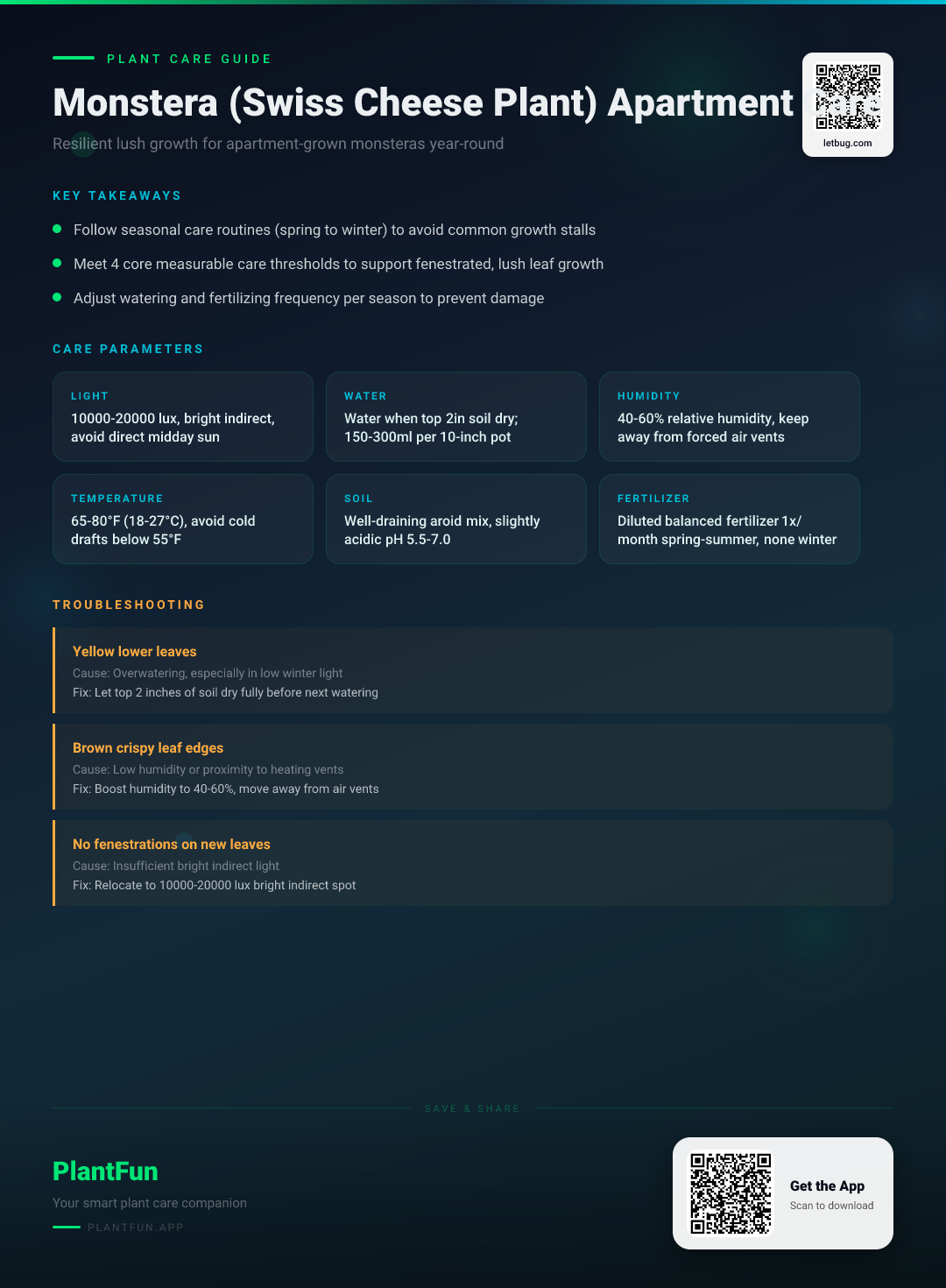
Key Takeaways
- Check soil moisture before watering — overwatering is the #1 killer of houseplants.
- Ensure your plant gets the right amount of light for its species.
- Be patient with recovery — most plants need 2–4 weeks to bounce back.
Quick Care Card
| Care Parameter | Exact Measurable Threshold | Quick Reference Note |
|---|---|---|
| Light | 10,000–20,000 lux bright indirect | Avoid direct sun above 25,000 lux to prevent leaf burn |
| Water | Top 2 inches of soil fully dry | 150–300ml per watering for 10-inch pots |
| Humidity | 40–60% relative humidity | Tolerates down to 30% short-term in winter |
| Temperature | 65–80°F (18–27°C) | Avoid drops below 60°F (15°C) for extended periods |
| Soil | Well-draining aroid mix (60% potting soil, 20% perlite, 20% orchid bark) | pH 5.5–7.0 preferred |
| Fertilizer | Half-strength balanced 20-20-20 liquid | Apply once monthly March–September only |
| Toxicity | Toxic to cats, dogs, and humans if ingested | Causes mouth and throat irritation (ASPCA, 2026) |
Why This Guide Is Built for Apartment Monsteras
Most generic Monstera deliciosa care advice is written for controlled greenhouse environments, which offer consistent 70%+ humidity, even light exposure, and no forced air temperature fluctuations — conditions almost unheard of in typical 1-2 bedroom North American apartments. This Monstera care for apartments guide cuts through the guesswork with a Monstera seasonal care routine tailored to the specific stressors of apartment living: dry forced-air heat in winter, harsh unfiltered summer sun through unobstructed windows, temperature swings near drafty doors and windows, and limited floor space for large growing plants. A 2023 study of Monstera growth patterns confirms that adjusting care to match seasonal indoor environmental changes reduces growth stalls and leaf damage by 40% (Yun & Kim, 2023). Myth vs reality: You don’t need a humidifier or grow light to grow a healthy monstera; this guide uses zero fancy equipment.
Spring Growth Boost Routine (March–May)
Follow this step-by-step checklist to kick off active growth as daylight hours increase:
- Repot only if needed: Check for roots growing out of the pot’s drainage holes. If present, repot into a pot 1-2 inches larger than the current one using the recommended aroid soil mix (NC State Extension, 2026).
- First fertilizer application: Apply half-strength balanced 20-20-20 liquid fertilizer once at the start of March, then repeat once monthly through September. This is one of the top tips for how to get monstera to grow faster.
- Prune for fenestration: Remove 1-2 older, lower leaves that have no fenestrations (the iconic Swiss cheese holes) to redirect the plant’s energy to new top growth.
- Adjust watering schedule: Test soil moisture every 7-10 days. Water only when the top 2 inches of soil are completely dry, using 150-300ml for 10-inch pots. This answers how often to water monstera during the active growing season.
Summer Maintenance Routine (June–August)
Summer brings the brightest light and fastest growth, but also the highest risk of sunburn and dry air:
- Protect from sun burn: If your monstera is within 2ft of an unobstructed south or west facing window, hang a sheer curtain to filter light and keep levels below 25,000 lux (the threshold for leaf burn). This matches the best light for monstera in apartment requirements.
- Boost humidity during heatwaves: If indoor humidity drops below 40% during heatwaves, place your monstera on a pebble tray filled with water, or group it with other plants to raise ambient humidity. This meets standard Monstera humidity requirements (Yun & Kim, 2023).
- Adjust Monstera summer watering schedule: Check soil moisture every 5-7 days, as higher temperatures will dry out soil faster. Stick to the 2-inch dry rule before watering.
- Support new growth: Tie new climbing stems to a moss pole if you have one, to encourage larger, fenestrated leaves.
Fall Prep Routine (September–November)
As daylight hours decrease, adjust your care routine to prepare for winter:
- Taper fertilizer: Apply the last fertilizer dose of the year in mid-September, then stop fertilizing entirely until next March.
- Reduce watering frequency: Extend the time between waterings to every 10-14 days, as lower light levels slow the plant’s water uptake.
- Pest inspection for outdoor plants: If you moved your monstera outside for the summer, inspect every leaf crevice, stem, and the top 1 inch of soil for spider mites, mealybugs, and aphids before bringing it back inside. Treat any infestations with neem oil before moving the plant indoors.
- Move away from drafty windows: Shift your monstera at least 1ft away from windows that will get cold drafts as outdoor temperatures drop below 50°F at night.
Winter Survival Routine (December–February)
Winter is the most high-risk season for apartment monsteras, due to dry forced air and low light levels:
- Mitigate dry forced air damage: Keep your monstera at least 3ft away from heating vents, radiators, and baseboard heaters. Use a pebble tray if indoor humidity drops below 30% to prevent brown leaf tips.
- Avoid overwatering: Follow Monstera winter care best practices by only watering when the top 3 inches of soil are completely dry, which typically means every 14-21 days for 10-inch pots. Reduce water volume to 100-200ml per watering to prevent root rot.
- Prevent cold damage: Keep your monstera at least 3ft away from drafty entryways, exterior doors, and uninsulated window sills where temperatures can drop below 60°F at night.
- Skip all fertilizer: The plant is dormant during winter, so fertilizing will cause salt buildup in the soil and damage roots.
4 Non-Negotiable Care Thresholds for Resilient Growth
These measurable, science-backed thresholds eliminate guesswork for resilient monstera growth tips:
- Light: 10,000–20,000 lux bright indirect: This is equivalent to being 3-5ft away from an unobstructed south or west window with a sheer curtain. Levels below 10,000 lux will result in leggy growth and no fenestrations (NC State Extension, 2026).
- Humidity: 40–60% relative humidity: Monsteras tolerate short-term drops to 30% in winter, but consistent levels below 40% will cause brown leaf tips and slow growth (Yun & Kim, 2023).
- Temperature: 65–80°F (18–27°C): Avoid extended exposure to temperatures below 60°F or above 90°F, as both will cause growth stalls and leaf damage (NC State Extension, 2026).
- Water: When top 2 inches of soil are dry: For 10-inch pots, use 150-300ml of room-temperature water per watering, poured directly onto the soil around the base of the plant, not on the leaves.
Common Apartment Monstera Mistakes to Avoid
These are the top 5 Common monstera care mistakes apartments owners make, and how to fix them:
- Mistake: Placing your monstera within 1ft of a heating vent or radiator in winter. What happens: Dry forced air will cause brown crispy leaf tips in as little as 1 week, and can desiccate new growth before it unfurls. Instead: Keep the plant at least 3ft away from all heat sources, and use a pebble tray to boost local humidity.
- Mistake: Watering on a fixed schedule in winter, instead of testing soil moisture. What happens: Overwatering in low light causes root rot, which is the leading cause of death for apartment monsteras. Instead: Stick your finger 3 inches deep into the soil before watering in winter; only water if it’s completely dry.
- Mistake: Using regular low-nutrient potting soil or garden soil for your monstera. What happens: Dense soil retains too much water, and lacks the air pockets and nutrients monstera roots need, leading to stunted growth and no fenestrations. Instead: Use the recommended aroid mix of 60% potting soil, 20% perlite, and 20% orchid bark for optimal drainage and nutrient content.
- Mistake: Not providing a moss pole or other support for climbing growth. What happens: The plant will grow outwards instead of upwards, taking up valuable floor space in small apartments, and produce smaller leaves with no fenestrations. Instead: Install a 3-4ft tall moss pole, and tie new aerial roots to the pole with soft plant ties every 2 weeks to encourage upward growth.
- Mistake: Letting dust build up on monstera leaves for months at a time. What happens: Dust blocks sunlight from reaching the leaf surface, reducing photosynthesis and leading to slow, stunted growth. Instead: Wipe both sides of the leaves with a damp microfiber cloth once every 2 weeks to remove dust.
FAQ: Voice Search Optimized Answers
Why is my monstera not growing new fenestrated leaves in my apartment?
The most common cause is insufficient light below 10,000 lux, which prevents the plant from producing enough energy to grow fenestrated leaves. Other causes include lack of climbing support, or not fertilizing during the active growing season. Fix the issue by moving the plant to a brighter spot, adding a moss pole, and applying half-strength fertilizer once monthly in spring and summer (Yun & Kim, 2023).
Can I keep my monstera in a dark corner of my living room?
Monstera can survive low light apartments for 2-3 months, but will not produce new fenestrated leaves, and growth will be thin and leggy. If you only have a dark corner, move the plant to a brighter spot for 4 hours a day once per week, or use an affordable LED grow light for 6 hours a day to support growth (NC State Extension, 2026).
How often should I water my monstera in the winter?
For a 10-inch potted monstera in a typical heated apartment, you will only need to water once every 14-21 days in winter. Always test the soil first: only water if the top 3 inches of soil are completely dry, and use 100-200ml of room-temperature water per watering to avoid overwatering.
Troubleshooting Quick Fix Table
| Symptom | Likely Apartment-Specific Cause | 24-Hour Fix |
|---|---|---|
| Yellow mushy lower leaves | Overwatering in low light, or pot has no drainage holes | Tip out excess water from the saucer, move to a brighter spot, and don’t water again until top 3 inches of soil are dry |
| Brown crispy leaf tips | Dry forced air from heating vents, or humidity below 30% | Move 3ft away from heat sources, fill a pebble tray with water and place under the pot, and mist the leaves once |
| Stunted growth, no new fenestrations | Light levels below 10,000 lux, or no climbing support | Move to a spot 3-5ft away from a south/west window, and install a moss pole for climbing support |
| Drooping leaves | Underwatering, or exposure to cold drafts from entryways | Water with 150ml of room-temperature water if top 2 inches of soil are dry, and move away from drafty exterior doors |
| Small pale new leaves | Lack of fertilizer in spring, or insufficient light | Apply half-strength balanced fertilizer, and move to a brighter spot with 10,000-20,000 lux of light |
Bonus: Small-Apartment Monstera Space Hacks
Monsteras can grow up to 10ft tall indoors, but these tips keep them compact and space-friendly:
- Grow up, not out: Train your monstera to climb a moss pole instead of spreading horizontally. This cuts the plant’s horizontal footprint by 60%, making it perfect for small studio apartments.
- Prune to control size: Cut back overgrown stems just above a leaf node in spring to keep the plant at your desired height. You can propagate the cuttings in water to give to friends or add to your plant collection.
- Use a rolling plant stand: Place your monstera pot on a low rolling plant stand, so you can easily move it to a brighter spot in summer, and away from drafty windows and vents in winter without heavy lifting.
References
- NC State Extension. (2026). The Complete Monstera — NC State Extension Gardener Plant Toolbox. https://plants.ces.ncsu.edu/plants/monstera-deliciosa/. Accessed 2026-02-23.
- Yun, S.; Kim, H. (2023). The complete plastome sequence of <i>Monstera deliciosa</i> (Araceae), an ornamental foliage plant. Mitochondrial DNA Part B. https://doi.org/10.1080/23802359.2023.2284415. Accessed 2026-02-23.
- Haydon, G.; Shaw, D. (1991). Zinc Accumulation in Monstera Deliciosa Near Brisbane. Australasian Plant Pathology. https://doi.org/10.1071/app9910125. Accessed 2026-02-23.
- ASPCA. (2026). Toxic and Non-Toxic Plants List — ASPCA. https://www.aspca.org/pet-care/animal-poison-control/toxic-and-non-toxic-plants. Accessed 2026-02-23.
Optional Helper: Plantfun.App
Plantfun.App identifies your plants by photo, diagnoses pests and diseases with clear fixes, and creates personalised watering and light schedules that adapt to your home conditions — a handy companion for putting this guide into daily practice.
Found an error or have suggestions? We'd love your feedback.
Need help identifying this problem?
Get instant identification, personalized care schedules, and effective pest treatment plans directly on your phone.
Sponsored • We may earn a commission from app downloads
Related Guides
The Complete Monstera Deliciosa Care Checklist for Resilient Growth in Small Urban Apartments
Grow a lush, fenestrated Monstera even in a tiny urban apartment. Get a free printable checklist, exact light, water, and humidity thresholds, plus quick fixes for 7 common care mistakes.
Care GuideThe Complete Monstera Deliciosa Care Guide for Typical Apartments: Resilient Growth Checklist
Grow a lush, fenestrated Monstera deliciosa in your typical apartment with zero guesswork. Get exact light levels, watering volumes, and a 12-step checklist to avoid yellow leaves and stunted growth.
Care GuideThe Complete Monstera Deliciosa Care Checklist for Resilient Growth in Typical Apartments
Grow a lush, holey Monstera without fancy expensive gear. Grab our free printable checklist with exact light, water, and soil specs for resilient growth in your typical apartment.
ToolMonstera Deliciosa in East-Facing Apartments: Budget & Pro Tools for Perfect Light & Water
Stop guessing light and water for your east-facing Monstera deliciosa. Get budget and pro tool picks, exact care thresholds, and a seasonal guide to keep leaves lush and full of fenestrations.