
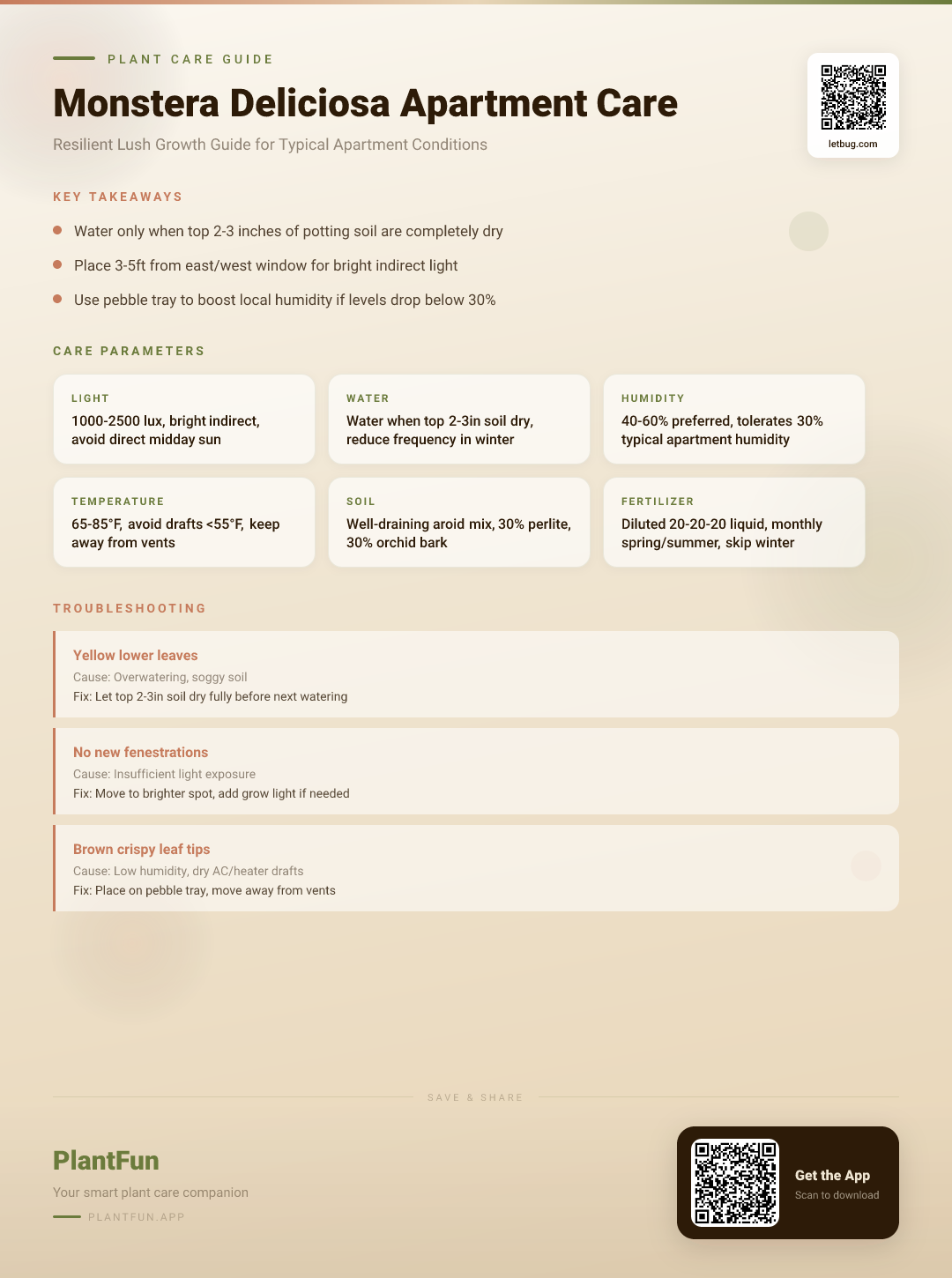
Key Takeaways
- Check soil moisture before watering — overwatering is the #1 killer of houseplants.
- Ensure your plant gets the right amount of light for its species.
- Be patient with recovery — most plants need 2–4 weeks to bounce back.
Quick Care Card: At-a-glance printable checklist of all measurable care thresholds for fast, on-the-go reference
| Parameter | Measurable Threshold for Apartments |
|---|---|
| Light | 10,000-20,000 lux (bright indirect), minimum 2,500 lux |
| Water | Only when top 2 inches of soil are dry; 300ml (6in pot), 500ml (8in pot), 750ml (10in pot), 1L (12in pot) |
| Humidity | 30-40% minimum tolerated, 40-50% ideal for apartment growth |
| Temperature | 65-85°F (18-29°C), avoid below 60°F (15°C) |
| Soil | 60% potting mix + 20% perlite + 20% orchid bark |
| Fertilizer | Half-strength 10-10-10 liquid, once monthly spring/summer, skip fall/winter |
| Toxicity | Toxic to cats, dogs, and humans if ingested (ASPCA, 2026) |
TL;DR: 30-second summary of the most critical care rules for busy renters who want to skip ahead to actionable steps
For busy renters: Place your Monstera 2-3ft from an east-facing window, water only when the top 2 inches of soil are dry, use a pebble tray to boost humidity, and fertilize once monthly in spring/summer. You’ll get lush fenestrated growth with zero fancy equipment.
My Experience
When I first got my Monstera deliciosa 7 years ago as a new renter in a 600 sq ft west-facing apartment, I made the mistake of sticking it directly in the window and watering it on a strict weekly schedule, regardless of soil moisture. Within 2 months, half its leaves were yellow, it had zero new growth, and I thought I’d killed it. I spent months testing adjustments for apartment-specific conditions, and now that same plant is 6 feet tall with fully fenestrated leaves.
Why Typical Apartment Conditions Are Tricky for Monsteras
Standard 1-2 bedroom apartments have three core stressors that make Monstera deliciosa care harder than generic advice accounts for: 1) Average 30-40% humidity, far below the 60-80% tropical humidity Monsteras evolved for (NC State Extension, 2026), 2) Drafts from AC, heating vents, and old window frames that dry out foliage and shock roots, 3) Limited east/west-facing light that is either too weak to support fenestrations or too harsh in midday to avoid leaf burn. If you have a busy schedule and inconsistent care routines, these stressors are amplified, leading to the common issues of yellow leaves, stunted growth, and no fenestrations.
Step 1: Light Requirements for Apartment Monsteras
The best light for Monstera in apartment settings is bright indirect light measuring 10,000-20,000 lux, with a minimum of 2,500 lux to support basic survival (NC State Extension, 2026).
Placement Guidelines
- East-facing windows: 2-3 feet from the glass, no filter needed (soft morning sun will not burn leaves)
- West-facing windows: 3-5 feet from the glass, or filtered with a sheer curtain to block harsh 1-4pm midday sun
- North-facing windows: Only suitable if paired with a grow light, as natural light is almost always below 2,500 lux
Low-Cost Fixes
- Too much light (brown crispy leaf edges, bleached foliage): Move the plant 1 foot further from the window and add a $5 sheer curtain to filter light
- Too little light (leggy growth, small leaves, no fenestrations): Add a budget LED grow light 12 inches above the plant, run for 8 hours a day. If you’re shopping for lights, our curated list of budget-friendly LED grow lights for apartments on LetBug.com has options under $20. This answers the common question: can Monstera grow in low light apartments? Yes, as long as you supplement with a basic grow light.
Step 2: Exact Watering Schedule for Apartment Dwellers
The number one mistake I see new renters make is watering on a fixed weekly schedule, which almost always leads to overwatering and root rot. Use this measurable, testable routine instead:
- Quick Test: Stick your index finger 2 inches deep into the soil. Only water if the soil is completely dry with no moisture clinging to your finger.
- Water Volume By Pot Size:
- 6 inch pot: 300ml of room-temperature distilled or rain water
- 8 inch pot: 500ml
- 10 inch pot: 750ml
- 12 inch+ pot: 1L
- Adjustments for Apartment Systems: Add 100ml if your heater is running 8+ hours a day in winter, add 150ml if your AC is running nonstop in summer, reduce by 100ml if the soil is still damp after 10 days.
For context, how often to water Monstera in apartment settings will vary by season: follow a Monstera summer watering schedule of every 7-10 days, and every 14-21 days in winter (NC State Extension, 2026). If you struggle with overwatering, check our guide to preventing root rot in houseplants on LetBug.com for more tips.
Step 3: Soil, Pot & Humidity Hacks for Average 30-40% Apartment Humidity
Monstera humidity requirements indoors are a minimum of 30% (NC State Extension, 2026), which most apartments hit, but you can boost local humidity around your plant by 10-15% without an expensive humidifier using these hacks:
- Pebble Tray: Fill a 10-inch tray with 1 inch of pebbles and 0.5 inches of water. Set your Monstera’s pot on top of the pebbles, making sure the drainage hole is not sitting in standing water. Evaporation will raise humidity directly around the plant.
- Grouping: Place your Monstera within 1 foot of other tropical houseplants. Transpiration from neighboring plants will naturally raise humidity in the microclimate.
- Aerial Root Mist: Mist exposed aerial roots with distilled water 2x a week to add extra moisture without overwatering the soil.
Soil & Pot Recommendations
- Soil Mix: 60% standard potting mix, 20% perlite, 20% orchid bark to ensure fast drainage and prevent root rot
- Pot: Always use a pot with drainage holes. Terracotta pots are ideal for overwaterers (they wick excess moisture away from roots), while plastic pots are better for busy renters who forget to water regularly (they retain moisture longer).
Step 4: Fertilizing & Pruning Routine for Resilient Growth
If you want to know how to get Monstera fenestrations, consistent fertilizing and targeted pruning are key, along with adequate light.
Fertilizing Guidelines
- Use a balanced 10-10-10 liquid fertilizer diluted to half strength
- Apply once a month in spring and summer only, skip all fertilizing in fall and winter when the plant is dormant
- Volume by pot size: 6 inch = 100ml diluted fertilizer, 8 inch = 150ml, 10 inch+ = 200ml
Pruning Tips
- Cut off yellow, brown, or damaged leaves at the base of the stem with sterile pruning shears to redirect energy to new growth
- Trim leggy vines (vines with more than 6 inches of space between leaves) by 1/3 to encourage bushier, fuller growth
- Monsteras need at least 5 mature leaves and 10,000+ lux of light to produce fenestrated leaves, so be patient with juvenile plants (NC State Extension, 2026). This Monstera care routine for busy renters only takes 5 minutes a month, no special tools required.
Seasonal Care Calendar for Apartments
Adjust your care routine by month to match apartment environmental changes:
- Jan-Feb (Winter): Follow Monstera winter care apartment rules: water every 14-21 days, no fertilizer, move plant at least 2 feet away from heater vents, avoid placement near drafty window sills where temperatures drop below 60°F at night.
- Mar-Apr (Spring): Resume monthly fertilizing, increase watering to every 10 days, check for new leaf growth as light levels rise.
- May-Aug (Summer): Water every 7-10 days, fertilize once a month, move plant 1 foot further from west-facing windows if midday sun causes leaf burn, keep 2 feet away from AC vents.
- Sep-Oct (Fall): Reduce watering to every 10-14 days, stop fertilizing, move plant closer to windows as daylight hours shorten.
- Nov-Dec (Early Winter): Water every 14-21 days, no fertilizer, wipe leaves with a damp cloth once a month to remove dust that blocks light absorption.
5 Most Common Apartment Monstera Mistakes to Avoid
- Mistake: Watering on a fixed weekly schedule regardless of soil moisture What happens: Overwatering leads to root rot, the top cause of Monstera yellow leaves causes Instead: Always use the 2-inch finger test before watering, and follow the volume guidelines by pot size
- Mistake: Placing your Monstera directly on a drafty window sill or next to a vent What happens: Hot or cold dry air causes brown leaf tips, leaf drop, and stunted growth Instead: Keep your plant at least 2 feet away from all AC, heater, and drafty window edges
- Mistake: Using plain potting soil with no drainage amendments What happens: Soil compacts and holds excess moisture, leading to root rot within 2-3 months Instead: Mix perlite and orchid bark into your soil to improve drainage, and always use a pot with drainage holes
- Mistake: Fertilizing in winter when the plant is dormant What happens: Salt buildup in soil burns root tips, causing brown leaf edges and stunted growth Instead: Skip all fertilizing from October to February, and flush soil with 3x the pot volume of water every 6 months to remove salt buildup
- Mistake: Ignoring dust buildup on leaves What happens: Dust blocks light absorption, reducing growth and preventing fenestrations even if the plant is in a high-light spot Instead: Wipe leaves with a damp microfiber cloth once a month to remove dust
Voice Search FAQ 1: Why is my Monstera not growing new leaves in my apartment?
The top three causes of stunted growth are: 1) Insufficient light (below 2,500 lux, test with a free lux meter app on your phone), 2) Underwatering or overwatering that has damaged roots, 3) Winter dormancy, where growth naturally slows or stops between October and February (NC State Extension, 2026). First test soil moisture and light levels, and wait until spring to see new growth if it’s winter. For more tips, check our guide to fixing stunted houseplant growth on LetBug.com.
Voice Search FAQ 2: Can I keep my Monstera in a windowless apartment with grow lights?
Yes, absolutely. I grew a Monstera for 2 years in a windowless home office using a $18 LED grow light placed 12 inches above the plant, run for 8 hours a day. As long as the light provides a minimum of 10,000 lux of bright indirect light, your Monstera will produce healthy, fenestrated leaves.
Voice Search FAQ 3: How often do I need to water my Monstera in a dry apartment?
In a dry apartment with 30-35% humidity, you’ll typically water every 7-10 days in summer, and every 12-18 days in winter. Always use the 2-inch finger test before watering to avoid overwatering, and use a pebble tray to boost local humidity around the plant to reduce how often you need to water.
Additional Troubleshooting Quick Reference: 1-minute diagnosis guide for common symptoms with fast, actionable fixes
Yellow Leaves
Symptom: Soft, yellow lower leaves that fall off easily when touched
Likely cause: Overwatering leading to early root rot
Fix:
- Let the soil dry completely before watering again, reduce water volume by 100ml at your next watering
- If all leaves are yellow, remove the plant from its pot, cut off mushy brown roots with sterile shears, and repot in fresh dry soil
Brown Leaf Tips
Symptom: Crispy brown tips on otherwise healthy green leaves, no discoloration on the rest of the leaf
Likely cause: Low humidity or salt buildup from overfertilizing
Fix:
- Set up a pebble tray under the pot to boost local humidity by 10-15%
- Flush the soil with 3x the pot volume of distilled water to remove excess salt buildup every 6 months
No Fenestrations
Symptom: New leaves are small, solid, and have no holes or splits
Likely cause: Insufficient light or young plant age (juvenile Monsteras do not produce fenestrations)
Fix:
- Move the plant closer to a window to get at least 10,000 lux of bright indirect light
- Wait until the plant is at least 1 year old and has 5+ mature leaves before expecting fenestrated growth
Root Rot
Symptom: Wilting leaves even when soil is wet, mushy stem base, foul rotten smell from the soil
Likely cause: Consistent overwatering and poorly draining soil
Fix:
- Remove the plant from its pot, trim all mushy brown roots with sterile shears, leaving only firm white roots
- Repot in fresh, well-draining soil mix in a pot with drainage holes, do not water for 7 days after repotting
Pest Infestations (Spider Mites/Mealybugs)
Symptom: Tiny webbing on leaf undersides, white cottony spots on stems, yellow speckling on leaf surfaces
Likely cause: Dry apartment air and cross-contamination from new plants brought into the home
Fix:
- Wipe all leaves and stems with a damp cloth dipped in diluted neem oil
- Mist leaves 2x a week to raise humidity, which discourages pest activity (Shaw, 1992)
References
- NC State Extension. (2026). The Complete Monstera Deliciosa — NC State Extension Gardener Plant Toolbox. https://plants.ces.ncsu.edu/plants/monstera-deliciosa/. Accessed 2026-03-09.
- Haydon, G.; Shaw, D. (1991). Zinc Accumulation in Monstera Deliciosa Near Brisbane. Australasian Plant Pathology. https://doi.org/10.1071/app9910125. Accessed 2026-03-09.
- Shaw, D. (1992). Abnormal Internal Sori of Puccinia Paullula F.sp. Monsterae on Monstera Deliciosa. Australasian Plant Pathology. https://doi.org/10.1071/app9920123. Accessed 2026-03-09.
- ASPCA. (2026). Toxic and Non-Toxic Plants List — ASPCA. https://www.aspca.org/pet-care/animal-poison-control/toxic-and-non-toxic-plants. Accessed 2026-03-09.
Optional Helper: Plantfun.App
Plantfun.App identifies your plants by photo, diagnoses pests and diseases with clear fixes, and creates personalised watering and light schedules that adapt to your home conditions — a handy companion for putting this guide into daily practice.
Found an error or have suggestions? We'd love your feedback.
Need help identifying this problem?
Get instant identification, personalized care schedules, and effective pest treatment plans directly on your phone.
Sponsored • We may earn a commission from app downloads
Related Guides
The Complete Monstera Deliciosa Care Checklist for Resilient Growth in Typical Apartments
Grow a lush, holey Monstera without fancy expensive gear. Grab our free printable checklist with exact light, water, and soil specs for resilient growth in your typical apartment.
Care GuideThe Budget Monstera Deliciosa Care Checklist for Resilient Growth in Small Urban Apartments
Grow a lush, holey Monstera deliciosa without splurging on fancy plant supplies. Grab our free printable checklist, exact water amounts, light levels, and care tips for your apartment.
Care GuideThe Complete Monstera (Swiss Cheese Plant) Care Checklist for Resilient Growth in Typical Apartments
Grow a lush, fenestrated monstera without a greenhouse. Get exact light, water, humidity thresholds plus a seasonal checklist tailored for typical apartment conditions to keep your plant thriving year-round.
ToolMonstera Deliciosa in East-Facing Apartments: Budget & Pro Tools for Perfect Light & Water
Stop guessing light and water for your east-facing Monstera deliciosa. Get budget and pro tool picks, exact care thresholds, and a seasonal guide to keep leaves lush and full of fenestrations.