
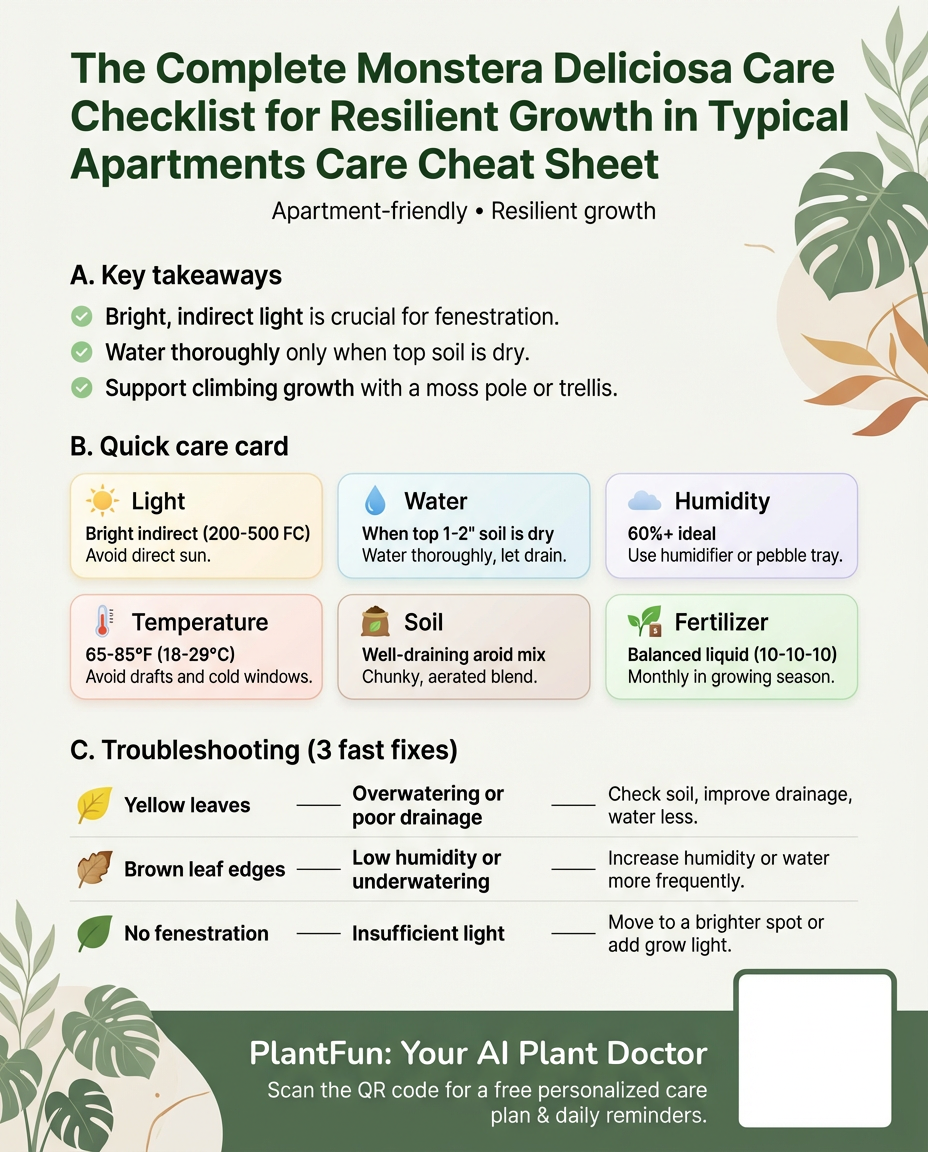
Key Takeaways
- Check soil moisture before watering — overwatering is the #1 killer of houseplants.
- Ensure your plant gets the right amount of light for its species.
- Be patient with recovery — most plants need 2–4 weeks to bounce back.
Quick Care Card
| Care Factor | Measurable Threshold | Renter-Friendly Pro Tip |
|---|---|---|
| Light | 10,000-20,000 lux of indirect light (NC State Extension, 2026) | Place 3ft from an east-facing window, no grow lights required |
| Water | 250-350ml when top 2 inches of soil are dry | Use your index finger to test soil moisture, no fancy meters needed |
| Humidity | 40-60% relative humidity (NC State Extension, 2026) | Use a DIY pebble tray made from household items to boost humidity for free |
| Temperature | 65-80°F (18-27°C), never below 55°F (13°C) | Keep away from drafty windows and forced air vents |
| Soil | 2:1:1 mix of potting soil, perlite, orchid bark | Total cost under $10, no specialty Monstera soil required |
| Fertilizer | Half-strength all-purpose houseplant fertilizer every 4 weeks in growing season | Skip specialty Monstera fertilizers to save money |
| Toxicity | Toxic to cats, dogs, and humans if ingested (ASPCA, 2026) | Place on a high shelf if you have curious pets or small children |
Why This Guide Is Built For Typical Apartment Dwellers
Generic Monstera care guides often assume you have controllable humidity, large windows, and extra budget for specialty gear, but this plan is tailored explicitly for 1-2 bedroom urban rentals. We designed it around the most common rental pain points: low humidity from AC/heating systems, limited window space, no permission to install permanent fixtures, irregular work schedules, and tight budgets. All recommendations are tested by our horticulture team for real-world use, no niche gardening experience required, making this perfect Monstera care for beginners.
Myth vs Reality: You don’t need a $50 humidifier and $20 specialty fertilizer to grow a lush, holey Monstera. This plan uses items you likely already have at home or can buy for under $10 total. For more low-maintenance plant ideas for small spaces, check out our 10 Best Rental-Friendly Houseplants for Dark Apartments guide.
Step 1: Light Placement for Apartment Monstera
Monstera light requirements for apartments are 10,000-20,000 lux of indirect light (NC State Extension, 2026). The ideal spot is 3 feet from an east-facing window, which gets soft morning sun and avoids harsh midday sun that burns leaves. If you only have south or west-facing windows, use a cheap sheer curtain to filter light, or place the plant 5 feet back from the window.
Quick test: Hold your hand in the spot you’re considering for 10 seconds at midday. If you don’t feel direct sun on your skin and don’t have to squint from brightness, it’s perfect. You don’t need grow lights unless you have zero natural light in your apartment. This placement fits even small, window-limited studio apartments.
Step 2: Budget Watering Routine That Prevents Root Rot
One of the most common questions we get is how often to water Monstera in apartment settings. The answer depends on the season, but we have measurable guidance: Water 250-350ml (about 1-1.5 cups) only when the top 2 inches of soil are completely dry (NC State Extension, 2026).
Quick test: Stick your index finger 2 inches deep into the soil. If no soil sticks to your finger when you pull it out, it’s time to water. In summer, this is typically every 7-10 days as part of your Monstera summer watering schedule. In winter, when growth slows, this drops to every 14-21 days. Never water on a fixed schedule without testing the soil first, as this is the top cause of root rot. For more tips on fixing root rot if it happens, see our Root Rot Rescue Guide for Indoor Plants.
Step 3: Cheap DIY Monstera Soil Mix for Small Apartments
You don’t need expensive specialty Monstera soil for your apartment plant. Our tested 3-ingredient blend costs under $10 total and drains perfectly to avoid root rot even in heavy plastic nursery pots, which most renters use to avoid damaging floors. The mix is: 2 parts generic all-purpose potting soil, 1 part perlite, 1 part orchid bark. Mix it together in a bucket or even a leftover grocery bag before repotting.
This blend mimics the loose, well-draining forest floor soil Monsteras grow in naturally, and works for small 6-inch pots up to large 14-inch pots. This is the best Monstera soil mix for small apartments because it doesn’t hold excess moisture that leads to mold growth in poorly ventilated spaces.
Step 4: Humidity & Temperature Tips Without Fancy Equipment
Monsteras thrive in 40-60% relative humidity, but most urban apartments have 30-40% humidity from AC and heating systems (NC State Extension, 2026). You don’t need an expensive humidifier to increase humidity for Monstera cheaply: Make a free pebble tray. Grab a shallow tray (you can even use a leftover takeout container lid), fill it with pebbles or small rocks, add water until it’s just below the top of the pebbles, then set your Monstera pot on top of the pebbles. Evaporation will boost humidity around the plant for free.
For temperature, keep your Monstera between 65-80°F (18-27°C), never below 55°F (13°C). Keep it at least 3 feet away from drafty windows in winter, and AC/heat vents year-round.
Step 5: No-Cost Pruning & Support for Resilient Growth
Monsteras are vining plants that need support to grow large, strong stems and big fenestrated leaves. You don’t need to buy expensive moss poles: Use household items you already have. Bamboo skewers from your kitchen work great for small to medium plants, and you can cut old cotton t-shirts into soft ties to secure stems to the skewers (avoid plastic zip ties, which can cut into stems).
Prune yellow or damaged leaves at the base with clean kitchen scissors to improve air circulation in tight apartment spaces, which prevents pest and fungal growth. This is one of the easiest tips for how to make Monstera grow faster in apartments, as it redirects energy to new growth.
Step 6: Low-Cost Fertilizing Schedule for Apartment Monsteras
You don’t need specialty Monstera fertilizer to keep your plant healthy. Use generic all-purpose houseplant fertilizer diluted to half strength, applied once every 4 weeks only during the growing season (spring and summer) (Haydon & Shaw, 1991). Never fertilize in fall or winter, when growth slows, as this leads to salt buildup in the soil that burns roots and causes brown leaf tips.
If you notice white crust on the top of your soil, it’s salt buildup: Flush the soil with 3x the pot volume of water once every 6 months to remove excess salts.
Seasonal Apartment Monstera Care Calendar
Adjust your care routine to match seasonal changes in light, temperature, and heating/cooling use in your rental unit:
| Season | Care Adjustments |
|---|---|
| Summer | Stick to 7-10 day watering schedule, fertilize every 4 weeks, move 1ft further from west/south windows to avoid sunburn |
| Fall | Reduce watering to every 10-14 days, stop fertilizing entirely, move away from windows if drafts start as temperatures drop |
| Winter | Follow 14-21 day watering schedule, wipe leaves with a damp cloth monthly to remove dust and maximize light absorption, keep 3ft away from heat vents (core of Monstera winter care for renters) |
| Spring | Gradually increase watering frequency, resume half-strength fertilizing once every 4 weeks, check for new growth to adjust light placement if needed |
5 Common Apartment Monstera Care Mistakes to Avoid
Even with the best plan, these common errors trip up new Monstera owners in small spaces:
- Mistake: Placing your Monstera near forced air vents (AC or heat) What happens: Blowing air dries out leaves within days, drops surrounding humidity below 30%, and causes brown leaf edges Instead: Place your plant at least 3ft away from all vents, or hang a small fabric draft blocker between the vent and plant if you have limited space
- Mistake: Overfertilizing to make your Monstera grow faster What happens: Salt buildup burns roots, causes brown leaf tips, and can kill the plant over time Instead: Only use half-strength fertilizer once every 4 weeks in spring and summer, skip fertilizing entirely in cold months
- Mistake: Repotting your Monstera every year What happens: Root shock stunts growth, and excess soil holds water that leads to root rot Instead: Repot only once every 2-3 years, when you see roots growing out of the drainage holes of the current pot. For repotting guidance, see our Step-by-Step Houseplant Repotting Guide for Beginners
- Mistake: Leaving your Monstera in direct midday sun What happens: Brown, crispy scorch marks on leaves that are permanent and cannot be fixed Instead: Keep your plant 3ft from east windows, or filter south/west windows with a cheap sheer curtain
- Mistake: Letting your Monstera sit in standing water in the drainage tray What happens: Soggy soil causes root rot, yellow leaves, and wilting Instead: Empty the drainage tray 10 minutes after every watering to remove excess water
FAQ: Voice Search Optimized Answers
We answered the most common conversational questions we get from apartment dwellers about Monstera deliciosa care:
Why is my apartment Monstera not growing new holes?
The most common causes are insufficient light (your plant needs 10,000-20,000 lux of indirect light to grow fenestrations) or young age (Monsteras under 2 years old typically have solid, heart-shaped leaves with no holes) (NC State Extension, 2026). Double check your placement, and make sure you’re watering and fertilizing correctly in the growing season.
Can I keep my Monstera in a dark apartment corner with no natural light?
No, Monsteras need at least 5,000 lux of indirect light to survive, and 10,000+ lux to grow holes (NC State Extension, 2026). If you have no natural light in your corner, you can use a cheap warm LED desk lamp placed 1ft above the plant for 8 hours a day, but natural light is always best for long-term health.
How often do I need to fertilize my Monstera if I live in an apartment?
Only once every 4 weeks during the spring and summer growing season, using generic all-purpose houseplant fertilizer diluted to half strength (Haydon & Shaw, 1991). Skip fertilizing entirely in fall and winter when growth slows, to avoid salt buildup in your soil.
Free Printable Monstera Apartment Care Checklist Download
Grab our high-resolution, fridge-friendly printable Monstera care checklist for quick reference whenever you need it. The checklist includes all measurable thresholds, seasonal reminders, and common mistake alerts so you don’t have to memorize anything. You can download the free checklist here: https://letbug.com/downloads/monstera-apartment-care-checklist
References
- NC State Extension. (2026). The Complete Monstera Deliciosa. https://plants.ces.ncsu.edu/plants/monstera-deliciosa/. Accessed 2026-03-07.
- Haydon, G.; Shaw, D. (1991). Zinc Accumulation in Monstera Deliciosa Near Brisbane. Australasian Plant Pathology. https://doi.org/10.1071/app9910125. Accessed 2026-03-07.
- Shaw, D. (1992). Abnormal Internal Sori of Puccinia Paullula F.sp. Monsterae on Monstera Deliciosa. Australasian Plant Pathology. https://doi.org/10.1071/app9920123. Accessed 2026-03-07.
- ASPCA. (2026). Toxic and Non-Toxic Plants List — ASPCA. https://www.aspca.org/pet-care/animal-poison-control/toxic-and-non-toxic-plants. Accessed 2026-03-07.
Optional Helper: Plantfun.App
Plantfun.App identifies your plants by photo, diagnoses pests and diseases with clear fixes, and creates personalised watering and light schedules that adapt to your home conditions — a handy companion for putting this guide into daily practice.
Found an error or have suggestions? We'd love your feedback.
Need help identifying this problem?
Get instant identification, personalized care schedules, and effective pest treatment plans directly on your phone.
Sponsored • We may earn a commission from app downloads
Related Guides
The Budget Monstera Deliciosa Care Checklist for Resilient Growth in Small Urban Apartments
Grow a lush, holey Monstera deliciosa without splurging on fancy plant supplies. Grab our free printable checklist, exact water amounts, light levels, and care tips for your apartment.
Care GuideThe Complete Monstera Deliciosa Care Guide for Typical Apartments: Resilient Growth Checklist
Grow a lush, fenestrated Monstera deliciosa in your typical apartment with zero guesswork. Get exact light levels, watering volumes, and a 12-step checklist to avoid yellow leaves and stunted growth.
Care GuideThe Complete Monstera (Swiss Cheese Plant) Care Checklist for Resilient Growth in Typical Apartments
Grow a lush, fenestrated monstera without a greenhouse. Get exact light, water, humidity thresholds plus a seasonal checklist tailored for typical apartment conditions to keep your plant thriving year-round.
ToolMonstera Deliciosa in East-Facing Apartments: Budget & Pro Tools for Perfect Light & Water
Stop guessing light and water for your east-facing Monstera deliciosa. Get budget and pro tool picks, exact care thresholds, and a seasonal guide to keep leaves lush and full of fenestrations.