
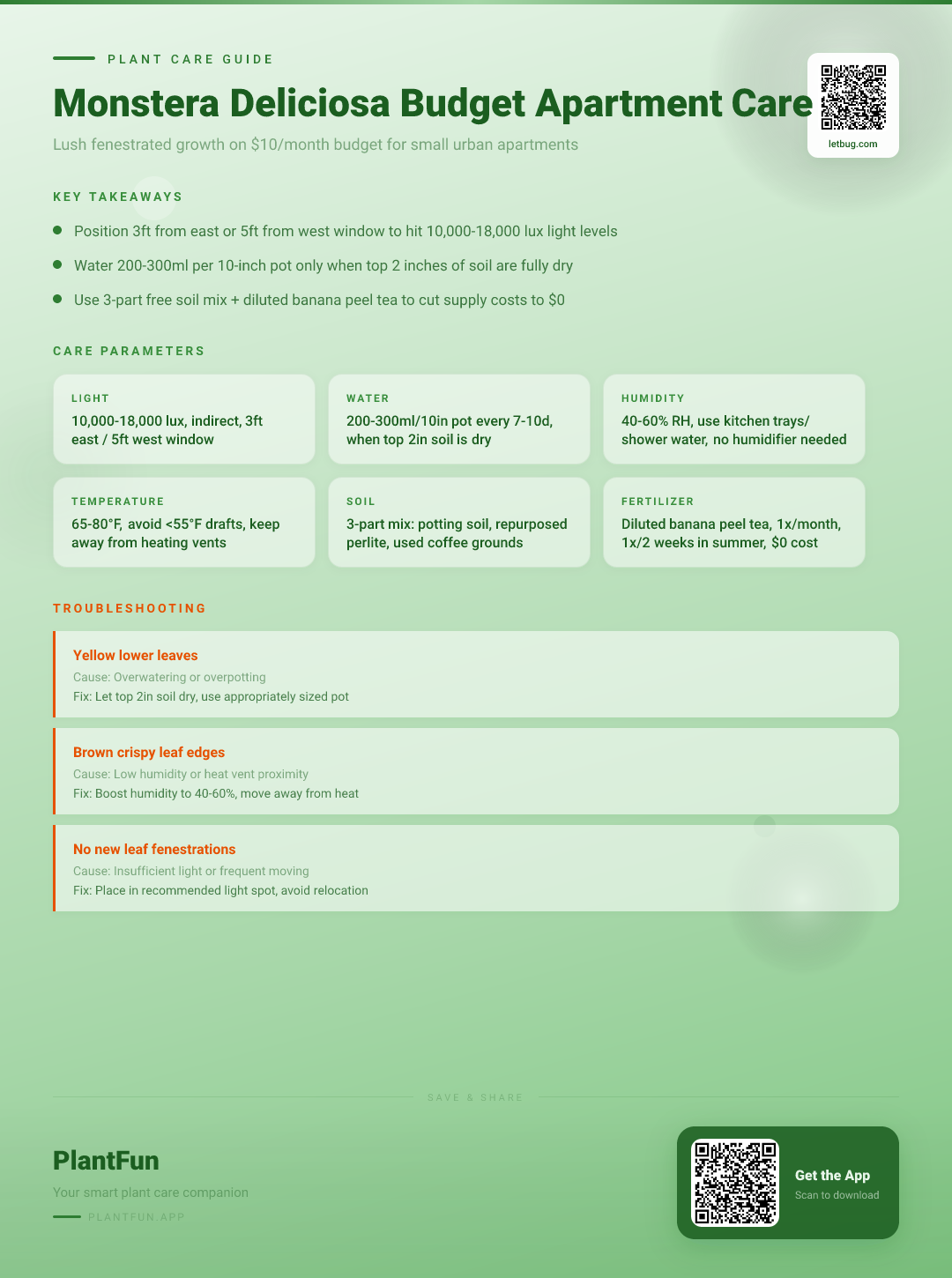
Key Takeaways
- Check soil moisture before watering — overwatering is the #1 killer of houseplants.
- Ensure your plant gets the right amount of light for its species.
- Be patient with recovery — most plants need 2–4 weeks to bounce back.
Quick Care Card
| Care Parameter | Apartment-Specific Rule |
|---|---|
| Light | 10,000–18,000 lux, 3ft from east-facing window or 5ft from west-facing window, no grow light required (NC State Extension, 2026) |
| Water | Water when top 2 inches of soil are dry, 200–300ml per 10-inch pot every 7–10 days, drain excess water after 15 minutes |
| Humidity | 40–60% relative humidity, maintained with household items, no expensive humidifier needed |
| Temperature | 65–80°F, keep 3ft away from all HVAC vents and drafty windows |
| Soil | 3-part zero-cost mix: 1 part existing potting soil, 1 part salvaged perlite, 1 part dried used coffee grounds |
| Fertilizer | Diluted banana peel tea, applied monthly in growing season, zero cost |
| Toxicity | Toxic to cats, dogs and humans if ingested (ASPCA, 2026) |
Why Standard Monstera Care Fails in Typical Urban Apartments
Generic Monstera deliciosa care guides assume you have spacious homes with south-facing windows, disposable income for specialty plant products, and no HVAC-related dry air issues — none of which apply to most 600-800 sq ft urban apartments. This guide is tailored exclusively to your space constraints, inconsistent light, and tight budget, with zero expensive products required. It’s perfect for Monstera care for beginners small apartment dwellers who don’t have extra time or cash to waste on fussy plant routines.
Step 1: Light Placement for Apartments Without South-Facing Windows
Monstera deliciosa thrives in 10,000–18,000 lux of bright indirect light (NC State Extension, 2026), a range you can easily hit without paying for grow lights. The best spots are:
- 3ft from an east-facing window: Gets soft morning light that won’t burn leaves, hitting the exact lux range for 4-6 hours per day
- 5ft from a west-facing window: Avoids harsh mid-afternoon sun that causes brown leaf scorch, while still delivering enough light for fenestration growth Quick test: Hold your hand up at the spot at noon. If you see a faint, blurry shadow without sharp edges, you’re in the ideal lux range. If you have no window access, a $10 basic LED grow light on a 12-hour timer works as a low-cost backup.
Step 2: Exact Watering Routine to Avoid Root Rot in Small Apartment Pots
Wondering how often to water Monstera deliciosa in apartment? Follow this exact, measurable routine for Monstera root rot prevention apartment:
- Stick your finger 2 inches deep into the soil. Only water if the soil is completely dry with no dampness
- Apply 200–300ml of room-temperature water per 10-inch pot, pouring directly on the soil (avoid wetting the leaves to prevent fungal growth)
- Dump any excess water that drains into the saucer after 15 minutes, so the roots never sit in standing water Myth vs reality: The myth that you need to water on a strict, unchanging schedule is wrong. Adjust frequency based on your HVAC use: if your heater runs nonstop in winter, check soil every 5 days; if you run AC constantly in humid summer, check every 12 days. For more tips on avoiding overwatering, check our guide to root rot prevention for houseplants.
Step 3: Budget Humidity Hacks Using Household Items
Monstera deliciosa humidity requirements apartment are 40–60% relative humidity (NC State Extension, 2026), a range you can hit without buying a $50+ humidifier. Try these zero-cost hacks:
- Grab an old kitchen baking tray, fill it with pebbles and leftover cool shower water, and set your Monstera pot on top of the pebbles (make sure the pot is not sitting directly in the water). Evaporating water will boost humidity around the plant for 2-3 days
- Group your Monstera with other houseplants to create a shared microclimate of higher humidity, as plants release moisture through their leaves
- Mist leaves once daily with cooled boiled water if your indoor humidity drops below 40% during winter heating season
Step 4: Cheap Soil & Fertilizer Swaps You Already Own
Skip the $15 specialty Monstera soil and $12 liquid fertilizer with these zero-cost swaps for budget Monstera care:
- Soil mix: Combine 1 part regular potting soil you already have, 1 part perlite salvaged from old empty planters, and 1 part dried used coffee grounds. The perlite improves drainage to prevent root rot, while coffee grounds add nitrogen and acidity that Monstera loves
- Fertilizer: Feed with diluted banana peel tea once a month in the growing season. Soak 3-4 leftover banana peels in a gallon of water for 3 days, dilute 1:1 with tap water, and pour directly on the soil. Banana peels are high in potassium and zinc, the key nutrients Monstera needs for fast growth and fenestration development (Haydon & Shaw, 1991). This is one of the easiest cheap Monstera care tips to implement, and it answers the question of how to make Monstera grow faster on budget with no extra cost.
Step 5: Space-Saving Support for Small Apartments
Sprawling Monstera stems can take up valuable floor and counter space in small apartments, but you can fix this with a DIY Monstera moss pole small space design that costs almost nothing:
- Grab a leftover cardboard shipping tube (from online orders) and cut it to 6 inches taller than your current Monstera height
- Wrap the tube with leftover sphagnum moss from craft projects, securing it with cotton string
- Stick the pole 4 inches deep into the soil next to your Monstera’s main stem
- Tie stems loosely to the pole as they grow to encourage upward, vertical growth instead of sprawling outward This setup takes up less than 6 inches of extra pot space, and it helps your Monstera grow larger, fenestrated leaves faster. If you prune excess stems to keep size under control, you can learn how to propagate Monstera deliciosa cuttings to share with friends.
Seasonal Care Calendar for Apartment Dwellers
Adjust your care routine based on seasonal changes in your apartment to keep your Monstera thriving year-round:
Winter (Monstera deliciosa winter care apartment)
- Temperature: Keep between 65–75°F, avoid placing near cold drafty windows
- Watering: Every 12–14 days, only when top 3 inches of soil are dry
- Fertilizer: Skip entirely, as plants go dormant in low light
- Extra step: Check humidity weekly, as forced heating can drop levels below 40%
Summer (Monstera deliciosa summer watering schedule)
- Temperature: Keep between 70–80°F, move 1ft further back from west-facing windows if afternoon sun is too harsh
- Watering: Every 7 days, or when top 2 inches of soil are dry
- Fertilizer: Every 2 weeks with diluted banana peel tea
- Extra step: Wipe dust off leaves every 2 weeks to improve photosynthesis
5 Common Apartment Monstera Mistakes to Avoid
- Mistake: Placing near heating vents or AC drafts What happens: Dry air burns leaf edges and dries out soil too fast, stunting growth Instead: Keep your Monstera at least 3ft away from all HVAC vents, check humidity levels weekly if your heater runs often
- Mistake: Overpotting your Monstera in a pot much larger than the root ball What happens: Excess soil holds too much water, leading to root rot, the #1 killer of apartment Monsteras Instead: Only repot into a pot 1-2 inches larger than the current root ball, every 2-3 years
- Mistake: Wiping leaves with harsh cleaning products or glass cleaner What happens: Clogs the leaf pores, preventing photosynthesis and leading to yellow leaves Instead: Wipe leaves with a damp microfiber cloth and plain water once a month to remove dust
- Mistake: Cutting off all aerial roots What happens: Reduces the plant’s ability to absorb moisture and nutrients from the air, slowing growth and reducing fenestration development Instead: Tuck aerial roots into the moss pole or let them grow down into the soil, don’t cut them unless they’re damaged
- Mistake: Moving your Monstera to a new spot every few weeks What happens: The plant has to constantly readjust to new light and humidity levels, leading to leaf drop and no new growth Instead: Pick a permanent spot that meets the light requirements, only move it temporarily if there’s a heatwave or cold draft
Frequently Asked Questions
Can I keep my Monstera deliciosa in a dark apartment corner with no direct window light?
When asking can I keep Monstera in low light apartment, the short answer is it can survive, but it won’t thrive. Monstera can tolerate as low as 5,000 lux, but it will grow leggy, stretch toward the nearest light source, and won’t produce fenestrated leaves (NC State Extension, 2026). If you only have a dark corner, a $10 basic LED grow light on a 12-hour timer will work as a low-cost fix. If you don’t want to use a grow light, check our list of best low-light houseplants for apartments for better options.
How do I stop my Monstera from taking up too much space in my 1-bedroom apartment?
Use the DIY moss pole outlined earlier to encourage upward, vertical growth instead of sprawling outward. You can also prune back overgrown stems in spring by cutting just above a leaf node (the bump on the stem where leaves grow from). Pruned stems can be propagated into new Monsteras, so you don’t have to waste the cuttings. Avoid letting stems trail across furniture by tying them loosely to the pole as they grow.
Why is my apartment Monstera not growing fenestrations even if it looks healthy?
The most common answers to why is my Monstera not growing fenestrations are: 1) Light levels are below 10,000 lux, the minimum required for fenestration growth; 2) Your plant is too young — Monsteras younger than 3 years old rarely produce fenestrated leaves; 3) It’s not getting enough potassium, the key nutrient for leaf development (NC State Extension, 2026). Try moving it closer to an east or west-facing window and feeding it diluted banana peel tea once a month for 3 months to see improvements.
Free Printable 5-Minute Weekly Monstera Care Checklist
Download our free, no-email-required Monstera deliciosa care checklist to eliminate guesswork from your routine. It takes less than 5 minutes to complete each week:
- Stick finger 2 inches into soil: Water if completely dry
- Check leaf edges for browning: Adjust humidity if needed
- Wipe 2-3 dusty leaves with a damp microfiber cloth
- Check that new stems are secured loosely to the moss pole
- Confirm the plant is at least 3ft away from HVAC vents and drafty windows
References
- NC State Extension. (2026). The Complete Monstera Deliciosa — NC State Extension Gardener Plant Toolbox. https://plants.ces.ncsu.edu/plants/monstera-deliciosa/. Accessed 2026-02-23.
- Haydon, G.; Shaw, D. (1991). Zinc Accumulation in Monstera Deliciosa Near Brisbane. Australasian Plant Pathology. https://doi.org/10.1071/app9910125. Accessed 2026-02-23.
- Shaw, D. (1992). Abnormal Internal Sori of Puccinia Paullula F.sp. Monsterae on Monstera Deliciosa. Australasian Plant Pathology. https://doi.org/10.1071/app9920123. Accessed 2026-02-23.
- ASPCA. (2026). Toxic and Non-Toxic Plants List — ASPCA. https://www.aspca.org/pet-care/animal-poison-control/toxic-and-non-toxic-plants. Accessed 2026-02-23.
Optional Helper: Plantfun.App
Plantfun.App identifies your plants by photo, diagnoses pests and diseases with clear fixes, and creates personalised watering and light schedules that adapt to your home conditions — a handy companion for putting this guide into daily practice.
Found an error or have suggestions? We'd love your feedback.
Need help identifying this problem?
Get instant identification, personalized care schedules, and effective pest treatment plans directly on your phone.
Sponsored • We may earn a commission from app downloads
Related Guides
The Complete Monstera Deliciosa Care Checklist for Resilient Growth in Standard Urban Apartments
Stop guessing your Monstera deliciosa care needs. Get exact light, water, and humidity thresholds plus a printable checklist for lush, fenestrated growth in your urban apartment.
Care GuideThe Complete Monstera Deliciosa Care Checklist for Resilient Growth in Small Urban Apartments
Grow a lush, fenestrated Monstera even in a tiny urban apartment. Get a free printable checklist, exact light, water, and humidity thresholds, plus quick fixes for 7 common care mistakes.
Care GuideMonstera Deliciosa in Small Urban Apartments: The Only Care Checklist for Resilient Lush Growth
Grow a lush, resilient Monstera deliciosa even in a tiny urban apartment. Get exact light, water, and space-saving tips plus a seasonal care checklist you can follow today.
Pest ControlHow to Spot Early Pest Warning Signs on Your Monstera Deliciosa & Stop Infestations Fast
Catch pest infestations before they ruin your east-facing dining room Monstera deliciosa. Get a 5-minute weekly inspection checklist, early warning signs, and step-by-step rescue plans you can use today to avoid full-blown outbreaks.