
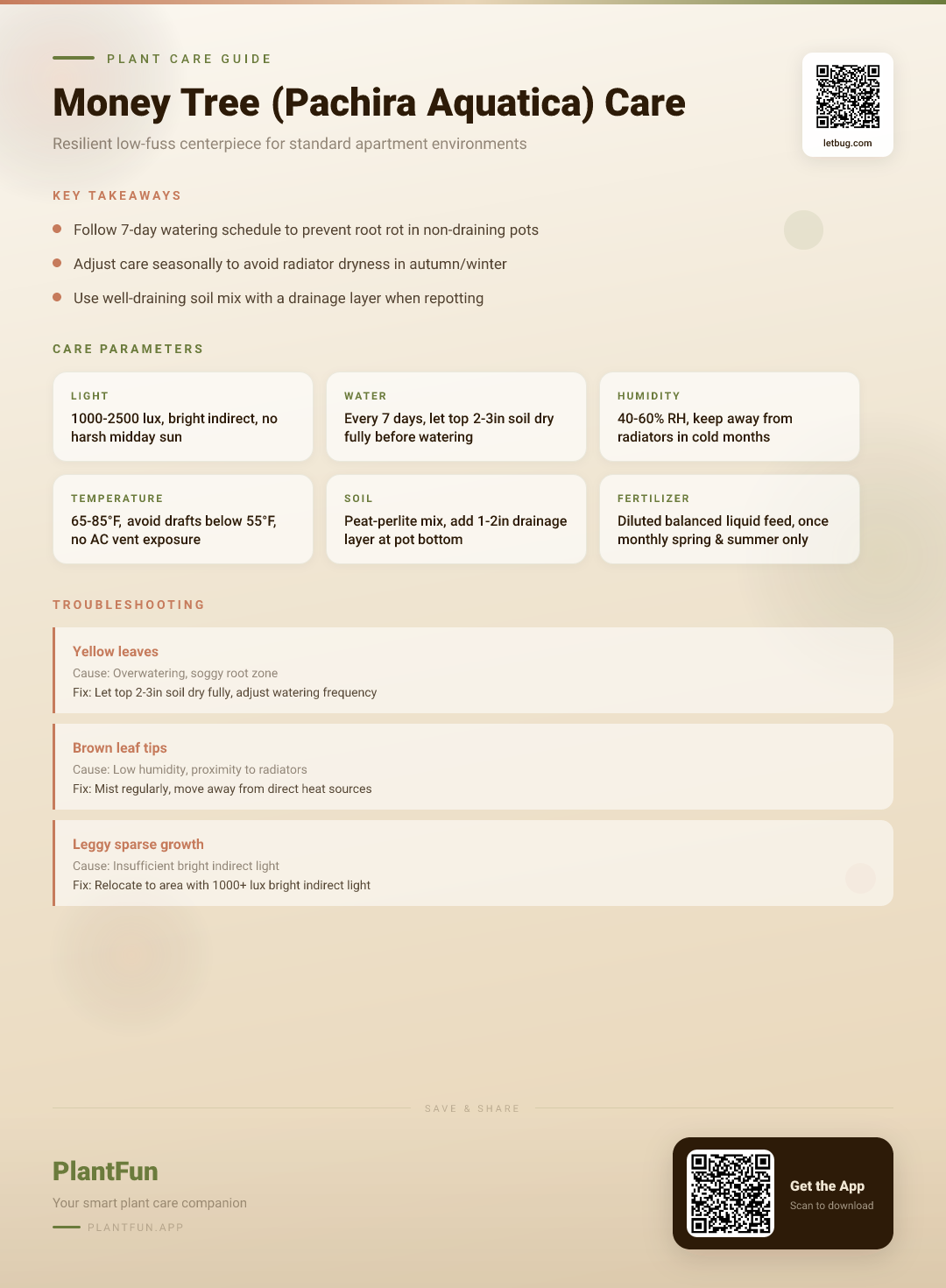
Key Takeaways
- Check soil moisture before watering — overwatering is the #1 killer of houseplants.
- Ensure your plant gets the right amount of light for its species.
- Be patient with recovery — most plants need 2–4 weeks to bounce back.
TL;DR: The Pachira aquatica (Money Tree) is a tropical native that thrives on consistency. To keep yours healthy in an apartment, prioritize bright, indirect light and a “soak and dry” irrigation cycle. Always allow the top 2-3 inches of soil to dry out completely before watering to prevent root rot. Keep away from cold AC drafts and dry heater vents. It is non-toxic to pets, making it an ideal apartment companion (ASPCA, 2026).
Quick Care Card: The Essentials at a Glance
| Feature | Requirement |
|---|---|
| Light | Bright, indirect (500–1,500 foot-candles) |
| Water | When top 2-3 inches of soil are dry |
| Humidity | 50%–70% (Use a pebble tray) |
| Temperature | 65°F–80°F (18°C–27°C) |
| Soil | Well-draining peat or coco-coir mix |
| Fertilizer | Balanced liquid 10-10-10 (monthly in spring/summer) |
| Toxicity | Non-toxic (ASPCA, 2026) |
My Experience: The Apartment Lesson
When I first brought home my first Money Tree, I placed it directly next to a radiator, thinking it wanted the warmth. Within a month, the tips turned crispy and the lower leaves yellowed rapidly. I learned that for a Pachira aquatica in an apartment, proximity to climate control is the enemy. It took moving the plant to a spot with consistent, ambient light—far from the drying effects of my heating unit—to finally see stable growth.
Why the Pachira Aquatica Struggles in Standard Apartment Environments
Money Trees are native to tropical wetlands (NC State Extension, 2026). In an apartment, they often struggle because our living spaces are designed for humans, not humidity-loving plants. Low light in corners and the sudden evaporation caused by central heating create an environment where the plant constantly fights to maintain cellular turgor pressure.
Thresholds for Resilient Growth: Lux, Humidity, and Irrigation Precision
Growth is predicated on light availability. In lower-light apartments, the Money Tree will grow slowly; if it drops below 200 foot-candles, expect leaf drop. For optimal health, aim for at least 500-1,000 foot-candles. Humidity should ideally stay above 50% (NC State Extension, 2026). If your apartment is consistently drier, consider a humidifier.
Spring & Summer: Boosting Growth with Strategic Feeding and Hydration
During active growth, your plant needs energy. I apply a balanced, water-soluble fertilizer at half-strength every 4–6 weeks. During these months, the plant uses more water; check moisture every 5 days. If the soil pulls away from the edges of the pot, it’s a sign the plant is thirsty.
Autumn & Winter: Protecting Your Money Tree from Seasonal Radiator Dryness
Winter care is about stability. As metabolism slows, stop fertilizing. Increase the distance from radiators significantly. If you see the edges of leaves browning, your plant is signaling low ambient moisture. Mist the foliage or use a humidifier to mimic the tropical environment it requires (Falkenstrom, 1995).
Decoding Common Symptoms: Why are my Money Tree leaves turning yellow?
Yellowing Leaves
Symptom: Leaves turn yellow, particularly the lower ones.
Likely cause: Overwatering is the most common culprit, leading to waterlogged roots.
Fix:
- Check for soil dampness at a 3-inch depth.
- Ensure the pot has drainage holes; if not, repot immediately.
How do I know if my Money Tree needs more sunlight in a low-light room?
If the plant exhibits “leggy” growth—long stems with wide gaps between leaves—it is stretching for light. You might also notice smaller leaf development or a lack of new growth over several months.
Can I keep my Money Tree in a room with air conditioning? Understanding cold drafts
While you can keep it in an AC-cooled room, do not place it directly in the path of the vent. Cold, dry air blast causes immediate leaf shock. A position near an east-facing window is usually safe, provided the vent is at least 6 feet away.
The 7-Day Watering Strategy: Preventing Root Rot in Non-Draining Decorative Pots
Never leave your plant in standing water. If you use a decorative cachepot (a pot without holes), lift the inner nursery pot out, water it in your sink until it runs freely, and let it sit for 20 minutes before replacing it. This prevents the anaerobic conditions that cause root rot.
Step-by-Step Repotting: Best Soil Mixes for Apartment Drainage
- Use a mix of 60% high-quality potting soil, 20% perlite, and 20% orchid bark to ensure fast drainage.
- Gently remove the plant from its current pot, keeping the root ball intact.
- Add a layer of fresh mix to the bottom of the new, slightly larger container.
- Place the plant and backfill, pressing gently to remove air pockets.
Common Mistakes to Avoid
- Mistake: Watering on a strict schedule (e.g., “every Monday”).
- What happens: The plant receives water when it doesn’t need it, leading to root suffocation.
- Instead: Water only when the top 3 inches of soil are dry.
- Mistake: Ignoring humidity levels.
- What happens: Dry winter air leads to browning leaf margins.
- Instead: Use a humidity tray or group it with other plants.
References and Botanical Standards
- Falkenstrom, K. (1995). The money tree plant. Rhetoric Review. https://doi.org/10.1080/07350199509359197. Accessed 2026-03-09.
- Day Care and Early Education. (1974). How to grow a money tree. Day Care and Early Education. https://doi.org/10.1007/bf02353449. Accessed 2026-03-09.
- ASPCA. (2026). Toxic and Non-Toxic Plants List — ASPCA. https://www.aspca.org/pet-care/animal-poison-control/toxic-and-non-toxic-plants. Accessed 2026-03-09.
- NC State Extension. (2026). The Complete Money Tree — NC State Extension Gardener Plant Toolbox. https://plants.ces.ncsu.edu/plants/tree-care/. Accessed 2026-03-09.
Optional Helper: Plantfun.App
Plantfun.App identifies your plants by photo, diagnoses pests and diseases with clear fixes, and creates personalised watering and light schedules that adapt to your home conditions — a handy companion for putting this guide into daily practice.
Found an error or have suggestions? We'd love your feedback.
Need help identifying this problem?
Get instant identification, personalized care schedules, and effective pest treatment plans directly on your phone.
Sponsored • We may earn a commission from app downloads
Related Guides
Money Tree Care for Small Apartments: A 5-Step Guide to Resilient Indoor Growth
Revive your Money Tree with our simple 5-step checklist. Get exact lux, watering ml, and apartment-specific tips to ensure resilient growth all year long.
Care GuideMoney Tree Care for Busy Apartments: The Complete Guide to Resilient Indoor Growth
Transform your apartment into a lush sanctuary. Master Money Tree care with expert light, water, and humidity thresholds designed to keep your plant thriving.
Care GuideMoney Tree Care in Small Apartments: The Essential Guide to Resilient Growth
Transform your cramped corner into a lush sanctuary. Master Money Tree care with specific light levels and watering schedules tailored for small apartment living.
Pest ControlAnts on Plants: What They Mean and What to Do
Ants usually aren't eating your plant. They are farming other pests.