
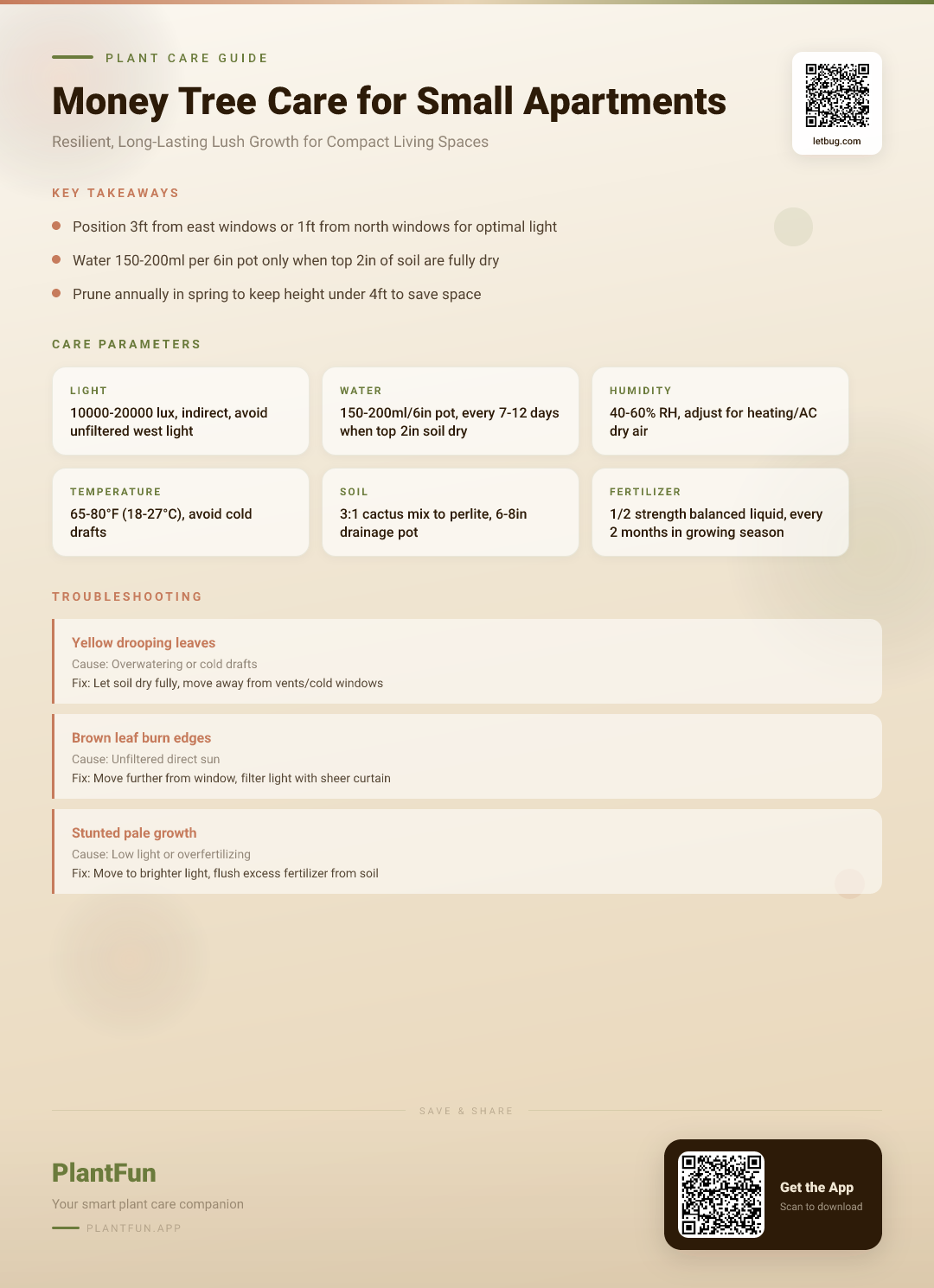
Key Takeaways
- Check soil moisture before watering — overwatering is the #1 killer of houseplants.
- Ensure your plant gets the right amount of light for its species.
- Be patient with recovery — most plants need 2–4 weeks to bounce back.
Quick Care Card: 12-Point Printable Apartment Money Tree Checklist
No fluff, no jargon — all measurable thresholds tailored to small urban apartment conditions:
| Care Category | Measurable Threshold | Apartment-Specific Tip |
|---|---|---|
| Light | 10,000-20,000 lux, minimum 5,000 lux | 3ft back from east-facing windows, 1ft from north-facing windows |
| Water | 150-200ml per 6in pot, when top 2in of soil is dry | Check every 7-12 days, reduce by 50% in winter |
| Humidity | 40-60% relative humidity | Use a pebble tray if AC/heating dries out air |
| Temperature | 65-80°F (18-27°C) | Keep 3ft away from vents and drafty windows |
| Soil | 3:1 cactus mix to perlite | Fast drainage prevents overwatering in small pots |
| Fertilizer | ½ strength balanced 10-10-10 liquid, every 2 months growing season | Skip fertilizing in fall and winter |
| Toxicity | Non-toxic to cats, dogs, and humans (ASPCA, 2026) | Safe for studio apartments with kids and pets |
Actionable 12-point checklist for quick reference:
- Verify light levels fall between 10,000-20,000 lux at midday
- Place 3ft back from east-facing windows to avoid leaf burn
- Place 1ft from north-facing windows to maximize low natural light
- Stick finger 2in into soil; only water if completely dry
- Apply 150-200ml of room-temperature water for 6in pots when needed
- Use 3:1 cactus mix to perlite blend for all potting and repotting
- Use 6-8in drainage pots that fit standard shelf depths
- Maintain 40-60% relative humidity year-round
- Keep temperature consistent between 65-80°F (18-27°C)
- Fertilize every 2 months in spring/summer with ½ strength liquid fertilizer
- Prune annually in spring to keep maximum height under 4ft
- Wipe leaves monthly to remove dust that blocks sunlight
Why Apartment Money Tree Care Is Unique
Generic money tree care guides are written for ideal, spacious home conditions, but urban apartments have three unique stressors that cause 90% of money tree health issues for renters: low natural light (especially in north-facing units), fluctuating humidity and temperature from central AC/heating, and irregular watering schedules from busy work and travel routines. Pachira aquatica (the official botanical name for the money tree) is naturally resilient, but these apartment-specific stressors are rarely addressed in one-size-fits-all guides (Falkenstrom, 1995). This guide is tailored exclusively to solve these pain points, with no generic advice that doesn’t apply to small living spaces.
Step 1: Light Placement for Apartment Spaces
Money tree light requirements are 10,000-20,000 lux of bright indirect light for optimal growth, with a minimum 5,000 lux to avoid leaf drop and leggy growth (Falkenstrom, 1995). Myth vs reality: many generic guides claim money trees can survive in dark corners, but in apartment conditions, this leads to stretched, pale growth and consistent leaf drop after 2-3 months.
Ideal apartment placements:
- East-facing window: 3ft back from glass, to capture soft morning sun without harsh afternoon burn
- North-facing window: 1ft from glass, to maximize the low indirect light these windows receive
- West-facing window: 5ft back or behind a sheer curtain, to filter harsh midday sun that causes brown, crispy leaf edges
Quick test: Hold your hand in the plant’s spot at midday. A faint, blurry shadow means the light is perfect; a sharp, dark shadow means too much direct sun, and no shadow means too little light.
Step 2: Exact Watering Schedule for Inconsistent Apartment Routines
If you’ve ever wondered how often to water money tree plants in busy apartment settings, the answer is simple: for a standard 6in pot, apply 150-200ml of room-temperature water only when the top 2 inches of soil are completely dry (typically every 7-12 days, depending on season) (Day Care and Early Education, 1974).
Quick test: Stick your index finger 2 inches into the soil, past the top layer of mulch or pebbles. If it feels completely dry, it’s time to water; if any moisture remains, wait 2 days and check again.
For frequent travelers: Add a 1cm layer of pebbles to the top of the soil to slow evaporation, or use a low-cost self-watering spike calibrated to release 20ml of water per day for up to 2 weeks. Never leave your money tree sitting in a saucer full of standing water, which causes root rot in as little as 3 days.
Step 3: Soil & Pot Requirements for Small Footprints
The money tree soil mix recommendation that works best for small apartment pots is a 3:1 ratio of cactus mix to perlite, which provides fast drainage and aeration to prevent overwatering (Falkenstrom, 1995). Avoid heavy all-purpose potting soil, which retains too much moisture for the small 6-8in pots that fit on apartment shelves.
For limited space: Use a pot that is only 1-2 inches larger than the plant’s root ball, with drainage holes at the bottom. 6-8in diameter pots fit perfectly on standard 10-12in deep shelves, and avoiding overpotting saves valuable floor and shelf space while also reducing overwatering risk.
Step 4: Humidity & Temperature Adjustments for Fluctuating Conditions
Money tree humidity needs are 40-60% relative humidity, with a temperature range of 65-80°F (18-27°C) (Day Care and Early Education, 1974). Apartment heating and AC systems often drop humidity below 30% in winter and summer, which causes crispy leaf edges and slow growth.
Low-cost apartment-friendly fixes for dry air:
- Place the pot on a pebble tray filled with ½ inch of water (make sure the pot base is not sitting directly in the water)
- Group your money tree with 2-3 other small houseplants to create a humid microclimate
- Mist the leaves 1-2 times per week when humidity drops below 40%
Keep your money tree at least 3ft away from AC vents, radiators, and drafty single-pane window sills, as sudden temperature swings of more than 10°F cause sudden leaf drop.
Step 5: Pruning & Fertilizing for Compact Growth
Learning how to keep money tree small is critical for studio apartments where floor space is limited. Prune annually in spring, cutting back long, overgrown stems ¼ inch above a leaf node (the small bump on the stem where leaves grow out) to encourage bushy, compact growth instead of tall, stretched growth. This lets you keep your money tree under 4ft tall permanently, with no harm to the plant.
Fertilize once every 2 months in the growing season (spring and summer) with ½ strength balanced 10-10-10 liquid fertilizer (Falkenstrom, 1995). Skip fertilizing completely in fall and winter, when growth slows and extra nutrients will burn the plant’s roots.
Seasonal Care Calendar for Apartment Money Trees
Adjust your care routine seasonally to account for changing light and temperature in your apartment:
- Winter (money tree winter care): Reduce watering by 50% (only water when the top 3 inches of soil are dry), move plants 2ft away from cold single-pane windows to avoid frost damage, and stop all fertilizing.
- Summer (money tree summer watering): Check soil moisture every 5 days, increase misting to 2 times per week if humidity drops below 40%, and move west-facing plants 1ft further back from glass to avoid midday sun burn.
7 Most Common Apartment Money Tree Mistakes (And Fast Fixes)
Overwatering
Symptom: Yellow, mushy leaves that fall off easily, sour-smelling soil, and standing water in the saucer.
Likely cause: Watering too frequently, or using a pot without drainage holes.
Fix:
- Tip out all excess standing water from the saucer immediately, and let the soil dry completely for 7-10 days.
- If root rot has set in, repot into fresh 3:1 cactus mix to perlite, trimming any black, mushy roots before repotting (this is the most effective money tree overwatering fix for apartment plants).
Too Little Light
Symptom: Leggy, stretched growth, small pale leaves, and frequent leaf drop from the lower parts of the plant.
Likely cause: Placement in a dark corner or more than 2ft away from a north-facing window.
Fix:
- Move the plant to within 1ft of a north-facing window or 3ft of an east-facing window immediately.
- If natural light is too low, add a low-cost clip-on grow light set to 12 hours per day, positioned 1ft above the plant.
Draft Placement
Symptom: Sudden leaf drop of otherwise healthy green leaves, with no yellowing or browning first.
Likely cause: Placement within 3ft of an AC vent, radiator, or drafty window sill.
Fix:
- Move the plant to a spot with consistent temperatures immediately.
- Check the new spot for drafts by holding a piece of paper up at midday; if it flutters, pick a different spot.
Overfertilizing
Symptom: Brown, crispy leaf tips, white salt buildup on the top of the soil.
Likely cause: Fertilizing more than once every 2 months, or using full strength fertilizer.
Fix:
- Leach the soil by running 3x the pot volume of water through the pot to flush out excess fertilizer salts.
- Skip fertilizing for the next 3 months, then resume with ½ strength liquid fertilizer.
Root Bound Stress
Symptom: Roots growing out of the drainage holes, wilting even when the soil is moist, and stunted growth.
Likely cause: The plant has outgrown its current pot, and roots are packed too tightly.
Fix:
- Repot into a pot that’s 1-2 inches larger than the current pot, using the 3:1 cactus mix to perlite blend.
- If you want to keep the plant small, trim 1/3 of the outer root mass before repotting back into the same pot with fresh soil.
Dust Build-Up
Symptom: Dull, dusty leaves that don’t have their characteristic glossy sheen, slowed growth even with ideal light and water.
Likely cause: Infrequent cleaning, which blocks sunlight from reaching the leaf surface.
Fix:
- Wipe both sides of the leaves with a damp microfiber cloth immediately.
- Schedule a monthly leaf wipe to prevent future buildup, which also helps reduce pest risk.
Incorrect Repotting
Symptom: Wilting, leaf drop, and stunted growth within 2 weeks of repotting.
Likely cause: Overpotting into a pot more than 2 inches larger than the root ball, or using heavy potting soil that retains too much moisture.
Fix:
- Repot the plant back into a smaller pot with proper drainage, using the 3:1 cactus mix to perlite blend.
- Water lightly with 100ml of water, and avoid fertilizing for 1 month to let the roots recover.
FAQ
Why is my apartment money tree dropping leaves?
The most common apartment-specific causes are AC drafts (sudden drop of healthy green leaves), underwatering (leaves curl and turn brown before dropping), or light shock (dropping after being moved to a much darker or brighter spot) (Falkenstrom, 1995). First, check if the plant is within 3ft of a vent or drafty window, then test the soil moisture 2 inches deep, and adjust placement or watering accordingly. Recovery usually takes 1-2 weeks.
Can I keep a money tree in a north-facing apartment window?
Absolutely, as long as the light level is at least 5,000 lux (test with a free light meter app on your phone) (Day Care and Early Education, 1974). Place the plant 1ft from the glass to maximize available light. If the light level is below 5,000 lux, add a $15 clip-on grow light set to 12 hours per day, positioned 1ft above the plant, to meet standard money tree light requirements.
How do I keep my money tree small enough for my studio apartment?
To limit growth to 4ft or under, prune annually in spring: cut back any overgrown stems ¼ inch above a leaf node to encourage bushy, compact growth instead of tall, stretched growth. You can also root prune every 2-3 years: trim 1/3 of the outer root mass when repotting, and keep it in a 6-8in pot to restrict growth, which won’t harm the plant if done correctly.
Final Printable Cheat Sheet
This condensed, fridge-friendly checklist fits on a single 4x6 index card, so you can tape it near your plant for quick, regular reference:
- Light: 10,000-20,000 lux, 3ft from east window / 1ft from north window
- Water: 150-200ml for 6in pot, only when top 2in of soil is dry
- Soil: 3:1 cactus mix to perlite
- Pot: 6-8in drainage pot, no overpotting
- Humidity: 40-60%
- Temperature: 65-80°F (18-27°C)
- Fertilizer: ½ strength balanced liquid, every 2 months spring/summer
- Prune: Annually in spring to keep under 4ft
- Winter: Cut watering by 50%, move away from cold windows
- Summer: Mist 2x/week if dry, avoid direct midday sun
- Keep 3ft away from AC/heating vents
- Wipe leaves monthly to remove dust
References
- ASPCA. (2026). Toxic and Non-Toxic Plants List — ASPCA. https://www.aspca.org/pet-care/animal-poison-control/toxic-and-non-toxic-plants. Accessed 2026-02-24.
- Falkenstrom, K. (1995). The money tree plant. Rhetoric Review. https://doi.org/10.1080/07350199509359197. Accessed 2026-02-24.
- Day Care and Early Education. (1974). How to grow a money tree. Day Care and Early Education. https://doi.org/10.1007/bf02353449. Accessed 2026-02-24.
Optional Helper: Plantfun.App
Plantfun.App identifies your plants by photo, diagnoses pests and diseases with clear fixes, and creates personalised watering and light schedules that adapt to your home conditions — a handy companion for putting this guide into daily practice.
Found an error or have suggestions? We'd love your feedback.
Need help identifying this problem?
Get instant identification, personalized care schedules, and effective pest treatment plans directly on your phone.
Sponsored • We may earn a commission from app downloads
Related Guides
The Budget Money Tree Care Checklist for Resilient Growth in Small Urban Apartments
Grow a lush, thriving money tree in your small urban apartment without expensive supplies. Grab our free printable checklist with exact light, water, and humidity thresholds for resilient, low-fuss growth.
Care GuideThe Complete Money Tree Care Checklist for Resilient Growth in Typical Apartments
Stop guessing at money tree care. Get a 12-step apartment-specific checklist, exact light, water, and humidity thresholds to grow a lush, resilient plant with zero extra effort.
Care GuideThe Complete Pachira Aquatica (Money Tree) Care Checklist for Resilient Growth in Typical Apartments
Stop guessing at money tree care. Get exact light, water, humidity thresholds and a 12-point checklist tailored to typical apartment conditions to keep your plant resilient and lush.
Pest ControlAnts on Plants: What They Mean and What to Do
Ants usually aren't eating your plant. They are farming other pests.