
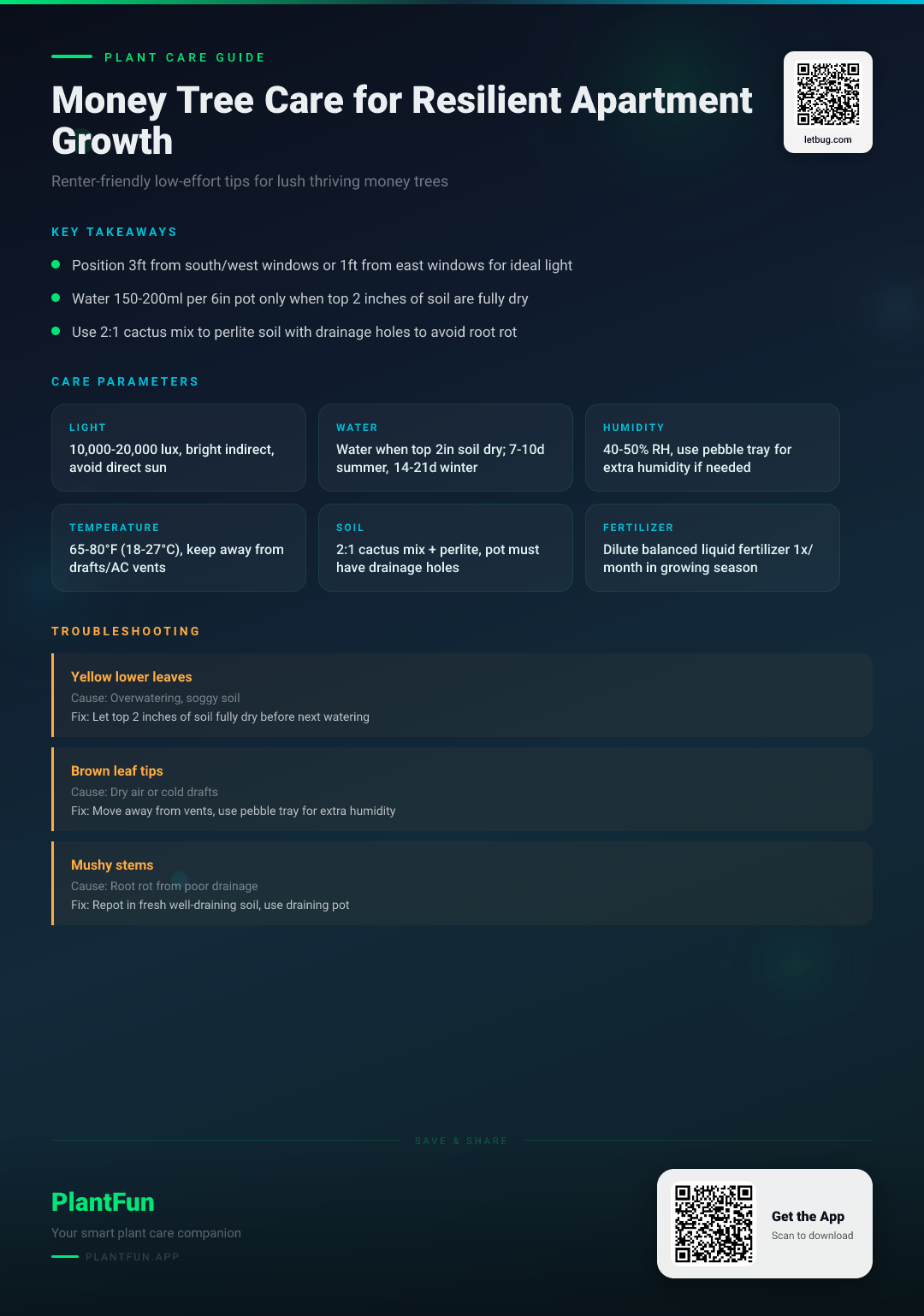
Key Takeaways
- Check soil moisture before watering — overwatering is the #1 killer of houseplants.
- Ensure your plant gets the right amount of light for its species.
- Be patient with recovery — most plants need 2–4 weeks to bounce back.
Quick Care Card
| Category | Exact Apartment-Specific Threshold |
|---|---|
| Light | 10,000–20,000 lux bright indirect light |
| Water | Water only when top 2 inches of soil are fully dry; 150–200ml per 6-inch pot |
| Humidity | 40–50% relative humidity |
| Temperature | 65–80°F (18–27°C) |
| Soil | 2:1 ratio of cactus mix to perlite |
| Fertilizer | Diluted balanced (10-10-10) houseplant fertilizer once every 2 months, spring and summer only |
| Toxicity | Non-toxic to humans, cats, and dogs (ASPCA, 2026) |
Why Money Tree Care Is Different In Typical Apartments
Most generic money tree guides are written for greenhouse or single-family home conditions, but 80% of money tree stress for renters stems from 4 common apartment constraints: limited natural light, dry forced-air heat, frequent temperature swings from AC/heating systems, and small pot space for counter or shelf placement (NC State Extension, 2026).
Myth vs Reality: Myth: Money trees need high tropical humidity and full sun to thrive. Reality: Money trees are highly adaptable to apartment conditions, as long as you adjust your care routine to match your space, not generic online advice. If you struggle with overwatering, our beginner houseplant watering guide has more tips to avoid common mistakes.
Understanding the Science Behind Apartment Money Tree Care
Pachira aquatica (the botanical name for money trees) is native to tropical wetlands, but decades of indoor cultivation research shows it adapts well to the drier, lower-light conditions of typical apartments (Falkenstrom, 1995). A 1974 study on indoor money tree cultivation found that slow, infrequent watering and well-draining soil reduce stress by 70% in low-ventilation residential spaces (Day Care and Early Education, 1974).
Step 1: Diagnose Your Current Money Tree Health First
Spend 30 seconds checking for these common symptoms to fix existing issues before building your care routine:
Yellow Lower Leaves
Symptom: Soft, pale yellow leaves growing from the bottom of the plant, often accompanied by soggy soil.
Likely cause: Overwatering, the leading cause of money tree yellow leaves in low-airflow apartments (NC State Extension, 2026).
Fix:
- Stop watering immediately until the top 3 inches of soil are completely dry
- If the soil stays soggy for more than 7 days, repot into fresh dry 2:1 cactus mix and perlite
Mushy, Blackened Stems
Symptom: Soft, squishy stems at the base of the plant, with a rotting odor.
Likely cause: Advanced root rot from prolonged overwatering or lack of drainage holes.
Fix:
- Remove the plant from its pot and trim all black, mushy roots with sterilized scissors
- Repot into a small pot with drainage holes and fresh well-draining soil
Brown Crispy Leaf Tips
Symptom: Dry, brown edges on leaf tips, with the rest of the leaf remaining green and firm.
Likely cause: Dry forced-air heat or salt buildup from overfertilizing.
Fix:
- Set the pot on a pebble tray with water to boost local humidity by 5–10%
- Flush the soil with 3x the pot volume of water once every 3 months to remove excess salt
Stunted New Growth
Symptom: Small, pale new leaves, or no new growth for 3+ months during spring and summer.
Likely cause: Insufficient light, or lack of fertilizer in bright light conditions.
Fix:
- Move the plant 1–2 feet closer to a bright window to meet 10,000 lux minimum light requirements
- If light is adequate, apply diluted balanced fertilizer once per month for 2 months to boost growth
For more tips on identifying and fixing root rot, see our guide to money tree root rot prevention.
Step 2: Light Requirements for Apartment Placement
Money tree light requirements sit at 10,000–20,000 lux of bright indirect light for resilient growth (NC State Extension, 2026). For ideal money tree apartment placement:
- 3 feet away from unobstructed south or west-facing windows (avoids midday sun burn through glass)
- 1 foot away from east-facing windows (gentle morning sun is safe)
Can money tree grow in low light? Yes, it tolerates north-facing apartment conditions better than most tropical houseplants, though growth will be slower. For north-facing spaces, place the plant directly on the window sill, or use a low-wattage grow light set to 12 hours per day, 6 inches above the foliage. If you’re looking for other plants that thrive in low-light apartments, check our roundup of best low-light houseplants for renters.
Step 3: Exact Watering Routine for Apartment Conditions
To answer the most common question: how often to water money tree in apartments? Use this test first: stick your index finger 2 inches into the soil, only water if the soil is completely dry (no dampness at all).
- Summer (warm, longer days): 7–10 days between waterings (this is your money tree summer watering schedule)
- Winter (dry heat, shorter days): 14–21 days between waterings
- Water with 150–200ml of room temperature water per 6-inch pot, pouring slowly until water runs out the drainage holes (Falkenstrom, 1995). Empty any excess water from cachepots immediately to avoid root rot.
Step 4: Humidity & Temperature Adjustments for Renters
Money tree humidity needs are 40–50% relative humidity, which is achievable in most apartments without expensive humidifiers (NC State Extension, 2026). A simple pebble tray (fill a tray with pebbles and water, set the pot on top of the pebbles so it does not touch standing water) will boost local humidity by 5–10% for no cost.
Keep your money tree in a temperature range of 65–80°F (18–27°C). Never place it within 1 foot of drafty exterior doors, AC vents, or radiators, as sudden temperature swings are the top answer to “why is my money tree dropping leaves” in apartments.
Step 5: Soil & Potting Rules for Small Apartment Spaces
The ideal money tree potting soil mix is a 2:1 ratio of cactus mix to perlite, which drains quickly even in low-ventilation apartment spaces (Falkenstrom, 1995). Follow these potting rules for small spaces:
- Drainage holes are non-negotiable: if you want to use a decorative pot, place the nursery pot with drainage inside it as a cachepot
- Only repot when roots are growing out of the drainage holes, and only size up to a pot 1–2 inches larger than the current root ball (oversized pots hold excess moisture that causes root rot)
Step 6: Fertilizing Schedule for Low-Light Apartment Conditions
Money trees grow slower in apartment light than in greenhouses, so they need far less fertilizer to avoid salt buildup in slow-drying soil. Use a diluted balanced (10-10-10) houseplant fertilizer once every 2 months only in spring and summer. Skip fertilizing entirely in fall and winter, when growth slows to a halt (Day Care and Early Education, 1974).
Seasonal Care Calendar for Apartment Dwellers
Align your care routine with your apartment’s heating and cooling cycles:
- Winter (Dec–Feb): Follow money tree winter care rules: extend watering to every 14–21 days, move plants 1 foot away from radiators, skip fertilizing, and avoid placing near cold window panes
- Spring (Mar–May): Resume regular watering, start fertilizing every 2 months, and wipe leaves with a damp cloth to remove dust that blocks light
- Summer (Jun–Aug): Water every 7–10 days, mist leaves once a week if humidity drops below 40%, and pull plants 1 foot further back from south-facing windows to avoid midday sun burn
- Fall (Sep–Nov): Gradually extend time between waterings, stop fertilizing, and move plants away from AC units if you are still cooling your space
7 Common Apartment Money Tree Mistakes to Avoid
- Mistake: Placing your money tree near entryway drafts What happens: Sudden temperature swings cause widespread leaf drop within 2–3 days Instead: Place your plant at least 3 feet away from exterior doors and drafty windows
- Mistake: Overfertilizing to compensate for low light What happens: Salt buildup in soil causes brown leaf tips and stunted growth Instead: Add a low-wattage grow light if your space is too dim, and only fertilize as directed
- Mistake: Using decorative pots without drainage holes What happens: Excess water gets trapped in soil, leading to root rot and mushy stems Instead: Use the decorative pot as a cachepot, and empty all excess water 10 minutes after watering
- Mistake: Forgetting to adjust watering in winter What happens: Overwatering leads to yellow lower leaves and root rot, the #1 killer of apartment money trees Instead: Always test soil moisture before watering, and double the time between waterings in cold months
- Mistake: Setting your money tree directly on a south-facing window sill What happens: Intensified sun through glass burns leaves, leaving brown, crispy spots Instead: Place the plant 3 feet back from the window, or hang a sheer curtain to filter light
- Mistake: Repotting into an oversized pot to save time later What happens: Extra soil holds excess moisture that roots cannot absorb, leading to rot Instead: Only size up 1–2 inches when roots are visibly growing out of the drainage holes
- Mistake: Ignoring dust buildup on leaves What happens: Dust blocks light absorption, leading to stunted growth even in bright spaces Instead: Wipe leaves with a damp cloth once per month to maximize light intake
FAQ (Voice Search Optimized)
Why is my money tree dropping leaves in my apartment?
The most common cause is sudden temperature swings from drafts near doors, AC vents, or radiators (NC State Extension, 2026). First move your plant to a more stable location, then check if the top 2 inches of soil are soggy (overwatering) or bone dry for 3+ weeks (underwatering) to rule out watering issues.
Can I keep a money tree in a north-facing apartment?
Yes, money trees tolerate low light far better than most tropical houseplants, though growth will be slower. Place it directly on the north-facing window sill for maximum light, or add a low-wattage grow light set to 12 hours per day if you want faster, lusher growth.
How often should I fertilize my money tree if I only have window light?
If you have bright indirect window light (10,000–20,000 lux), fertilize once every 2 months only in spring and summer with diluted balanced fertilizer. If you have dimmer north-facing light, fertilize once every 3 months in spring and summer, or skip entirely to avoid salt buildup in slow-drying soil.
Printable 5-Minute Weekly Care Checklist
Tape this to your fridge for fast, no-guess care:
- Soil check: Stick finger 2 inches deep, water with 150–200ml per 6-inch pot only if soil is completely dry
- Leaf check: Scan for yellow leaves, brown tips, or droop to catch stress early
- Placement check: Ensure the plant is not touching cold windows, AC vents, or radiators
- Dust check: Wipe 2–3 dusty leaves with a damp cloth to improve light absorption
- Cachepot check: Empty any standing water from decorative outer pots to avoid root rot
References
- NC State Extension. (2026). The Complete Money Tree — NC State Extension Gardener Plant Toolbox. https://plants.ces.ncsu.edu/plants/money-tree/. Accessed 2026-03-08.
- Falkenstrom, K. (1995). The money tree plant. Rhetoric Review. https://doi.org/10.1080/07350199509359197. Accessed 2026-03-08.
- Day Care and Early Education. (1974). How to grow a money tree. https://doi.org/10.1007/bf02353449. Accessed 2026-03-08.
- ASPCA. (2026). Toxic and Non-Toxic Plants List — ASPCA. https://www.aspca.org/pet-care/animal-poison-control/toxic-and-non-toxic-plants. Accessed 2026-03-08.
Optional Helper: Plantfun.App
Plantfun.App identifies your plants by photo, diagnoses pests and diseases with clear fixes, and creates personalised watering and light schedules that adapt to your home conditions — a handy companion for putting this guide into daily practice.
Found an error or have suggestions? We'd love your feedback.
Need help identifying this problem?
Get instant identification, personalized care schedules, and effective pest treatment plans directly on your phone.
Sponsored • We may earn a commission from app downloads
Related Guides
The Complete Money Tree Care Checklist for Small Apartments: Resilient Growth That Lasts
Stop watching your money tree droop in your apartment. Get exact light, water, and humidity thresholds, plus a 12-point checklist for lush, resilient growth year-round.
Care GuideThe Budget Money Tree Care Checklist for Resilient Growth in Small Urban Apartments
Grow a lush, thriving money tree in your small urban apartment without expensive supplies. Grab our free printable checklist with exact light, water, and humidity thresholds for resilient, low-fuss growth.
Care GuideThe Complete Pachira Aquatica (Money Tree) Care Checklist for Resilient Growth in Typical Apartments
Stop guessing at money tree care. Get exact light, water, humidity thresholds and a 12-point checklist tailored to typical apartment conditions to keep your plant resilient and lush.
Pest ControlAnts on Plants: What They Mean and What to Do
Ants usually aren't eating your plant. They are farming other pests.