
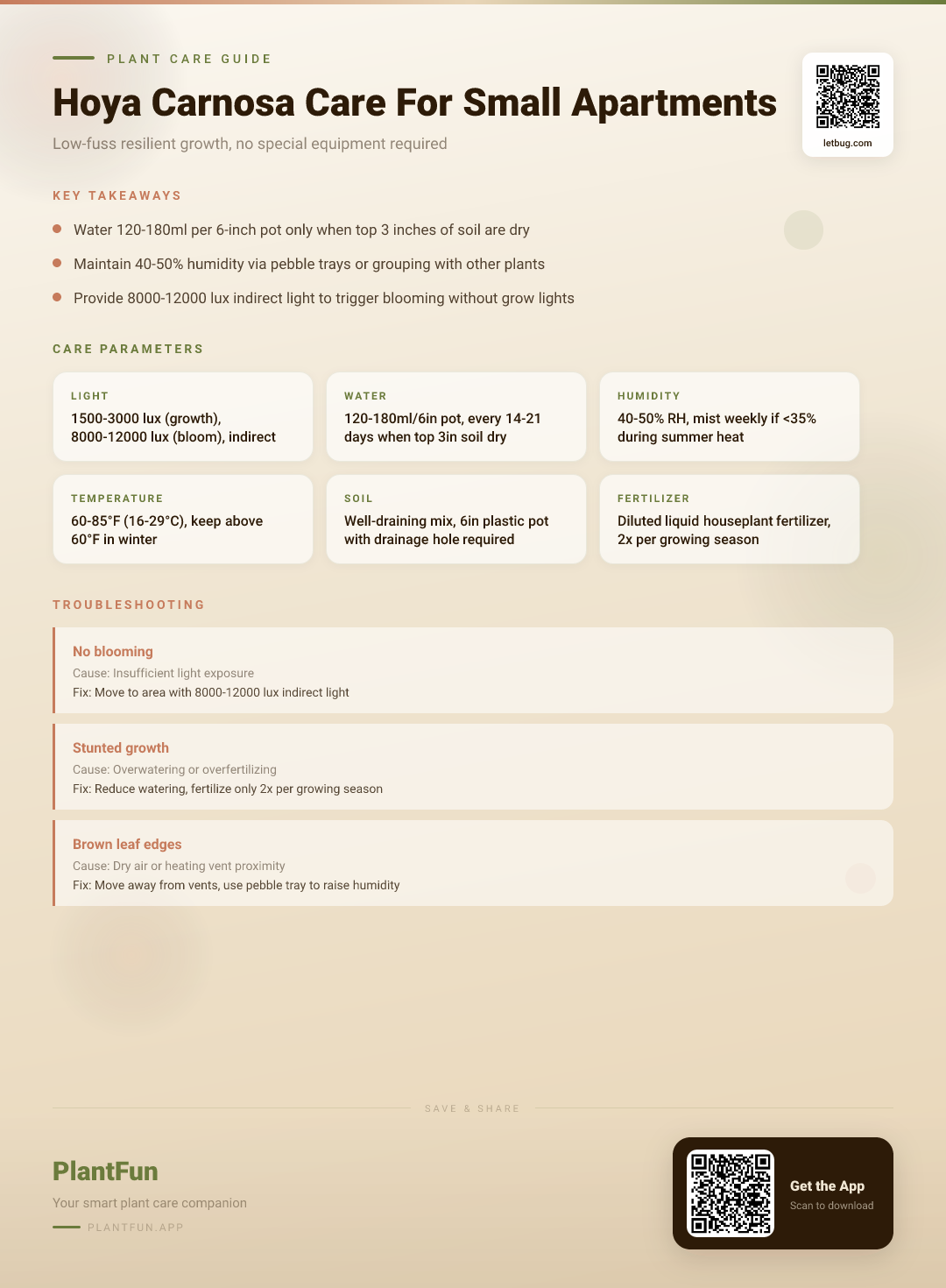
Key Takeaways
- Check soil moisture before watering — overwatering is the #1 killer of houseplants.
- Ensure your plant gets the right amount of light for its species.
- Be patient with recovery — most plants need 2–4 weeks to bounce back.
Quick Care Card: At-a-glance 1-minute reference with all measurable care thresholds for Hoya carnosa in small apartments
| Care Category | Exact Apartment-Specific Thresholds |
|---|---|
| Light | 1500-3000 lux for slow steady growth; 8000-12000 lux for blooming (no direct midday sun) |
| Water | 120-180ml per 6-inch pot when top 3 inches of soil are dry (14-21 days growing season, 28-35 days winter) |
| Humidity | 40-50% relative humidity (RH) |
| Temperature | 60-85°F (16-29°C), avoid drafts |
| Soil | 2 parts standard potting mix + 1 part perlite |
| Fertilizer | Diluted all-purpose liquid fertilizer (1/4 recommended strength) 2x per growing season only |
| Toxicity | Non-toxic to cats, dogs, and humans (ASPCA, 2026) |
Why This Guide Is Different
Generic Hoya carnosa care advice often calls for 6+ hours of direct sun, 60%+ humidity, and monthly fertilizing — requirements that are nearly impossible to meet in most small apartments, where renters deal with limited window access, dry forced air, and irregular care routines. This guide cuts through that generic advice to deliver zero-cost, renter-friendly tips backed by horticultural research, with no fancy humidifiers or grow lights required unless you choose to use them.
Myth vs Reality: Many guides claim Hoyas need bright direct sun to thrive, but Hoya carnosa is a CAM (crassulacean acid metabolism) plant, meaning it photosynthesizes extremely efficiently in low light to conserve water (Singh et al, 1984). This makes it perfectly adapted to typical apartment conditions with the right small tweaks. If you’re new to houseplants, this Hoya care for beginners guide is designed to work even if you can’t control your building’s heating or window placement.
Step 1: Light Placement Hack for Limited Windows
Hoya carnosa light requirements vary based on your growth goals: 1500-3000 lux supports slow, resilient growth, while 8000-12000 lux of soft indirect light is needed to trigger seasonal blooms (NC State Extension, 2026). You don’t need a lux meter to test your space: if you can read a book comfortably in the spot midday without a lamp, that’s ~1500 lux; if you cast a soft, diffused shadow, that’s ~8000 lux.
For north-facing units where light is extra limited, use this no-grow-light swap: hang a cheap tension rod across your north window and mount your Hoya in a macrame hanger 6 inches from the window pane. This positions it to capture the maximum amount of consistent ambient light, supporting healthy growth even for Hoya in north-facing apartment setups. For more low light plant picks, check out our list of the best low light houseplants for small apartments.
Step 2: Exact Watering Schedule for Irregular Routines
If you’re wondering how often to water Hoya carnosa, the rule is simple: only water when the top 3 inches of soil are completely dry. For most apartment environments, this works out to every 14-21 days in the spring and summer growing season, and every 28-35 days in winter (Kuang et al, 2025). When you water, use exactly 120-180ml (roughly half a cup) of room temperature water per 6-inch pot, pouring directly on the soil to avoid wetting the leaves.
Quick test: Stick your index finger all the way into the soil. If the tip of your finger is completely dry, it’s time to water. If it’s even slightly damp, wait another 3-5 days and check again. Overwatering is the #1 killer of houseplants, so if you struggle to get this right, check our guide to identifying and fixing overwatered plants.
Step 3: Budget Humidity Fixes That Work
Hoya humidity needs sit at 40-50% RH, which is slightly higher than the 30-40% RH common in apartments with forced air heating or cooling (NC State Extension, 2026). You don’t need an expensive humidifier to hit this threshold, though — use one of these zero-cost swaps:
- Pebble tray trick: Fill a shallow tray with pebbles and water, then set your Hoya pot on top of the pebbles (make sure the drainage hole is not sitting directly in the water). This adds 5-10% local humidity as the water evaporates, for free.
- Group with other plants: Clustering your Hoya with pothos, snake plants, or ZZ plants creates a small microclimate with elevated humidity, as all plants release moisture through their leaves.
Step 4: Soil & Potting for Renters
You don’t need specialty Hoya soil or expensive decorative pots to keep your plant healthy. Use this cheap, well-draining soil mix recipe: 2 parts standard, low-cost potting mix + 1 part perlite (a $3 bag of perlite will last for 10+ potted plants).
A drainage hole is non-negotiable to avoid root rot (Kuang et al, 2025), but you don’t need to drill holes in fancy ceramic pots if your rental lease prohibits modifications. Simply keep your Hoya in a cheap 6-inch plastic nursery pot, and slip it inside a decorative cover pot when guests come over. Just make sure to empty any excess water that collects in the bottom of the cover pot after watering. For more cheap soil recipes, check our DIY potting mix guide for renters.
Step 5: Low-Cost Fertilizing Routine
You don’t need expensive specialty Hoya fertilizer to support growth. Use any cheap liquid all-purpose houseplant fertilizer, diluted to 1/4 the strength recommended on the bottle, and apply only 2 times per growing season: once in early spring when new growth starts, and once in mid-summer. That’s it — no monthly fertilizing required, which is perfect for owners with inconsistent schedules. This is one of our top budget Hoya care tips that cuts down on both cost and effort.
Seasonal Care Calendar (12 Months)
Adjust your routine throughout the year to match your apartment’s changing conditions:
- Spring (March-May): Follow the standard 14-21 day Hoya carnosa watering schedule, apply your first fertilizer dose, and move your Hoya within 1 foot of your brightest window to capture longer daylight hours.
- Summer (June-August): Water every 14 days, mist the leaves once weekly if humidity drops below 35%, and keep your Hoya at least 3 feet away from AC vents to avoid cold drafts.
- Fall (September-November): Gradually reduce watering to every 21-28 days, and hold off on fertilizer as growth slows.
- Winter (December-February): For Hoya carnosa winter care, reduce water volume by 50% and only water when the top 4 inches of soil are dry (roughly every 28-35 days). Keep temperatures above 60°F / 16°C, and keep your Hoya at least 3 feet away from heating vents to avoid dry air damage (NC State Extension, 2026).
Common Apartment-Specific Mistakes to Avoid
- Mistake: Placing your Hoya within 2 feet of heating or AC vents. What happens: Dry forced air drops local humidity below 30% and causes sudden leaf drop. Instead: Place at least 3 feet away from vents, or use a pebble tray if you can’t move the plant to a different spot.
- Mistake: Overfertilizing more than 2x per year. What happens: Salt buildup in the soil burns the roots and stops growth, which is the most common answer to why is my Hoya not growing. Instead: Only fertilize twice a year at 1/4 strength, and flush the soil with plain water once a year to remove excess salt.
- Mistake: Repotting more than once every 3 years. What happens: Hoyas prefer being root bound, and repotting too soon shocks the plant and prevents it from blooming. Instead: Only repot when roots are visibly growing out of the drainage hole, and go up just one pot size (e.g., from a 6-inch to 8-inch pot).
- Mistake: Watering on a fixed schedule instead of checking soil moisture. What happens: Overwatering causes root rot, the #1 killer of Hoyas in apartments. Instead: Use the finger test every 2 weeks, and only water when the top 3 inches of soil are completely dry.
- Mistake: Pruning off old flower spurs after blooms fade. What happens: Hoyas bloom on the same spurs every year, so pruning them means you won’t get new blooms for 1-2 years. Instead: Leave spurs intact after flowers die back to get repeat blooms every season.
Voice Search FAQ 1: Can I keep my Hoya carnosa in a north-facing apartment window?
Yes! North-facing windows get consistent, soft ambient light between 1500-4000 lux, which is perfect for steady Hoya low light care. If you want to trigger blooms, place your Hoya within 6 inches of the window pane to get closer to the 8000 lux threshold, no grow light required (NC State Extension, 2026).
Voice Search FAQ 2: Why is my Hoya not growing even though I water it every week?
Overwatering is the #1 cause of stunted growth in Hoyas. Watering every week keeps the soil constantly wet, which rots the roots and stops the plant from absorbing water and nutrients. To fix it, stop watering immediately, let the soil dry completely, and only water when the top 3 inches of soil are dry going forward. If you see mushy brown roots, trim them off and repot in fresh, dry soil.
Voice Search FAQ 3: How do I get my apartment Hoya to bloom without grow lights?
First, make sure it’s getting 8000-12000 lux of soft indirect light (usually within 1 foot of an east or west window, or 6 inches of a bright north window). Second, keep it root bound — don’t repot unless roots are growing out of the drainage hole. Third, avoid moving it around once you find a spot it likes, as Hoyas are sensitive to sudden changes in light. It can take 2-3 years for a young Hoya to mature enough to bloom, so be patient. For more tips, check our guide to getting houseplants to bloom without fancy gear.
References
- NC State Extension. (2026). The Complete Hoya Carnosa — NC State Extension Gardener Plant Toolbox. https://plants.ces.ncsu.edu/plants/hoya-carnosa/. Accessed 2026-03-03.
- Kuang, Y.; Ouyang, K.; Xia, M. (2025). Near-complete reference genome assembly of Hoya carnosa. Scientific Data. https://doi.org/10.1038/s41597-025-05587-4. Accessed 2026-03-03.
- Singh, B.; Greenberg, E.; Preiss, J. (1984). ADPglucose Pyrophosphorylase from the CAM Plants <i>Hoya carnosa</i> and <i>Xerosicyos danguyi</i>. Plant Physiology. https://doi.org/10.1104/pp.74.3.711. Accessed 2026-03-03.
- ASPCA. (2026). Toxic and Non-Toxic Plants List — ASPCA. https://www.aspca.org/pet-care/animal-poison-control/toxic-and-non-toxic-plants. Accessed 2026-03-03.
Optional Helper: Plantfun.App
Plantfun.App identifies your plants by photo, diagnoses pests and diseases with clear fixes, and creates personalised watering and light schedules that adapt to your home conditions — a handy companion for putting this guide into daily practice.
Found an error or have suggestions? We'd love your feedback.
Need help identifying this problem?
Get instant identification, personalized care schedules, and effective pest treatment plans directly on your phone.
Sponsored • We may earn a commission from app downloads
Related Guides
Hoya Carnosa Care Checklist for Typical Apartments: Fix Mistakes For Resilient, Blooming Growth
Stop guessing at Hoya care for your apartment. Get exact light, water, and humidity thresholds, plus 7 common mistake fixes to grow resilient, blooming Hoya carnosa year-round.
Care GuideHoya Carnosa in East-Facing Apartments: The Complete Seasonal Care Checklist for Resilient Growth
Grow a lush, blooming Hoya carnosa in your east-facing apartment with our seasonal care checklist, exact light lux levels, watering schedules, and mistake-free resilient growth tips.
Care GuideThe Complete Hoya Carnosa Care Checklist for Resilient Growth in Typical Urban Apartments
Stop guessing at Hoya care. Get a 12-point actionable checklist, exact light, water, and humidity thresholds to grow resilient, blooming Hoya carnosa in your typical urban apartment.
Pest ControlAnts on Plants: What They Mean and What to Do
Ants usually aren't eating your plant. They are farming other pests.