
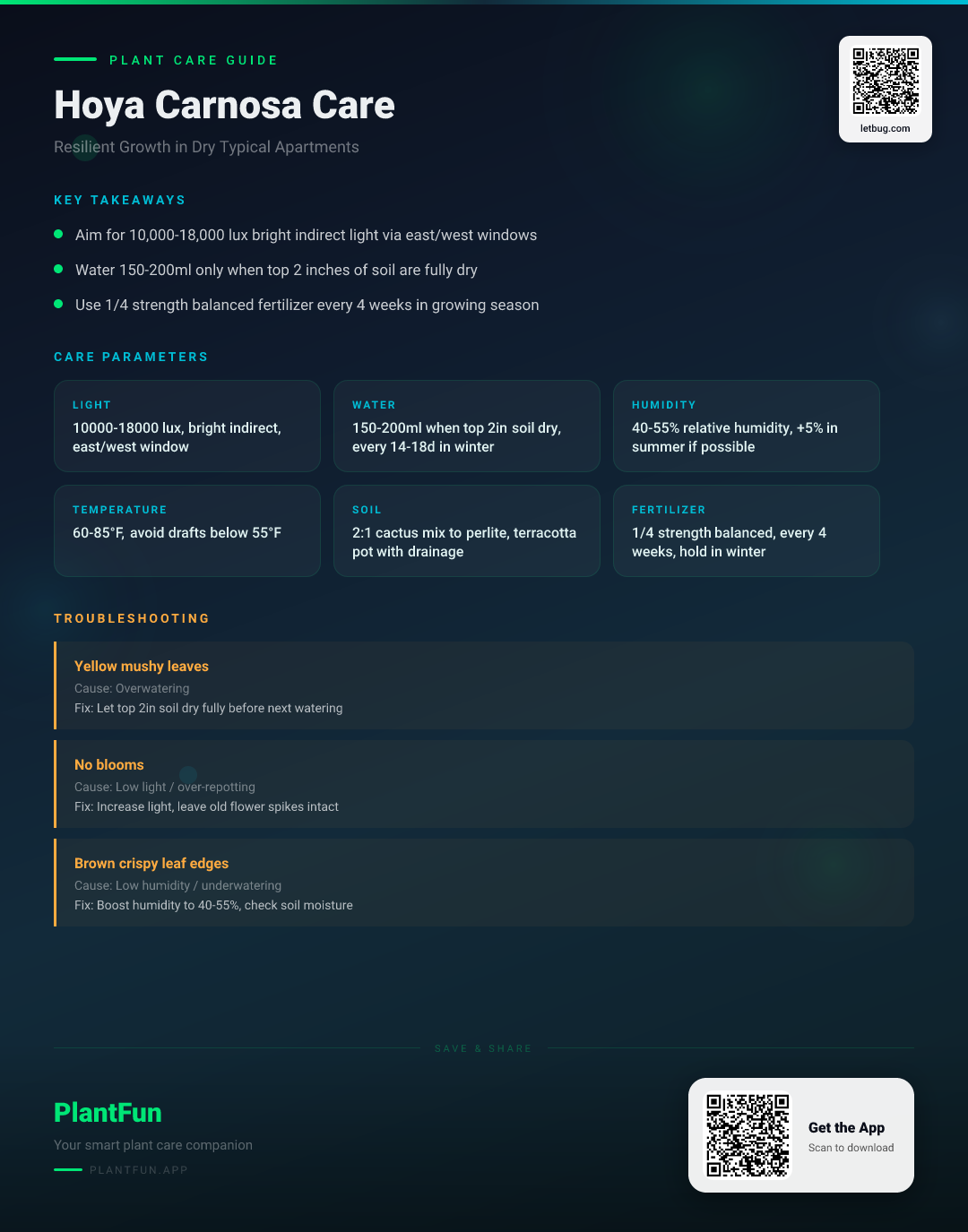
Key Takeaways
- Check soil moisture before watering — overwatering is the #1 killer of houseplants.
- Ensure your plant gets the right amount of light for its species.
- Be patient with recovery — most plants need 2–4 weeks to bounce back.
Quick Care Card
| Category | Measurable Requirement |
|---|---|
| Light | 10,000-18,000 lux bright indirect light, 2-3 hours of gentle morning sun allowed |
| Water | 150-200ml per 6-inch pot when top 2 inches of soil are completely dry |
| Humidity | 40-60% relative humidity (RH) |
| Temperature | 60-85°F (15-29°C), never below 50°F (10°C) |
| Soil | 3 parts fine orchid bark, 1 part perlite, 1 part peat moss |
| Fertilizer | Diluted 10-30-10 orchid fertilizer every 4 weeks in spring and summer |
| Toxicity | Non-toxic to cats, dogs, and humans (ASPCA, 2026) |
Why This Guide Is Built for Typical Apartments
Generic Hoya care guides often assume ideal greenhouse conditions, ignoring the unique constraints of standard urban apartments: 30-40% RH from winter heating, limited window space, irregular watering schedules from busy renters, and frequent temperature fluctuations from HVAC systems. This guide is tailored explicitly to these pain points, with no fancy equipment required to grow a thriving Hoya.
Myth: Hoya carnosa requires high tropical humidity and constant care to thrive. Reality: As a CAM plant adapted to dry, variable forest canopy conditions (Singh et al, 1984), Hoya carnosa is one of the most forgiving houseplants for busy apartment renters. If you struggle with remembering plant care tasks, check out our low-effort watering schedule for renters to simplify your routine.
Diagnosis First: How to Spot a Thriving vs. Stressed Hoya Carnosa
Catch issues early before they harm your plant by checking for these visual cues:
Thriving Hoya Cues
- Thick, waxy, deep green leaves that feel firm when pressed
- Pale green new vine growth in spring and summer
- Small woody peduncles (bloom stalks) forming on mature 3+ year old plants
- No unexpected leaf drop
Stressed Hoya Cues
- Wrinkled, soft leaves (first sign of water stress)
- Yellowing lower leaves or mushy stems
- Brown crispy leaf tips
- No new growth for 6+ months during growing season
Quick test: Press your finger into the middle of a mature leaf. A thriving Hoya will feel rigid, while a stressed Hoya will feel soft or squishy.
12-Point Step-by-Step Care Checklist for Resilient Growth
Follow these actionable, measurable steps for consistent Hoya carnosa care:
- Place your Hoya 1-3 feet from an east-facing window to get 10,000-18,000 lux of bright indirect light (NC State Extension, 2026)
- Use a free smartphone light meter app to confirm light levels stay within the 10,000-18,000 lux range, avoiding levels over 20,000 lux which cause leaf burn
- Stick your index finger 2 inches deep into the soil before watering: only water if the soil is completely dry
- Pour 150-200ml of room temperature water per 6-inch pot, directly onto the soil to avoid wetting leaves
- Maintain relative humidity between 40-60% using a $10 hygrometer to track levels (Hoya carnosa humidity level)
- Keep temperatures between 60-85°F (15-29°C) year-round, never expose to temperatures below 50°F (10°C) (Kuang et al, 2025)
- Empty the saucer under your pot 10 minutes after watering to prevent root rot from standing water
- Wipe leaves with a damp microfiber cloth once a month to remove dust and improve light absorption
- Rotate your Hoya 90 degrees once every 2 weeks to encourage even growth on all sides
- Avoid moving your Hoya once it forms peduncles to prevent bud drop
- Keep your Hoya at least 3 feet away from AC, heating vents, and drafty windows
- Check for pests on the undersides of leaves every time you water
If you live in a space with limited natural light, check our list of low-light houseplants for dark apartments for more suitable options if your Hoya struggles.
Optimal Potting & Soil Mix for Apartment Growing
Use this exact low-cost Hoya carnosa soil mix to prevent root rot, the most common killer of apartment Hoyas:
- 3 parts fine orchid bark
- 1 part perlite
- 1 part peat moss (or coco coir for a sustainable alternative)
This fast-draining mix replicates the epiphytic growing conditions of wild Hoyas, which grow on tree branches rather than in dense soil. For pots, use a terracotta pot with drainage holes that is 1-2 inches larger than the root ball: terracotta wicks away excess moisture, perfect for renters who tend to overwater. Only repot every 2-3 years, as Hoyas prefer being slightly root bound.
Seasonal Care Calendar for Apartments
Adjust your care routine to match seasonal apartment conditions:
Winter (October - February, Northern Hemisphere)
- Cut watering frequency to every 21-28 days, only water when the top 3 inches of soil are dry (Hoya carnosa winter care) (NC State Extension, 2026)
- Move your Hoya at least 2 feet away from drafty windows and heating vents
- Stop fertilizing completely during winter months
- Use a pebble tray to boost humidity if indoor heating drops RH below 40%
Summer (June - August)
- Increase watering to every 7-10 days if temperatures exceed 80°F (27°C) (Hoya carnosa summer watering)
- Add a pebble tray if RH drops below 40% from running AC
- Move your Hoya out of direct west-facing afternoon sun to avoid leaf burn
- Fertilize once every 4 weeks with diluted 10-30-10 orchid fertilizer
Common Apartment Hoya Mistakes to Avoid
- Mistake: Placing in direct west-facing afternoon sun What happens: Leaves get sunburned, develop brown crispy patches, and drop prematurely Instead: Place 1-3 feet from an east-facing window, or use a sheer curtain to filter west-facing sun
- Mistake: Overwatering in winter What happens: Roots rot, leaves turn yellow and mushy, plant dies quickly Instead: Cut watering to every 21-28 days in winter, only water when the top 3 inches of soil are completely dry
- Mistake: Using regular potting soil What happens: Soil retains too much moisture, leads to root rot, and stunts growth Instead: Use the 3:1:1 orchid bark, perlite, peat moss mix outlined earlier for optimal drainage
- Mistake: Repotting too often What happens: Disturbs the root system, prevents bloom formation, and increases risk of root rot Instead: Only repot every 2-3 years, when roots are growing out of the drainage holes
- Mistake: Placing near AC or heating vents What happens: Sudden temperature fluctuations cause leaf drop, dry air leads to brown leaf tips and pest infestations Instead: Keep your Hoya at least 3 feet away from all HVAC vents and drafty windows
FAQ (Voice Search Optimized)
Why is my Hoya carnosa getting wrinkly leaves?
Wrinkly leaves are almost always caused by either underwatering or overwatering (why is my Hoya carnosa wrinkly). First, check the soil: if the top 2 inches are completely dry, your Hoya is underwatered, give it 150-200ml of water and it should perk up within 24 hours. If the soil is wet, your Hoya is overwatered, let it dry out completely before watering again, or repot into fresh dry soil if root rot is present.
Can I keep my Hoya in a dark apartment room?
While Hoya carnosa is more tolerant of low light than many tropical plants, it won’t grow or bloom in rooms with less than 5,000 lux of light (Hoya carnosa in low light apartment) (NC State Extension, 2026). If your room has no windows, you’ll need a small grow light set to 10,000 lux for 8 hours a day to keep it healthy.
How do I get my Hoya to bloom in an apartment?
To get your Hoya to bloom indoors, you need three key things: 1) 10,000-18,000 lux of bright indirect light plus 2-3 hours of gentle morning sun per day, 2) keep it slightly root bound (don’t repot unless roots are coming out the drainage holes), 3) fertilize with 10-30-10 orchid fertilizer once every 4 weeks in spring and summer (how to get Hoya to bloom indoors). Mature Hoyas (3+ years old) are the most likely to bloom, so be patient if your plant is young. For more fertilization tips, see our complete guide to indoor plant fertilizer.
Troubleshooting Common Apartment Hoya Issues
Yellow Hoya Leaves
Symptom: Lower leaves turn pale yellow, feel mushy or fall off easily
Likely cause: Overwatering, root rot, or exposure to cold drafts
Fix:
- Check the soil moisture: if it’s wet, remove the plant from the pot, trim any mushy brown roots, and repot into fresh dry soil mix
- If the soil is dry, move your Hoya away from drafty windows or AC vents, and maintain temperatures above 60°F (15°C)
Brown Leaf Tips
Symptom: Edges of leaves turn brown and crispy, rest of the leaf remains green and firm
Likely cause: Low humidity (below 40% RH) or fertilizer burn from over-fertilizing
Fix:
- Add a pebble tray under your pot to boost humidity to 40-60% RH
- Flush the soil with 3 times the pot volume of water to remove excess fertilizer salts, and reduce fertilizing to once every 4 weeks in spring and summer only
No New Growth
Symptom: No new vine or leaf growth for 6+ months during spring and summer
Likely cause: Insufficient light (below 10,000 lux) or being too root bound
Fix:
- Move your Hoya closer to an east-facing window to get 10,000-18,000 lux of bright indirect light, or add a grow light if your apartment has low light
- If roots are growing out of the drainage holes, repot into a pot 1 inch larger than the current root ball with fresh soil mix
Dry Air Pests (Mealybugs/Spider Mites)
Symptom: Small white fuzzy spots (mealybugs) or fine webbing on the undersides of leaves, leaves turn yellow and drop
Likely cause: Low humidity (below 40% RH) which creates ideal conditions for these common apartment pests
Fix:
- Wipe all leaves and stems with a cotton swab dipped in 70% isopropyl alcohol to remove visible pests and webbing
- Spray the entire plant with a diluted neem oil solution once a week for 3 weeks to kill remaining eggs
- Add a pebble tray to boost humidity above 40% to prevent future infestations
If you struggle with persistent mealybug infestations, check our step-by-step mealybug treatment guide for more tips.
How to Encourage Blooms on Your Apartment Hoya
Follow these specific actionable tips to trigger bloom production:
- Prioritize light: Give your Hoya 2-3 hours of gentle morning sun from an east-facing window, plus bright indirect light the rest of the day (10,000-18,000 lux total) (NC State Extension, 2026)
- Keep roots slightly root bound: Don’t repot your Hoya until roots are visibly growing out of the drainage holes, as crowded roots trigger bloom production
- Use the right fertilizer: Use a diluted 10-30-10 orchid fertilizer (high in phosphorus, which supports blooms) once every 4 weeks during spring and summer, stop fertilizing completely in winter
- Don’t remove old peduncles: After your Hoya blooms, leave the woody bloom stalks intact, as they will produce new blooms every year
- Avoid moving your Hoya once buds form: Moving a budding Hoya can cause it to drop all its buds before they open
Long-Term Growth Tips for Small Apartments
Maximize space while encouraging healthy growth:
- Save shelf space by hanging your Hoya in a macramé hanger near an east-facing window, so vines trail down instead of taking up surface space
- Trellis your Hoya using a small bamboo trellis or moss pole to encourage upward growth, perfect for apartments with limited floor space
- Prune your Hoya in early spring to encourage bushier growth: Cut back long vines just above a leaf node (the small bump on the stem where leaves grow) to trigger new side shoots to form
- Propagate cuttings from pruned vines to share with friends: Simply place a 4-6 inch cutting with 2-3 leaves in a jar of water, wait for roots to grow 1-2 inches long, then pot up in the Hoya soil mix
Note: Hoya carnosa is non-toxic to cats, dogs, and humans (ASPCA, 2026), so it’s safe to place on low shelves or hang near pets and kids.
Understanding the Science
Hoya carnosa is a Crassulacean Acid Metabolism (CAM) plant, meaning it opens its stomata at night to take in carbon dioxide, reducing water loss during the day (Singh et al, 1984). This adaptation makes it extremely tolerant of irregular watering and low humidity, perfect for apartment conditions. Recent genome research confirms that Hoya carnosa has evolved specific genes to tolerate variable light and water conditions (Kuang et al, 2025), so it’s one of the most resilient indoor plants for urban renters.
References
- NC State Extension. (2026). The Complete Hoya Carnosa — NC State Extension Gardener Plant Toolbox. https://plants.ces.ncsu.edu/plants/hoya-carnosa/. Accessed 2026-03-01.
- Kuang, Y.; Ouyang, K.; Xia, M. (2025). Near-complete reference genome assembly of Hoya carnosa. Scientific Data. https://doi.org/10.1038/s41597-025-05587-4. Accessed 2026-03-01.
- Singh, B.; Greenberg, E.; Preiss, J. (1984). ADPglucose Pyrophosphorylase from the CAM Plants Hoya carnosa and Xerosicyos danguyi. Plant Physiology. https://doi.org/10.1104/pp.74.3.711. Accessed 2026-03-01.
- ASPCA. (2026). Toxic and Non-Toxic Plants List — ASPCA. https://www.aspca.org/pet-care/animal-poison-control/toxic-and-non-toxic-plants. Accessed 2026-03-01.
Optional Helper: Plantfun.App
Plantfun.App identifies your plants by photo, diagnoses pests and diseases with clear fixes, and creates personalised watering and light schedules that adapt to your home conditions — a handy companion for putting this guide into daily practice.
Found an error or have suggestions? We'd love your feedback.
Need help identifying this problem?
Get instant identification, personalized care schedules, and effective pest treatment plans directly on your phone.
Sponsored • We may earn a commission from app downloads
Related Guides
Hoya Carnosa Care Checklist for Typical Apartments: Fix Mistakes For Resilient, Blooming Growth
Stop guessing at Hoya care for your apartment. Get exact light, water, and humidity thresholds, plus 7 common mistake fixes to grow resilient, blooming Hoya carnosa year-round.
Care GuideHoya carnosa in a Standard Apartment: The Ultimate Budget-Friendly Resilient Growth Care Guide
Transform your Hoya carnosa into a thriving vine. Learn the exact lux, water, and soil requirements to guarantee resilient growth in any standard apartment home.
Care GuideThe Complete Hoya Carnosa Care Guide for Small Apartments: Budget Tips for Resilient Growth
Grow a thriving Hoya carnosa even in a tiny, low-light apartment without splurging on expensive plant gear. Get a free printable care checklist, exact light/water thresholds, and zero-fuss budget tips for steady resilient growth.
Pest ControlAnts on Plants: What They Mean and What to Do
Ants usually aren't eating your plant. They are farming other pests.