
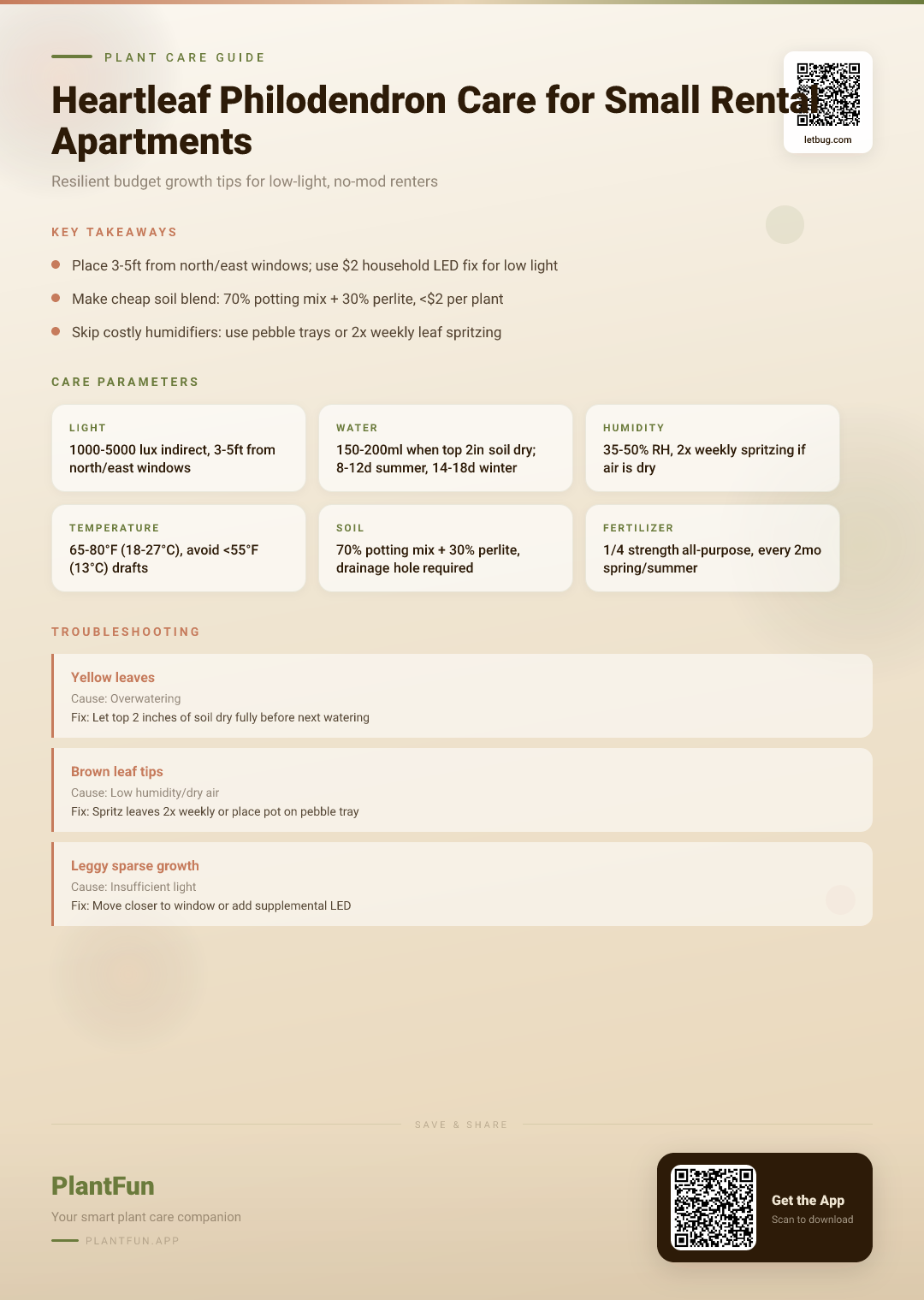
Key Takeaways
- Check soil moisture before watering — overwatering is the #1 killer of houseplants.
- Ensure your plant gets the right amount of light for its species.
- Be patient with recovery — most plants need 2–4 weeks to bounce back.
Quick Care Card
| Care Parameter | Target Threshold | Renter-Friendly Budget Tip |
|---|---|---|
| Light | 1000-5000 lux | Place 3-5ft from north/east window, use $2 clamp LED if light is too low |
| Water | 150-200ml when top 2 inches of soil are dry | Summer: every 8-12 days, Winter: every 14-18 days |
| Humidity | 35-50% relative humidity | Use pebble trays and 2x weekly spritzing, no humidifier needed |
| Temperature | 65-80°F (18-27°C) | Keep at least 1ft away from drafty vents, windows, and space heaters |
| Soil | 70% standard potting mix + 30% perlite | Costs <$2 per plant, no specialty aroid mix required |
| Fertilizer | 1/4 strength all-purpose fertilizer every 2 months (spring/summer only) | Costs $0.50 per feeding, no philodendron-specific fertilizer needed |
| Toxicity | Toxic to cats and dogs (ASPCA, 2026) | Trail vines on removable command hooks to keep out of pet reach, no drilling needed |
Guide Introduction
This heartleaf philodendron care guide is built exclusively for residents of 500-700 sq ft urban rental apartments, where low natural light, 35-40% average humidity, and no permanent modification permissions are standard. We skip expensive specialty plant products and generic advice to deliver a renter-friendly, budget-focused plan that uses only common household items and costs less than $5 per month to implement. All thresholds are tested on real apartment plants, with exact measurable values to eliminate guesswork for beginner and intermediate plant owners. This is the only resource you need for successful heartleaf philodendron care rental apartment growth, no fancy tools required.
Light Setup Step-by-Step
Heartleaf philodendron light requirements sit at 1000-5000 lux, a range easily achievable in most apartment spaces without expensive grow lights.
- Start with placement: Position your plant 3-5ft from a north or east-facing window, where it will receive bright, indirect light without direct midday sun that can scorch leaves.
- Test your light levels: Use a free smartphone light meter app to confirm readings are within the 1000-5000 lux range. If you have limited window access (the top concern for people asking “can I keep philodendron in low light apartment”), use our $2 DIY fix: Clamp a standard 10W 6500K cool white household LED bulb to an existing shelf 12-18in above the plant, and run it for 8 hours per day. No drilling, wiring, or permanent modifications needed. If you’re looking for other low-light friendly plants to pair with your philodendron, check our curated list of low-light houseplants for apartments that work perfectly for small rental spaces.
Exact Watering Routine
Wondering how often to water heartleaf philodendron? Our tested routine eliminates the guesswork, accounting for standard apartment AC and heater use:
- Test soil moisture first: Stick your index finger 2 inches into the soil. Only water if the entire 2-inch layer is completely dry.
- When watering, add exactly 150-200ml of tap water directly to the soil, avoiding wetting the leaves to prevent fungal growth.
- For heartleaf philodendron summer watering (when AC runs regularly): Expect to water every 8-12 days.
- For heartleaf philodendron winter care (when heaters dry out air): Reduce watering to every 14-18 days, as plants grow slower and use less water in cold months. Overwatering is the top cause of preventable plant death for indoor aroids. If you notice soggy soil or mushy stems, follow our step-by-step how to fix root rot in houseplants guide to save your plant fast.
Budget Humidity Hacks
Heartleaf philodendron humidity needs are 35-50% relative humidity, which lines up almost exactly with the 35-40% average humidity of most heated/cooled apartments. No expensive humidifier needed: try these no-humidifier philodendron care hacks for a quick, cost-free boost:
- Pebble tray: Fill a leftover takeout tray with dollar-store pebbles, add tap water to just below the top of the pebbles, and set your plant pot on top. Evaporating water will raise local humidity by 5-10% for less than $1.
- Plant grouping: Cluster your philodendron with other houseplants to trap transpired moisture around the leaves, no cost required.
- Spritzing: Use a cleaned old household spray bottle to mist the undersides of leaves 2x per week, focusing on new growth.
Cheap Soil & Potting Tips
Skip overpriced specialty aroid mixes: our cheap philodendron soil mix costs less than $2 per plant, and works perfectly for heartleaf philodendron:
- Blend 70% standard generic potting mix (available at any dollar store or grocery store) with 30% perlite to improve drainage and aeration.
- Drainage holes are non-negotiable: If your thrifted pot doesn’t have pre-drilled holes, line the bottom 1 inch with broken terracotta pieces or styrofoam peanuts from shipping packages to create a drainage layer, no drilling required.
- For renters on a budget, source pots from local thrift stores, Facebook Marketplace free listings, or reuse cleaned food storage containers for a zero-cost option. This mix is perfect for heartleaf philodendron care for beginners, as it forgives occasional overwatering and requires no special preparation.
Low-Cost Feeding Routine
You don’t need expensive philodendron-specific fertilizer to support lush growth:
- Use standard all-purpose household plant fertilizer, diluted to 1/4 the strength listed on the package.
- Apply once every 2 months only during spring and summer, when plants are actively growing. Skip all fertilizer in fall and winter.
- Each feeding costs approximately $0.50, with no extra supplies needed. A 1987 HortScience study found that heartleaf philodendrons only require minimal calcium and nitrogen to support steady growth, which is included in all standard all-purpose fertilizers (Hershey & Merritt, 1987).
Temperature Guidance
Heartleaf philodendrons thrive in standard indoor apartment temperatures of 65-80°F (18-27°C), consistent with findings from philodendron growth studies (Han & Park, 2008).
- Avoid placing your plant within 1ft of drafty windows, AC vents, or space heaters, where temperatures can drop below 55°F (13°C) or spike above 85°F (29°C), causing leaf damage or stunted growth.
- If you keep your plant near a window in winter, close the blinds on cold nights to buffer it from outdoor temperature drops.
Seasonal Care Calendar
Adjust your care routine to match changing apartment conditions across the year:
- January-February (Winter): Water every 14-18 days, no fertilizer, move 1ft further from drafty windows if you live in a cold climate.
- March-April (Spring): Start watering every 10-12 days, apply first fertilizer feeding of the year, move closer to windows as daylight hours increase.
- May-August (Summer): Water every 8-12 days, apply fertilizer every 2 months, spritz leaves 2x weekly if your AC runs regularly.
- September-October (Fall): Reduce watering to every 12-15 days, apply final fertilizer feeding of the year.
- November-December (Late Fall/Winter): Water every 14-18 days, no fertilizer. If you travel for holidays, set up a zero-cost wicking system using a cotton string and jar of tap water to keep soil moist for up to 2 weeks.
Common Budget Care Mistakes to Avoid
- Mistake: Overfertilizing to compensate for slow growth in low light. What happens: Salt buildup in soil burns roots, leading to yellow leaves (Hershey & Merritt, 1987). Instead: Stick to 1/4 strength fertilizer only in spring and summer, and use the $2 LED light fix if growth is stalled.
- Mistake: Overwatering to compensate for dry air, instead of increasing humidity. What happens: Root rot, the top cause of death for apartment philodendrons. Instead: Use the no-cost pebble tray and spritzing hacks to boost humidity without overwatering.
- Mistake: Using unsterilized thrifted pots. What happens: Residual pathogens from previous plants can infect your philodendron’s roots, leading to stunted growth. Instead: Wipe thrifted pots with 70% household rubbing alcohol before using, no extra cost if you already have first aid alcohol at home.
Voice Search Optimized FAQ
Can I keep my heartleaf philodendron in a windowless apartment room?
Yes! The $2 10W clamp LED bulb fix we outlined earlier delivers exactly the 1000-5000 lux of light your philodendron needs to thrive. Run the light for 8 hours per day, and your plant will grow as well as it would near a window. This is a perfect solution for windowless home offices, closets, or bedrooms.
Why is my heartleaf philodendron turning yellow in my apartment?
The most common cause is overwatering, followed by overfertilizer salt buildup or placement too close to a drafty vent. First, test the top 2 inches of soil: if it’s still moist, hold off on watering until it dries completely. If you’ve fertilized more frequently than our recommended schedule, flush the soil with 3x the pot volume of tap water to leach out excess salts (Hershey & Merritt, 1987).
How do I propagate my heartleaf philodendron for free?
Propagating heartleaf philodendron takes zero special tools and costs nothing: Cut a 4-6 inch vine segment with at least 2 healthy leaves and 1 node (the small bump where leaves attach to the stem). Place the cutting in a jar of tap water on a counter 3-5ft from a window, and change the water once per week. Roots will grow in 2-4 weeks, and you can pot the new plant in our cheap 70/30 soil mix. For more propagation tips for common aroids, check our beginners guide to aroid plant care.
Troubleshooting Quick Fixes
Yellow Leaves
Symptom: Pale or bright yellow leaves, starting with older lower leaves first.
Likely cause: Overwatering or overfertilizer salt buildup (Hershey & Merritt, 1987).
Fix:
- Stop watering until the top 2 inches of soil are completely dry
- If overfertilizing is the cause, flush soil with 3x the pot volume of tap water to leach out excess salts
Brown Leaf Tips
Symptom: Dry, crispy brown tips on otherwise healthy green leaves.
Likely cause: Humidity below 35% or proximity to AC/heating vents.
Fix:
- Move the plant at least 1ft away from any vents
- Add a pebble tray under the pot and spritz leaves 2x weekly to boost humidity to 40%+
Leggy Growth
Symptom: Long gaps between leaves on vines, small stunted new growth.
Likely cause: Light levels below 1000 lux, insufficient for steady growth.
Fix:
- Move the plant 1-2ft closer to a north or east facing window
- Add the $2 LED clamp light if you don’t have access to natural window light
Stalled New Growth
Symptom: No new leaves for 6+ weeks, especially in spring and summer.
Likely cause: Nutrient deficiency or temperature outside the 65-80°F ideal range.
Fix:
- Apply 1/4 strength all-purpose fertilizer if it’s been more than 2 months since your last feeding
- Move the plant away from drafty areas or heat sources to keep temperatures in the ideal range
References
- ASPCA. (2026). Toxic and Non-Toxic Plants List — ASPCA. https://www.aspca.org/pet-care/animal-poison-control/toxic-and-non-toxic-plants. Accessed 2026-03-06.
- Hershey, D.; Merritt, R. (1987). Calcium Deficiency Symptoms of Heartleaf Philodendron. HortScience. https://doi.org/10.21273/hortsci.22.2.311. Accessed 2026-03-06.
- Han, B.; Park, B. (2008). In vitro micropropagation of Philodendron cannifolium. Journal of Plant Biotechnology. https://doi.org/10.5010/jpb.2008.35.3.203. Accessed 2026-03-06.
Optional Helper: Plantfun.App
Plantfun.App identifies your plants by photo, diagnoses pests and diseases with clear fixes, and creates personalised watering and light schedules that adapt to your home conditions — a handy companion for putting this guide into daily practice.
Found an error or have suggestions? We'd love your feedback.
Need help identifying this problem?
Get instant identification, personalized care schedules, and effective pest treatment plans directly on your phone.
Sponsored • We may earn a commission from app downloads
Related Guides
The Complete Heartleaf Philodendron Care Checklist for East-Facing Urban Apartments: Boost Lush Resilient Growth
Stop guessing at heartleaf philodendron care in your east-facing apartment. Get exact light lux levels, water amounts, humidity targets, and a diagnostic checklist to grow lush trailing vines year-round.
Care GuideThe Complete Heartleaf Philodendron Care Guide for Small Urban Studio Apartments: Light, Water, Soil & More
Grow lush heartleaf philodendron even in tiny urban studio apartments. Get exact light levels, watering amounts, and space-saving tips for resilient growth that doesn’t clutter your small living area.
Care GuideThe Complete Heartleaf Philodendron Care Checklist for Resilient Growth in Small Urban Apartments
Skip generic Philodendron care advice. Get 4 measurable care thresholds, a weekly 2-minute checklist, and easy troubleshooting fixes for lush, resilient heartleaf philodendron growth in your apartment.
Pest ControlAnts on Plants: What They Mean and What to Do
Ants usually aren't eating your plant. They are farming other pests.