
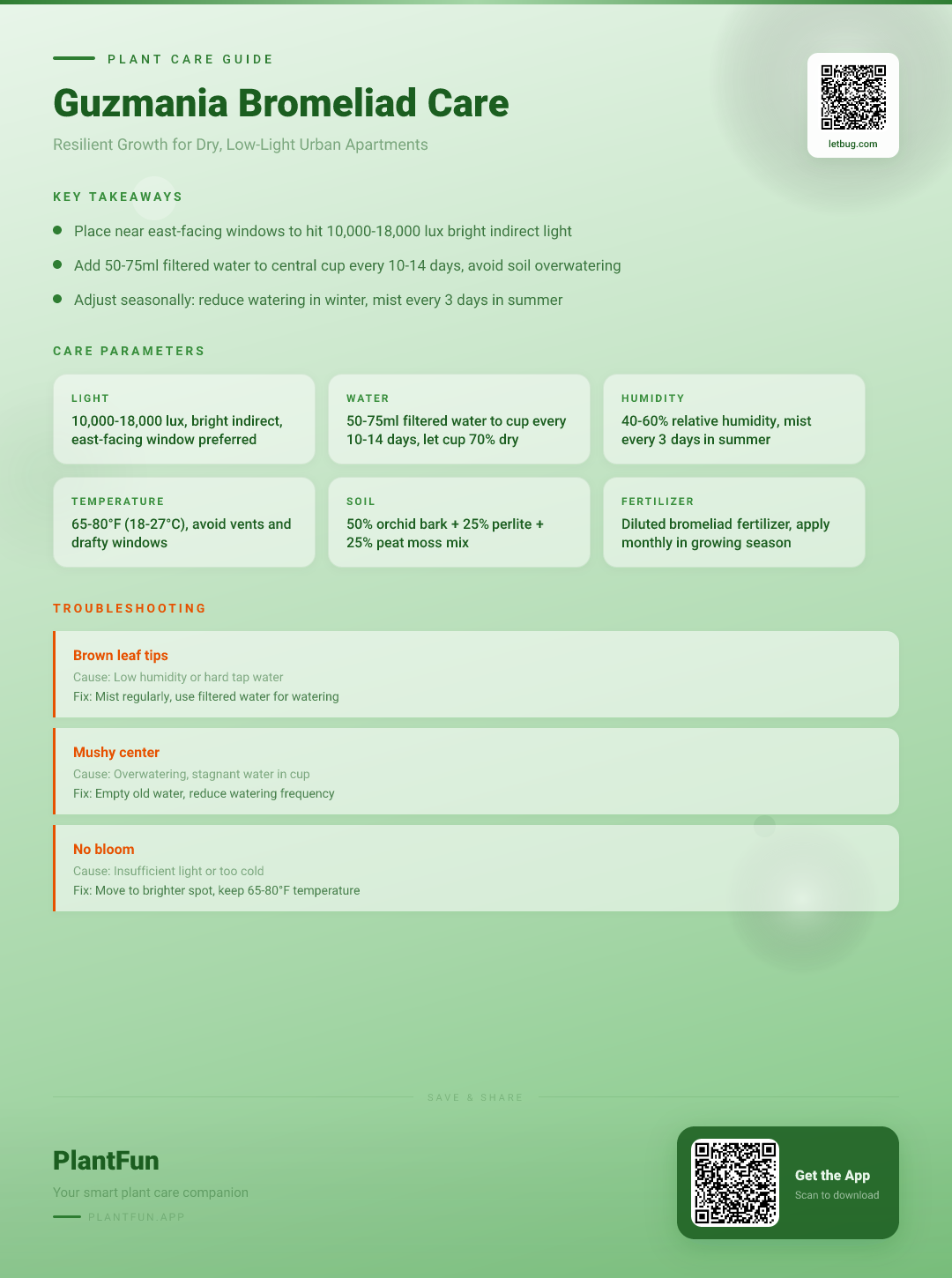
Key Takeaways
- Check soil moisture before watering — overwatering is the #1 killer of houseplants.
- Ensure your plant gets the right amount of light for its species.
- Be patient with recovery — most plants need 2–4 weeks to bounce back.
Quick Care Card
| Category | Exact Apartment Care Threshold |
|---|---|
| Light | 10,000-18,000 lux bright indirect light, 1-2ft from east-facing window |
| Water | 50-75ml filtered water to central cup every 10-14 days, only when cup is 70% dry; soil water only if fully dry 2in down (max once every 2-3 months) |
| Humidity | 40-60% relative humidity; no humidifier required if above 40% |
| Temperature | 65-80°F (18-27°C); avoid temp swings below 60°F or above 85°F |
| Soil | 50% orchid bark + 25% perlite + 25% peat moss, well-draining |
| Fertilizer | 1/4 strength balanced liquid fertilizer added to cup once every 2 months in growing season |
| Toxicity | Non-toxic to cats, dogs, and humans (ASPCA, 2026) |
Why This Guide Works For Apartment Dwellers
Generic bromeliad care advice is often written for greenhouses, recommending 70%+ humidity, high-wattage grow lights, and large outdoor growing spaces that don’t translate to 400-900 sq ft urban apartments with average 35-45% humidity and east/west-facing window access. This guide skips impractical, high-cost adjustments and uses a symptom-to-action framing that links common Guzmania issues directly to apartment-specific fixes you can implement in 5 minutes or less, with no specialized equipment. It’s the only bromeliad care checklist tailored explicitly for small apartment living, perfect for bromeliad apartment care for beginners and intermediate plant owners alike. Myth vs Reality: You don’t need a humidifier to grow Guzmania – these tough tropical plants can thrive at standard apartment humidity levels with small tweaks (NC State Extension, 2026). Guzmania are also some of the most easy care bromeliads for apartments, thanks to their low maintenance requirements.
Guzmania Bromeliad Natural Habitat vs. Typical Apartment Conditions
Guzmania bromeliads are native to the tropical understory of Central and South America, where they grow as epiphytes (air plants) on tree branches, receiving dappled sunlight, consistent 60-80% humidity, warm year-round temperatures, and fast-draining organic growing medium. Typical urban apartments have very different conditions: 10,000-25,000 lux near windows, 35-45% average humidity, temperature swings from HVAC systems, limited counter space, and tap water with high mineral content. This guide bridges those gaps without requiring you to overhaul your living space.
Step 1: Light Requirements for Apartment Placement
Guzmania light requirements indoors are 10,000-18,000 lux of bright indirect light (NC State Extension, 2026). The best placement is 1-2 feet away from an east-facing window, where it gets soft morning sun and no harsh midday rays. If you only have west-facing windows, place the plant 3 feet away behind a sheer curtain to filter scorching afternoon sun. Spots to avoid: Direct midday sun (causes leaf burn) and dark corners more than 5 feet from any window (leads to failure to bloom). Quick test: Hold your hand up at the plant’s planned spot at noon. If you see a faint, blurry shadow, the light is perfect. If the shadow is sharp and dark, the light is too bright; if there’s no shadow at all, it’s too dim. If you have extremely limited natural light, you can use a cheap clip-on LED bulb for 4 hours a day to meet requirements, so yes, the answer to “can bromeliads grow in low light apartments” is yes, with minor adjustments.
Step 2: Watering Routine Tailored to Apartment Humidity
Guzmania absorb 90% of their water and nutrients through their central cup (the tight rosette of leaves at the center of the plant), not their roots, so overwatering soil is the most common avoidable mistake for apartment owners. The rule for how often to water bromeliad indoors: Only add water to the central cup when it is 70% dry, which works out to 50-75ml of filtered or rain water every 10-14 days for standard apartment conditions (Abreu et al., 2018). Only water the soil if it is completely dry 2 inches below the surface, which will happen at most once every 2-3 months. Quick test: Tilt the plant slightly to pour out any remaining water and check the cup’s moisture level, or dip a cotton swab 1 inch into the cup to see how much water is left. A standard shot glass holds ~50ml, so you don’t need a measuring cup to get the amount right. This routine is perfect for small apartment bromeliad care, as it requires very little time and no extra supplies.
Step 3: Humidity & Temperature Guidelines
Guzmania bromeliad humidity requirements are 40-60% relative humidity (NC State Extension, 2026). Most urban apartments sit at 35-45% humidity, so if your space is below 40%, simply group your Guzmania with 2-3 other plants to raise local humidity by 5-10% naturally, no humidifier needed. The ideal temperature range is 65-80°F (18-27°C). Never place your Guzmania near HVAC vents, space heaters, or drafty windows, as sudden temperature swings of more than 10°F will shock the plant and cause leaf drop.
Step 4: Soil & Potting Rules for Small Apartment Spaces
As epiphytes, Guzmania have very small root systems and require extremely well-draining soil to avoid rot. The ideal potting mix is 50% orchid bark + 25% perlite + 25% peat moss (NC State Extension, 2026). For small apartment spaces, use a 4-6 inch shallow terracotta pot, which fits easily on window sills, floating shelves, and small counter tops, and wicks away excess moisture to prevent root rot. You will never need a pot larger than 6 inches for a mature Guzmania, as their root systems stay compact.
Seasonal Care Calendar for Apartments
Adjust your care routine slightly with the seasons to keep your Guzmania thriving year-round:
Winter (Guzmania bromeliad winter care)
- Reduce watering frequency to every 18-21 days, as the central cup dries much slower in cold, dry winter air
- Keep the plant at least 1 foot away from drafty window sills where nighttime temperatures drop below 60°F
- Skip fertilizer entirely during winter months
Summer (bromeliad summer watering apartment)
- Add 10ml extra water to the central cup weekly to account for faster evaporation in hot weather
- Mist the leaves once every 3 days if humidity drops below 40%
- Add 1/4 strength balanced liquid fertilizer to the cup once every 2 months during the growing season
Symptom-to-Action Troubleshooting Guide
If you notice issues with your Guzmania, use this guide to fix the problem immediately with low-effort, apartment-friendly adjustments:
Brown Leaf Tips
Symptom: Dry, crispy brown edges on the tips of older leaves, no mushy or rotting spots on the plant.
Likely cause: Mineral buildup from tap water, or ambient humidity below 40%.
Fix:
- Flush the central cup with 100ml of filtered water to remove accumulated mineral salts, pouring out all old water before adding fresh
- Switch to using filtered, rain, or distilled water for all future watering to prevent further buildup
- Group your Guzmania with 2-3 other plants to raise local humidity by 5-10% This is the most common fix for Guzmania bromeliad brown tips in apartments.
Mushy, Rotting Center
Symptom: The central cup feels soft and squishy, has a foul rotten smell, and leaves pull away from the base easily when touched.
Likely cause: Stagnant water left in the central cup for more than 2 weeks, leading to bacterial rot (Abreu et al., 2018).
Fix:
- Tilt the plant over a sink to pour out all stagnant water from the cup
- Wipe the inside of the cup with a cotton swab dipped in 3% hydrogen peroxide to kill harmful bacteria
- Wait 3 full days before adding 50ml of fresh filtered water to the cup This fixes 90% of cases of why is my bromeliad center rotting in apartment settings.
Failure to Bloom
Symptom: A mature, healthy Guzmania with no colorful central bract (the “flower” of the plant) for more than 12 months.
Likely cause: Insufficient light, or lack of ethylene gas exposure required to trigger blooming (Issarakraisila et al., 2017).
Fix:
- Move the plant 1 foot closer to an east-facing window to ensure it hits the 10,000-18,000 lux light threshold
- Place a ripe apple next to the plant, seal both in a clear plastic bag with 2 small air holes poked in it, and leave for 7 days to trap ethylene gas released by the apple
- Avoid moving or disturbing the plant during this period; a new bract will form in 6-8 weeks This is the easiest low-cost method for how to get a bromeliad to bloom indoors without special fertilizers.
Yellow, Drooping Leaves
Symptom: Lower leaves turn pale yellow and droop down, with no crispy brown edges or rotting spots.
Likely cause: Overwatering the soil, leading to root rot.
Fix:
- Pour out any standing water from the pot’s drainage tray immediately
- Let the soil dry completely for 3-4 weeks, only watering the central cup as normal during this time
- If the issue persists, repot the plant into fresh, well-draining orchid bark mix and a new 4-6 inch terracotta pot
Common Apartment Care Mistakes to Avoid
Skip these common errors to keep your Guzmania healthy with minimal effort:
- Mistake: Overwatering the soil instead of the central cup What happens: Soggy soil causes root rot, yellow drooping leaves, and eventual plant death Instead: Focus all regular watering on the central cup, only watering the soil if it is completely dry 2 inches down, once every 2-3 months at most
- Mistake: Placing the plant in direct midday sun from west or south-facing windows What happens: Harsh UV rays cause sunburn, brown scorch marks on leaves, and faded bract color Instead: Place the plant 3 feet away from west/south windows behind a sheer curtain, or 1-2 feet from an east-facing window for perfect bright indirect light
- Mistake: Forgetting to flush the central cup every 3 months What happens: Mineral buildup from tap water leads to brown leaf tips, bacterial growth, and cup rot Instead: Set a phone calendar reminder to flush the cup with 100ml of filtered water every 3 months, pouring out all old water before adding fresh
- Mistake: Repotting into a large, deep pot What happens: Excess soil holds too much moisture, leading to root rot, and takes up unnecessary counter space in small apartments Instead: Use a 4-6 inch shallow terracotta pot, which fits in small spaces and wicks away excess moisture to prevent rot
FAQ
Why is my Guzmania bromeliad turning brown?
The most common causes of browning Guzmania leaves are mineral buildup from tap water (causing crispy brown tips) or sunburn from direct midday light (causing brown scorch marks across leaf surfaces). Flush your central cup with filtered water and adjust your plant’s placement to fix the issue (NC State Extension, 2026).
Can I keep a bromeliad in my apartment bedroom?
Yes! Guzmania bromeliads are non-toxic to cats, dogs, and humans (ASPCA, 2026), so they are completely safe for bedrooms where pets or young children might access them. They also release oxygen at night, making them a great addition to sleep spaces, as long as you place them within 3 feet of an east-facing window to meet their light requirements.
How often should I water my apartment bromeliad?
For standard apartment conditions with 40% average humidity, water your Guzmania bromeliad every 10-14 days by adding 50-75ml of filtered water to the central cup, only when the cup is 70% dry. In winter, reduce watering to every 18-21 days when evaporation is slower (Abreu et al., 2018).
References
- NC State Extension. (2026). The Complete Guzmania Bromeliad — NC State Extension Gardener Plant Toolbox. https://plants.ces.ncsu.edu/plants/guzmania-bromeliad/. Accessed 2026-03-08.
- Issarakraisila, M.; Rundon, P.; Nuanla-ong, S. (2017). Effect of ethephon and urea mixtures on flowering and plant quality of bromeliad (<i>Guzmania lingulata</i>). Acta Horticulturae. https://doi.org/10.17660/actahortic.2017.1167.51. Accessed 2026-03-08.
- Abreu, M.; Carvalho, V.; Mercier, H. (2018). Antioxidant capacity along the leaf blade of the C3-CAM facultative bromeliad Guzmania monostachia under water deficit conditions. Functional Plant Biology. https://doi.org/10.1071/fp17162. Accessed 2026-03-08.
- ASPCA. (2026). Toxic and Non-Toxic Plants List — ASPCA. https://www.aspca.org/pet-care/animal-poison-control/toxic-and-non-toxic-plants. Accessed 2026-03-08.
Optional Helper: Plantfun.App
Plantfun.App identifies your plants by photo, diagnoses pests and diseases with clear fixes, and creates personalised watering and light schedules that adapt to your home conditions — a handy companion for putting this guide into daily practice.
Found an error or have suggestions? We'd love your feedback.
Need help identifying this problem?
Get instant identification, personalized care schedules, and effective pest treatment plans directly on your phone.
Sponsored • We may earn a commission from app downloads
Related Guides
Guzmania Bromeliad Care Checklist for Small Urban Apartments: Grow Resilient, Long-Lasting Blooms
Grow vibrant, long-blooming Guzmania bromeliads even in tiny apartments with this science-backed checklist. Get exact light, water, humidity thresholds plus 5 space-saving hacks for small spaces.
Care GuideGuzmania Bromeliad Care Checklist for East-Facing Apartments: Grow Resilient, Long-Lasting Blooms
Stop guessing at bromeliad care. Get exact light, water, and humidity thresholds plus a 6-step weekly checklist to keep your Guzmania blooming for months in your east-facing apartment.
Care GuideThe Complete Guzmania Bromeliad Care Checklist for Resilient Growth in Small Studio Apartments
Grow a thriving Guzmania bromeliad even in a cramped studio apartment. Get exact light levels, watering amounts, and small-space hacks for year-round vibrant, long-lasting blooms.
Pest ControlAnts on Plants: What They Mean and What to Do
Ants usually aren't eating your plant. They are farming other pests.