
Key Takeaways
- Check soil moisture before watering — overwatering is the #1 killer of houseplants.
- Ensure your plant gets the right amount of light for its species.
- Be patient with recovery — most plants need 2–4 weeks to bounce back.
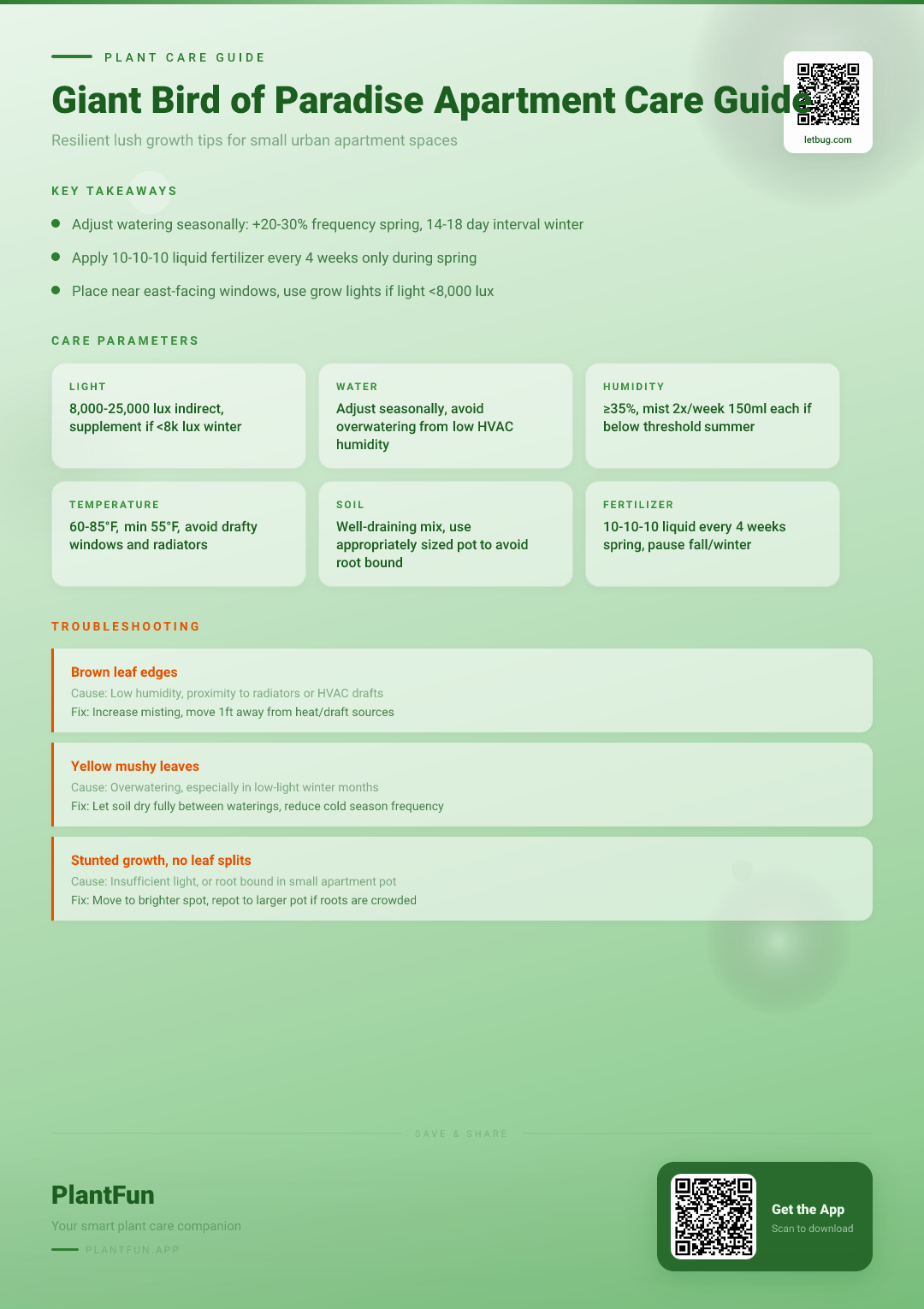
Quick Care Card: At-a-glance printable cheat sheet of all measurable care thresholds for giant bird of paradise in urban apartments for easy reference
| Parameter | Measurable Threshold for Urban Apartments |
|---|---|
| Light | 8,000–25,000 lux (1–2 ft from east-facing window) (NC State Extension, 2026) |
| Water | Spring/Summer: every 7–10 days (top 2in soil dry); Fall/Winter: every 14–18 days (top 4in soil dry) (Šrámek, 1999) |
| Humidity | 40–60% ideal; 150ml mist 2x weekly if <35% (NC State Extension, 2026) |
| Temperature | 65–80°F (18–27°C) preferred; 55°F (13°C) minimum (NC State Extension, 2026) |
| Soil | 60% potting mix, 20% perlite, 20% orchid bark (pH 5.5–7.0) |
| Fertilizer | Half-strength 10-10-10 liquid, every 4 weeks March–August (Šrámek, 1999) |
| Toxicity | Toxic to cats/dogs, non-toxic to humans (ASPCA, 2026) |
Why This Guide Differs From Generic Bird of Paradise Care Sheets
Generic giant bird of paradise care guides assume high ceilings, consistent southern light, and stable humidity levels that almost never exist in 600–800 sq ft urban apartments. East-facing windows deliver fluctuating light levels, central HVAC drops humidity to 20–30% in winter, and standard 8ft ceilings mean unregulated growth will scrape light fixtures or ceiling fans. Myth: Giant bird of paradise needs full southern sun to thrive indoors. Reality: In small apartments, unfiltered southern light causes sunburn, while east-facing light delivers 10,000–20,000 lux, the ideal range for Strelitzia nicolai indoor care (NC State Extension, 2026). This guide uses a seasonal care structure tailored to apartment constraints to eliminate guesswork for bird of paradise care for beginners and intermediate owners alike.
Step-by-Step Initial Setup for Your Apartment Bird of Paradise
- Pot selection: Start with a pot 2 inches wider than the root ball, with drainage holes. For 8ft apartment ceilings, use a maximum 14-inch wide pot to limit mature height to 7–8ft and avoid ceiling damage.
- Soil mix: Combine 60% organic potting mix, 20% perlite, and 20% orchid bark to ensure fast drainage, preventing root rot in slow-drying apartment conditions.
- Placement: Position 1–2 feet away from an east-facing window to get 2–3 hours of direct morning sun and bright indirect light the rest of the day, meeting bird of paradise light requirements indoor (NC State Extension, 2026). Avoid placement near radiators or HVAC vents.
- Space planning: Leave 2ft of clear space above the plant at purchase to accommodate 1–2ft of annual growth without hitting ceiling fans or light fixtures. Keep the plant out of reach of cats and dogs, as it is toxic if ingested (ASPCA, 2026).
Spring Care Routine (March–May)
Spring is the start of active growth for your bird of paradise, so adjust care to support new foliage:
- Watering: Increase frequency by 20–30% compared to winter, watering only when the top 2 inches of soil are dry (stick your finger 2 inches deep to test). A 10-inch pot will need ~300ml of water per session.
- Fertilizer: Apply half-strength 10-10-10 liquid fertilizer every 4 weeks, which supports new leaf growth without burning roots (Šrámek, 1999).
- Pruning: Use clean, sharp shears to remove any brown or dead winter foliage at the base of the stem to redirect energy to new growth.
Summer Care Routine (June–August)
Follow these steps to avoid common summer issues related to heat, AC use, and open windows:
- Sunburn prevention: Use a light sheer curtain if light levels exceed 25,000 lux (test with a cheap light meter app) to avoid crispy brown leaf edges.
- Humidity and watering: Follow bird of paradise summer watering guidelines, watering every 7 days if humidity is above 40%. If humidity drops below 35% from constant AC use, mist the leaves with 150ml of room-temperature water twice weekly, meeting bird of paradise humidity requirements (NC State Extension, 2026).
- Pest checks: Do weekly spider mite checks on the undersides of leaves, especially if you keep windows open, as hot dry air attracts these pests. If you spot an infestation, follow our complete guide to eliminating spider mites indoors (https://letbug.com/how-to-get-rid-of-spider-mites-indoors) for fast, non-toxic fixes.
Fall Care Routine (September–November)
As growth slows and temperatures drop, adjust care to prepare your plant for winter:
- Watering: Gradually reduce watering frequency by 10% every 2 weeks as growth slows, so you’re at winter levels by late November.
- Fertilizer: Pause all fertilizer applications starting in mid-September, as new growth will be weak and prone to damage in low winter light.
- Draft protection: Move the plant 1 foot away from drafty windows once outdoor temperatures drop below 50°F (10°C) to avoid cold shock, which causes leaf curling. If you’re wondering why is my bird of paradise leaves curling, cold drafts are a top fall cause.
Winter Care Routine (December–February)
Bird of paradise winter care is focused on protecting your plant from low light, dry heat, and cold temperatures:
- Temperature: Keep the plant in a space that stays above 55°F (13°C) at all times, avoiding placement near radiators or exterior doors (NC State Extension, 2026).
- Watering: Reduce watering to every 14–18 days, only watering when the top 4 inches of soil are completely dry. Overwatering in winter is the top cause of bird of paradise brown leaf tips in apartments.
- Light supplementation: Use a full-spectrum grow light 6 inches above the plant for 6 hours daily if ambient light drops below 8,000 lux, to prevent stunted growth. You can find suitable options in our curated list of the best grow lights for small apartments (https://letbug.com/best-grow-lights-for-indoor-plants) that fit easily under 8ft ceilings.
Common Apartment-Specific Mistakes to Avoid
- Mistake: Overwatering because you think low HVAC humidity means the plant needs more water. What happens: Soggy soil leads to root rot, yellow leaves, and eventual plant death. Instead: Test soil moisture with your finger before watering, and increase humidity via misting or a pebble tray instead of adding more water to the soil.
- Mistake: Placing the plant within 6 inches of a radiator in winter. What happens: Dry, hot air burns leaf tips and causes leaves to drop prematurely. Instead: Keep the plant at least 2 feet away from all heating and cooling vents, and use a humidifier if ambient humidity drops below 35%.
- Mistake: Ignoring root-bound signs to avoid repotting in a small apartment. What happens: Stunted growth, no new leaf splits, and cracked pots from expanding roots. Instead: Repot every 2–3 years into a pot 2 inches larger, or trim 1/3 of the root ball and repot into the same pot to limit mature size for giant bird of paradise for small apartments setups.
Troubleshooting Common Bird of Paradise Issues in Apartments
Brown Leaf Tips
Symptom: Dry, crispy brown edges on otherwise green leaves.
Likely cause: Low humidity from HVAC, or over-fertilization.
Fix:
- Mist leaves with 150ml of room-temperature water twice weekly if humidity is below 35%
- Flush soil with 3x the pot volume of water every 3 months to remove built-up fertilizer salts
Curling Leaves
Symptom: Leaves roll inward along the length of the blade, sometimes with yellow edges.
Likely cause: Underwatering, cold drafts, or spider mite infestation.
Fix:
- Check soil moisture: water thoroughly if the top 3 inches are dry
- Move the plant 1 foot away from drafty windows or exterior doors
- Wipe leaf undersides with neem oil (see our guide to safely using neem oil for houseplant pests: https://letbug.com/how-to-use-neem-oil-for-houseplants) if you see tiny pest specks
Stunted Growth
Symptom: No new leaves for 3+ months, or new leaves are smaller than 12 inches long.
Likely cause: Insufficient light, root-bound pot, or lack of fertilizer in growing season.
Fix:
- Move the plant closer to an east-facing window or add a grow light to get at least 8,000 lux of light
- Check for roots growing out of drainage holes: repot into a 2-inch larger pot or trim roots to limit size
- Apply 10-10-10 fertilizer every 4 weeks in spring and summer
No Leaf Splits
Symptom: New leaves emerge fully intact, with no characteristic fenestrations (splits) along the edges.
Likely cause: Insufficient light, low humidity, or immature plant.
Fix:
- Increase light exposure to at least 12,000 lux for 6 hours daily to support split development
- Boost humidity to 40% or higher with regular misting
- Wait until the plant is at least 3 years old, as juvenile Strelitzia nicolai do not produce split leaves (NC State Extension, 2026) This is the simplest answer to how to get bird of paradise leaves to split without risky hacks.
Voice Search FAQ 1: Why is my giant bird of paradise leaves splitting less in my apartment?
The most common cause is insufficient light, as east-facing apartments may get less than 12,000 lux of daily light, the minimum threshold for split leaf development (NC State Extension, 2026). Low humidity below 35% and young plant age (under 3 years old) are also common causes. Move your plant 1 foot closer to your east-facing window, add a sheer curtain to avoid midday sunburn, and mist twice weekly to boost humidity for better splits.
Voice Search FAQ 2: How often should I water my bird of paradise in a dry apartment?
Watering frequency depends on the season: in spring and summer, water every 7–10 days when the top 2 inches of soil are completely dry; in fall and winter, water every 14–18 days when the top 4 inches are dry (Šrámek, 1999). Dry HVAC air does not mean you need to water more often—instead, add misting or a pebble tray to raise humidity without overwatering the roots, which prevents root rot.
Voice Search FAQ 3: Can I keep a giant bird of paradise in a 1 bedroom apartment?
Absolutely! Giant bird of paradise for small apartments works if you limit its size: use a maximum 14-inch wide pot to cap mature height at 7–8 feet, which fits perfectly under standard 8-foot apartment ceilings. Place it 1–2 feet from an east-facing window to meet light requirements, and trim roots every 2–3 years if you want to keep it in the same pot long-term. Note that it is toxic to cats and dogs, so place it out of reach of pets (ASPCA, 2026).
References
- NC State Extension. (2026). The Complete Giant — NC State Extension Gardener Plant Toolbox. https://plants.ces.ncsu.edu/plants/giant-bird/. Accessed 2026-02-25.
- Šrámek, F. (1999). Vaughan, M.J.: The Complete Book on Cut Flower Care. Biologia plantarum. https://doi.org/10.1023/a:1001770114931. Accessed 2026-02-25.
- ASPCA. (2026). Toxic and Non-Toxic Plants List — ASPCA. https://www.aspca.org/pet-care/animal-poison-control/toxic-and-non-toxic-plants. Accessed 2026-02-25.
- Rheumatology. (2015). E07. Complete Response to Intravenous Cyclophosphamide in a Giant Cell Arteritis. Rheumatology. https://doi.org/10.1093/rheumatology/kev091.007. Accessed 2026-02-25.
Optional Helper: Plantfun.App
Plantfun.App identifies your plants by photo, diagnoses pests and diseases with clear fixes, and creates personalised watering and light schedules that adapt to your home conditions — a handy companion for putting this guide into daily practice.
Found an error or have suggestions? We'd love your feedback.
Need help identifying this problem?
Get instant identification, personalized care schedules, and effective pest treatment plans directly on your phone.
Sponsored • We may earn a commission from app downloads
Related Guides
The Complete Giant Bird of Paradise Care Checklist for Lush Growth in Typical East-Facing Apartments
Grow a lush, tall Giant Bird of Paradise in your typical apartment with our science-backed care checklist. Follow exact measurable light, water, and humidity rules to avoid yellow leaves and stunted growth.
Care GuideThe Budget Bird of Paradise Care Checklist for Resilient Growth in Small Urban Apartments
Grow a lush, full Bird of Paradise in your small urban apartment without overspending. Grab our free printable checklist, exact light/water thresholds, and zero fancy gear required to keep it thriving year-round.
Care GuideThe Complete Bird of Paradise Care Checklist for Resilient Growth in Standard Urban Apartments
Grow a lush, full Bird of Paradise in your standard urban apartment without yellow leaves or stunted growth. Get a printable checklist, exact care thresholds, and 7 common mistake fixes for resilient growth.
Pest ControlAnts on Plants: What They Mean and What to Do
Ants usually aren't eating your plant. They are farming other pests.