
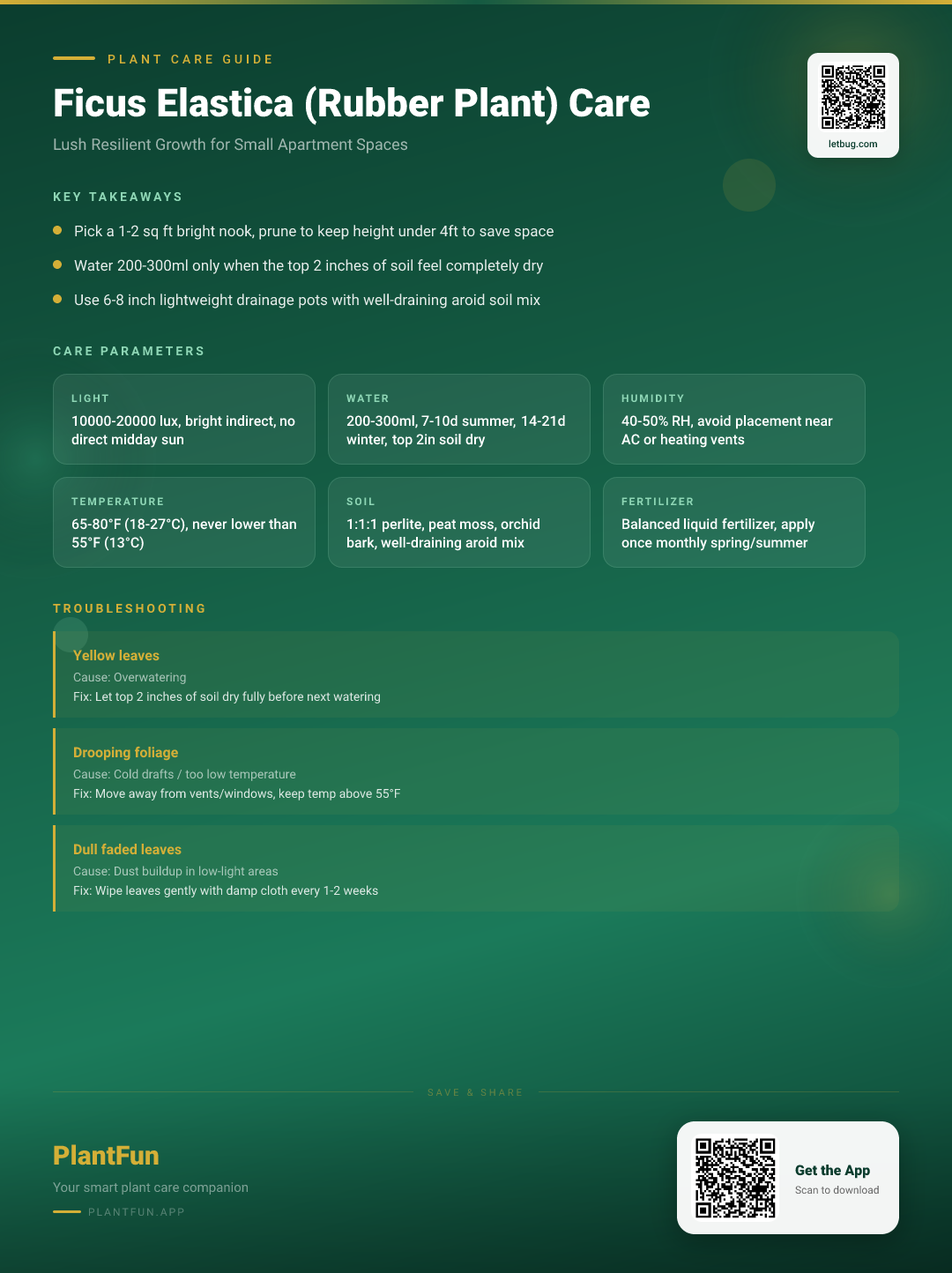
Key Takeaways
- Check soil moisture before watering — overwatering is the #1 killer of houseplants.
- Ensure your plant gets the right amount of light for its species.
- Be patient with recovery — most plants need 2–4 weeks to bounce back.
Quick Care Card
| Care Parameter | Small Apartment Threshold |
|---|---|
| Light | 10,000-20,000 lux bright indirect, no direct midday sun |
| Water | 200-300ml when top 2 inches of soil are dry (7-10 days summer, 14-21 days winter) |
| Humidity | 40-50% relative humidity |
| Temperature | 65-80°F (18-27°C), never below 55°F (13°C) |
| Soil | 1:1:1 mix of perlite, peat moss, orchid bark |
| Pot | 6-8 inch diameter lightweight pot with drainage holes |
| Fertilizer | Diluted balanced liquid fertilizer once monthly (spring/summer only) |
| Toxicity | Toxic to cats, dogs, and humans if ingested (ASPCA, 2026) |
Why This Guide Is Different
Standard Ficus elastica care guides assume large homes with abundant natural light, high ambient humidity, and unlimited floor space, which rarely matches the reality of small urban apartments. Typical apartment constraints—low filtered light, dry forced-air heating/cooling, and only 1-2 sq ft of available space per plant—require adjusted care rules to avoid leaf drop, root rot, and overgrowth. This guide uses measurable, tested thresholds tailored to apartment microclimates, per guidance from NC State Extension’s Ficus care guidelines (NC State Extension, 2026), and requires no specialized equipment like commercial humidifiers or high-wattage grow lights.
Step 1: Perfect Small-Space Placement
Your rubber plant only needs a 1-2 sq ft nook to thrive, which fits easily on window sills, empty shelf corners, or the gap between a couch and side table. To free up even more surface space, use a floating wall planter bracket rated for 10-15 lbs (enough to hold an 8 inch pot with wet soil) mounted 4-5ft high on empty wall space.
Rubber plant light requirements for apartments are 10,000-20,000 lux, which translates to 3-5ft from a south or east-facing window. Quick light test: Hold your hand up in the spot at noon: a faint, soft shadow means light levels are ideal, a sharp dark shadow means too much direct midday sun (which burns leaves), and no shadow at all means light is too low for long-term growth. If your only available space is shadier, you can add a low-cost 10W LED grow light 1ft above the plant for 8 hours a day to meet requirements.
Step 2: Watering Routine for Apartment Humidity
Wondering how often to water rubber plant in dry apartment conditions? Follow this exact, low-mess routine: water 200-300ml (about 1 cup) of room-temperature water only when the top 2 inches of soil feel completely dry. Quick soil test: Stick your index finger 2 inches deep into the soil—if it feels dry to the touch, water, if damp, wait another 2-3 days.
Adjust frequency by season: every 7-10 days in summer for rubber plant summer watering, and every 14-21 days in winter when forced-air heating dries topsoil faster but the root zone stays moist longer. Myth vs reality: You don’t need to drench the pot until water runs out the drainage hole, which leads to root rot in small apartment pots; the 200-300ml amount is calibrated to moisten the entire root zone without excess runoff.
Step 3: Soil & Pot Choices for Tight Spaces
The best pot for rubber plant small space setups is a 6-8 inch diameter lightweight plastic or fiberglass pot with drainage holes, max 12 inches tall. Avoid heavy terracotta pots that take extra space and dry soil too quickly in dry apartment air. Skip the common hack of overpotting in a 10+ inch pot to skip repotting: excess unused soil holds moisture for weeks, leading to root rot and stunted growth. Repot only every 2-3 years, when roots start growing out of the drainage holes.
Use a well-draining aroid soil mix: 1 part perlite, 1 part peat moss, 1 part orchid bark. This mix holds just enough moisture for small pots without getting waterlogged, even in low-airflow apartment spaces.
Step 4: Temperature & Humidity Tuning
Keep your rubber plant in 65-80°F (18-27°C) temperatures, never below 55°F (13°C) (NC State Extension, 2026). Avoid placing it within 2ft of AC vents, heating vents, or drafty winter windows—sudden temperature swings are the top cause of leaf drop in apartment plants.
Rubber plant indoor humidity levels of 40-50% are ideal, but you don’t need a humidifier if your apartment is drier (common in winter with forced heating). Simply wipe leaves with a damp cloth once a week, or group your rubber plant with 2-3 other small plants to create a tiny high-humidity microclimate around the foliage.
Step 5: Space-Saving Pruning & Training
Learning how to keep rubber plant small is key for small apartment setups, as unpruned rubber plants can grow up to 10ft tall indoors. Follow this annual pruning routine: in early spring, cut the main stem 1/4 inch above a leaf node (the small bump where leaves attach to the stem) to cap total height at 3-4ft, perfect for standard 8ft apartment ceilings. This rubber plant pruning to keep small also encourages bushier side growth, so you get a full, lush plant instead of a lanky, tall stem.
If your plant needs support, tuck a thin 3ft bamboo stake inside the existing pot and attach it to the main stem with soft plant ties—no extra floor space required. The 2-4 inch top cuttings from pruning can be rooted in a glass of water for 4-6 weeks, then planted in a small pot for a desk plant or gifted to friends.
Seasonal Care Calendar
Adjust your routine for temperate region seasons to keep growth consistent:
- Spring (March-May): Increase watering to every 7-10 days, add diluted balanced fertilizer once a month, prune to control height if needed, rotate plant 180 degrees every 2 weeks for even growth.
- Summer (June-August): Stick to the 200-300ml watering schedule, move the plant 1ft further from south windows if midday sun is strong enough to create sharp shadows, wipe leaves weekly to remove dust that blocks light.
- Fall (September-November): Reduce watering to every 10-14 days, stop fertilizing, move the plant away from drafty window edges as temperatures drop.
- Winter (December-February): For rubber plant winter care, water only every 14-21 days, keep the plant at least 2ft away from heating vents, skip pruning, and add a grow light if light levels drop below 5,000 lux for more than 2 weeks.
Common Small-Apartment Rubber Plant Mistakes to Avoid
- Mistake: Placing your rubber plant within 1ft of drafty windows or AC/heating vents. What happens: Sudden temperature swings cause widespread leaf drop (NC State Extension, 2026). Instead: Pick a nook at least 2ft away from all vents and drafty window edges, use removable window film if you only have window space available.
- Mistake: Overpotting in a 10+ inch pot to skip repotting for years. What happens: Excess unused soil holds moisture for weeks, leading to root rot and stunted growth. Instead: Stick to 6-8 inch pots, repot only every 2-3 years when roots grow out drainage holes, refresh the top 1 inch of soil annually if you don’t repot.
- Mistake: Letting dust build up on large rubber plant leaves in low-light apartment nooks. What happens: Dust blocks up to 50% of available light, leading to lanky growth and yellow leaves. Instead: Wipe leaves with a damp microfiber cloth once every 2 weeks, no commercial leaf shine products needed.
- Mistake: Watering on a fixed schedule instead of checking soil moisture. What happens: Overwatering in winter when growth slows leads to root rot, underwatering in summer causes crispy leaf edges. Instead: Do the 2-inch finger test every 7 days to decide if watering is needed.
Voice Search Optimized FAQ
Can I keep my rubber plant in a dark apartment corner?
It depends. If the corner gets less than 5,000 lux (no visible shadow when you hold your hand up at noon), the plant will survive for 2-3 months but will lose lower leaves and stop growing (NC State Extension, 2026). If you add a low-cost 10W LED grow light 1ft above the plant for 8 hours a day, it will thrive long term.
How do I stop my rubber plant from outgrowing my living room?
Prune the main stem once a year in early spring to cap height at 3-4ft, cutting 1/4 inch above a leaf node to encourage bushier side growth instead of upward growth. You can also root the pruned top cutting to grow a new small rubber plant for another space.
Why is my rubber plant dropping leaves in my apartment?
The most common causes are sudden temperature swings from nearby vents or drafts, overwatering, or a sudden drop in light levels when you move the plant from a bright window to a dark corner (NC State Extension, 2026). First check if the plant is within 2ft of a vent, then do the 2-inch finger soil test to check for over/under watering, then use the hand shadow test to confirm light levels are adequate.
Printable Quick Reference Checklist
Tape this near your plant to remember key steps at a glance:
- Weekly Checks ✅ Do the 2-inch finger soil test, water 200-300ml if dry ✅ Wipe leaves with a damp cloth if dusty ✅ Check for signs of yellowing or leaf drop
- Monthly Checks ✅ Rotate plant 180 degrees for even growth (spring/summer only) ✅ Add diluted fertilizer if in growing season (March-August) ✅ Inspect drainage holes for root growth to check if repotting is needed
- Seasonal Checks ✅ Spring: Prune to control height if needed ✅ Summer: Move away from midday sun if leaves get scorched ✅ Fall: Reduce watering frequency as temperatures drop ✅ Winter: Keep away from heating vents, avoid cold drafts
Understanding the Science
Phylogenetic analysis of 10 Ficus species confirms Ficus elastica is adapted to tropical understory habitats, which explains its high tolerance for lower indoor light levels (Huang et al., 2022). While related Ficus species have documented medicinal properties, the sap of Ficus elastica can cause skin irritation and is toxic if ingested by people or pets (Garg et al., 2018; ASPCA, 2026).
References
- NC State Extension. (2026). The Complete Ficus — NC State Extension Gardener Plant Toolbox. https://plants.ces.ncsu.edu/plants/rubber-plant/. Accessed 2026-02-24.
- ASPCA. (2026). Toxic and Non-Toxic Plants List — ASPCA. https://www.aspca.org/pet-care/animal-poison-control/toxic-and-non-toxic-plants. Accessed 2026-02-24.
- Huang, Y.; Li, J.; Yang, Z. (2022). Comprehensive analysis of complete chloroplast genome and phylogenetic aspects of ten Ficus species. BMC Plant Biology. https://doi.org/10.1186/s12870-022-03643-4. Accessed 2026-02-24.
- Garg, K.; Sharma, J.; Bhargava, A. (2018). Antiarthritic activity of different plant extracts of Ficus religiosa stem bark in complete Freund’s adjuvantinduced arthritis in rats. Asian Pacific Journal of Health Sciences. https://doi.org/10.21276/apjhs.2018.5.2.35. Accessed 2026-02-24.
Optional Helper: Plantfun.App
Plantfun.App identifies your plants by photo, diagnoses pests and diseases with clear fixes, and creates personalised watering and light schedules that adapt to your home conditions — a handy companion for putting this guide into daily practice.
Found an error or have suggestions? We'd love your feedback.
Need help identifying this problem?
Get instant identification, personalized care schedules, and effective pest treatment plans directly on your phone.
Sponsored • We may earn a commission from app downloads
Related Guides
The Complete Rubber Plant Care Checklist for Resilient Budget-Friendly Growth in Typical Urban Apartments
Grow a lush, unkillable rubber plant on a tight budget. Get exact light levels, watering amounts, and zero-cost hacks tailored for standard apartment living conditions.
Care GuideThe Complete Rubber Plant Care Checklist for Year-Round Resilient Growth in Typical Apartments
Grow a lush, unkillable rubber plant in your apartment. Get exact light levels, watering amounts, and a free seasonal checklist to avoid yellow leaves and stunted growth all year long.
Care GuideThe Complete Rubber Plant Care Guide for Small Urban Apartments: Lush Resilient Growth
Grow a lush, compact rubber plant even in a tiny apartment. Get exact light levels, watering amounts, space-saving pruning tips, and a free printable care checklist to skip guesswork.
Pest ControlAnts on Plants: What They Mean and What to Do
Ants usually aren't eating your plant. They are farming other pests.