
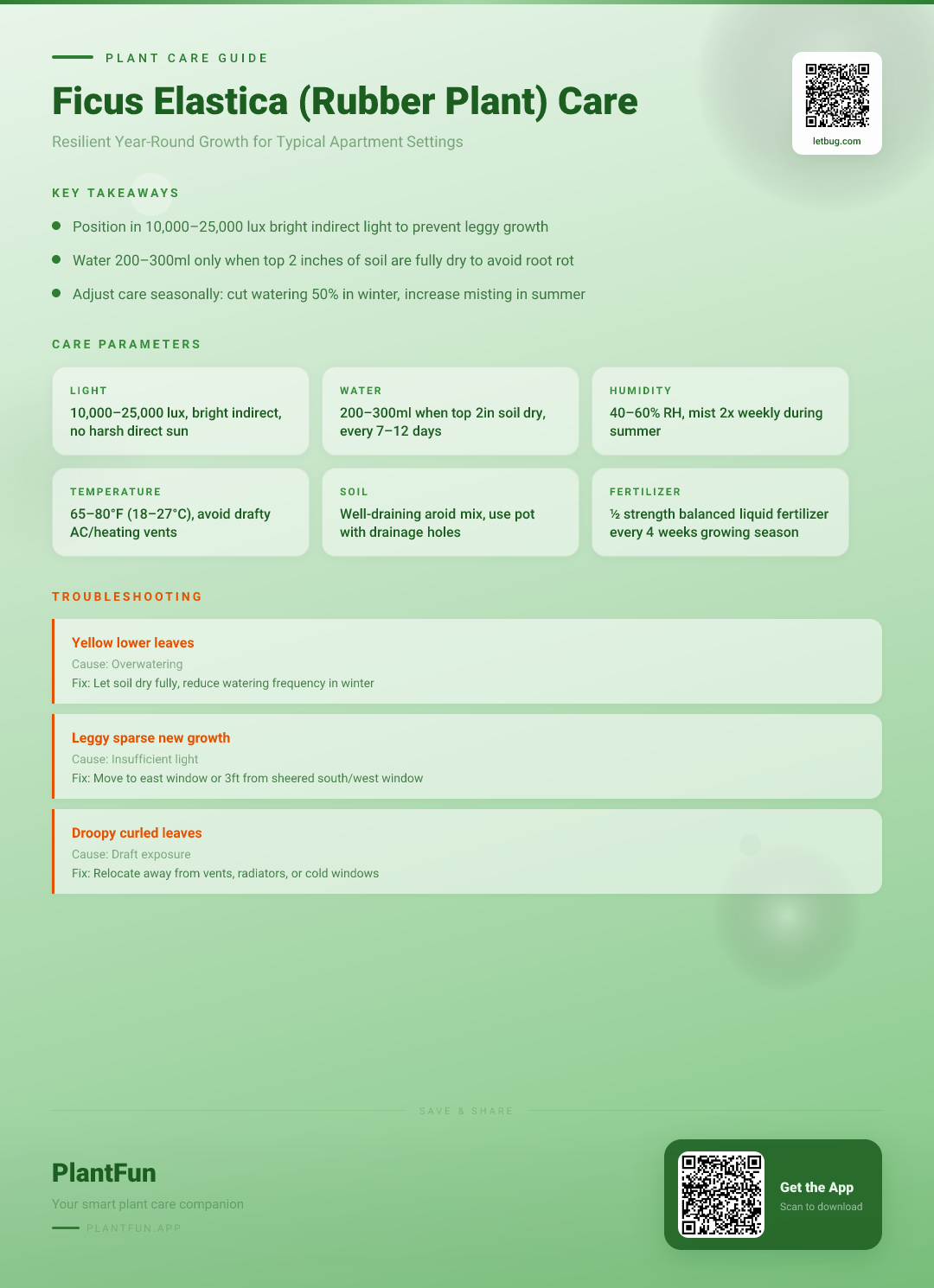
Key Takeaways
- Check soil moisture before watering — overwatering is the #1 killer of houseplants.
- Ensure your plant gets the right amount of light for its species.
- Be patient with recovery — most plants need 2–4 weeks to bounce back.
Quick Care Card: At-a-glance measurable care thresholds for busy apartment dwellers (light lux, water volume, humidity, temperature ranges)
| Parameter | Measurable Threshold for Apartments |
|---|---|
| Light | 10,000–25,000 lux bright indirect |
| Water | 200–300ml when top 2 inches of soil are fully dry |
| Humidity | 40–60% relative humidity |
| Temperature | 65–80°F (18–27°C) |
Quick Care Card: Exact soil mix, fertilization schedule, and pruning cheat sheet for fast reference
| Category | Exact Cheat Sheet |
|---|---|
| Soil Mix | 60% potting soil + 20% perlite + 20% orchid bark (well-draining aroid mix) |
| Fertilization | ½ strength balanced 10-10-10 liquid fertilizer every 4 weeks in spring/summer |
| Pruning | Only remove fully yellow/brown damaged leaves with sterile sharp shears |
| Toxicity | Toxic to cats, dogs, and humans if ingested (ASPCA, 2026) |
Why This Guide Is Tailored For Typical Apartments
Native to the dappled, humid tropical forests of South Asia, Ficus elastica evolved to receive consistent bright light, warm temperatures, and regular rainfall. But standard North American apartments have very different conditions: low to medium natural light, dry forced air heat in winter, frequent drafts from vents and entryways, and limited placement options. This guide cuts through generic tropical plant care advice to give you actionable, low-cost fixes tailored exactly to these apartment conditions, no expensive grow lights or humidifiers required. Phylogenetic analysis of 10 Ficus species confirms rubber plants have evolved natural tolerance to variable growing conditions, making them far more adaptable to apartment life than many houseplant resources claim (Huang et al., 2022). This guide is perfect for rubber plant care for beginners and intermediate owners alike.
Myth vs Reality
Myth: Rubber plants need 70%+ tropical humidity to thrive. Reality: NC State Extension data shows they adapt perfectly to 40% humidity, the standard level for most heated apartments in winter (NC State Extension, 2026).
Step 1: Light Setup for Apartment Rubber Plants
Rubber plants require 10,000–25,000 lux of bright indirect light to grow full, lush foliage (NC State Extension, 2026). To hit this threshold in your apartment without harsh leaf burn, use these placement options:
- East-facing window: Receives soft morning sun that won’t scorch leaves, and hits the ideal lux range 90% of the year
- 3ft away from a south or west-facing window with a sheer curtain: Blocks harsh midday sun while still letting in enough bright light
Quick test: Hold your hand 1ft above the plant at midday on a sunny day. If you see a soft, fuzzy-edged shadow, the light is perfect. A sharp, dark shadow means the light is too strong, and no shadow means the light is too low. If you’re unsure how to measure light levels, check our guide to testing lux for houseplants for simple, no-tool tricks. This meets all rubber plant light requirements for apartments.
Step 2: Watering Routine That Avoids Root Rot
The #1 cause of rubber plant death in apartments is overwatering. Follow this exact routine to avoid root rot: Water 200–300ml only when the top 2 inches of soil are fully dry, which works out to every 7–12 days depending on the season (NC State Extension, 2026).
Quick test: Stick your index finger 2 inches deep into the soil. If it’s completely dry with no dampness, it’s time to water. If there’s any moisture, wait 2-3 days and test again. Always empty excess water from the saucer 10 minutes after watering to avoid roots sitting in standing water. If you’re prone to overwatering, our guide to houseplant watering mistakes has more easy hacks. This answers the common question of how often to water rubber plant for apartment dwellers.
Step 3: Humidity & Temperature Adjustments for Apartments
Rubber plants thrive in 40–60% relative humidity and temperatures between 65–80°F (18–27°C) (NC State Extension, 2026). You don’t need a humidifier to hit these thresholds: group your rubber plant with other houseplants to naturally raise humidity via transpiration, or set it on a pebble tray filled with water (make sure the pot sits on the pebbles, not directly in the water).
Never place your rubber plant within 3ft of drafty AC vents, heating radiators, or cold entryways, as sudden temperature swings cause leaf drop. For more low-cost humidity hacks, see our guide to increasing humidity without a humidifier. This covers all rubber plant humidity needs for standard apartments.
Step 4: Soil, Fertilizer, & Pruning Best Practices
The best soil for rubber plant in apartments is a well-draining aroid mix: 60% standard potting soil, 20% perlite, and 20% orchid bark. This mix drains fast enough to avoid root rot while still holding enough moisture for healthy growth.
Fertilize with ½ strength balanced 10-10-10 liquid fertilizer every 4 weeks only during the spring and summer growing season. Stop fertilizing entirely in fall and winter, when growth slows down.
For pruning, only remove fully yellow or brown damaged leaves with sterile sharp scissors. You don’t need to prune healthy foliage unless you want to encourage branching, which you can do by cutting the top 2 inches off the main stem during the growing season.
Note: Rubber plant sap is toxic to cats, dogs, and humans if ingested, causing mouth irritation and vomiting (ASPCA, 2026). Keep plants on high shelves out of reach of curious pets and small children.
Seasonal Care Calendar
Winter Care Adjustments
Winter is the highest-risk season for apartment rubber plants, thanks to dry forced air and cold drafts. Follow these tweaks:
- Reduce watering by 50%: Only give 100–150ml when the top 3 inches of soil are fully dry, approximately every 14–21 days
- Stop fertilizing entirely until spring
- Move plants 1ft away from cold single-pane windows to avoid leaf damage from frost For more winter care tips, see our guide to winter houseplant care mistakes. This covers all rubber plant winter care requirements.
Summer Care Tweaks
Summer is the active growing season for rubber plants, so adjust your routine accordingly:
- Check soil moisture every 5 days, as higher temperatures dry out soil faster
- Increase misting to 2x per week if humidity drops below 40%
- Wipe leaves with a damp cloth once a month to remove dust, which blocks light absorption This covers all rubber plant summer watering needs for apartment conditions.
Common Mistake 1: Overwatering (most frequent apartment issue)
Symptom: Yellow leaves on the lower portion of the plant, mushy stems, soil that stays damp for more than 2 weeks after watering
Likely cause: Watering on a fixed schedule instead of testing soil moisture, or using a poorly draining soil mix
Fix:
- Tip out all standing water from the saucer immediately, and move the plant to a sunnier spot for 2-3 days to speed up soil drying
- If leaves continue to yellow after 1 week, gently remove the root ball, cut off any mushy brown roots with sterile scissors, and repot in fresh dry aroid mix
- For future waterings, always test the top 2 inches of soil before adding water This is the fastest how to fix overwatered rubber plant method for mild to moderate cases, no repotting required for early stages.
Common Mistake 2: Too Little Light
Symptom: Leggy growth with long gaps between leaves, small pale new foliage, the plant leaning heavily towards the nearest light source
Likely cause: Placement in a low-light area with less than 10,000 lux of light Fix (no expensive grow lights required):
- Move the plant to an east-facing window, or 3ft away from a south/west window with a sheer curtain
- Rotate the pot 15 degrees every week to ensure all sides of the plant get even light exposure
- Wipe leaves monthly to remove dust that blocks light absorption This is the easiest rubber plant leggy growth fix for apartment dwellers, and answers whether can rubber plant survive low light apartments (they can short-term, but will not thrive long-term).
Common Mistake 3: Wrong Placement
Symptom: Sudden, widespread leaf drop, brown crispy leaf edges, stunted growth
Likely cause: Placement near drafty vents, radiators, cold windows, or dark hallways with frequent air flow
Fix:
- Move the plant at least 3ft away from any heating or cooling vents, radiators, or drafty entry doors
- Keep it 1ft away from single-pane windows in winter to avoid exposure to cold glass
- Avoid placing it in dark hallways with no natural light, even if it fits the decor These are the most common rubber plant care mistakes for new apartment owners, and fixing placement will resolve 80% of sudden leaf drop issues.
Voice Search FAQ 1: Why is my rubber plant getting yellow leaves at the bottom?
Yellow lower leaves are almost always caused by overwatering. First, test the top 2 inches of soil: if it’s damp, stop watering until it dries out completely. If only 1-2 lower leaves yellow every few months, this is normal aging of older foliage, and no action is needed (NC State Extension, 2026).
Voice Search FAQ 2: Can I keep my rubber plant in a dark apartment corner?
It will survive for 1-2 months in a dark corner, but will develop leggy growth, stop producing new leaves, and eventually drop foliage. If you really want it in a dark corner for decor, rotate it to a bright spot for 2 weeks every month to keep it healthy.
Voice Search FAQ 3: How often do I need to water my rubber plant in winter?
Every 14-21 days, giving only 100-150ml of water, and only when the top 3 inches of soil are completely dry. Rubber plant growth slows significantly in winter, so they need 50% less water than in the growing season. Overwatering in winter is the #1 cause of rubber plant death for apartment dwellers.
References
- NC State Extension. (2026). The Complete Ficus — NC State Extension Gardener Plant Toolbox. https://plants.ces.ncsu.edu/plants/ficus-elastica/. Accessed 2026-03-06.
- Garg, K.; Sharma, J.; Bhargava, A. (2018). Antiarthritic activity of different plant extracts of Ficus religiosa stem bark in complete Freund’s adjuvantinduced arthritis in rats. Asian Pacific Journal of Health Sciences. https://doi.org/10.21276/apjhs.2018.5.2.35. Accessed 2026-03-06.
- Huang, Y.; Li, J.; Yang, Z. (2022). Comprehensive analysis of complete chloroplast genome and phylogenetic aspects of ten Ficus species. BMC Plant Biology. https://doi.org/10.1186/s12870-022-03643-4. Accessed 2026-03-06.
- ASPCA. (2026). Toxic and Non-Toxic Plants List — ASPCA. https://www.aspca.org/pet-care/animal-poison-control/toxic-and-non-toxic-plants. Accessed 2026-03-06.
Optional Helper: Plantfun.App
Plantfun.App identifies your plants by photo, diagnoses pests and diseases with clear fixes, and creates personalised watering and light schedules that adapt to your home conditions — a handy companion for putting this guide into daily practice.
Found an error or have suggestions? We'd love your feedback.
Need help identifying this problem?
Get instant identification, personalized care schedules, and effective pest treatment plans directly on your phone.
Sponsored • We may earn a commission from app downloads
Related Guides
The Complete Rubber Plant Care Checklist for Resilient Growth in Small Urban Apartments
Stop stunting your rubber plant’s growth in your apartment. Get 8 actionable care steps, exact light and water thresholds, and a free printable checklist for lush, resilient foliage year-round.
Care GuideFicus Elastica in Small Apartments: The Essential Rubber Plant Care Guide for Resilient Growth
Transform your Ficus elastica into a resilient centerpiece. Master these 4 exact care thresholds and a simple seasonal routine to ensure lush, consistent growth.
Care GuideThe Complete Ficus Elastica (Rubber Plant) Care Guide for Small Apartments: Get Lush Resilient Growth
Grow a lush, resilient rubber plant even in your small apartment. Get exact light levels, watering amounts, and space-saving tips for glossy, low-fuss foliage that won’t outgrow its nook.
Pest ControlAnts on Plants: What They Mean and What to Do
Ants usually aren't eating your plant. They are farming other pests.