
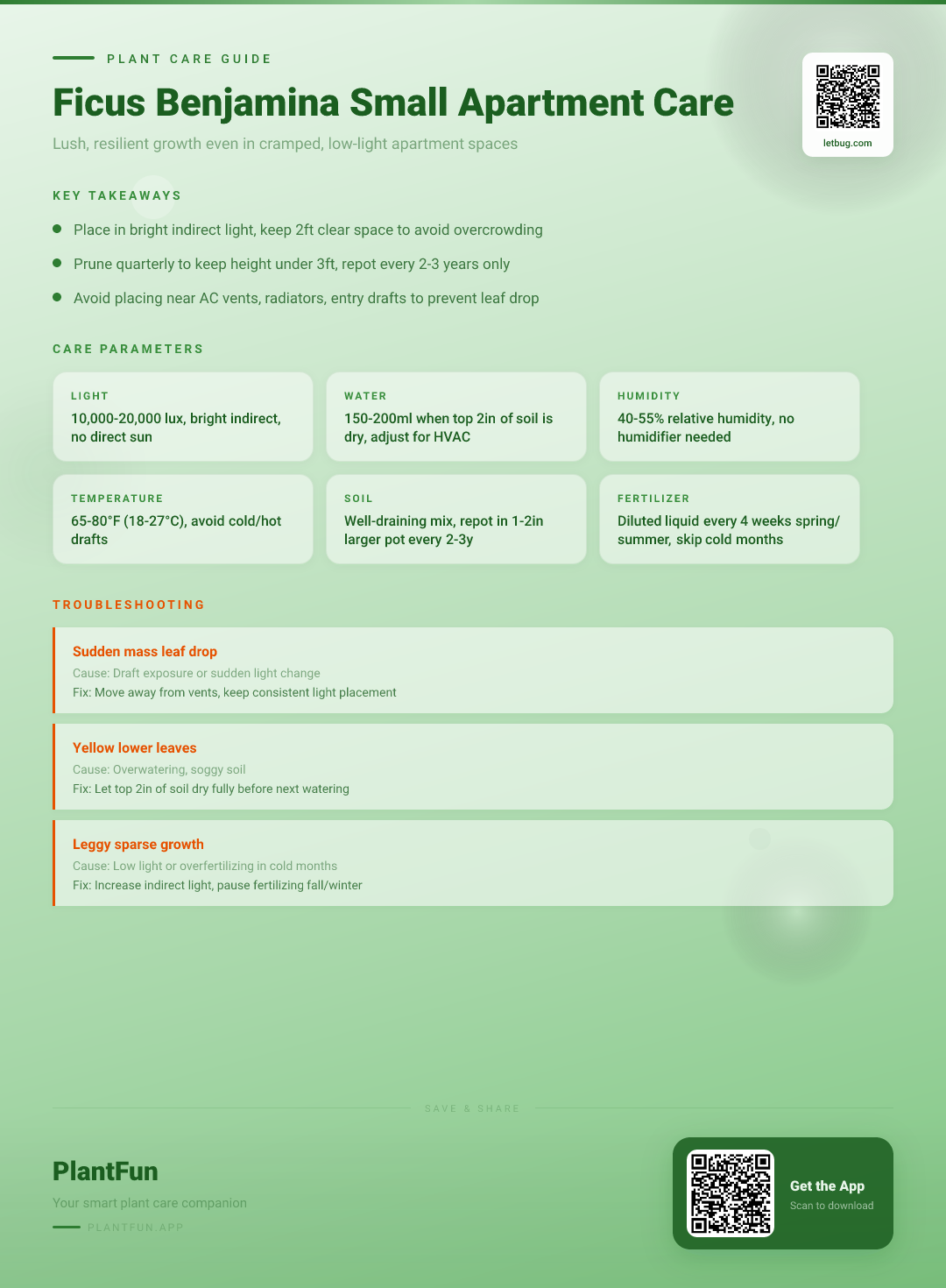
Key Takeaways
- Check soil moisture before watering — overwatering is the #1 killer of houseplants.
- Ensure your plant gets the right amount of light for its species.
- Be patient with recovery — most plants need 2–4 weeks to bounce back.
Quick Care Card
| Care Factor | Small Apartment Threshold |
|---|---|
| Light | 10,000-20,000 lux bright indirect light |
| Water | 150-200ml when top 2 inches of soil are completely dry |
| Humidity | 40-55% relative humidity |
| Temperature | 65-80°F (18-27°C) |
| Soil | 3 parts all-purpose potting mix + 1 part perlite + 1 part orchid bark |
| Fertilizer | 1/2 strength balanced liquid fertilizer every 4 weeks (spring/summer only) |
| Pruning | Quarterly to maintain <3ft height and <18in width |
| Toxicity | Toxic to cats, dogs, and humans if ingested (ASPCA, 2026) |
Why This Guide Is Different
Generic Ficus Benjamina care advice is designed for spacious homes with consistent light, low HVAC use, and plenty of floor space. For 600-800 sq ft urban 1-bedroom apartments, common constraints like variable light, dry forced air, and limited square footage make standard checklists ineffective, often leading to rampant overgrowth or the Ficus Benjamina leaf drop that plagues many new owners.
Myth vs Reality: Generic guides often claim Ficus Benjamina needs full sun and 60%+ humidity to thrive, but NC State Extension research shows apartment-grown weeping figs adapt perfectly to 10,000-20,000 lux bright indirect light and 40-55% humidity if acclimated slowly (NC State Extension, 2026). This guide cuts through generic advice to deliver space-optimized, measurable steps tailored to your apartment’s unique conditions, with no expensive equipment required. ASPCA notes this species is toxic to pets and children, so all placement tips prioritize safety for small households (ASPCA, 2026).
Step 1: Optimal Small-Space Placement
Smart Ficus Benjamina placement in apartment layouts saves valuable floor space while meeting light requirements. Follow these rules:
- Choose wall-mounted floating shelves 4-5ft high in south or east-facing corner nooks to free up floor space and keep the plant out of reach of pets and small children
- Leave 2ft of clear space around the entire canopy to avoid leaf damage from brushing against walls, furniture, or foot traffic
- Meet Ficus Benjamina light requirements of 10,000-20,000 lux bright indirect light (NC State Extension, 2026). Quick test: Hold your hand up at midday in the spot; a soft, fuzzy shadow (no sharp edges) confirms perfect light levels.
If your apartment lacks bright natural light, our guide to the best compact grow lights for small spaces [https://letbug.com/best-compact-grow-lights-small-apartments] can help you meet light requirements without taking up extra room.
Step 2: Watering Schedule for Apartment Conditions
This section answers the most common question for new owners: how often to water Ficus Benjamina in small apartments.
- Give 150-200ml of room-temperature water only when the top 2 inches of soil are completely dry. Quick test: Stick your index finger 2 inches into the soil; if no dampness sticks to your skin, it’s time to water.
- Adjust for seasonal HVAC use: Ficus Benjamina summer watering frequency is every 7-10 days if AC runs constantly, while Ficus Benjamina winter care requires cutting back to every 14-21 days when heating is on, as soil dries slower in cool, dry air.
- Always pour water directly onto the soil, not the leaves, to avoid fungal growth.
Overwatering is the leading cause of root rot in weeping figs, which triggers widespread leaf drop and can kill the plant (Bolton, 1984). If you struggle to tell when your soil is dry, check our list of low-cost, space-saving soil moisture meters [https://letbug.com/soil-moisture-meters-for-apartments] to eliminate guesswork.
Step 3: Humidity & Temperature Tuning
Ficus Benjamina humidity needs indoors are 40-55% relative humidity, with a temperature range of 65-80°F (18-27°C) (NC State Extension, 2026). You don’t need a bulky humidifier to hit these thresholds in small apartments; try these space-saving hacks:
- Place a 4-inch tray of pebbles and water under the pot, making sure the pot’s drainage holes sit above the water line to avoid root rot
- Group your ficus with 2-3 other small plants to create a humid microclimate
- Mist the canopy 2x weekly in winter when forced heating dries out indoor air
Avoid placing your ficus near kitchens or bathrooms, where extreme humidity swings from cooking or showering can trigger leaf drop. For more no-humidifier solutions, see our 5 easy humidity hacks for apartment plants [https://letbug.com/humidity-hacks-apartment-plants] to meet humidity needs without extra equipment.
Step 4: Space-Saving Pruning Routine
This step covers how to prune Ficus Benjamina to save space and how to keep Ficus Benjamina small enough for tight quarters:
- Prune once every 3 months (quarterly) to maintain a maximum height of 3ft and width of 18 inches, perfect for small living rooms and corners
- Snip 2-3 inches of new growth from the top of the plant to limit vertical growth, and trim back any outward-facing branches that extend more than 6 inches from the main stem to avoid wide, space-hogging growth
- Use clean, sharp pruning shears, and wipe cuts with a damp cloth to stop sap leakage
- Prune in early spring before new growth starts for best results
If you’re new to pruning houseplants, our beginner’s guide to damage-free pruning [https://letbug.com/pruning-indoor-plants-for-beginners] walks you through every step without harming your plant.
Step 5: Soil & Repotting for Small Containers
Use a well-draining soil mix of 3 parts all-purpose potting mix, 1 part perlite, and 1 part orchid bark to prevent root rot (Bolton, 1984). Follow these repotting rules to limit growth and save space:
- Repot only every 2-3 years, when roots are visibly growing out of the drainage holes
- Choose a new pot that is only 1-2 inches larger than the current pot to intentionally restrict root growth, which keeps the plant compact
- If you don’t want your ficus to grow at all, trim 1/3 of the root ball and repot it back into the same container with fresh soil
Never repot into a pot 3+ inches larger, as excess soil holds unwanted moisture that causes root rot (Bolton, 1984).
Step 6: Fertilizing for Resilient Growth
Avoid leggy, space-hogging growth with this simple fertilizing schedule:
- Use 1/2 strength balanced liquid all-purpose fertilizer, applied once every 4 weeks only in spring and summer, when the plant is actively growing
- Skip fertilizing entirely in fall and winter, as excess nutrients cause weak, leggy growth that is prone to leaf drop
- Always water the plant first before applying fertilizer to avoid burning the roots
Step 7: Draft Protection for Apartment Layouts
Sudden temperature changes from drafts are a top trigger for Ficus Benjamina leaf drop (NC State Extension, 2026). Follow these rules for apartment layouts:
- Never place your ficus within 3ft of AC vents, radiators, front entry doors, or window sills that get cold winter drafts
- If your only available spot is near a vent, use a small draft blocker (you can make one from a rolled-up towel) between the vent and the plant to deflect air flow
- Avoid moving the plant frequently, as sudden changes in light or temperature can also trigger leaf drop
Seasonal Care Calendar for Apartments
Follow this month-by-month adjustment guide tailored to apartment conditions:
- Jan-Feb (Winter): Cut watering to every 14-21 days, mist 2x weekly to combat heating dryness, keep away from radiators, skip all fertilizer
- Mar-Apr (Spring): Increase watering to every 7-10 days, complete quarterly pruning to control size, apply first fertilizer dose of the year, acclimate slowly to longer daylight hours
- May-Aug (Summer): Follow Ficus Benjamina summer watering schedule of every 7 days if AC runs constantly, check soil moisture twice weekly, keep away from AC vents, apply fertilizer every 4 weeks
- Sep-Oct (Fall): Reduce watering to every 10-14 days, stop fertilizing entirely, trim any leggy summer growth, move away from windows that will get cold drafts as temperatures drop
- Nov-Dec (Late Fall/Winter): Cut watering to every 14-21 days, avoid placement near cold entry doors, skip fertilizer, mist weekly to counteract heating dryness
Common Small-Apartment Mistakes to Avoid
These errors cause 90% of leaf drop and growth issues for apartment-grown weeping figs:
- Mistake: Overpotting into a pot 3+ inches larger to avoid frequent repotting. What happens: Excess soil holds too much moisture, leading to root rot and severe Ficus Benjamina leaf drop (Bolton, 1984). Instead: Repot only every 2-3 years into a pot 1-2 inches larger, or root prune and reuse the same pot to limit growth.
- Mistake: Placing your ficus in low-light corners (less than 10,000 lux) to save space. What happens: The plant drops lower leaves, grows leggy, and becomes weak and prone to pests. Instead: Use a wall-mounted shelf near a bright window, or add a small compact grow light if no bright spot is available.
- Mistake: Watering on a fixed schedule without checking soil moisture. What happens: Soggy soil causes root rot, the leading cause of death for apartment-grown weeping figs (Bolton, 1984). Instead: Only water when the top 2 inches of soil are completely dry, adjust frequency for HVAC use and seasons.
- Mistake: Skipping pruning to save time. What happens: The ficus can grow up to 6ft tall and 3ft wide in just 2 years, taking up valuable living space in small apartments. Instead: Follow the quarterly pruning routine to keep the plant under 3ft tall and compact.
Voice Search FAQ
Can I keep my Ficus Benjamina in a small living room?
Absolutely. With regular quarterly pruning and wall-mounted placement, you can easily keep a weeping fig under 3ft tall, so it fits perfectly even in 600 sq ft 1-bedroom apartments without crowding furniture. Just make sure it gets 10,000-20,000 lux of bright indirect light, and avoid drafty spots.
Why is my apartment Ficus dropping leaves?
The most common causes for Ficus Benjamina leaf drop in apartments are exposure to drafts from AC vents or entry doors, overwatering, light levels below 10,000 lux, or sudden changes in temperature or humidity (NC State Extension, 2026). Check your placement first, then test soil moisture to rule out overwatering.
How do I keep my Ficus Benjamina small?
To keep your ficus compact for small spaces, prune 2-3 inches of new top growth and trim back outward-facing branches every 3 months, repot only every 2-3 years into a pot only 1-2 inches larger than the current one, and skip fertilizing in fall and winter to avoid leggy growth.
How often to water Ficus Benjamina in an apartment?
Water 150-200ml only when the top 2 inches of soil are completely dry. For most apartments, this works out to every 7-10 days in summer when AC is running, and every 14-21 days in winter when heating is on.
References
- NC State Extension. (2026). The Complete Ficus Benjamina — NC State Extension Gardener Plant Toolbox. https://plants.ces.ncsu.edu/plants/benjamina-care/. Accessed 2026-02-28.
- Bolton, A. (1984). Root Rot of <i>Ficus benjamina</i>. Plant Disease. https://doi.org/10.1094/pd-69-816. Accessed 2026-02-28.
- Bolton, A. (1984). Root Rot of <i>Ficus benjamina</i>. Plant Disease. https://doi.org/10.1094/pd-68-816. Accessed 2026-02-28.
- ASPCA. (2026). Toxic and Non-Toxic Plants List — ASPCA. https://www.aspca.org/pet-care/animal-poison-control/toxic-and-non-toxic-plants. Accessed 2026-02-28.
Optional Helper: Plantfun.App
Plantfun.App identifies your plants by photo, diagnoses pests and diseases with clear fixes, and creates personalised watering and light schedules that adapt to your home conditions — a handy companion for putting this guide into daily practice.
Found an error or have suggestions? We'd love your feedback.
Need help identifying this problem?
Get instant identification, personalized care schedules, and effective pest treatment plans directly on your phone.
Sponsored • We may earn a commission from app downloads
Related Guides
The Complete Ficus Benjamina Care Checklist for Resilient Growth in Typical Apartments
Stop losing Ficus Benjamina leaves to apartment stress. Get 4 actionable seasonal care routines, measurable light/water thresholds, and a free printable checklist to boost steady, resilient growth year-round.
Care GuideThe Complete Ficus Benjamina Care Checklist for Resilient Growth in Small Apartments
Stop losing your Ficus Benjamina to tricky apartment growing conditions. Get 8 budget-friendly checklist items, exact care thresholds, and a seasonal guide to keep it lush and drop-free all year.
Care GuideFicus Benjamina in Small Urban Apartments: The Only Resilient Growth Checklist You’ll Ever Need
Stop losing leaves on your Ficus Benjamina. Grab our 8-step apartment-specific checklist with exact light, water, and humidity thresholds to keep your tree lush and resilient year-round.
Pest ControlAnts on Plants: What They Mean and What to Do
Ants usually aren't eating your plant. They are farming other pests.