
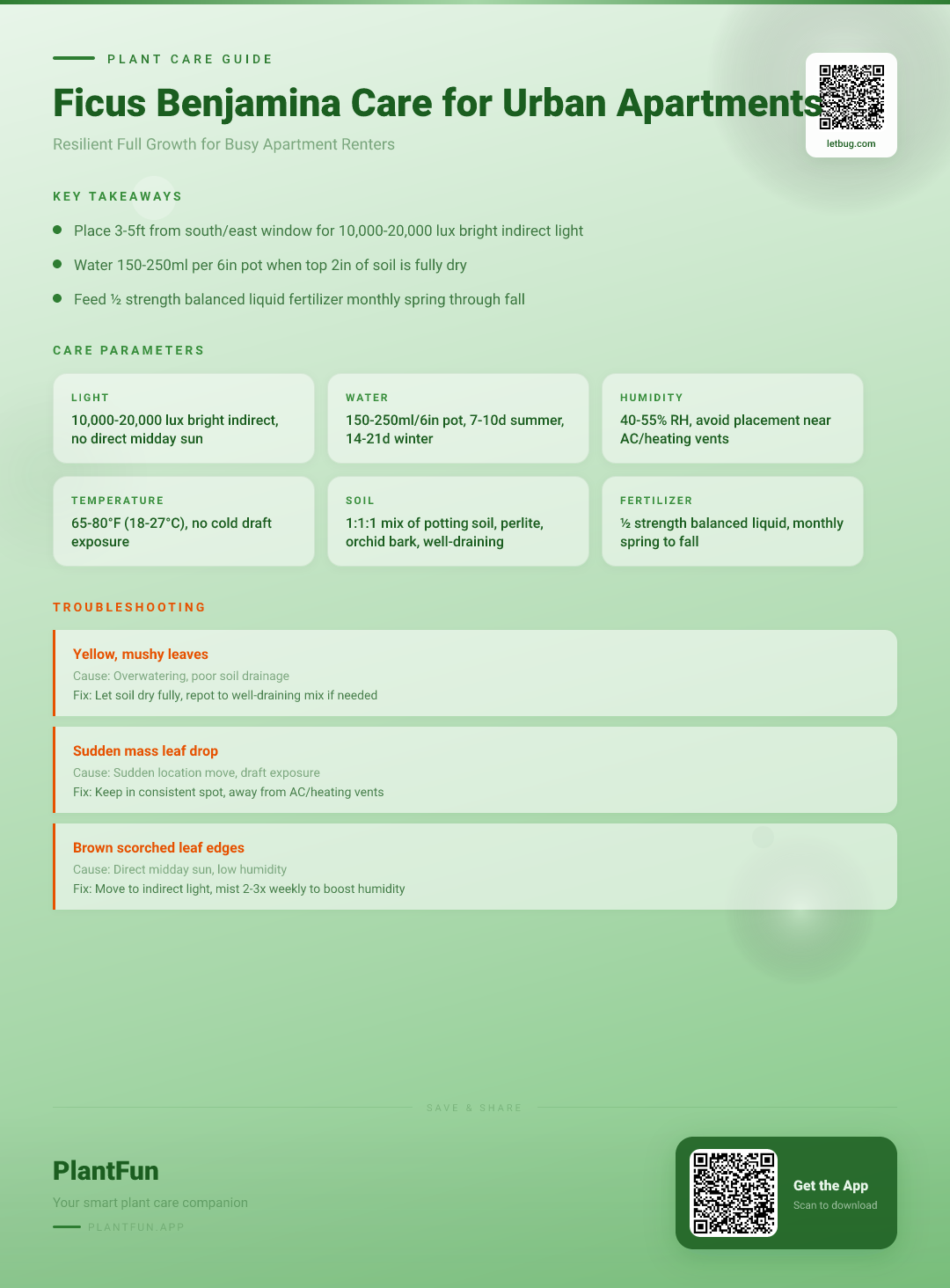
Key Takeaways
- Check soil moisture before watering — overwatering is the #1 killer of houseplants.
- Ensure your plant gets the right amount of light for its species.
- Be patient with recovery — most plants need 2–4 weeks to bounce back.
Quick Care Card
| Parameter | Exact Apartment-Specific Threshold |
|---|---|
| Light | 10,000-20,000 lux bright indirect light, 3-5ft from south/east facing window, no midday direct sun |
| Water | 150-250ml per 6in pot when top 2in of soil is dry; 7-10 days summer, 14-21 days winter |
| Humidity | 40-55% relative humidity |
| Temperature | 65-80°F (18-27°C), no placement within 2ft of AC/heating vents |
| Soil | 1:1:1 mix of potting soil, perlite, orchid bark |
| Fertilizer | ½ strength balanced liquid fertilizer, 1x per month spring through fall |
| Toxicity | Toxic to cats, dogs, and humans if ingested (ASPCA, 2026) |
Why Ficus Benjamina Struggles in Typical Urban Apartments
Most generic Ficus Benjamina care guides are written for spacious suburban homes, not the unique constraints of 500-1000 sq ft urban rentals. The top stressors for apartment-grown ficus include forced air HVAC that dries out foliage in 48 hours, drafty window frames that cause 10+°F temperature swings overnight, limited bright floor space, and inconsistent watering schedules from busy renters.
Myth: Ficus Benjamina are inherently fussy plants that drop leaves for no reason. Reality: Leaf drop is a targeted stress response to abrupt changes in their environment, which are extremely common in urban apartment settings (NC State Extension, 2026). This guide cuts through generic advice to give you measurable, apartment-specific steps to keep your ficus full and resilient.
Step 1: Light Placement Checklist for Steady Growth
Ficus Benjamina light requirements are specific for indoor growth: aim for 10,000-20,000 lux of bright indirect light, 3-5 feet from a south or east-facing window (NC State Extension, 2026). Direct midday sun will scorch delicate leaves, causing brown edges and premature drop.
Quick test: Hold your hand up at plant height at noon. If you see a sharp, defined shadow, the light is too intense — move the plant 1 foot back, or hang a sheer curtain to filter harsh rays. For small apartments, use a narrow plant stand to fit the ficus next to the window without taking up valuable floor space.
Step 2: Exact Watering Schedule to Avoid Sudden Leaf Drop
Wondering how often to water Ficus Benjamina in an apartment? For a standard 6-inch pot, give 150-250ml of room-temperature water only when the top 2 inches of soil are completely dry. This translates to every 7-10 days in summer, and every 14-21 days in winter when growth slows (NC State Extension, 2026).
Quick test: Stick your index finger 2 inches into the soil, past the top layer of mulch. If it feels completely dry, it’s time to water. Never water on a fixed schedule without checking soil moisture first — overwatering is the top cause of root rot in indoor ficus (Bolton, 1984). For more tips, check out our guide to testing soil moisture for indoor plants.
Step 3: Humidity & Temperature Requirements for Apartment Settings
Ficus Benjamina humidity needs fall between 40-55% relative humidity, with a stable temperature range of 65-80°F (18-27°C) (NC State Extension, 2026). Never place your ficus within 2 feet of AC or heating vents: forced air strips moisture from leaves faster than the plant can replace it, triggering widespread leaf drop in 3 days or less.
Quick test: Place a $10 hygrometer next to the plant for 24 hours to measure average humidity. If levels fall below 40%, use a misting bottle or pebble tray to boost local moisture. For more low-effort hacks, see our full guide to boosting indoor humidity without a humidifier.
Step 4: Soil & Repotting Checklist for Small Spaces
Use a well-draining 1:1:1 mix of standard potting soil, perlite, and orchid bark to prevent soggy soil and root rot (Bolton, 1984). Follow this Ficus Benjamina repotting guide for small apartments: only repot every 2-3 years, moving the plant to a pot just 1 inch larger than its current container. Overpotting leaves excess wet soil around the roots, which leads to root rot even if you follow a perfect watering schedule (Bolton, 1984). For step-by-step repotting instructions, see our beginner’s repotting guide.
Step 5: Pruning & Feeding Routine for Full, Bushy Growth
Wondering how to make Ficus Benjamina grow faster and fuller? Feed it with ½ strength balanced liquid fertilizer once a month from spring through fall (NC State Extension, 2026). Skip fertilizing in winter when growth is dormant. In late winter, prune 1-2 inches of leggy, stretched growth to encourage branching. Never remove more than 20% of the plant’s foliage at once to avoid stress.
Seasonal Care Calendar for Year-Round Resilience
Winter (Ficus Benjamina winter care)
- Reduce watering to every 14-21 days, only when the top 2 inches of soil are dry
- Move the plant 1 foot away from drafty windows if nighttime temperatures drop below 60°F
- Stop fertilizing until early spring
Summer (Ficus Benjamina summer watering)
- Check soil moisture twice per week, as higher temperatures dry out soil faster
- Mist 2x per week if humidity drops below 40%
- Rotate the plant ¼ turn every 2 weeks for even, symmetrical growth
3 Most Common Ficus Benjamina Apartment Care Mistakes to Avoid
- Mistake: Overwatering on a fixed schedule without checking soil moisture first. What happens: Soggy soil leads to root rot (Bolton, 1984), which causes yellowing leaves and sudden widespread leaf drop. Instead: Use the 2-inch finger test before every watering, and only give 150-250ml per 6-inch pot.
- Mistake: Moving the ficus to a new location abruptly. What happens: Sudden changes in light or temperature trigger a stress response that makes the plant drop up to 50% of its leaves in 3 days (NC State Extension, 2026). Instead: If you need to move it, shift it 1 foot per day over 3-4 days to acclimate it gradually.
- Mistake: Leaving it in extended direct midday sun. What happens: Delicate leaves get scorched, turning brown at the edges and dropping prematurely. Instead: Keep it 3-5 feet back from south/east windows, or hang a sheer curtain to filter harsh midday sun.
Frequently Asked Questions
Why is my Ficus Benjamina dropping leaves all of a sudden?
Follow these 3 quick diagnostic steps to find the root cause: 1. Check if you moved the plant recently or placed it near a new vent/draft (acclimate it gradually if so). 2. Stick your finger 2 inches into the soil — if it’s soggy, you’re overwatering; if it’s bone dry for more than 3 days, you’re underwatering. 3. Check light levels with a cheap lux meter — if it’s below 8,000 lux, it’s not getting enough light (NC State Extension, 2026). These simple checks will show you exactly how to stop Ficus Benjamina from dropping leaves fast.
Can I keep my Ficus Benjamina in a north-facing apartment?
Yes! Ficus Benjamina can grow in low light apartments if you supplement with a full-spectrum grow light placed 12-18 inches above the plant for 10-12 hours per day, if natural light levels are below 8,000 lux (NC State Extension, 2026). For budget-friendly options, see our roundup of affordable apartment-friendly grow lights.
How often should I mist my Ficus Benjamina in a dry apartment?
Mist 2-3 times per week in winter when forced air heating is running, or 1-2 times per week in summer if humidity is below 40%. If you don’t have time for regular misting, use a pebble tray: fill a tray with pebbles and water, set the pot on top of the pebbles (make sure the pot isn’t sitting in standing water) to boost local humidity by 10-15%.
Printable Apartment Ficus Care Checklist Download
Grab our free, 1-page fridge-friendly Ficus Benjamina care checklist here. It includes all the exact measurements and quick checks you need, no extra fluff, so you can reference it in 10 seconds during your weekly plant care routine.
References
- NC State Extension. (2026). The Complete Ficus Benjamina — NC State Extension Gardener Plant Toolbox. https://plants.ces.ncsu.edu/plants/benjamina-care/. Accessed 2026-03-07.
- Bolton, A. (1984). Root Rot of Ficus benjamina. Plant Disease. https://doi.org/10.1094/pd-69-816. Accessed 2026-03-07.
- Bolton, A. (1984). Root Rot of Ficus benjamina. Plant Disease. https://doi.org/10.1094/pd-68-816. Accessed 2026-03-07.
- ASPCA. (2026). Toxic and Non-Toxic Plants List — ASPCA. https://www.aspca.org/pet-care/animal-poison-control/toxic-and-non-toxic-plants. Accessed 2026-03-07.
Optional Helper: Plantfun.App
Plantfun.App identifies your plants by photo, diagnoses pests and diseases with clear fixes, and creates personalised watering and light schedules that adapt to your home conditions — a handy companion for putting this guide into daily practice.
Found an error or have suggestions? We'd love your feedback.
Need help identifying this problem?
Get instant identification, personalized care schedules, and effective pest treatment plans directly on your phone.
Sponsored • We may earn a commission from app downloads
Related Guides
The Complete Ficus Benjamina Care Checklist for Resilient Growth in Typical Apartments
Stop losing Ficus Benjamina leaves to apartment stress. Get 4 actionable seasonal care routines, measurable light/water thresholds, and a free printable checklist to boost steady, resilient growth year-round.
Care GuideThe Complete Ficus Benjamina Care Checklist for Resilient Growth in Small Apartments
Stop losing your Ficus Benjamina to tricky apartment growing conditions. Get 8 budget-friendly checklist items, exact care thresholds, and a seasonal guide to keep it lush and drop-free all year.
Care GuideFicus Benjamina in Small Urban Apartments: The Only Resilient Growth Checklist You’ll Ever Need
Stop losing leaves on your Ficus Benjamina. Grab our 8-step apartment-specific checklist with exact light, water, and humidity thresholds to keep your tree lush and resilient year-round.
Pest ControlAnts on Plants: What They Mean and What to Do
Ants usually aren't eating your plant. They are farming other pests.