
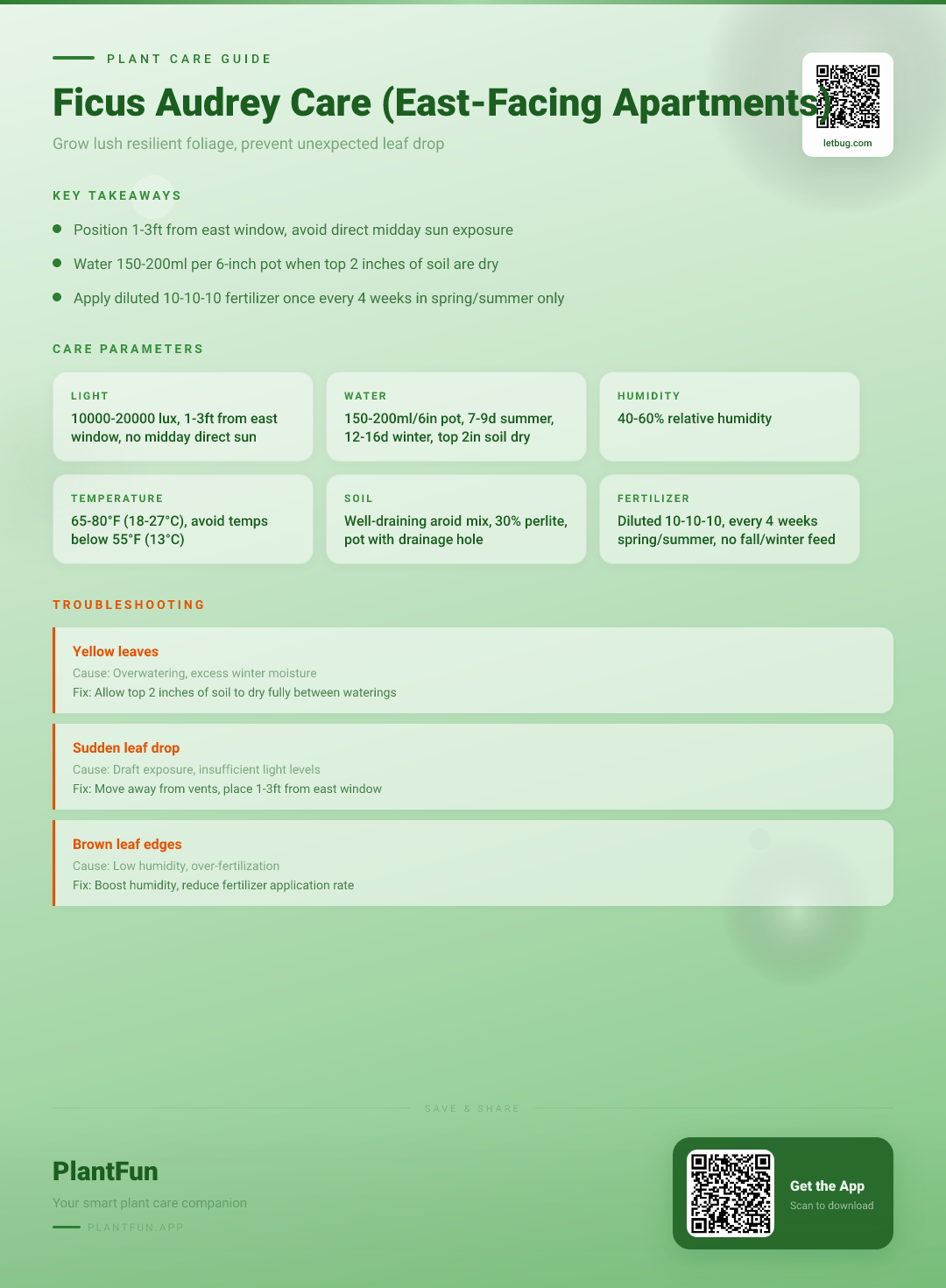
Key Takeaways
- Check soil moisture before watering — overwatering is the #1 killer of houseplants.
- Ensure your plant gets the right amount of light for its species.
- Be patient with recovery — most plants need 2–4 weeks to bounce back.
Quick Care Card
| Care Parameter | Exact Threshold for East-Facing Apartments |
|---|---|
| Light | 10,000-20,000 lux, 1-3ft from east window, 1-2hrs soft direct morning sun only |
| Water | 150-200ml per 6-inch pot, when top 2 inches of soil are dry; 7-9 days summer, 12-16 days winter |
| Humidity | 40-60% relative humidity |
| Temperature | 65-80°F (18-27°C), no exposure below 55°F (13°C) |
| Soil | Well-draining aroid mix with 30% perlite |
| Fertilizer | Diluted 10-10-10 balanced, every 4 weeks spring/summer, no fertilizing fall/winter |
| Toxicity | Toxic to cats, dogs, and humans if ingested (ASPCA, 2026) |
Why This Guide Is Different From Generic Ficus Audrey Advice
Generic Ficus Audrey care advice is often written for greenhouse conditions: 70%+ humidity, consistent 20,000+ lux bright indirect light, and no temperature fluctuations. Standard east-facing apartments have very different baseline conditions: 1-2 hours of soft direct morning sun, 30-40% average humidity, and regular drafts from window seals, AC units, and heating vents. This guide cuts through vague terms like “bright indirect light” to give measurable thresholds matched exactly to your space, so you never have to guess if your setup is right. If you’re new to growing ficuses, start with our beginner’s guide to low-fuss indoor ficus varieties to build your foundational knowledge.
Myth vs Reality
Myth: Ficus Audrey needs bright south-facing sun to thrive. Reality: East-facing windows provide the perfect amount of gentle morning sun for this species, avoiding the scorching midday and afternoon sun that damages its leathery leaves (NC State Extension, 2026).
Understanding the Science of Ficus Audrey Care
Phylogenetic analysis of 10 Ficus species (Huang et al., 2022) confirms Ficus Audrey (Ficus benghalensis) is closely related to the sacred fig (Ficus religiosa), native to subtropical South Asia where it grows under dappled forest canopy with moderate humidity and consistent warm temperatures. Research on Ficus species extracts (Garg et al., 2018) notes their thick, waxy leaves are adapted to store moisture, making them far more tolerant of underwatering than overwatering, a key detail for apartment growers who often overcorrect for low humidity.
Common Ficus Audrey Mistakes East-Facing Apartment Owners Make First
- Mistake: Placing the plant more than 3 feet away from the east window. What happens: Light levels drop below 8,000 lux, leading to stunted growth and frequent leaf drop. Instead: Keep it 1-3 feet from the window, with no obstructions like heavy blinds or curtains between the plant and glass during morning hours.
- Mistake: Overwatering in winter when light levels are low. What happens: Soggy soil leads to root rot, yellow lower leaves, and sudden mass leaf drop. Instead: Extend watering intervals to 12-16 days, and only water when the top 2 inches of soil are completely dry to the touch.
- Mistake: Ignoring drafty edges near east windows or AC vents. What happens: Temperatures drop below 55°F, causing shock and leaf drop (NC State Extension, 2026). Instead: Move the plant at least 1 foot away from drafty window sills and AC/heating vents.
- Mistake: Using a dense potting mix with no perlite. What happens: Soil retains too much moisture, leading to root rot even if you follow watering guidelines. Instead: Use a well-draining aroid mix with 30% perlite to improve root aeration.
- Mistake: Fertilizing in fall and winter when the plant is dormant. What happens: Excess salts build up in the soil, burning root tips and causing brown leaf edges. Instead: Skip fertilizing entirely from October to February (Northern Hemisphere).
- Mistake: Repotting too frequently into an oversized pot. What happens: Extra soil holds excess moisture, leading to root rot and slow growth. Instead: Repot only when roots are growing out of the drainage hole, and only go up 1 inch in pot size at a time.
- Mistake: Leaving humidity at the standard 35% apartment level long-term. What happens: Leaf edges turn brown, and new leaves unfurl small or misshapen. Instead: Boost humidity to 40-60% with a pebble tray or small humidifier near the plant.
- Mistake: Moving the plant frequently to different spots in the apartment. What happens: Ficus Audrey is highly sensitive to environmental changes, leading to stress-induced leaf drop. Instead: Once you find a spot that meets light and temperature requirements, leave it there unless conditions change drastically.
Step 1: Light Placement Guide for East-Facing Spaces
Ficus Audrey light requirements for east-facing apartments are 10,000-20,000 lux, achieved by placing the plant 1-3 feet directly in front of an unobstructed east window (NC State Extension, 2026). The 1-2 hours of soft direct morning sun it gets in this spot is completely safe, but any direct sun after 11 AM will scorch leaves, so hang a sheer curtain if your window gets late-morning direct sun. Quick test: Use a cheap light meter app to measure lux at your chosen spot between 9 and 10 AM. If readings fall in the 10,000-20,000 lux range, your spot is perfect. If you don’t have a light meter, follow our step-by-step guide to measuring indoor light levels without special tools.
Step 2: Exact Watering Schedule & Amounts
For a 6-inch potted Ficus Audrey, water 150-200 ml when the top 2 inches of soil are completely dry: every 7-9 days in summer, and every 12-16 days in winter (NC State Extension, 2026). Water slowly until a small amount of liquid drains out the bottom of the pot, then empty the saucer immediately to avoid standing water that causes root rot. Quick test: Stick your index finger 2 inches into the soil. If it feels completely dry with no moisture, it’s time to water. If you struggle with overwatering, check our guide to common indoor plant watering mistakes to avoid costly errors.
Step 3: Humidity & Temperature Parameters
Maintain 40-60% relative humidity and a 65-80°F (18-27°C) temperature range, and never expose your plant to temperatures below 55°F (13°C) (Huang et al., 2022). East-facing apartments often have cold drafts near window seals and dry air from heating systems in winter, so use a cheap hygrometer to monitor conditions near your plant. If humidity is below 40%, a pebble tray (fill a tray with pebbles and water, set the pot on top, ensuring the pot is not sitting in water) can boost humidity by 5-10% without a humidifier.
Step 4: Soil & Potting Requirements for Apartment Growth
Use a well-draining aroid mix with 30% perlite to balance moisture retention and aeration (NC State Extension, 2026). You can make your own mix by combining 40% coco coir, 30% orchid bark, and 30% perlite. For young plants under 2 feet tall, use a 6-inch terracotta pot with 1 drainage hole: terracotta wicks excess moisture from soil, reducing overwatering risk for low-light east-facing spaces. Only go up 1 inch in pot size when repotting to avoid excess soil holding unwanted moisture.
Step 5: Fertilizing Routine for Resilient Growth
Use a diluted balanced 10-10-10 fertilizer once every 4 weeks in spring and summer, and skip fertilizing entirely in fall and winter (NC State Extension, 2026). Dilute the fertilizer to half the strength recommended on the package to avoid salt buildup in soil, which causes brown leaf edges. Regular, light fertilizing supports Ficus Audrey resilient growth, helping it produce thicker, lusher foliage and grow faster during the growing season.
Seasonal Care Calendar for East-Facing Apartments (Northern Hemisphere)
- March (Spring start): Gradually reduce watering intervals to 9 days, start fertilizing at half strength, and prune any dead or yellow leaves from winter. Rotate the pot 1/4 turn to encourage even growth.
- April-June (Peak spring growth): Water every 7-9 days, fertilize every 4 weeks, rotate 1/4 turn every 2 weeks, and monitor for new leaf growth to confirm conditions are ideal.
- July-August (Summer): Water every 7 days for Ficus Audrey summer watering, move the plant at least 1 foot away from AC vents to avoid drafts, and mist occasionally if humidity drops below 40%.
- September (Fall start): Gradually extend watering intervals to 10 days, stop fertilizing, and move the plant away from window edges if nighttime temperatures drop below 60°F.
- October-February (Winter): Follow Ficus Audrey winter care guidelines: water every 12-16 days, no fertilizing, keep 2 feet away from heating vents to avoid dry air scorch, and seal drafty window edges near the plant.
Troubleshooting Common Symptoms
Yellow Lower Leaves
Symptom: Older leaves at the bottom of the plant turn solid yellow and fall off over 1-2 weeks.
Likely cause: Overwatering, especially common in winter when light levels are low in east-facing apartments.
Fix:
- Let the top 3 inches of soil dry out completely before watering again.
- If the problem persists, check the roots for rot, trim any mushy brown roots, and repot in fresh, dry aroid mix.
Sudden Leaf Drop
Symptom: Multiple green, healthy-looking leaves fall off the plant in a 24-48 hour period.
Likely cause: Environmental stress from cold drafts, sudden temperature changes, or being moved to a new spot with lower light levels.
Fix:
- Move the plant back to its original spot if you recently moved it, and leave it in place once you find a location that meets light and temperature requirements.
- Seal drafty window edges or move the plant at least 1 foot away from AC/heating vents.
Brown Leaf Edges
Symptom: Crispy, brown edges on otherwise green, healthy leaves.
Likely cause: Humidity below 40%, or salt buildup in the soil from over-fertilizing.
Fix:
- Boost humidity to 40-60% with a pebble tray or small humidifier near the plant.
- Leach the soil by running 3x the pot volume of water through the pot to flush out excess salts, then avoid fertilizing for 8 weeks.
Stunted Growth
Symptom: No new leaf growth for 3+ months during spring and summer, or new leaves are smaller than average.
Likely cause: Light levels below 8,000 lux, or lack of nutrients from under-fertilizing.
Fix:
- Move the plant to within 3 feet of the east window to increase light levels to the 10,000-20,000 lux range.
- Start fertilizing with diluted 10-10-10 fertilizer every 4 weeks during the growing season.
Voice Search FAQ
Why is my Ficus Audrey dropping leaves?
The most common cause for leaf drop in east-facing apartments is environmental stress from cold drafts, sudden temperature changes, or light levels below 8,000 lux (NC State Extension, 2026). First check that your plant is not near a drafty window or AC vent, and measure light levels at its current spot to ensure it meets the 10,000-20,000 lux requirement.
Can I keep my Ficus Audrey near an east window?
Yes! East windows are actually ideal for Ficus Audrey, as they provide 1-2 hours of soft, direct morning sun that won’t scorch leaves, followed by bright indirect light for the rest of the day (NC State Extension, 2026). Just keep it 1-3 feet away from the window to avoid cold drafts near the glass.
How often do I water my Ficus Audrey in an east-facing apartment?
For a 6-inch potted Ficus Audrey, water 150-200 ml every 7-9 days in summer, and every 12-16 days in winter, only when the top 2 inches of soil are completely dry. Always empty the saucer after watering to avoid standing water that causes root rot. If you struggle to remember watering schedules, our free printable indoor plant watering tracker can help.
How to make Ficus Audrey grow faster?
To encourage fast, resilient growth, keep light levels between 10,000-20,000 lux, fertilize with diluted 10-10-10 fertilizer every 4 weeks during spring and summer, and maintain humidity between 40-60%. Rotate the pot 1/4 turn every 2 weeks to ensure even growth on all sides.
References
- NC State Extension. (2026). The Complete Ficus Audrey — NC State Extension Gardener Plant Toolbox. https://plants.ces.ncsu.edu/plants/audrey-care/. Accessed 2026-03-01.
- Huang, Y.; Li, J.; Yang, Z. (2022). Comprehensive analysis of complete chloroplast genome and phylogenetic aspects of ten Ficus species. BMC Plant Biology. https://doi.org/10.1186/s12870-022-03643-4. Accessed 2026-03-01.
- Garg, K.; Sharma, J.; Bhargava, A. (2018). Antiarthritic activity of different plant extracts of Ficus religiosa stem bark in complete Freund’s adjuvantinduced arthritis in rats. Asian Pacific Journal of Health Sciences. https://doi.org/10.21276/apjhs.2018.5.2.35. Accessed 2026-03-01.
- ASPCA. (2026). Toxic and Non-Toxic Plants List — ASPCA. https://www.aspca.org/pet-care/animal-poison-control/toxic-and-non-toxic-plants. Accessed 2026-03-01.
Optional Helper: Plantfun.App
Plantfun.App identifies your plants by photo, diagnoses pests and diseases with clear fixes, and creates personalised watering and light schedules that adapt to your home conditions — a handy companion for putting this guide into daily practice.
Found an error or have suggestions? We'd love your feedback.
Need help identifying this problem?
Get instant identification, personalized care schedules, and effective pest treatment plans directly on your phone.
Sponsored • We may earn a commission from app downloads
Related Guides
Ficus Audrey in Typical Apartments: The Only Care Checklist You’ll Need for Lush, Resilient Growth
Stop watching your Ficus Audrey drop leaves from apartment-related stress. Get 8 actionable checklist items, exact light, water, and humidity levels for resilient, lush growth year-round.
Care GuideThe Complete Ficus Audrey Care Checklist for Thriving Growth in East-Facing Urban Apartments
Stop losing Ficus Audrey leaves to tricky apartment growing conditions. Get our 10-step printable checklist, exact light, water, and humidity specs for resilient, lush growth all year.
Care GuideThe Complete Ficus Audrey Care Checklist for Resilient Growth in Typical Urban Apartments
Stop dealing with Ficus Audrey leaf drop and stunted growth. Grab our apartment-specific seasonal care checklist with exact light, water, and humidity parameters to keep your tree thriving year-round.
Pest ControlAnts on Plants: What They Mean and What to Do
Ants usually aren't eating your plant. They are farming other pests.