
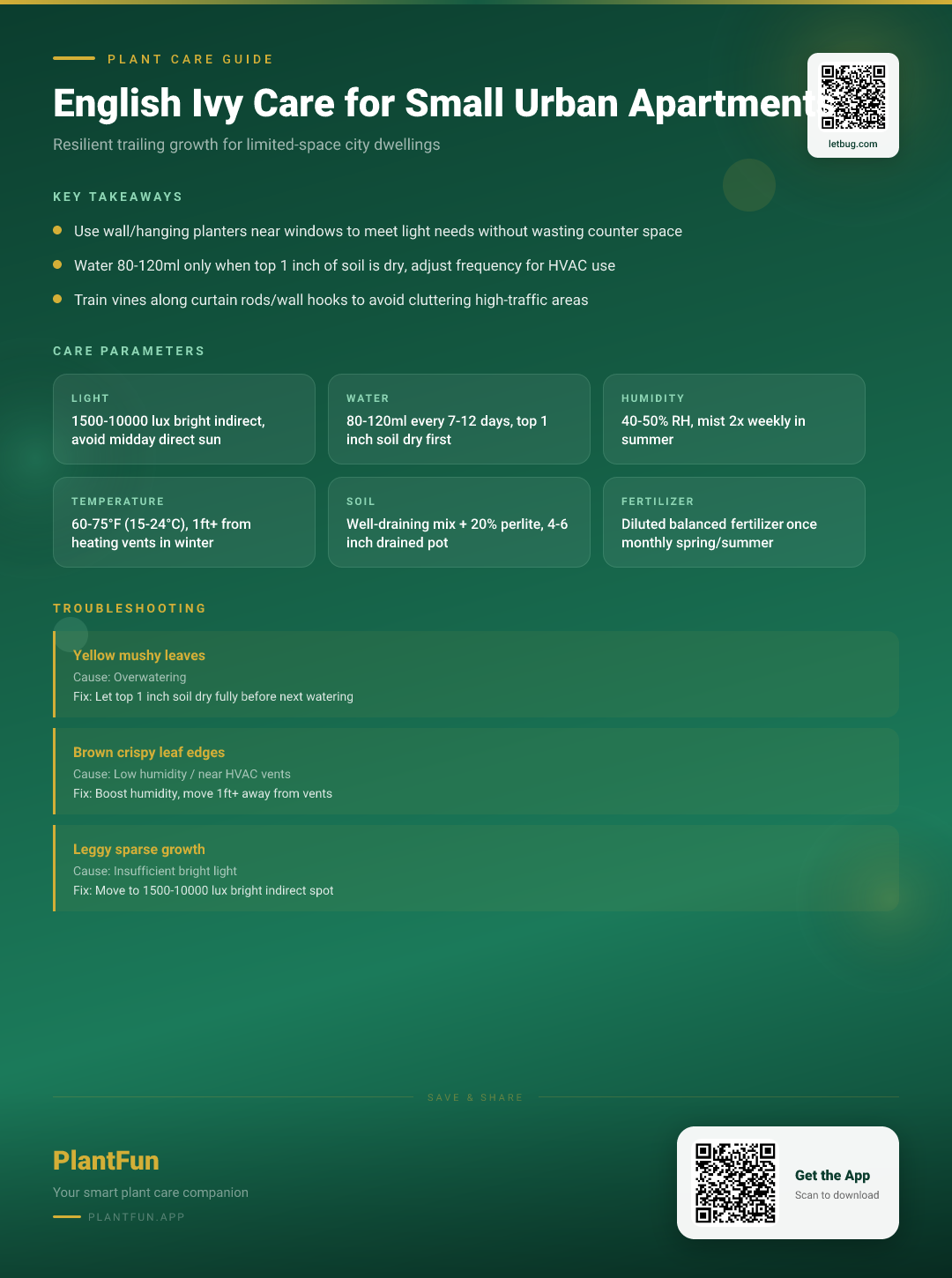
Key Takeaways
- Check soil moisture before watering — overwatering is the #1 killer of houseplants.
- Ensure your plant gets the right amount of light for its species.
- Be patient with recovery — most plants need 2–4 weeks to bounce back.
Quick Care Card
This printable, pocket-sized checklist fits on fridge magnets or can be saved to your phone lock screen for quick reference:
| Care Category | Exact Threshold for Small Apartments |
|---|---|
| Light | 1,500–10,000 lux bright indirect light |
| Water | 80–120 ml only when top 1 inch of soil is dry |
| Humidity | 40–50% relative humidity |
| Temperature | 60–75°F (15–24°C) |
| Soil | Well-draining potting mix + 20% perlite |
| Fertilizer | ½ strength balanced liquid, once monthly spring/summer |
| Toxicity | Toxic to cats, dogs, and humans if ingested (ASPCA, 2026) |
Why This Guide Is Different
Generic English ivy care advice is written for homeowners with extra shelf space, abundant natural light, and no HVAC-controlled dry air — which rarely applies to small urban apartment dwellers. This guide cuts through filler to focus only on solutions that work for 300–700 square foot studios and 1-bed apartments:
- No counter or shelf space required for any care step
- Measurable, science-backed thresholds so you never guess if your conditions are right
- Renter-friendly hacks that require no drilling or permanent modifications
Myth vs Reality:
Myth: English ivy needs large planters and full sun to thrive.
Reality: It grows perfectly in 4–6 inch wall-mounted pots and bright indirect light, with zero surface space used.
Step 1: Light Placement for Small Spaces
English ivy light requirements indoors are 1,500–10,000 lux of bright indirect light for 4+ hours daily to maintain lush growth and variegation (Kim et al., 2012). Use these space-saving placement spots to avoid taking up counter or shelf space:
- Wall-mounted planters 1–2 feet above east or west-facing windows
- Hanging planters in corner nooks 3 feet away from south-facing windows
- Small pots tied to curtain rods, with vines trained to trail along the rod
Quick test: Hold your hand at the planned placement spot at midday. If you see a faint, soft shadow, light levels are ideal. A sharp, dark shadow means too much direct sun, and no shadow means light is too low (under 1,000 lux). For north-facing apartments, add a low-profile grow light strip along your curtain rod to boost light levels to the required threshold, if needed.
Step 2: Exact Watering Schedule for Apartment Conditions
Wondering how often to water English ivy in an apartment? Use this exact, measurable routine:
- Water 80–120 ml of room-temperature water only when the top 1 inch of soil feels completely dry to the touch
- This works out to every 7–12 days on average for most apartments (NC State Extension, 2026)
- Adjustment: If you run your AC or heating 24/7, check soil moisture every 5 days, as forced air dries soil 2x faster than average
Quick test: Stick your index finger 1 inch into the soil. If it’s completely dry, water. If it’s even slightly damp, wait 2 days and check again. Overwatering is the top cause of root rot, which answers the common question “why is my English ivy turning brown” for most new plant parents.
Step 3: Humidity & Temperature Adjustments
English ivy humidity requirements indoors are 40–50% relative humidity, with temperatures between 60–75°F (15–24°C) (NC State Extension, 2026). Use these no-cost, zero-space hacks to adjust conditions without cluttering your counters:
- Hang a damp microfiber cloth on the curtain rod next to your ivy to boost local humidity by 10–15%
- Mist the vines directly 1–2 times per week with room-temperature water
- Group your ivy with other hanging plants to create a high-humidity microclimate
- Keep ivy at least 1 foot away from all HVAC vents to avoid dry air blasts that cause leaf browning
Step 4: Soil & Potting for Minimal Footprints
To minimize space use and avoid overpotting (a top cause of English ivy death), follow these rules:
- Use only 4–6 inch hanging or wall-mounted pots with drainage holes. Larger pots waste valuable space and hold excess moisture that causes root rot
- Use a soil mix of 80% standard well-draining potting mix + 20% perlite to boost aeration and drainage
- Repot only once every 2–3 years, when you see roots growing out of the drainage holes. Only size up by 1 inch maximum to avoid extra space use
For English ivy wall mount care, add a small, low-profile drip tray to the back of your wall mount to avoid water damage to apartment walls, which is perfect for renters.
Step 5: Pruning & Training for Contained Trailing Growth
Learning how to prune English ivy to save space keeps your plant from sprawling into high-traffic areas and cluttering your apartment:
- Use clean, sharp scissors to snip off overgrown vines just above a leaf node (the small bump where leaves attach to the stem) to encourage bushy, compact growth instead of long, leggy vines
- Prune stray vines once per month to keep growth contained to your desired area
- Train vines along removable adhesive wall hooks or curtain rods to direct trailing growth away from walkways, counters, and other usable space This is one of the most popular trailing English ivy small apartment ideas for studios, as it lets you add greenery without taking up any usable floor or surface space.
Seasonal Care Calendar
Adjust your routine for apartment-specific seasonal conditions:
Winter (English ivy winter care for apartments)
- Reduce watering to every 14–18 days, as growth slows in low light
- Keep ivy at least 1 foot away from heating vents to avoid leaf scorch
- Stop fertilizing entirely until spring
- Mist once weekly if humidity drops below 35% due to running heat
Summer (English ivy summer watering tips)
- Check soil moisture every 5 days, as higher temperatures dry soil faster
- You may need to water every 7 days on average
- Mist vines 2x per week to boost humidity
- Move ivy 1 foot further away from south-facing windows to avoid direct midday sun that scorches leaves
- Fertilize with ½ strength balanced liquid fertilizer once per month
Common Small-Apartment English Ivy Mistakes to Avoid
- Mistake: Placing ivy within 6 inches of AC or heating vents. What happens: Dry air blasts cause leaf browning and drop within 2 weeks. Instead: Keep ivy at least 1 foot away from all HVAC vents, and mist 2x weekly if you run HVAC constantly.
- Mistake: Overpotting in a pot larger than 6 inches. What happens: Extra soil holds excess moisture, leading to root rot, the top cause of indoor English ivy death. Instead: Stick to 4–6 inch wall or hanging pots, only size up 1 inch when repotting.
- Mistake: Leaving vines to trail across walkways or counter edges. What happens: Vines get knocked or pulled regularly, leading to broken stems and stunted growth. Instead: Train vines along curtain rods or wall hooks 6+ feet above the ground to keep them out of the way.
- Mistake: Placing ivy in dark corners with under 1,000 lux light. What happens: Leggy growth, loss of variegation, and eventual plant death (Kim et al., 2012). Instead: Place near a window with 1,500+ lux bright indirect light, or add a low-profile grow light strip above the plant if you only have dark corners.
FAQ
Can I keep English ivy in my 500 square foot studio with only north-facing windows?
Yes, as long as you measure light levels and ensure they hit at least 1,500 lux for 4+ hours a day (Kim et al., 2012). If light levels are lower, add a 10W grow light strip mounted along your curtain rod 1 foot above the plant, running for 6 hours a day. You can mount the ivy on the wall next to the window to use zero surface space, so it won’t clutter your small studio.
How often do I water my English ivy if my apartment has super dry winter heat?
Check the top 1 inch of soil every 7 days, as dry winter heat can dry soil 2x faster than normal. You will likely need to water 80–120ml every 10–14 days, instead of the standard 14–18 day winter schedule. Mist the vines 2x weekly to boost humidity around the plant to avoid leaf browning.
Can I grow English ivy without using any counter or shelf space?
Absolutely. Use a wall-mounted pot attached above your window, a hanging planter mounted to your ceiling, or a small pot tied to your curtain rod to keep the plant entirely off surfaces. Train vines along adhesive wall hooks or curtain rods for trailing growth that doesn’t take up any usable living space, which is a top trailing English ivy small apartment idea for studios.
Why is my English ivy turning brown?
The most common causes are overwatering, exposure to direct HVAC blasts, or light levels below 1,000 lux. Check the top 1 inch of soil first: if it’s damp, you’re overwatering, let it dry out completely before watering again. If the soil is dry, check if the plant is near a vent or in a low-light spot, and adjust accordingly.
Final Printable Checklist Recap
Save this list to your phone lock screen or print it as a 2x3 inch fridge magnet for quick weekly reference:
- ✅ Light: 1,500–10,000 lux bright indirect, no direct midday sun
- ✅ Water: 80–120ml only when top 1 inch of soil is dry
- ✅ Humidity: 40–50% RH, mist 1–2x weekly if dry
- ✅ Temperature: 60–75°F (15–24°C), keep 1+ feet from HVAC vents
- ✅ Pot: 4–6 inch wall/hanging pot with drainage holes
- ✅ Prune: Snip stray vines above leaf nodes monthly to keep growth contained
- ✅ Seasonal adjust: Reduce watering in winter, increase misting in summer
References
- ASPCA. (2026). Toxic and Non-Toxic Plants List — ASPCA. https://www.aspca.org/pet-care/animal-poison-control/toxic-and-non-toxic-plants. Accessed 2026-03-02.
- Kim, J.; Kang, S.; Pak, C. (2012). Changes in Leaf Variegation and Coloration of English Ivy and Polka Dot Plant under Various Indoor Light Intensities. HortTechnology. https://doi.org/10.21273/horttech.22.1.49. Accessed 2026-03-02.
- NC State Extension. (2026). The Complete English Ivy — NC State Extension Gardener Plant Toolbox. https://plants.ces.ncsu.edu/plants/english-ivy/. Accessed 2026-03-02.
- Polito, V.; Chang, Y. (1984). Quantitative nuclear cytology of english ivy (Hedera helix L.). Plant Science Letters. https://doi.org/10.1016/s0304-4211(84)80017-6. Accessed 2026-03-02.
Optional Helper: Plantfun.App
Plantfun.App identifies your plants by photo, diagnoses pests and diseases with clear fixes, and creates personalised watering and light schedules that adapt to your home conditions — a handy companion for putting this guide into daily practice.
Found an error or have suggestions? We'd love your feedback.
Need help identifying this problem?
Get instant identification, personalized care schedules, and effective pest treatment plans directly on your phone.
Sponsored • We may earn a commission from app downloads
Related Guides
The Complete English Ivy Care Guide for Typical Apartments: Tips for Lush, Resilient Growth
Stop struggling with brown, crispy English Ivy leaves. Get exact light levels, watering amounts, and apartment-specific care hacks that encourage lush, resilient growth year-round.
Care GuideThe Complete English Ivy Care Checklist for Small Urban Apartments: No Fancy Tools Required
Grow lush, non-yellowing English Ivy in your apartment without spending extra on fancy gear. Get our free 12-point care checklist with exact light, water, and soil parameters you can implement today.
Care GuideThe Complete English Ivy Care Guide for Small Urban Apartments: Resilient Growth Tips
Grow lush, trailing English ivy even in cramped 500-700 sq ft urban apartments. Get exact light, water, and space-saving tips to avoid yellow leaves and encourage resilient, fast growth.
Pest ControlAnts on Plants: What They Mean and What to Do
Ants usually aren't eating your plant. They are farming other pests.