
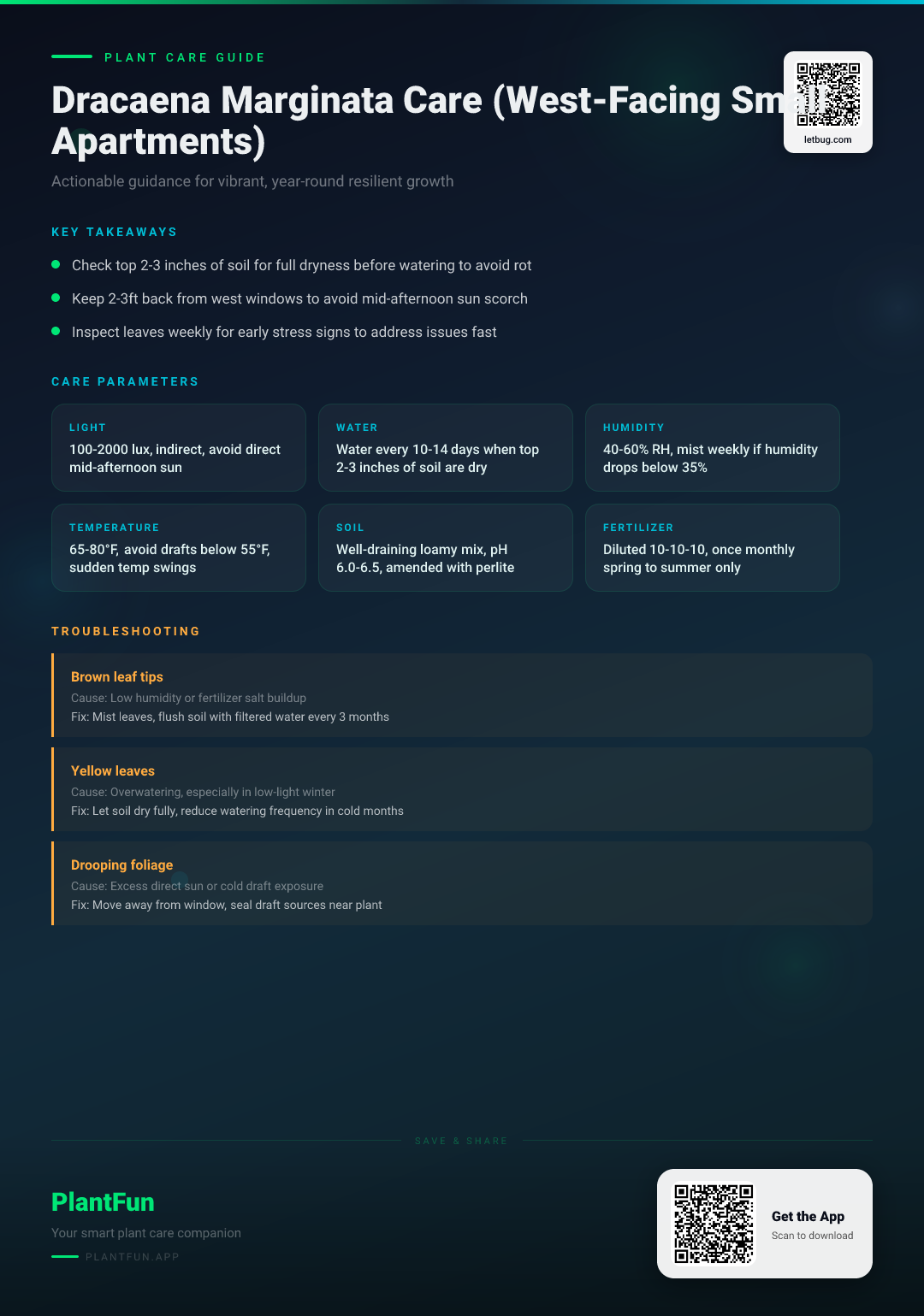
Key Takeaways
- Check soil moisture before watering — overwatering is the #1 killer of houseplants.
- Ensure your plant gets the right amount of light for its species.
- Be patient with recovery — most plants need 2–4 weeks to bounce back.
Quick Care Card
| Care Factor | Measurable Rules for West-Facing Apartments |
|---|---|
| Light | 10,000–20,000 lux, 2–3ft from west window; avoid direct mid-afternoon summer sun (NC State Extension, 2026) |
| Water | 150–250ml per 6in pot when top 3 inches of soil are completely dry; reduce by 50% in winter |
| Humidity | 30–50% tolerance; no humidifier required for most apartments |
| Temperature | 65–80°F (18–27°C); avoid drops below 60°F (15°C) (NC State Extension, 2026) |
| Soil | Well-draining cactus/succulent mix with 20% perlite added |
| Fertilizer | 1/2-strength balanced liquid fertilizer once every 2 months, spring and summer only |
| Toxicity | Toxic to cats and dogs (ASPCA, 2026) |
Why This Guide Is Different
Generic Dracaena care advice often fails for west-facing apartment residents: vague tips like “bright indirect light” don’t account for the 2–4 hour spikes of intense direct afternoon sun common in these spaces, and one-size-fits-all watering schedules ignore the dry forced air and temperature swings of urban units. This guide uses a symptom-first troubleshooting framework tailored explicitly to small west-facing apartment conditions, so you can diagnose and fix issues in minutes without guesswork. A common myth you can ignore: Dracaenas don’t need high humidity to thrive—their specialized cellular structure lets them adapt to the dry air of most apartments (Rezgui et al, 2014). For general tips on keeping low-fuss plants alive in tight spaces, check out our guide to low-maintenance plants for small apartments.
West-Facing Apartment Environment Baseline
West-facing apartments have unique conditions that directly impact Dracaena marginata growth:
- Afternoon sun spikes: Late spring and summer sun can reach 40,000 lux directly on window sills, hot enough to scorch leaves in 1–2 hours
- Dry forced air: Winter heating systems often drop indoor humidity to 20–25%, which can trigger brown leaf tips if salt buildup is already present
- Temperature swings: Drafty window sills can see 10–15°F temperature drops overnight in winter, far outside the stable range Dracaenas prefer These conditions mean standard care rules for east or north-facing homes will not work for your space, and adjustments for season and placement are non-negotiable for resilient growth.
Weekly Care Checklist
Follow these 5-minute weekly tasks to catch issues early and keep your Dracaena healthy:
- Light test: Hold your hand at plant height at 3pm. If you see a sharp, defined shadow, light levels exceed 25,000 lux—move the plant 1ft further from the window to avoid scorch.
- Moisture check: Stick your finger 3 inches deep into the soil. If it is completely dry, it’s time to water; if damp, wait 3 days and retest. This is the most reliable way to determine how often to water Dracaena marginata in variable apartment light.
- Leaf inspection: Check 5–6 top and bottom leaves for discoloration, spots, or drooping. Wipe dust off with a damp microfiber cloth to improve light absorption.
- Temperature check: Hold a thermometer near the plant for 10 minutes. If readings are below 60°F or above 85°F, move to a more temperature-stable spot.
Seasonal Care Calendar
Adjust your care routine month-by-month to match shifting west-facing apartment conditions:
- January–February (Winter): Reduce watering by 50%, skip fertilizer, move 1ft further from windows to avoid cold drafts. Mist leaves once weekly if humidity drops below 25%. Follow our full Dracaena winter care apartments guide for more cold-weather tips.
- March–April (Spring): Resume regular watering, start 1/2-strength fertilizer every 2 months, gradually move closer to the window as sun intensity increases.
- May–August (Summer): Keep 2–3ft away from west windows, use a sheer curtain if afternoon sun is direct for more than 2 hours. Follow our Dracaena summer watering schedule to adjust for higher temperatures.
- September–October (Fall): Reduce watering by 25%, stop fertilizer, move closer to the window as sun intensity drops.
- November–December (Early Winter): Reduce watering by another 25%, move away from drafty window sills, wipe leaves monthly to remove dust from heating vents.
Symptom-to-Action Troubleshooting Cheat Sheet
Brown Leaf Tips
Symptom: Dry, crispy brown edges or tips on otherwise green leaves, no yellowing at the leaf base.
Likely cause: Low humidity below 25%, salt buildup from tap water or overfertilization, or cold draft exposure.
Fix:
- Trim brown tips with clean scissors, leaving a 1mm green edge to avoid damaging healthy tissue.
- Flush soil with 3x the pot volume of distilled water to remove excess salt, repeat once every 3 months.
- Move the plant 2ft away from drafty window sills or AC/heating vents if 24-hour temperature swings exceed 10°F.
Yellow Lower Leaves
Symptom: Older, lower leaves turn uniform yellow and drop off gradually, no spotting or discoloration on new growth.
Likely cause: Overwatering, or natural leaf shedding (1–2 leaves per month is normal).
Fix:
- Stop watering immediately, wait until the top 3 inches of soil are completely dry before watering again.
- If soil stays soggy for more than 7 days, repot into fresh, dry well-draining mix. Learn how to identify and fix root rot in our indoor plant root rot rescue guide.
- If only 1–2 leaves drop per month, no action is needed—this is normal growth (NC State Extension, 2026).
Drooping Foliage
Symptom: All leaves hang limply, no discoloration initially.
Likely cause: Underwatering, or extreme temperature exposure outside the 60–85°F range.
Fix:
- Water with 200ml of room-temperature distilled water per 6in pot, wait 2 hours; if leaves don’t perk up, add another 100ml.
- Check temperature near the plant, if it’s below 55°F or above 90°F, move to a spot with stable 65–75°F temperatures.
Sun Scorch Spots
Symptom: Pale brown or white dry spots on leaves facing the west window, spots are uniform in shape and only appear on sun-exposed sides of the plant.
Likely cause: Direct mid-afternoon summer sun exceeding 25,000 lux for more than 1 hour.
Fix:
- Trim damaged leaves at the base—they will not regrow green tissue.
- Move the plant 1ft further away from the window, or install a sheer curtain to filter light to below 20,000 lux.
Common Apartment Care Mistakes to Avoid
- Mistake: Placing your Dracaena directly on the west-facing window sill year-round. What happens: Summer sun scorches leaves, winter cold drafts cause leaf drop and brown tips. Instead: Keep the plant 2–3ft away from the window, or use a window shelf mounted 6 inches away from the glass to reduce temperature swings.
- Mistake: Watering on a fixed weekly schedule regardless of season or soil moisture. What happens: Overwatering in low-light winter months leads to root rot, the #1 cause of Dracaena death in apartments (NC State Extension, 2026). Instead: Only water when the top 3 inches of soil are completely dry, adjust frequency to match seasonal light levels.
- Mistake: Overfertilizing to speed up growth in small spaces. What happens: Excess salt builds up in soil, causing brown leaf tips and stunted growth. Instead: Use 1/2-strength balanced fertilizer only once every 2 months in spring and summer, skip fertilizer entirely in fall and winter.
- Mistake: Using a pot that is 2+ sizes larger than the root ball to avoid frequent repotting. What happens: Extra soil holds excess moisture, leading to root rot even if you water correctly. Instead: Use a pot that is only 1–2 inches wider than the current root ball, with drainage holes at the bottom.
- Mistake: Leaving dust on leaves for months at a time. What happens: Dust blocks light absorption, slowing growth and making the plant more susceptible to pest infestations. Instead: Wipe leaves with a damp microfiber cloth once a week during your regular care check.
FAQ
Can I keep my Dracaena marginata right next to my west-facing apartment window?
You can only keep your Dracaena marginata right next to a west-facing window in fall and winter when afternoon sun intensity is below 20,000 lux. In spring and summer, direct afternoon sun can exceed 40,000 lux near glass, which will scorch leaves within 1 week (NC State Extension, 2026). If you want to keep it near the window in warmer months, install a sheer curtain to filter light to below 20,000 lux.
Why is my Dracaena getting brown tips even when I water it regularly?
Brown tips on regularly watered Dracaena marginata are almost always caused by either low humidity below 25%, salt buildup from tap water or overfertilizer, or exposure to cold drafts from window sills or AC vents. To fix, first flush the soil with 3x the pot volume of distilled water to remove excess salts, then move the plant 2ft away from drafty areas, and mist leaves once a week if your apartment humidity is below 25%. This is one of the most common questions we get for Dracaena marginata care for beginners.
How often do I need to repot my Dracaena in a small apartment?
You only need to repot your Dracaena marginata once every 2–3 years, or when you see roots growing out of the drainage holes at the bottom of the pot. Dracaenas grow slowly in indoor apartment conditions, and prefer being slightly root bound, so you don’t need to repot more frequently (NC State Extension, 2026). When you do repot, use a pot that is only 1–2 inches wider than the current root ball to save space in your small apartment.
Bonus Space-Saving Display Tips
These practical placement hacks for small apartments avoid sun scorch, save floor space, and support healthy Dracaena growth:
- Use a wall-mounted floating shelf 2–3ft away from your west window, 5ft above the floor, to avoid taking up floor space and keep the plant out of reach of pets (note: Dracaena marginata is toxic to cats and dogs, per ASPCA, 2026).
- Use a narrow corner plant stand placed in the corner next to your west window—this reduces direct sun exposure by 30% compared to placing the plant directly in front of the window, and fits in small unused corner space.
- Group your Dracaena marginata with other low-humidity tolerant plants like snake plants and ZZ plants—this raises local humidity slightly by 5–10% without needing a humidifier, and creates a compact display that saves shelf space.
Understanding the Science
- A 2014 study of Dracaena species found that Dracaena marginata produces specialized steroidal glycosides that help it retain water in low-humidity environments, which explains why it tolerates dry apartment air far better than tropical plants like ferns (Rezgui et al, 2014).
- A 1981 HortScience study documented that Dracaena marginata grows best in light levels between 10,000 and 20,000 lux, which matches the filtered afternoon light found 2–3ft away from west-facing apartment windows (Chua et al, 1981).
References
- NC State Extension. (2026). The Complete Dracaena Marginata. https://plants.ces.ncsu.edu/plants/dracaena-marginata/. Accessed 2026-03-06.
- Rezgui, A.; Mitaine-Offer, A.; Miyamoto, T. (2014). New steroidal glycosides from Dracaena marginata, Dracaena fragrans and Allium flavum. Planta Medica. https://doi.org/10.1055/s-0034-1394712. Accessed 2026-03-06.
- Chua, B.; Kunisaki, J.; Sagawa, Y. (1981). In Vitro Propagation of Dracaena marginata ‘Tricolor’. HortScience. https://doi.org/10.21273/hortsci.16.4.494. Accessed 2026-03-06.
- ASPCA. (2026). Toxic and Non-Toxic Plants List — ASPCA. https://www.aspca.org/pet-care/animal-poison-control/toxic-and-non-toxic-plants. Accessed 2026-03-06.
Optional Helper: Plantfun.App
Plantfun.App identifies your plants by photo, diagnoses pests and diseases with clear fixes, and creates personalised watering and light schedules that adapt to your home conditions — a handy companion for putting this guide into daily practice.
Found an error or have suggestions? We'd love your feedback.
Need help identifying this problem?
Get instant identification, personalized care schedules, and effective pest treatment plans directly on your phone.
Sponsored • We may earn a commission from app downloads
Related Guides
Dracaena Marginata Care Checklist for Typical Apartments: Grow Lush, Resilient Plants Without Fuss
Stop guessing at Dracaena care. Get exact light, water, and humidity thresholds, plus a printable checklist that keeps your Dracaena marginata thriving in variable apartment conditions.
Care GuideThe Budget-Friendly Dracaena Care Checklist for Resilient Growth in Small East-Facing Apartments
Skip overpriced plant supplies and get your dracaena thriving in your small east-facing apartment. Follow this free, science-backed checklist for lush, resilient growth with minimal effort.
Care GuideThe Complete Dracaena Fragrans Care Guide for Urban Apartments: Resilient Growth Made Easy
Keep your Dracaena fragrans thriving in a typical apartment. Get exact light levels, watering amounts, and a 4-season care checklist for lush, resilient growth year-round.
ToolThe Complete Dracaena Care Checklist for East-Facing Apartments: Seasonal Tips for Resilient Growth
Keep your Dracaena thriving in small east-facing apartments with this science-backed seasonal checklist, complete with exact light, water, and humidity thresholds for year-round resilient growth, no fancy equipment required.