
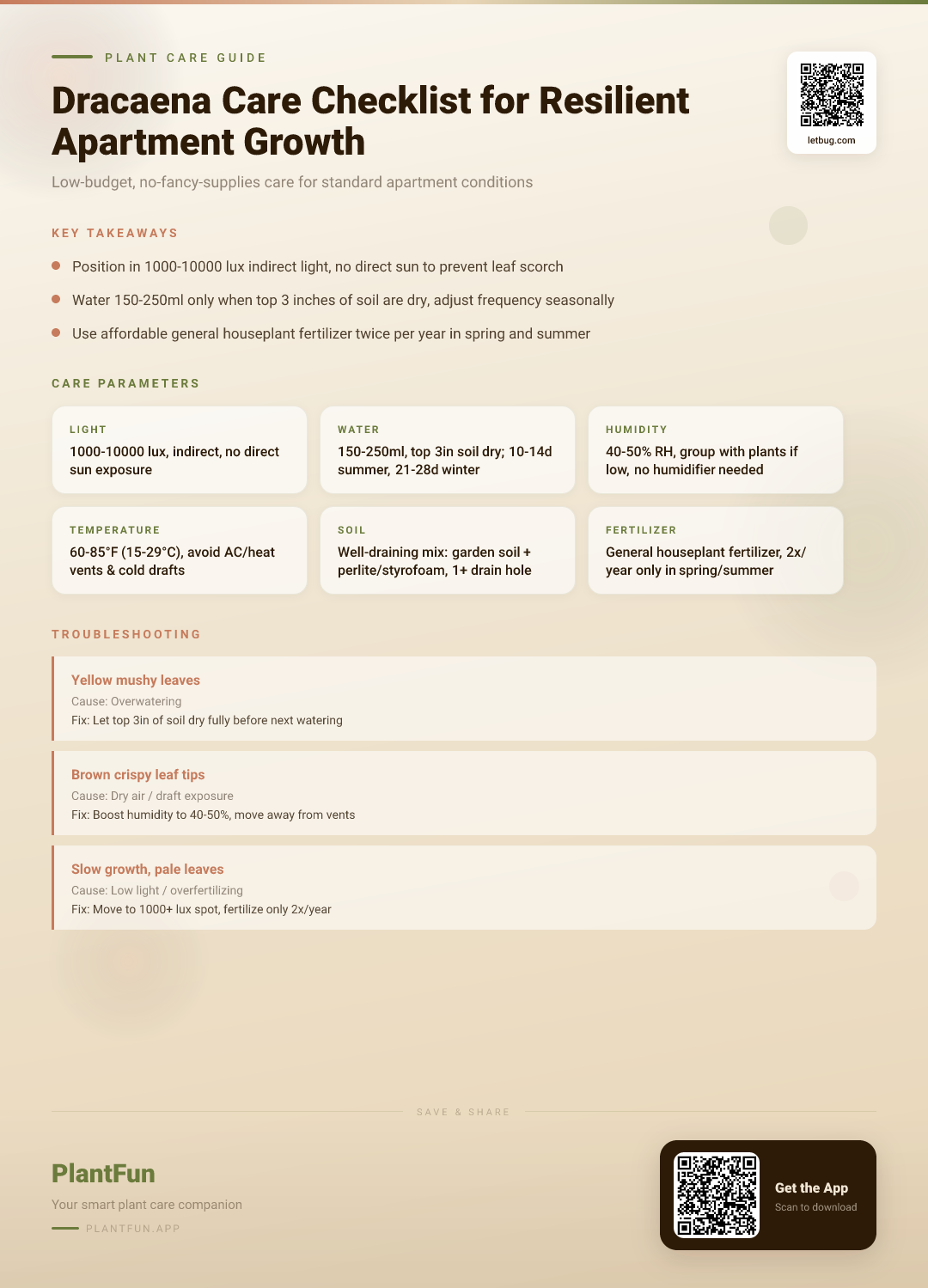
Key Takeaways
- Check soil moisture before watering — overwatering is the #1 killer of houseplants.
- Ensure your plant gets the right amount of light for its species.
- Be patient with recovery — most plants need 2–4 weeks to bounce back.
Quick Care Card
This scannable table doubles as a printable fridge-friendly checklist: screenshot it, resize to 4x6 inches, and tape it to your fridge for no-fuss reference.
| Care Factor | Measurable Threshold | Quick Tip |
|---|---|---|
| Light | 1,000–10,000 lux, no direct sun | Dust leaves weekly to maximize light absorption |
| Water | 150–250 ml, only when top 3 inches of soil are dry | Stick your index finger 3 inches deep to test moisture, no meter needed |
| Humidity | 40–50% relative humidity | No humidifier required, use free hacks to boost dry HVAC air |
| Temperature | 60–85°F (15–29°C) | Keep 3+ feet away from AC/heating vents and drafty windows |
| Soil | 60% loamy soil + 40% aeration material | Use crunched styrofoam from packaging as a free perlite substitute |
| Fertilizer | General houseplant fertilizer, 2x per year (spring + summer) | No specialized Dracaena fertilizer needed, dilute to half strength |
| Toxicity | Toxic to cats and dogs (ASPCA, 2026) | Place on high shelves or windowsills out of pet reach |
Why This Guide Is Built For Typical Apartment Dracaena Owners
Most generic Dracaena care advice assumes you have unobstructed bright indirect light, extra budget for humidifiers and grow lights, and permission to modify your rental space. This guide is tailored specifically for renters in 500-800 sq ft apartments, with zero-cost hacks and measurable parameters that work for blocked windows, dry HVAC air, limited counter space, and tight budgets.
Myth vs Reality: Myth: Dracaenas need bright indirect light to survive. Reality: Dracaenas can thrive in as little as 1,000 lux if you supplement with a regular desk lamp for 12 hours a day (Gilman, 2007).
Step 1: Light Placement For Apartment Dracaenas
Dracaena light requirements fall between 1,000–10,000 lux, with no direct sun exposure (Gilman, 2007). This range fits most apartment lighting conditions, even with less-than-ideal windows:
- If you have a north-facing window: Place your Dracaena 1–2 feet from the window, no further.
- If your only window faces a brick wall: Place the plant directly on the windowsill (no direct sun will reach it, so leaf burn is not a risk).
- Zero-cost light boost hack: Tape a cheap mirror opposite your window to reflect extra light onto the plant.
If you’re wondering can Dracaena grow in low light apartments, the answer is yes, as long as you meet the 1,000 lux minimum (equivalent to the light level of a brightly lit office space).
Step 2: Budget Watering Routine That Prevents Root Rot
Wondering how often to water Dracaena? Follow this rule to avoid root rot (the top killer of indoor Dracaenas):
- Water 150–250 ml only when the top 3 inches of soil are completely dry (NC State Extension, 2026).
- Quick test: Stick your index finger 3 inches into the soil. If it feels completely dry, water; if any moisture remains, wait 2–3 days.
- In summer, this equals watering every 10–14 days (Dracaena summer watering schedule). In winter, stretch to every 21–28 days as part of your Dracaena winter care routine.
No fancy moisture meters are required for this Dracaena root rot prevention method.
Step 3: Humidity & Temperature Adjustments For HVAC Apartments
Dracaena humidity requirements indoors are 40–50% relative humidity, which is easy to achieve without a humidifier (NC State Extension, 2026):
- Group your Dracaena with other houseplants: Plants release moisture through their leaves, raising surrounding humidity for free.
- Place a shallow tray of water under the pot’s drainage saucer (evaporating water boosts local humidity).
Keep temperatures between 60–85°F (15–29°C), and never place your Dracaena within 3 feet of AC vents, heating units, or drafty old windows. Sudden temperature swings cause leaf drop and brown tips.
Step 4: Zero-Cost Soil & Potting Tips For Dracaenas
Skip expensive pre-mixed Dracaena soil with this Dracaena soil mix DIY that uses free or leftover supplies:
- Mix 60% free loamy garden soil from a friend or community garden with 40% aeration material. If you don’t have perlite, use crunched styrofoam from shipping or food packaging as a free substitute.
- Ensure your pot has at least 1 drainage hole. If you want to use a decorative pot without drainage, add a 2-inch layer of crunched styrofoam at the bottom first to catch excess water.
These budget Dracaena care tips cut your potting costs to $0.
Step 5: Low-Cost Fertilizing Schedule For Resilient Growth
Wondering how to make Dracaena grow faster without specialized, expensive fertilizer? Follow this simple schedule:
- Use a $5 general houseplant fertilizer diluted to half strength, applied only 2 times per year: once in early spring, once in mid-summer (Gilman, 2007).
- Skip fertilizing completely in fall and winter, when Dracaenas enter a slow growth phase.
No specialized Dracaena fertilizer is needed, making this one of the best cheap Dracaena care supplies swaps for renters.
Seasonal Care Calendar For Apartment Dracaenas
Follow this month-by-month adjustment schedule for consistent growth:
- December–February (Winter): Water every 21–28 days, no fertilizer, move plants away from drafty windows if temperatures drop below 60°F.
- March–May (Spring): Resume watering every 14 days, apply first fertilizer dose of the year, dust all leaves to boost light absorption.
- June–August (Summer): Water every 10–14 days, apply second fertilizer dose, dust leaves monthly to remove HVAC dust buildup.
- September–November (Fall): Taper watering to every 18–21 days, stop fertilizing, move plants away from window AC units before you turn off cooling for the season.
Common Apartment-Specific Mistakes To Avoid
- Mistake: Placing your Dracaena next to drafty windows or HVAC vents. What happens: Sudden temperature swings cause widespread leaf drop and brown tips. Instead: Keep plants 3+ feet from vents, and place a draft stopper behind the plant if it’s near a leaky old window.
- Mistake: Overfertilizing to speed up growth. What happens: Excess salts burn roots, leading to brown leaf edges and stunted growth. Instead: Fertilize only 2 times per year, diluted to half strength.
- Mistake: Repotting every year, even if roots aren’t overgrown. What happens: Root shock leads to months of stunted growth or leaf drop. Instead: Repot only when roots are growing out of the drainage hole, every 2–3 years.
- Mistake: Ignoring dust buildup on leaves. What happens: Dust blocks up to 30% of available light, slowing growth significantly. Instead: Wipe leaves with a damp paper towel once a month, no expensive leaf shine products needed.
FAQ 1: Why is my Dracaena getting brown leaf tips in my apartment?
The two most common apartment-specific causes are dry HVAC air (which drops humidity below 40%) and fluoride/chlorine in tap water (NC State Extension, 2026). Cheap fixes: Group your Dracaena with other plants to boost humidity, use leftover filtered drinking water for watering, and trim brown tips with clean scissors following the natural shape of the leaf for a seamless look.
FAQ 2: Can I keep my Dracaena in a dark apartment corner with no natural light?
Dracaenas need a minimum of 1,000 lux to survive, but you don’t need to buy a fancy grow light to hit this threshold (Gilman, 2007). Free workaround: Use your existing cool white LED desk lamp, placed 1 foot away from the plant, and run it for 12 hours per day. This provides enough light for steady, resilient growth without any extra cost.
FAQ 3: How do I propagate my Dracaena for free to get more plants?
This simple stem cutting propagation method uses supplies you already have at home:
- Use a clean kitchen knife to cut a 4–6 inch section from the top of a healthy Dracaena stem, making sure the cutting has at least 3 leaves.
- Let the cut end dry on your kitchen counter for 24 hours to prevent rot.
- Place the cutting in a clean jar of tap water, making sure only the bottom 1 inch of the stem is submerged.
- Change the water every 3 days. Roots will grow in 4–6 weeks, at which point you can plant the cutting in your DIY Dracaena soil mix.
Troubleshooting Quick Reference Chart
Yellow Lower Leaves
Symptom: Older leaves at the bottom of the plant turn soft yellow and fall off gradually.
Likely cause: Overwatering, the most common cause of Dracaena health issues in apartments.
Fix:
- Stop watering immediately, and let the soil dry out completely for 2–3 weeks.
- If root rot is visible (soggy, brown roots when you pull the plant out of the pot), trim rotten roots and repot in fresh dry soil.
Brown Leaf Tips
Symptom: Dry, crispy brown tips on otherwise healthy green leaves.
Likely cause: Dry HVAC air, fluoride in tap water, or placement near a drafty vent.
Fix:
- Group your Dracaena with other plants to boost humidity, or switch to filtered drinking water for watering.
- Move the plant at least 3 feet away from AC/heating vents or drafty windows.
Drooping Stems
Symptom: Normally upright stems wilt and droop, with leaves curling inward.
Likely cause: Severe underwatering, or sudden cold exposure.
Fix:
- Water with 250 ml of room temperature water, and check soil moisture every 3 days until it bounces back.
- Move the plant to a spot with consistent temperatures between 65–75°F.
Brown Spots on Leaves
Symptom: Dry, circular brown spots surrounded by yellow halos on upper leaves.
Likely cause: Accidental direct sun exposure, or fertilizer burn.
Fix:
- Move the plant out of direct sun, and trim damaged leaves if they are unsightly.
- Flush the soil with 3x the pot volume of water to wash out excess fertilizer salts, and skip fertilizing for 6 months.
Understanding the Science
All care parameters in this guide are grounded in peer-reviewed horticultural research and extension data. Dracaena fragrans (the most common apartment Dracaena variety) is adapted to low-light understory environments in its native African range, which explains its tolerance for low apartment light levels (Gilman, 2007). Research on foliage plant care confirms that consistent, minimal watering and low fertilization rates reduce stress for indoor Dracaenas more than frequent, variable care (Šrámek, 1999).
References
- Šrámek, F. (1999). Vaughan, M.J.: The Complete Book on Cut Flower Care. Biologia plantarum. https://doi.org/10.1023/a:1001770114931. Accessed 2026-03-05.
- Gilman, E. (2007). Dracaena fragrans ‘Massangeana’ Corn Plant, Fragrant Dracaena. EDIS. https://doi.org/10.32473/edis-fp184-1999. Accessed 2026-03-05.
- ASPCA. (2026). Toxic and Non-Toxic Plants List — ASPCA. https://www.aspca.org/pet-care/animal-poison-control/toxic-and-non-toxic-plants. Accessed 2026-03-05.
- NC State Extension. (2026). The Complete Dracaena Care — NC State Extension Gardener Plant Toolbox. https://plants.ces.ncsu.edu/plants/dracaena-care/. Accessed 2026-03-05.
Optional Helper: Plantfun.App
Plantfun.App identifies your plants by photo, diagnoses pests and diseases with clear fixes, and creates personalised watering and light schedules that adapt to your home conditions — a handy companion for putting this guide into daily practice.
Found an error or have suggestions? We'd love your feedback.
Need help identifying this problem?
Get instant identification, personalized care schedules, and effective pest treatment plans directly on your phone.
Sponsored • We may earn a commission from app downloads
Related Guides
The Budget-Friendly Dracaena Care Checklist for Resilient Growth in Small East-Facing Apartments
Skip overpriced plant supplies and get your dracaena thriving in your small east-facing apartment. Follow this free, science-backed checklist for lush, resilient growth with minimal effort.
Care GuideThe Complete Dracaena Care Checklist for Resilient Growth in Typical Low-Light Apartments
Grow a lush, low-fuss Dracaena even in your dark, dry apartment. Get exact light, water, and humidity thresholds plus a seasonal checklist to keep leaves vibrant and growth steady all year.
ToolThe Complete Dracaena Care Checklist for East-Facing Apartments: Seasonal Tips for Resilient Growth
Keep your Dracaena thriving in small east-facing apartments with this science-backed seasonal checklist, complete with exact light, water, and humidity thresholds for year-round resilient growth, no fancy equipment required.
Care GuideThe Complete Dracaena Care Checklist for Resilient Growth in Low-Light Urban Apartments
Grow lush, brown-tip-free Dracaena in your low-light apartment. Get exact light lux targets, watering volumes, and a 4-season care routine to keep your plant thriving year-round.