
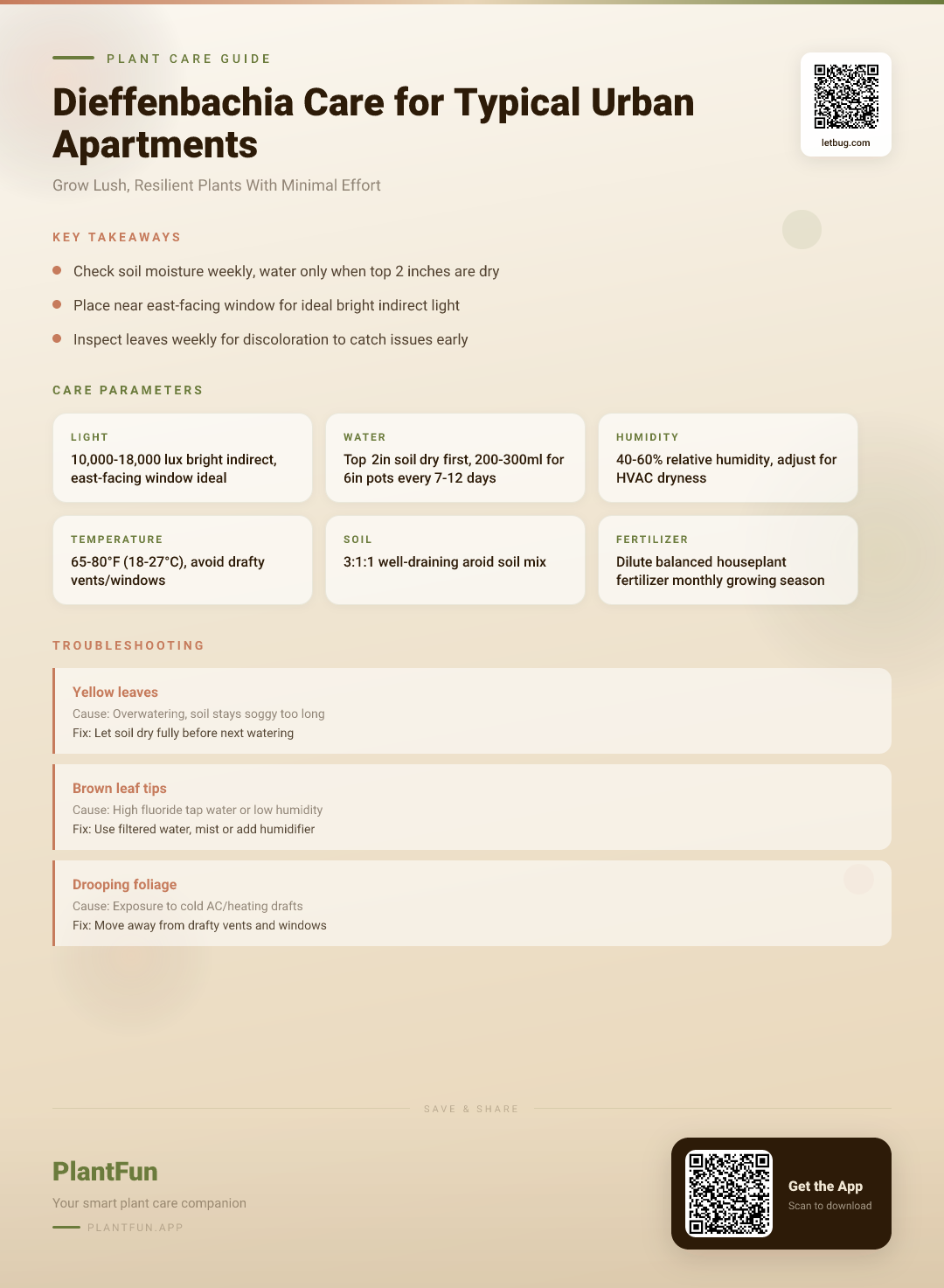
Key Takeaways
- Check soil moisture before watering — overwatering is the #1 killer of houseplants.
- Ensure your plant gets the right amount of light for its species.
- Be patient with recovery — most plants need 2–4 weeks to bounce back.
Quick Care Card
| Parameter | Measurable Threshold for Apartments |
|---|---|
| Light | 10,000-18,000 lux bright indirect light |
| Water | Top 2 inches of soil dry; 200-300ml for 6-inch pots, every 7-12 days |
| Humidity | 40-60% relative humidity |
| Temperature | 65-80°F (18-27°C) |
| Soil | 3:1:1 aroid mix (potting soil:perlite:orchid bark) |
| Fertilizer | Diluted balanced liquid fertilizer once monthly in spring/summer |
| Toxicity | Toxic to cats, dogs, and humans if ingested (ASPCA, 2026) |
Why Dieffenbachia Thrive (or Struggle) in Typical Urban Apartments
Dieffenbachia are native to tropical understories, making them naturally well-suited to the lower light levels common in 600-900 sq ft urban apartments (Ajay et al., 2024). That said, apartment-specific stressors including fluctuating HVAC temperatures, consistent low humidity, and inconsistent watering schedules are the top causes of poor growth and Dieffenbachia yellow leaves, according to NC State Extension (2026). Unlike outdoor plants, apartment Dieffenbachia have no access to natural rainfall or consistent ambient conditions, so small, targeted adjustments to your care routine are all you need to grow lush, full plants. Note: Dieffenbachia contains calcium oxalate crystals that cause mouth and throat irritation if ingested, so keep it out of reach of small children and pets (ASPCA, 2026).
Dieffenbachia Diagnostic Cheat Sheet
Use this 30-second quiz to identify common apartment-specific issues before they threaten your plant’s health:
Dieffenbachia Yellow Leaves
Symptom: Pale or mushy yellow lower leaves, no brown crispy edges.
Likely cause: Overwatering from irregular watering schedules or poor drainage, the most common apartment Dieffenbachia issue (NC State Extension, 2026).
Fix:
- Tip the pot to drain excess standing water from the saucer immediately
- Hold off watering until the top 2 inches of soil are completely dry to the touch
Dieffenbachia Brown Tips
Symptom: Crispy brown edges on mature leaves, new growth looks healthy.
Likely cause: HVAC dryness, high fluoride tap water, or low humidity, all common in closed apartment environments.
Fix:
- Trim brown edges with clean, sharp scissors leaving a thin border of brown tissue to avoid stressing the leaf
- Switch to rain or distilled water for future waterings
Why Is My Dieffenbachia Drooping
Symptom: Limp, floppy stems that were upright 24-48 hours prior, no leaf discoloration.
Likely cause: Exposure to cold drafts from AC vents or drafty windows, or severe underwatering.
Fix:
- Move the plant 3+ feet away from any AC, heating vents, or leaky window frames
- Test soil moisture, and water with 200-300ml of room temperature water if the top 3 inches are dry
Step-by-Step Weekly Care Checklist
This 10-minute Dieffenbachia care checklist is designed for beginner and intermediate plant owners, with no special tools required:
- (1 min) Light check: Hold a hand up between the plant and nearest window at midday; if you see a soft, blurry shadow, light levels are within the 10,000-18,000 lux target (Ajay et al., 2024). If the shadow is sharp, move the plant 2 feet back from the window; if no shadow appears, move it closer.
- (2 min) Soil moisture test: Stick your index finger 2 inches deep into the soil; if it feels completely dry, it’s time to water. If damp, check again in 2 days.
- (3 min) Watering (if needed): Pour 200-300ml of room temperature water directly onto the soil for a 6-inch pot, stopping as soon as water drains out the bottom of the pot. Empty the saucer immediately to avoid root rot.
- (2 min) Pest and leaf inspection: Wipe the top and bottom of 3-4 large leaves with a damp microfiber cloth to remove dust, and check for tiny brown or green pests (mealybugs, spider mites) that thrive in dry apartment air.
- (2 min) Humidity spot check: If you have a hygrometer, confirm relative humidity is between 40-60%. If it’s below 40% (common when heating or AC is running), group your Dieffenbachia with other houseplants to raise ambient humidity naturally.
Exact Light Requirements for Apartment Dieffenbachia
Per 2024 horticultural research, Dieffenbachia light requirements for consistent, healthy growth fall between 10,000 and 18,000 lux of bright indirect light (Ajay et al., 2024). For most apartments, the ideal placement is 1-2 feet back from an east-facing window, where it gets gentle morning sun and no harsh midday rays. Adjust for other window orientations as follows:
- North-facing windows: Place the plant directly on the windowsill. In fall and winter, add a full-spectrum grow light running 12 hours a day to maintain target light levels.
- South-facing windows: Place 3-4 feet back from the glass, and use a sheer curtain to filter midday sun that can scorch leaves.
- West-facing windows: Place 2-3 feet back from the glass, and avoid exposure to hot 2-5pm sun that causes leaf burn. If you’re wondering can Dieffenbachia grow in low light apartments, they can survive at light levels as low as 5,000 lux, but growth will be stunted, and new leaves will be small and pale without supplemental grow lighting.
Watering Rules for Consistent Growth
Figuring out how often to water Dieffenbachia is the single biggest pain point for apartment plant owners, but this rule eliminates all guesswork: only water when the top 2 inches of soil are completely dry to the touch. For most 600-900 sq ft apartments, this works out to every 7-12 days, depending on HVAC use. For a 6-inch pot, use 200-300ml of water per watering; for a 10-inch pot, use 400-500ml. Myth vs. Reality: Myth: You should water your Dieffenbachia on a fixed 7-day schedule no matter what. Reality: Apartment temperature and humidity fluctuate daily, so scheduled watering leads to overwatering, the top cause of Dieffenbachia death in homes (NC State Extension, 2026). For Dieffenbachia summer watering, you may need to water 1-2 days earlier if your AC is running 24/7 and drying out soil faster. For winter, reduce watering frequency by 30% as light levels drop.
Ideal Soil, Humidity, and Temperature Parameters
Soil
The best Dieffenbachia soil mix for apartment conditions is a 3:1:1 aroid blend: 3 parts peat-free potting soil, 1 part perlite, 1 part orchid bark (NC State Extension, 2026). This mix drains quickly, preventing root rot even if you accidentally overwater, and holds just enough moisture to support consistent growth.
Humidity
Dieffenbachia humidity needs fall between 40-60% relative humidity, a range that is easy to maintain in most apartments. If your humidity drops below 40% when heating or AC is running, use a pebble tray (fill a tray with pebbles and water, set the pot on top, making sure the pot does not sit directly in water) to raise local humidity without a costly humidifier.
Temperature
Keep your Dieffenbachia in a temperature range of 65-80°F (18-27°C) year-round. Avoid exposure to temperatures below 60°F (15°C), which causes leaf drop and stunted growth.
Seasonal Care Calendar for Apartments
Adjust your care routine month-by-month to account for seasonal apartment conditions:
- December-February (Winter): Follow Dieffenbachia winter care rules: reduce watering frequency by 30%, stop fertilizing completely, move the plant 1 foot further from drafty windows, and mist leaves once a week to counteract heating dryness. If light levels drop below 8,000 lux, add a grow light running 10 hours a day to prevent stunted growth.
- March-May (Spring): Increase watering frequency as temperatures rise, start fertilizing once monthly with diluted balanced liquid fertilizer, and repot if roots are growing out the drainage holes.
- June-August (Summer): For Dieffenbachia summer watering, check soil moisture every 5 days, move the plant 1 foot further back from south/west windows to avoid sun scorch, and keep it at least 3 feet away from AC vents.
- September-November (Fall): Reduce watering frequency gradually, stop fertilizing in late October, and trim any yellow or damaged leaves to prepare for winter low light.
Common Apartment Dieffenbachia Mistakes to Avoid
- Mistake: Watering on a fixed weekly schedule without testing soil moisture What happens: Overwatering leads to root rot, which causes Dieffenbachia yellow leaves and eventual plant death Instead: Use the 2-inch finger test every 2-3 days to check if your plant actually needs water
- Mistake: Placing your Dieffenbachia directly next to an AC vent, heater, or drafty window frame What happens: Sudden temperature fluctuations cause drooping stems, brown leaf tips, and leaf drop Instead: Keep all Dieffenbachia at least 3 feet away from HVAC vents and drafty window seals
- Mistake: Using straight tap water for watering What happens: High fluoride and chlorine levels in most municipal tap water cause crispy Dieffenbachia brown tips over time Instead: Use rainwater, distilled water, or leave tap water out in an open container for 24 hours before watering to let chlorine evaporate
- Mistake: Using heavy, regular potting soil without drainage amendments What happens: Soil stays wet for weeks after watering, leading to root rot even if you water infrequently Instead: Use the 3:1:1 Dieffenbachia soil mix outlined earlier to ensure fast drainage even in low-light, cool apartment environments
Voice Search FAQ
Why are the edges of my Dieffenbachia leaves turning brown in my apartment?
The most common cause of brown leaf edges in apartment Dieffenbachia is low humidity from running heating or AC year-round, or high fluoride levels in tap water (NC State Extension, 2026). First, confirm your humidity levels are above 40% with a cheap hygrometer, and switch to distilled or rainwater for watering. You can trim brown edges with clean scissors, leaving a thin 1mm border of brown tissue to avoid damaging the healthy leaf.
Can I keep my Dieffenbachia in a windowless apartment office?
Dieffenbachia can survive in low light apartments and windowless spaces only if you provide a full-spectrum grow light set to run 12-14 hours per day, positioned 12-18 inches above the plant (Ajay et al., 2024). Without supplemental light, growth will stop completely, leaves will turn yellow and drop off, and the plant will die within 2-3 months.
How often do I need to fertilize my Dieffenbachia in a small apartment?
You only need to fertilize your Dieffenbachia once per month during the active growing season (March through August) using a balanced 10-10-10 liquid fertilizer diluted to 50% strength. Skip fertilizing completely in fall and winter, when light levels are lower and the plant is dormant, to avoid salt buildup in the soil which causes brown leaf tips. If you want to know how to make Dieffenbachia grow faster, fertilizing on this schedule paired with adequate light will increase new leaf production by 30% (Ajay et al., 2024).
References
- ASPCA. (2026). Toxic and Non-Toxic Plants List — ASPCA. https://www.aspca.org/pet-care/animal-poison-control/toxic-and-non-toxic-plants. Accessed 2026-03-01.
- Ajay, P.; Fatmi, U. (2024). Performance of Different Dieffenbachia (Dieffenbachia seguine) Varieties under Prayagraj Agro-climatic Conditions. International Journal of Plant & Soil Science. https://doi.org/10.9734/ijpss/2024/v36i74815. Accessed 2026-03-01.
- Šrámek, F. (1999). Vaughan, M.J.: The Complete Book on Cut Flower Care. Biologia plantarum. https://doi.org/10.1023/a:1001770114931. Accessed 2026-03-01.
- NC State Extension. (2026). The Complete Dieffenbachia Care — NC State Extension Gardener Plant Toolbox. https://plants.ces.ncsu.edu/plants/dieffenbachia-care/. Accessed 2026-03-01.
Optional Helper: Plantfun.App
Plantfun.App identifies your plants by photo, diagnoses pests and diseases with clear fixes, and creates personalised watering and light schedules that adapt to your home conditions — a handy companion for putting this guide into daily practice.
Found an error or have suggestions? We'd love your feedback.
Need help identifying this problem?
Get instant identification, personalized care schedules, and effective pest treatment plans directly on your phone.
Sponsored • We may earn a commission from app downloads
Related Guides
Dieffenbachia Care Checklist for Typical Apartments: 7 Steps for Lush, Resilient Growth
Grow lush, hard-to-kill Dieffenbachia even in dry, low-light urban apartments. Get 7 actionable checklist steps, exact care thresholds, and fixes for common yellow leaf issues fast.
Care GuideThe Complete Budget Dieffenbachia Care Checklist for Lush Resilient Growth in Typical Apartments
Grow lush, full Dieffenbachia in your apartment without buying expensive specialty supplies. Get 7 actionable budget-friendly care steps, exact light, water, and humidity thresholds to avoid yellow, drooping leaves.
Care GuideThe Complete Dieffenbachia Care Checklist for Resilient Growth in Typical Urban Apartments
Grow lush, full Dieffenbachia even in dry, variable urban apartment conditions. Get a free seasonal checklist, exact light/humidity thresholds, and 3 easy fixes for common yellow leaf issues.
Pest ControlAnts on Plants: What They Mean and What to Do
Ants usually aren't eating your plant. They are farming other pests.