
Key Takeaways
- Check soil moisture before watering — overwatering is the #1 killer of houseplants.
- Ensure your plant gets the right amount of light for its species.
- Be patient with recovery — most plants need 2–4 weeks to bounce back.
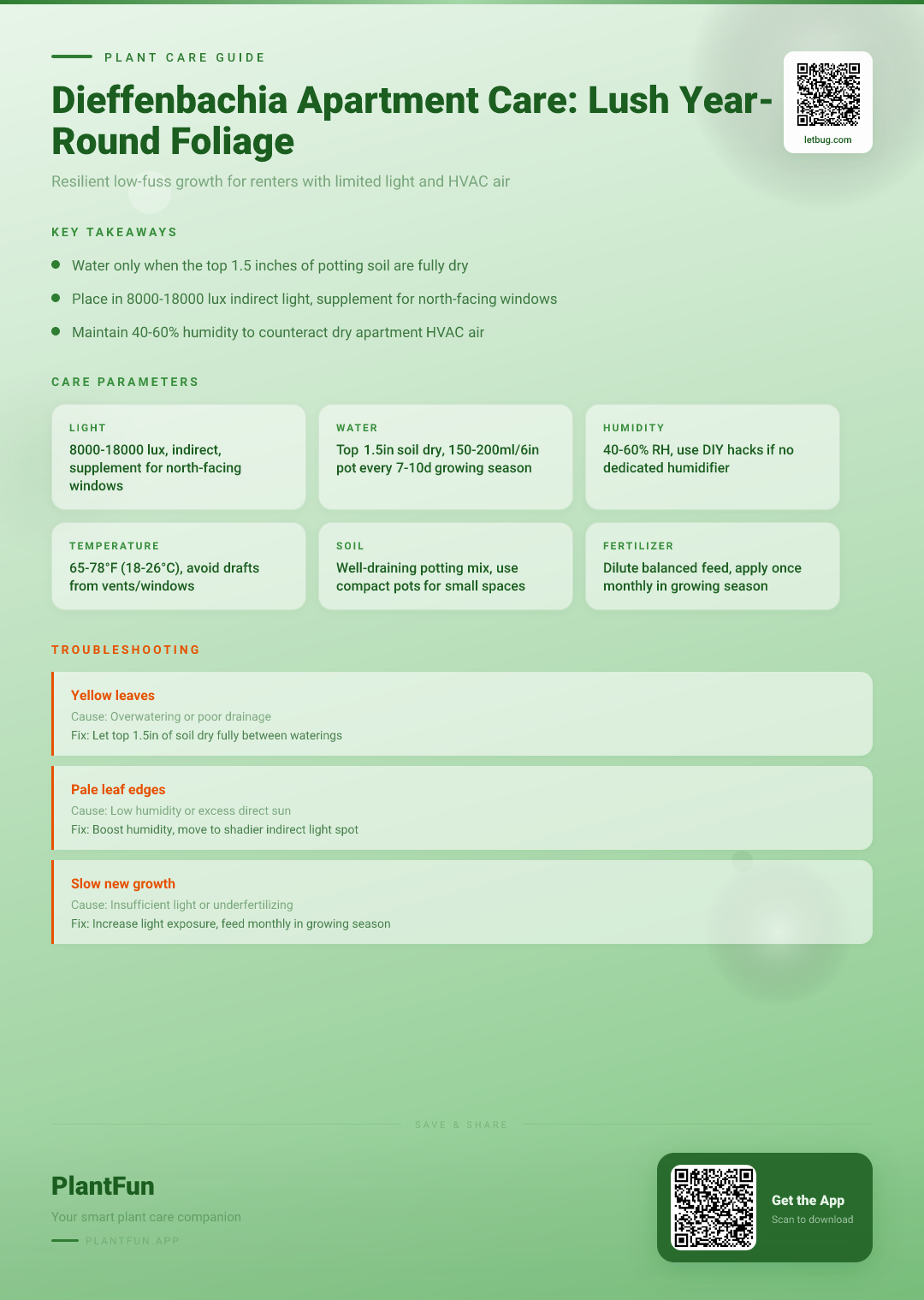
Quick Care Card: At-a-glance printable checklist of all key care thresholds for apartment-grown Dieffenbachia, ideal for quick reference for busy renters
| Care Parameter | Exact Apartment-Friendly Threshold |
|---|---|
| Light | 8,000–18,000 lux (bright indirect light) |
| Water | 150–200ml per 6-inch pot when top 1.5 inches of soil are dry; 7–10 days growing season, 14–21 days winter |
| Humidity | 40–60% relative humidity |
| Temperature | 65–78°F (18–26°C) |
| Soil | Well-draining aroid mix (60% potting soil, 20% perlite, 20% orchid bark) |
| Fertilizer | 20-20-20 all-purpose, diluted to ½ strength, every 4–6 weeks in growing season |
| Toxicity | Toxic to cats, dogs, and humans if ingested (causes oral irritation) (ASPCA, 2026) |
Why Dieffenbachia Struggle in Typical Apartments
Standard Dieffenbachia care guides are often written for greenhouse or single-family home settings with consistent environmental conditions, but urban apartments have unique stressors that lead to stunted growth, yellowing leaves, and drooping foliage. These include HVAC systems that drop humidity to 20% or lower in winter, drafty window sills that swing 20°F in temperature overnight, limited natural light in north-facing or shaded units, and irregular watering from busy renters who travel or work long hours (NC State Extension, 2026). This guide is tailored specifically to these constraints to support Dieffenbachia resilient growth even in small, fluctuating apartment spaces.
Diagnosis First: Spot Early Stress Signs Before They Worsen
Catch issues before they cause permanent damage with these 3 easy-to-spot early warning signals:
Pale, crispy leaf edges
Symptom: Thin, bleached edges on mature leaves, no brown or mushy spots.
Likely cause: Low humidity from HVAC, or chlorine buildup from tap water.
Slow new growth
Symptom: Fewer than 1 new leaf per month in spring/summer, new leaves are smaller than mature foliage.
Likely cause: Insufficient light, or under-fertilization.
Droopy lower leaves
Symptom: Soft, hanging leaves near the base of the plant, no yellowing or browning yet.
Likely cause: Either overwatering (soil is soggy) or underwatering (soil is bone dry).
Light Requirements for Apartment Placement
Dieffenbachia light requirements indoors fall between 8,000 and 18,000 lux, which is bright indirect light (Ajay & Fatmi, 2024). Ideal apartment spots include:
- 1–2 feet away from an east-facing window (gets gentle morning sun, no harsh midday rays)
- 3–4 feet away from a south-facing window with a sheer curtain to filter direct sun
- For north-facing units, use an affordable full-spectrum clip-on grow light placed 12 inches above the plant, run for 12 hours per day to meet the minimum 8,000 lux requirement.
Myth vs Reality: Myth: Dieffenbachia needs full sun to grow large, lush leaves. Reality: Direct midday sun over 20,000 lux will scorch Dieffenbachia foliage, while it will thrive even in low-light apartments that meet the 8,000 lux minimum, answering the common question of can Dieffenbachia grow in low light apartments (NC State Extension, 2026).
Exact Watering Schedule for Busy Renters
Wondering how often to water Dieffenbachia? Follow this measurable, low-effort routine:
- Do the 1.5-inch finger test: Stick your index finger 1.5 inches into the top of the soil. If it is completely dry, water; if any moisture remains, wait 2 more days and test again.
- For a standard 6-inch nursery pot, use 150–200ml of water per watering session, enough to moisten the root zone without saturating the soil.
- In spring and summer (growing season), this translates to watering every 7–10 days.
Travel adjustments: If you are gone for 1–2 weeks, fill a pebble tray under the pot with water before leaving, or use a cheap self-watering spike. For trips longer than 2 weeks, ask a neighbor to water only if the 1.5-inch soil test shows dryness (NC State Extension, 2026).
Humidity & Temperature Rules for HVAC-Heated/Cooled Apartments
Dieffenbachia humidity needs sit at 40–60% relative humidity, and a temperature range of 65–78°F (18–26°C) (Šrámek, 1999). Most apartments fall below 40% humidity when HVAC is running, so use these renter-friendly DIY hacks to raise humidity without a dedicated humidifier:
- Group your Dieffenbachia with other tropical plants: transpiration from surrounding plants will raise local humidity by 10–15%.
- Fill a tray with pebbles and water, set the pot on top of the pebbles (make sure the pot is not sitting directly in water to avoid root rot).
- Mist the foliage 2–3 times per week with room-temperature water if your hygrometer reads below 35% humidity.
Avoid placing your Dieffenbachia within 2 feet of drafty windows, AC vents, or heating units, which can cause temperature swings of 15°F or more overnight.
Soil & Repotting Guidance for Small Apartment Spaces
The best Dieffenbachia soil mix is a well-draining aroid blend: 60% standard potting soil, 20% perlite, 20% orchid bark (NC State Extension, 2026). This mix prevents root rot from accidental overwatering, a common issue for renters.
Follow this Dieffenbachia repotting guide tailored to small apartments:
- Repot only every 2–3 years, when you see roots growing out of the drainage holes at the bottom of the pot.
- Choose a pot only 1–2 inches larger than the current pot to avoid excess soil that holds water and causes rot.
- Opt for compact 6–8 inch plastic or ceramic pots that fit on apartment shelves, kitchen counters, or windowsills without taking up too much space.
- If you use a decorative pot without drainage holes, add a 1-inch layer of pebbles at the bottom to catch excess water.
Seasonal Care Calendar
Adjust your care routine for apartment seasonal changes to keep your plant thriving year-round:
Winter (Dieffenbachia winter care)
- Reduce watering to every 14–21 days, as lower light slows growth and the soil takes longer to dry out.
- Add 2–4 hours of extra grow light per day if your apartment gets less than 8,000 lux of natural light in winter.
- Stop fertilizing completely, as the plant is dormant.
Summer (Dieffenbachia summer watering)
- Stick to the 7–10 day watering schedule, and test soil moisture more often if your apartment gets very hot.
- Add an extra misting session per week to raise humidity as air conditioners run more frequently.
- Fertilize every 4 weeks instead of every 6 weeks to support new growth (Ajay & Fatmi, 2024).
Common Apartment Dieffenbachia Mistakes to Avoid
- Mistake: Placing your Dieffenbachia directly in front of an AC or heating vent. What happens: Constant airflow dries out foliage, leading to Dieffenbachia drooping leaves and brown leaf edges. Instead: Move the plant at least 3 feet away from all HVAC vents, or place a small barrier between the vent and the plant to redirect airflow.
- Mistake: Overfertilizing to speed up growth. What happens: Salt buildup in the soil burns root tips, leading to yellowing leaves and stunted growth. Instead: Only fertilize in the growing season, dilute fertilizer to ½ strength, and flush the soil with 3x the pot volume of water every 3 months to remove excess salt.
- Mistake: Using high-chlorine tap water directly on the plant. What happens: Chlorine and fluoride in tap water cause pale, crispy leaf edges over time. Instead: Leave tap water out in an open container for 24 hours before watering to let chlorine evaporate, or use collected rainwater if available.
- Mistake: Repotting into an oversized pot to avoid repotting again soon. What happens: Excess soil holds water for weeks, leading to root rot which is the top cause of why is my Dieffenbachia turning yellow queries. Instead: Only size up by 1–2 inches when repotting, and use a well-draining aroid mix.
- Mistake: Placing your Dieffenbachia in direct midday sun to give it more light. What happens: Direct sun over 20,000 lux scorches leaves, leaving permanent brown patches. Instead: Use a sheer curtain to filter south-facing window light, or add a grow light if you need to increase light levels without direct sun.
FAQ
Why is my Dieffenbachia turning yellow in my apartment?
The most common cause is overwatering: first, do the 1.5-inch soil test. If the soil is soggy, stop watering until it is completely dry, and check that the pot has working drainage holes. If the soil is dry, the yellowing may be from underwatering, low humidity, or nutrient deficiency (NC State Extension, 2026).
Can I keep a Dieffenbachia in a windowless apartment office?
Yes! You just need a 10W full-spectrum grow light placed 12 inches above the plant, run for 12 hours per day to meet the minimum 8,000 lux light requirement. Dieffenbachia is a great low-maintenance office plant as long as it gets consistent light and water (Ajay & Fatmi, 2024).
How often should I fertilize my Dieffenbachia as a beginner?
For Dieffenbachia care for beginners, stick to fertilizing once every 4–6 weeks only in the spring and summer, using a 20-20-20 all-purpose fertilizer diluted to ½ strength. Stop fertilizing completely in winter, and do not fertilize for the first 6 months after repotting, as fresh potting mix already has enough nutrients.
Free Printable Care Checklist
Grab our free, fridge-friendly Dieffenbachia care checklist to take the guesswork out of care. The printable checklist includes:
- Weekly 1-minute check prompts for soil moisture, light, and humidity
- Monthly fertilization reminders for the growing season
- Seasonal adjustment tips for winter and summer
- Early stress sign cheat sheet to catch issues before they worsen It’s designed for busy renters, so you can mark off checks in seconds and never forget a watering session again.
References
- ASPCA. (2026). Toxic and Non-Toxic Plants List — ASPCA. https://www.aspca.org/pet-care/animal-poison-control/toxic-and-non-toxic-plants. Accessed 2026-03-01.
- NC State Extension. (2026). The Complete Dieffenbachia Care — NC State Extension Gardener Plant Toolbox. https://plants.ces.ncsu.edu/plants/dieffenbachia-care/. Accessed 2026-03-01.
- Ajay, P.; Fatmi, U. (2024). Performance of Different Dieffenbachia (Dieffenbachia seguine) Varieties under Prayagraj Agro-climatic Conditions. International Journal of Plant & Soil Science. https://doi.org/10.9734/ijpss/2024/v36i74815. Accessed 2026-03-01.
- Šrámek, F. (1999). Vaughan, M.J.: The Complete Book on Cut Flower Care. Biologia plantarum. https://doi.org/10.1023/a:1001770114931. Accessed 2026-03-01.
Optional Helper: Plantfun.App
Plantfun.App identifies your plants by photo, diagnoses pests and diseases with clear fixes, and creates personalised watering and light schedules that adapt to your home conditions — a handy companion for putting this guide into daily practice.
Found an error or have suggestions? We'd love your feedback.
Need help identifying this problem?
Get instant identification, personalized care schedules, and effective pest treatment plans directly on your phone.
Sponsored • We may earn a commission from app downloads
Related Guides
The Complete Budget Dieffenbachia Care Checklist for Lush Resilient Growth in Typical Apartments
Grow lush, full Dieffenbachia in your apartment without buying expensive specialty supplies. Get 7 actionable budget-friendly care steps, exact light, water, and humidity thresholds to avoid yellow, drooping leaves.
Care GuideThe Complete Budget Dieffenbachia Care Checklist for Resilient Growth in Typical Apartments
Skip expensive specialty plant products to grow lush, full Dieffenbachia in your typical apartment. Get 7 actionable budget care steps, exact light/water thresholds, and fixes for common issues.
Care GuideThe Complete Dieffenbachia Care Checklist for Resilient Growth in Typical City Apartments
Grow a lush, full Dieffenbachia even in a standard city apartment. Get a 9-step actionable checklist, measurable care thresholds, and quick fixes for common leaf issues to keep your plant thriving year-round.
Pest ControlAnts on Plants: What They Mean and What to Do
Ants usually aren't eating your plant. They are farming other pests.