
Key Takeaways
- Check soil moisture before watering — overwatering is the #1 killer of houseplants.
- Ensure your plant gets the right amount of light for its species.
- Be patient with recovery — most plants need 2–4 weeks to bounce back.
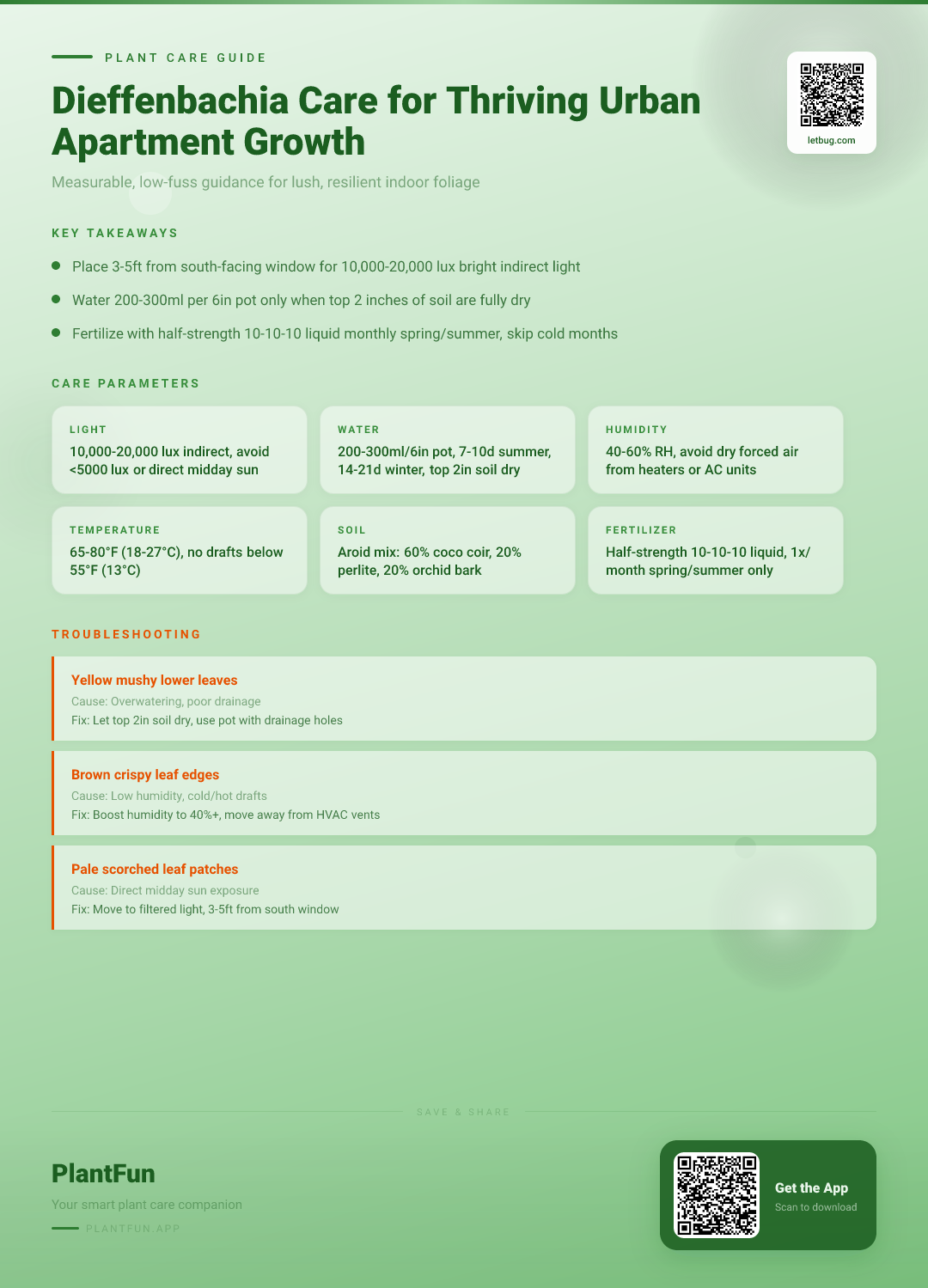
Quick Care Card: At-a-glance printable 1-page checklist
This printable checklist includes all core measurable care thresholds for Dieffenbachia in typical apartments, no fluff. Save or print it for easy reference:
| Care Factor | Threshold for Standard Urban Apartments |
|---|---|
| Light | 10,000-20,000 lux bright indirect light, no direct midday sun |
| Water | 200-300ml per 6in pot when top 2 inches of soil are dry |
| Humidity | 40-60% relative humidity |
| Temperature | 65-80°F (18-27°C), no drafts below 55°F (13°C) |
| Soil | 60% coco coir, 20% perlite, 20% orchid bark aroid mix |
| Fertilizer | Half-strength 10-10-10 liquid fertilizer, once monthly spring/summer only |
| Toxicity | Toxic to cats, dogs, and children if ingested (ASPCA, 2026) |
Why Generic Dieffenbachia Care Fails In Apartments
Most mainstream Dieffenbachia care guides are written for greenhouse environments, which have consistent 60%+ humidity, filtered full light, and stable temperatures that don’t match typical urban apartment conditions. Your apartment likely has 30-45% baseline humidity, partial variable light, forced air heating/cooling, and limited space, which means one-size-fits-all rules will often lead to stressed plants. Common missteps for new Dieffenbachia care for beginners include following fixed weekly watering schedules without checking soil moisture, placing plants in dark corners assuming they tolerate full shade, and ignoring drafty vents that cause temperature shock.
Myth vs Reality: Myth: Dieffenbachia grows well in full dark. Reality: Dieffenbachia needs at least 5,000 lux of light to avoid stunted growth (NC State Extension, 2026).
Step 1: Light Requirements for Apartment Placement
Dieffenbachia light requirements fall in the 10,000-20,000 lux bright indirect light range for optimal growth (Ajay & Fatmi, 2024). The ideal placement is 3-5ft from a south-facing window, where it gets filtered morning sun and avoids harsh midday rays that burn leaves. Avoid spots with less than 5,000 lux (dark corners more than 8ft from any window) which will lead to leggy growth and yellow leaves.
Quick test: Hold your hand 1ft above the plant at midday. If you see a sharp, defined shadow, the spot gets too much direct sun. If you see no shadow at all, the light is too low for sustained growth.
Step 2: Exact Watering Schedule for Apartment Humidity Levels
Wondering how often to water Dieffenbachia in your apartment? For a standard 6in pot, water 200-300ml of filtered water when the top 2 inches of soil feel completely dry to the touch (NC State Extension, 2026). This typically translates to:
- Dieffenbachia summer watering: Every 7-10 days when temperatures are warm and humidity is moderate
- Dieffenbachia winter care watering: Every 14-21 days when growth slows and heating dries out the air
Quick test: Stick your index finger 2 inches deep into the soil. If it comes out completely dry with no clumps of soil stuck to it, it’s time to water. Avoid high-chlorine tap water by letting it sit out for 24 hours before use to let chlorine evaporate.
Step 3: Humidity & Temperature Thresholds to Prevent Leaf Browning
Dieffenbachia humidity levels should stay between 40-60% to prevent brown leaf tips and crispy edges (Šrámek, 1999). Most apartments have 30-45% baseline humidity, so you can boost levels without a fancy humidifier by placing a tray of pebbles and water under the pot, or grouping your Dieffenbachia with other tropical plants.
Keep temperatures between 65-80°F (18-27°C) year-round, and never expose your plant to drafts below 55°F (13°C) near leaky windows, AC vents, or heating vents. Sudden temperature shifts are one of the most common causes of leaf drop in apartment plants.
Step 4: Soil & Potting Requirements for Small Apartment Spaces
The best Dieffenbachia soil mix for apartments is a well-draining aroid blend: 60% coco coir, 20% perlite, 20% orchid bark (NC State Extension, 2026). This mix holds just enough moisture without staying soggy, which prevents root rot in small, enclosed apartment spaces.
Use a pot that is only 1-2 inches larger than the current root ball, with at least one drainage hole at the bottom. Oversized pots hold excess soil that stays wet for weeks, which is a leading cause of Dieffenbachia drooping and root rot.
Step 5: Fertilizing Routine for Steady Resilient Growth
Wondering how to make Dieffenbachia grow faster in your apartment? Use a balanced 10-10-10 liquid fertilizer diluted to half strength, applied once a month only during the spring and summer growing seasons (Ajay & Fatmi, 2024). Skip fertilizing entirely in fall and winter, when growth slows and the plant can’t absorb excess nutrients, which lead to brown leaf tips.
Seasonal Care Calendar for Apartments
Adjust your Dieffenbachia care routine to match changing urban apartment conditions throughout the year:
- Spring (March-May): Increase watering frequency as light levels rise, start monthly half-strength fertilizing, and check for roots growing out of drainage holes to see if repotting is needed.
- Summer (June-August): Move the plant 1ft further from south-facing windows to avoid midday sun burn, keep at least 2ft away from AC vents, and mist leaves weekly if humidity drops below 40%.
- Fall (September-November): Reduce watering frequency, stop fertilizing entirely, and move away from drafty windows as outdoor temperatures drop.
- Winter (December-February): Water only every 14-21 days, keep 3ft away from heating vents to avoid dry air damage, and avoid placing on cold windowsills that drop below 55°F.
Common Apartment Care Mistakes to Avoid
- Mistake: Watering on a fixed weekly schedule without checking soil moisture first What happens: Soggy soil causes root rot, yellow lower leaves, and Dieffenbachia drooping Instead: Always check the top 2 inches of soil before watering, and only water when completely dry
- Mistake: Placing your Dieffenbachia within 2ft of AC, heating vents, or leaky windows What happens: Sudden temperature shifts cause leaf drop, brown edges, and stunted growth Instead: Choose a spot with consistent temperature, away from all direct air flow sources
- Mistake: Using regular garden potting soil that retains too much moisture What happens: Soggy soil suffocates roots, leading to widespread yellowing and plant death Instead: Use the recommended well-draining aroid mix for Dieffenbachia apartment care
- Mistake: Repotting more than once every 2-3 years, or using a pot more than 2 inches larger than the root ball What happens: Excess soil holds water for weeks, causing root rot even if you water on schedule Instead: Only repot when roots are growing out of drainage holes, and size up by 1-2 inches maximum
Diagnosis-First Troubleshooting Guide
Yellow Leaves
Symptom: Lower leaves turning pale yellow, mushy at the base, or upper leaves with irregular yellow splotches
Likely cause: Overwatering, insufficient light below 5,000 lux, or overfertilizing (NC State Extension, 2026)
Fix:
- Poke 4-5 3-inch deep holes in the soil with a chopstick to aerate and speed up drying if the soil is soggy
- Move to a spot with 10,000-20,000 lux bright indirect light if the plant is in a dark corner
- Flush soil with 3x the pot volume of filtered water to remove excess fertilizer salts if you recently fertilized at full strength
Drooping Stems
Symptom: Soft, bending stems, leaves hanging limp even when the soil is not completely dry
Likely cause: Root rot from overwatering, cold draft exposure, or severe underwatering
Fix:
- If soil is soggy, remove the plant from its pot, cut off all mushy brown roots, and repot in fresh dry aroid mix
- If soil is bone dry, water with 300ml of filtered water and let all excess drain out of the bottom of the pot
- Move to a spot with no drafts below 55°F
Brown Leaf Tips
Symptom: Dry, crispy brown tips on leaf edges, with the rest of the leaf remaining green and healthy
Likely cause: Low humidity below 40%, high chlorine in tap water, or overfertilizing (NC State Extension, 2026)
Fix:
- Boost humidity to 40%+ by grouping with other plants or using a pebble tray under the pot
- Use filtered water, or let tap water sit out for 24 hours before watering to let chlorine evaporate
- Flush soil with filtered water every 3 months to remove built-up fertilizer salts
Stunted Growth
Symptom: No new leaves growing for 3+ months, or new leaves that are significantly smaller than older leaves
Likely cause: Insufficient light, lack of fertilizer during growing season, or a root-bound pot
Fix:
- Move to a spot with at least 10,000 lux bright indirect light
- Apply half-strength 10-10-10 fertilizer once a month during spring and summer
- Check for roots growing out of drainage holes; if present, repot into a 1-2 inch larger pot with fresh aroid mix
Voice Search FAQ
Why is my Dieffenbachia getting yellow leaves?
The most common cause of yellow Dieffenbachia leaves is overwatering, followed by insufficient light below 5,000 lux, or overfertilizing (NC State Extension, 2026). First check the top 2 inches of soil: if it’s still wet, hold off on watering until it dries completely, and move the plant to a brighter spot if it’s in a dark corner.
Can I keep my Dieffenbachia in a dark apartment corner?
Dieffenbachia can survive short periods of low light, but it will not thrive long-term in spots below 5,000 lux, which is typical for most dark apartment corners. You’ll see stunted growth, yellow leaves, and thin, leggy stems over time. If you only have a dark spot, consider adding a grow light set to 10,000 lux for 8 hours a day to support growth.
How often do I need to water my Dieffenbachia in winter?
For a standard 6-inch pot in a typical apartment with 30-40% baseline humidity, you’ll only need to water your Dieffenbachia every 14-21 days in winter, when growth slows. Always check the top 2 inches of soil first, and only water when it’s completely dry to avoid root rot.
References
- NC State Extension. (2026). The Complete Dieffenbachia Care — NC State Extension Gardener Plant Toolbox. https://plants.ces.ncsu.edu/plants/dieffenbachia-care/. Accessed 2026-03-01.
- Ajay, P.; Fatmi, U. (2024). Performance of Different Dieffenbachia (Dieffenbachia seguine) Varieties under Prayagraj Agro-climatic Conditions. International Journal of Plant & Soil Science. https://doi.org/10.9734/ijpss/2024/v36i74815. Accessed 2026-03-01.
- Šrámek, F. (1999). Vaughan, M.J.: The Complete Book on Cut Flower Care. Biologia plantarum. https://doi.org/10.1023/a:1001770114931. Accessed 2026-03-01.
- ASPCA. (2026). Toxic and Non-Toxic Plants List — ASPCA. https://www.aspca.org/pet-care/animal-poison-control/toxic-and-non-toxic-plants. Accessed 2026-03-01.
Optional Helper: Plantfun.App
Plantfun.App identifies your plants by photo, diagnoses pests and diseases with clear fixes, and creates personalised watering and light schedules that adapt to your home conditions — a handy companion for putting this guide into daily practice.
Found an error or have suggestions? We'd love your feedback.
Need help identifying this problem?
Get instant identification, personalized care schedules, and effective pest treatment plans directly on your phone.
Sponsored • We may earn a commission from app downloads
Related Guides
The Complete Budget Dieffenbachia Care Checklist for Resilient Growth in Typical Apartments
Skip expensive specialty plant products to grow lush, full Dieffenbachia in your typical apartment. Get 7 actionable budget care steps, exact light/water thresholds, and fixes for common issues.
Care GuideDieffenbachia Care Checklist for North-Facing Apartments: Grow Resilient Plants Without Yellow Leaves
Stop dealing with yellow, droopy Dieffenbachia leaves in your apartment. Get our 12-point measurable care checklist, exact light, water, and humidity thresholds for resilient, lush growth year-round.
Care GuideThe Budget Dieffenbachia Care Checklist for Resilient Growth in Typical Small Apartments
Skip pricy plant gadgets. Grab our free Dieffenbachia care checklist with exact light, water, and soil specs to grow lush, resilient plants even in cramped, low-humidity apartments.
Pest ControlAnts on Plants: What They Mean and What to Do
Ants usually aren't eating your plant. They are farming other pests.