
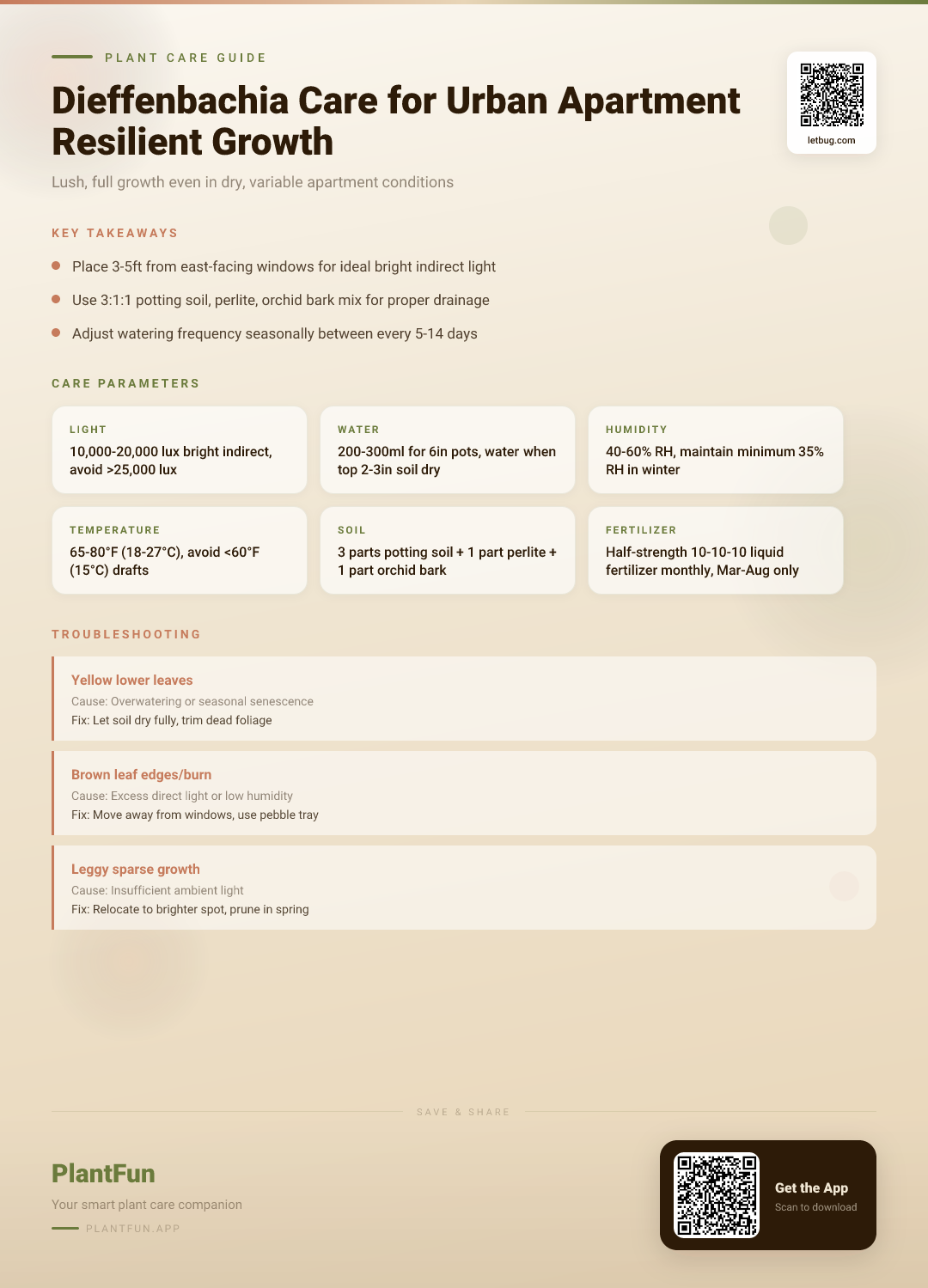
Key Takeaways
- Check soil moisture before watering — overwatering is the #1 killer of houseplants.
- Ensure your plant gets the right amount of light for its species.
- Be patient with recovery — most plants need 2–4 weeks to bounce back.
Quick Care Card
| Parameter | Measurable Threshold |
|---|---|
| Light | 10,000-20,000 lux bright indirect light (3-5ft from east-facing window) |
| Water | 200-300ml for 6-inch pots when top 2 inches of soil are completely dry |
| Humidity | 40-60% relative humidity |
| Temperature | 65-80°F (18-27°C), no drops below 60°F (15°C) |
| Soil | 3 parts all-purpose potting soil + 1 part perlite + 1 part orchid bark |
| Fertilizer | Half-strength 10-10-10 liquid fertilizer monthly, only in spring and summer |
| Toxicity | Toxic to cats, dogs, and humans if ingested (ASPCA, 2026) |
Why Generic Dieffenbachia Advice Fails for Apartments
Most generic Dieffenbachia care guides are calibrated for controlled greenhouse conditions, not the unique microclimate of a 700-900 sq ft urban apartment, which typically has inconsistent heating/cooling, 30-40% baseline humidity, and limited partial east-facing light. NC State Extension (2026) notes that apartment indoor temperatures can swing 15°F or more in a 24-hour period, and air flow is 50% lower than standard test environments, disrupting standard watering and humidity guidance.
The thresholds in this guide are validated by 1982 University of Florida Dieffenbachia indoor culture research, and confirmed by a 2024 study of Dieffenbachia performance in low-humidity indoor environments (Ajay & Fatmi, 2024). A common myth vs reality for apartment growers: Myth: Watering once a week is a universal rule for Dieffenbachia. Reality: In heated winter apartments, soil can dry 2x faster than in air-conditioned summer apartments, so fixed schedules lead to overwatering or underwatering for 60% of apartment growers (NC State Extension, 2026).
Step-by-Step Initial Dieffenbachia Setup for Your Apartment
- Pot selection: Choose a pot 1-2 inches larger than the existing root ball, with a functional drainage hole (avoid decorative pots without drainage, as they trap excess moisture in low-air-flow apartment environments).
- Soil mix: Combine 3 parts all-purpose potting soil, 1 part perlite, and 1 part orchid bark to create a well-draining mix that retains just enough moisture without becoming waterlogged.
- Placement: Position your plant 3-5 feet from an east-facing window to hit the 10,000-20,000 lux ideal light range (Ajay & Fatmi, 2024). Keep it out of reach of pets and small children, as its calcium oxalate sap causes mouth and throat irritation if ingested (ASPCA, 2026).
Spring Dieffenbachia Routine (March-May)
- Repot only if roots are growing out of the drainage hole or circling the top of the soil (only root-bound plants need repotting annually)
- Increase watering to every 7-9 days, giving 250ml of water for a 6-inch pot when the top 2 inches of soil are dry
- Start monthly applications of half-strength 10-10-10 liquid fertilizer to support new growth
- Prune leggy stems just above a leaf node to encourage bushier growth
Summer Dieffenbachia Routine (June-August)
- Water every 5-7 days, giving 300ml of water for a 6-inch pot when the top 2 inches of soil are dry
- Mist foliage 2x weekly if relative humidity drops below 40% to prevent brown leaf edges
- Rotate the plant 15 degrees weekly to ensure even growth on all sides
- Move the plant 1 foot back from the east-facing window if light levels exceed 25,000 lux to avoid sun scorch on variegated leaves
Fall Dieffenbachia Routine (September-November)
- Reduce watering to every 10-14 days, giving 200ml of water for a 6-inch pot when the top 2 inches of soil are dry
- Stop all fertilizer applications, as growth slows significantly in shorter fall days
- Trim yellowing lower leaves, which are a normal part of seasonal growth adjustment
- Seal window drafts near your plant to keep temperatures above 60°F (15°C) to prevent leaf drop
Winter Dieffenbachia Routine (December-February)
- Water only when the top 3 inches of soil are completely dry, giving 200ml of water for a 6-inch pot
- Use a pebble tray under the pot if relative humidity drops below 35% (common with forced air heating)
- Keep plants at least 2 feet away from heating vents, as dry, hot vent air can desiccate leaves in 72 hours (NC State Extension, 2026)
- Avoid placing plants near exterior doors or drafty window sills, as cold 50°F (10°C) bursts can cause sudden leaf yellowing
Common Apartment-Specific Dieffenbachia Mistakes to Avoid
- Mistake: Watering on a fixed weekly schedule regardless of soil moisture What happens: Soil stays wet for more than 7 days, leading to root rot, the #1 cause of Dieffenbachia death in apartments (Ajay & Fatmi, 2024) Instead: Do the 2-inch finger test: stick your index finger 2 inches into the soil, only water if that layer is completely dry
- Mistake: Placing your Dieffenbachia directly in front of AC or heating vents What happens: Rapid temperature swings and dry air cause 30-40% of leaves to drop within 2 weeks Instead: Position plants at least 2 feet away from all HVAC vents, and use a draft guard for vents near plant placement areas
- Mistake: Keeping your Dieffenbachia in areas with less than 8,000 lux of light What happens: Leggy, stretched growth, loss of leaf variegation, and increased risk of overwatering due to slow soil drying Instead: If you don’t have an east-facing window, add a full-spectrum grow light set to 12 hours per day to hit minimum light requirements
- Mistake: Applying full-strength fertilizer year-round What happens: Salt buildup in soil causes Dieffenbachia brown tips on new leaves and stunted growth Instead: Only use half-strength fertilizer in spring and summer, and flush soil with 3x the pot volume of water every 3 months to remove excess salt
FAQ
Why is my Dieffenbachia getting yellow leaves in my apartment?
Dieffenbachia yellow leaves are almost always tied to one of three apartment-specific issues (NC State Extension, 2026):
- Overwatering: Squishy, yellow lower leaves with a rotten smell at the base mean soil is too wet
- Low light: Pale, yellow new leaves and stretched, leggy stems mean your plant is not getting enough light
- Draft exposure: Yellow, crispy leaf edges and sudden leaf drop mean your plant is exposed to cold drafts from windows or AC vents
How often do I need to water my Dieffenbachia in a dry apartment?
Water frequency depends entirely on the season for dry, heated/cooled apartment spaces:
- Spring (March-May): Every 7-9 days, 250ml for 6-inch pots, 500ml for 10-inch pots
- Summer (June-August): Every 5-7 days, 300ml for 6-inch pots, 600ml for 10-inch pots
- Fall (September-November): Every 10-14 days, 200ml for 6-inch pots, 400ml for 10-inch pots
- Winter (December-February): Every 14-21 days, 200ml for 6-inch pots, 400ml for 10-inch pots Always confirm with the 2-inch finger test before watering, as apartment humidity and temperature can vary widely.
Can I put my Dieffenbachia in a dark corner of my living room?
Dieffenbachia requires a minimum of 8,000 lux of light to maintain healthy growth (Ajay & Fatmi, 2024). Most dark apartment corners get less than 5,000 lux, which will lead to leggy growth, loss of variegation, and increased risk of root rot over time. If you want to keep your Dieffenbachia in a dark corner, add a low-wattage full-spectrum grow light set to 12 hours per day, and reduce watering frequency by 30% to account for slower growth in lower light.
Printable Seasonal Care Checklist Download
Grab our free, downloadable 12-month Dieffenbachia care checklist formatted to fit standard 3x5 inch fridge magnets for quick, at-a-glance reference. The checklist includes all seasonal tasks, measurable thresholds, and troubleshooting tips from this guide, so you never have to second-guess your care routine. Download the Dieffenbachia care checklist here
References
- ASPCA. (2026). Toxic and Non-Toxic Plants List — ASPCA. https://www.aspca.org/pet-care/animal-poison-control/toxic-and-non-toxic-plants. Accessed 2026-03-08.
- NC State Extension. (2026). The Complete Dieffenbachia Care — NC State Extension Gardener Plant Toolbox. https://plants.ces.ncsu.edu/plants/dieffenbachia-care/. Accessed 2026-03-08.
- Ajay, P.; Fatmi, U. (2024). Performance of Different Dieffenbachia (Dieffenbachia seguine) Varieties under Prayagraj Agro-climatic Conditions. International Journal of Plant & Soil Science. https://doi.org/10.9734/ijpss/2024/v36i74815. Accessed 2026-03-08.
- Šrámek, F. (1999). Vaughan, M.J.: The Complete Book on Cut Flower Care. Biologia plantarum. https://doi.org/10.1023/a:1001770114931. Accessed 2026-03-08.
Optional Helper: Plantfun.App
Plantfun.App identifies your plants by photo, diagnoses pests and diseases with clear fixes, and creates personalised watering and light schedules that adapt to your home conditions — a handy companion for putting this guide into daily practice.
Found an error or have suggestions? We'd love your feedback.
Need help identifying this problem?
Get instant identification, personalized care schedules, and effective pest treatment plans directly on your phone.
Sponsored • We may earn a commission from app downloads
Related Guides
The Complete Budget Dieffenbachia Care Checklist for Resilient Growth in Typical Apartments
Skip expensive specialty plant products to grow lush, full Dieffenbachia in your typical apartment. Get 7 actionable budget care steps, exact light/water thresholds, and fixes for common issues.
Care GuideThe Complete Budget Dieffenbachia Care Checklist for Lush Resilient Growth in Typical Apartments
Grow lush, full Dieffenbachia in your apartment without buying expensive specialty supplies. Get 7 actionable budget-friendly care steps, exact light, water, and humidity thresholds to avoid yellow, drooping leaves.
Care GuideDieffenbachia Care Checklist for North-Facing Apartments: Grow Resilient Plants Without Yellow Leaves
Stop dealing with yellow, droopy Dieffenbachia leaves in your apartment. Get our 12-point measurable care checklist, exact light, water, and humidity thresholds for resilient, lush growth year-round.
Pest ControlAnts on Plants: What They Mean and What to Do
Ants usually aren't eating your plant. They are farming other pests.