
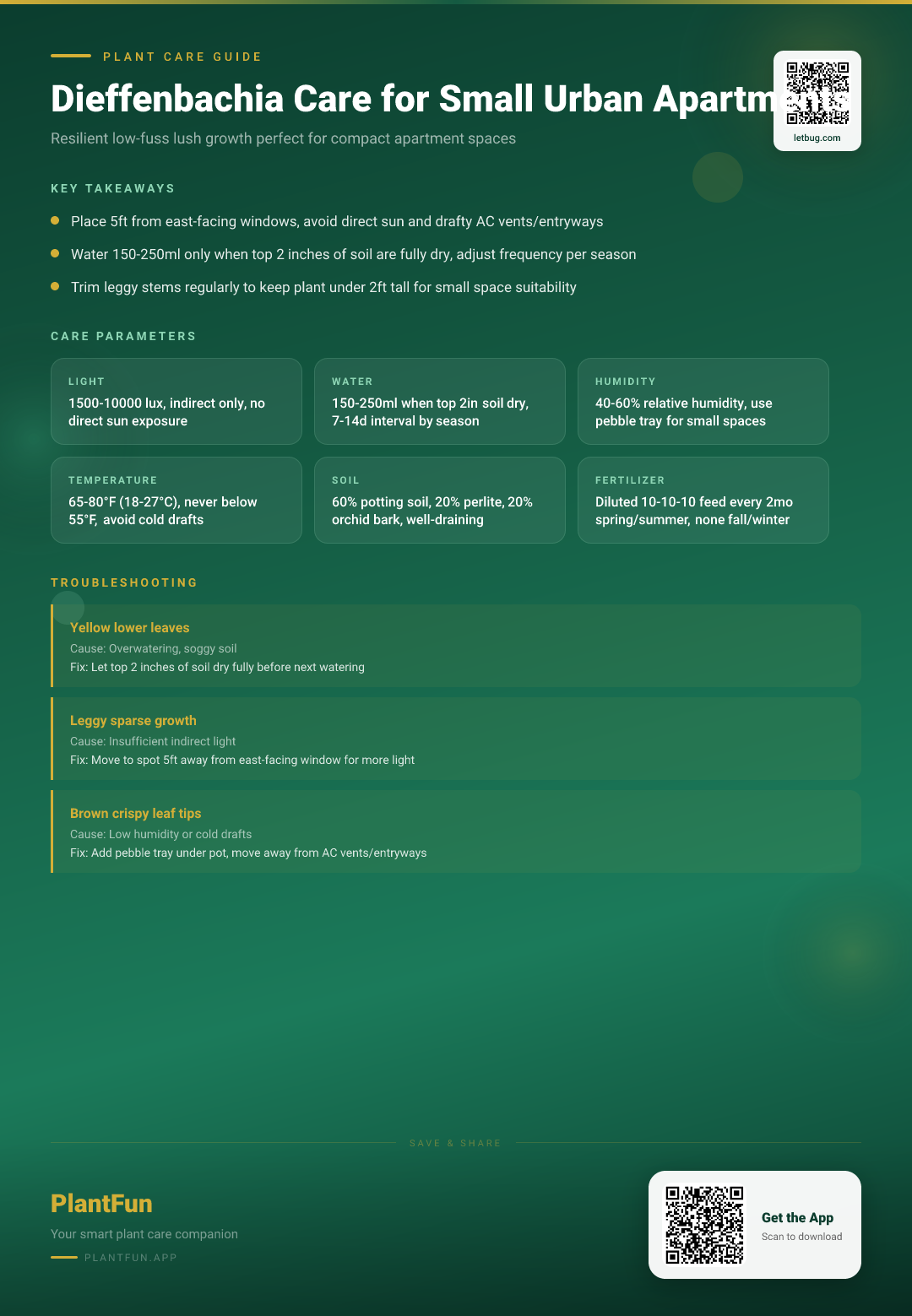
Key Takeaways
- Check soil moisture before watering — overwatering is the #1 killer of houseplants.
- Ensure your plant gets the right amount of light for its species.
- Be patient with recovery — most plants need 2–4 weeks to bounce back.
Quick Care Card
| Parameter | Exact Apartment-Specific Threshold |
|---|---|
| Light | 1,500–10,000 lux, no direct sun |
| Water | 150–250ml when top 2 inches of soil are fully dry (7–10 days summer, 9–14 days winter) |
| Humidity | 40–60% relative humidity |
| Temperature | 65–80°F (18–27°C), never below 55°F (13°C) |
| Soil | 60% potting soil, 20% perlite, 20% orchid bark |
| Fertilizer | Diluted 10-10-10 liquid every 2 months spring/summer, no feeding fall/winter |
| Toxicity | Toxic to humans, cats, and dogs if ingested (ASPCA, 2026) |
Download our free printable version of this checklist to tape to your fridge for 10-second reference any time.
Why Dieffenbachia Thrives in Small Apartments
Unlike large, high-light houseplants like fiddle leaf figs or monstera, Dieffenbachia (also called dumb cane) evolved in tropical understory environments, so it naturally tolerates the lower light levels common in compact urban apartments (Ajay & Fatmi, 2024). It also stays comfortably under 2ft tall with minimal pruning, so it never outgrows small shelf or counter space, and filters formaldehyde and other VOCs from indoor air (NC State Extension, 2026).
Myth vs. Reality: Myth: Dieffenbachia needs bright direct sun to grow full and lush. Reality: Direct sun burns its leaves, and it actually performs best in the low-to-medium bright indirect light most apartment dwellers already have available.
Step 1: Space-Saving Placement Guide for Apartments
Dieffenbachia light requirements indoors are 1,500–10,000 lux, with no exposure to direct midday sun (Ajay & Fatmi, 2024). For optimal Dieffenbachia placement in apartment spaces:
- Best spots: 5ft away from east-facing windows, under mounted kitchen shelves (use under-shelf hanging hooks to suspend the pot and save counter space entirely), or north-facing living room corners 3–6ft from the window.
- Spots to avoid: Next to AC/heating vents, drafty entry doors, or within 1ft of unobstructed south-facing windows.
Quick test: Hold your hand up at the proposed placement spot at midday on a sunny day. If you don’t see a distinct, dark shadow, the light level is perfect for Dieffenbachia. If you’re struggling to find enough bright spots, check our guide to low-light houseplants for small apartments for more creative placement hacks.
Step 2: Watering Routine Tailored to Apartment HVAC
How often to water Dieffenbachia in apartments depends on HVAC use, but the golden rule is to apply 150–250ml of room-temperature water only when the top 2 inches of soil are completely dry (NC State Extension, 2026). This works out to 7–10 days in summer when AC runs frequently, and 9–14 days in winter when central heating dries out indoor air.
Quick test: Stick your index finger 2 inches deep into the soil. If it feels completely dry, it’s time to water; if there’s any moisture left, wait 2–3 days and test again. For low-maintenance care, use self-watering inserts for 4-inch compact pots to cut down on watering frequency without taking extra shelf space. For more HVAC-specific watering tips, read our complete guide to watering houseplants in heated apartments.
Step 3: Soil & Pot Selection for Small Spaces
Follow this Dieffenbachia small pot size guide to save space and prevent root rot: stick to 4–6 inch diameter terracotta pots with drainage holes (Ajay & Fatmi, 2024). Larger pots take up unnecessary counter space and hold excess moisture that suffocates roots, even if you water correctly. Dieffenbachia actually prefers to be slightly root-bound, so you won’t stunt growth by using a compact pot.
Use a well-draining soil mix for small containers: 60% general potting soil, 20% perlite, 20% orchid bark to ensure water flows through quickly and doesn’t pool around roots. Learn how to clean and reuse old terracotta pots for new plants in our terracotta pot care 101 guide.
Step 4: Humidity & Temperature Adjustments for Apartment Conditions
The ideal Dieffenbachia humidity level is 40–60% relative humidity, with a temperature range of 65–80°F (18–27°C) (NC State Extension, 2026). Never expose it to temperatures below 55°F (13°C), as this causes permanent leaf damage.
Space-saving hack: Skip bulky countertop humidifiers that take up valuable space. Instead, place a 4oz pebble tray under the pot, filling it with water just below the top of the pebbles so the pot isn’t sitting in standing water. This raises local humidity by 10–15% around the plant without taking any extra shelf or counter space.
Step 5: Low-Effort Fertilizing Schedule
Feed your Dieffenbachia once every 2 months in spring and summer only, using 10-10-10 liquid fertilizer diluted to half the package’s recommended strength. Skip fertilizing entirely in fall and winter, when low light slows growth and overfeeding causes salt buildup that leads to yellow leaves and stunted growth.
Step 6: Pruning Tips for Compact Growth
Trim leggy stems just above a leaf node with sharp, sterilized pruning shears to keep your Dieffenbachia under 2ft tall for small spaces. This encourages bushy, full growth instead of tall, sparse stems that take up extra vertical room.
Safe handling note: Dieffenbachia sap contains calcium oxalate crystals that are toxic to humans, cats, and dogs if ingested, and can cause skin irritation on contact (ASPCA, 2026). Wear disposable gloves while pruning, wash your hands immediately after handling, and keep cuttings away from pets and small children. If you have curious pets, check our list of pet-safe small-space houseplant alternatives for more options.
Seasonal Care Calendar for Apartment Dwellers
This month-by-month guide is tailored to typical urban apartment HVAC cycles and light levels:
- January–February (Winter): Dieffenbachia winter care: Water only every 9–14 days, skip fertilizer, and keep at least 3ft away from heating vents. Monthly 2-minute task: Wipe leaves with a damp microfiber cloth to remove dust that blocks light absorption.
- March–April (Spring): Gradually increase watering to every 7–10 days, start your every-2-month fertilizing schedule. Monthly 2-minute task: Check for root bound if growth has stalled; only repot into a pot 1 inch larger if roots are growing out of the drainage holes.
- May–August (Summer): Dieffenbachia summer watering: 150–250ml every 7–10 days, keep away from cold AC vents. Monthly 2-minute task: Check the undersides of leaves for spider mites, which thrive in dry AC air.
- September–December (Fall/Winter): Stop fertilizing entirely, reduce watering frequency as light levels drop, and move away from drafty windows as temperatures cool. Monthly 2-minute task: Test soil moisture with your finger before watering to avoid overwatering in low light.
Common Apartment-Specific Mistakes to Avoid
- Mistake: Placing Dieffenbachia next to drafty window AC units or entry doors. What happens: Sudden temperature drops cause widespread leaf drop and stunted growth. Instead: Place it at least 3ft away from all vents and drafty areas, or use a small floating shelf to block direct drafts.
- Mistake: Overwatering because you assume dry HVAC air means the plant needs more water. What happens: Root rot is the #1 cause of dying Dieffenbachia in apartments (NC State Extension, 2026). Instead: Always test the top 2 inches of soil first, only water when it’s completely dry.
- Mistake: Using a pot larger than 6 inches to “let the plant grow faster”. What happens: The extra soil holds excess moisture that causes root rot, and takes up valuable counter or shelf space you could use for other plants. Instead: Stick to 4–6 inch pots, only size up by 1 inch when the plant is fully root bound.
- Mistake: Placing it in direct south-facing sun to “give it more light”. What happens: Direct sun burns leaves, causing brown, crispy edges that never recover. Instead: Keep it 5ft away from east-facing windows, or 3–6ft from south-facing windows with a sheer curtain to filter light.
- Mistake: Fertilizing year-round to encourage faster growth. What happens: Overfertilization causes salt buildup in the soil, leading to yellow leaves and stunted growth in low winter light. Instead: Only fertilize in spring and summer, skip entirely in fall and winter.
FAQ (Voice Search Optimized)
Can I keep my Dieffenbachia in my studio apartment bedroom?
Yes, as long as it gets 1,500–10,000 lux of bright indirect light (the equivalent of being 5ft from an east-facing window) and is kept out of reach of pets and small children, since the sap is toxic (ASPCA, 2026). It also filters VOCs from indoor air, making it a great low-maintenance bedroom plant for small spaces.
Why is my Dieffenbachia getting yellow leaves in my apartment?
The most common causes are overwatering, exposure to cold drafts, or overfertilization. First, check if the top 2 inches of soil are wet: if they are, hold off on watering until it’s fully dry. If you recently placed it near a drafty window or AC vent, move it to a warmer, more consistent spot. If you fertilized in the last 2 months, flush the soil with distilled water to remove excess salt buildup.
How small of a pot can I use for my Dieffenbachia?
You can use a 4-inch diameter pot for young Dieffenbachia plants, as long as it has drainage holes. Mature plants up to 2ft tall do perfectly fine in 6-inch pots, as they prefer to be slightly root bound (Ajay & Fatmi, 2024). Avoid pots smaller than 4 inches, as they dry out too quickly in dry apartment HVAC air and require constant watering.
How to save a dying Dieffenbachia in my apartment?
First, gently remove the plant from its pot and check the roots: if they are brown and mushy, trim off all rotten roots, repot in fresh well-draining soil, and hold off on watering for 1 week. If the roots are white and firm, check for drafts or overfertilization, adjust your watering schedule to only water when the top 2 inches of soil are dry, and move it to a spot with 1,500–10,000 lux of bright indirect light.
Final Quick Checklist Recap
Print this 8-item list and tape it to your fridge for 10-second reference whenever you need it:
- Place in 1,500–10,000 lux of bright indirect light, no direct sun, 3ft away from vents and drafts
- Water 150–250ml only when top 2 inches of soil are fully dry (7–10 days summer, 9–14 days winter)
- Use a 4–6 inch terracotta pot with drainage holes to save space and prevent root rot
- Use well-draining soil mix: 60% potting soil, 20% perlite, 20% orchid bark
- Maintain 40–60% relative humidity and 65–80°F (18–27°C) temperatures
- Feed with diluted 10-10-10 liquid fertilizer every 2 months in spring and summer only
- Prune leggy stems to keep the plant under 2ft tall, wear gloves to avoid toxic sap
- Wipe leaves monthly to remove dust and check for pest infestations
References
- Ajay, P.; Fatmi, U. (2024). Performance of Different Dieffenbachia (Dieffenbachia seguine) Varieties under Prayagraj Agro-climatic Conditions. International Journal of Plant & Soil Science. https://doi.org/10.9734/ijpss/2024/v36i74815. Accessed 2026-03-09.
- Šrámek, F. (1999). Vaughan, M.J.: The Complete Book on Cut Flower Care. Biologia plantarum. https://doi.org/10.1023/a:1001770114931. Accessed 2026-03-09.
- ASPCA. (2026). Toxic and Non-Toxic Plants List — ASPCA. https://www.aspca.org/pet-care/animal-poison-control/toxic-and-non-toxic-plants. Accessed 2026-03-09.
- NC State Extension. (2026). The Complete Dieffenbachia Care — NC State Extension Gardener Plant Toolbox. https://plants.ces.ncsu.edu/plants/dieffenbachia-care/. Accessed 2026-03-09.
Optional Helper: Plantfun.App
Plantfun.App identifies your plants by photo, diagnoses pests and diseases with clear fixes, and creates personalised watering and light schedules that adapt to your home conditions — a handy companion for putting this guide into daily practice.
Found an error or have suggestions? We'd love your feedback.
Need help identifying this problem?
Get instant identification, personalized care schedules, and effective pest treatment plans directly on your phone.
Sponsored • We may earn a commission from app downloads
Related Guides
The Complete Dieffenbachia Care Checklist for Resilient Growth in Typical City Apartments
Grow a lush, full Dieffenbachia even in a standard city apartment. Get a 9-step actionable checklist, measurable care thresholds, and quick fixes for common leaf issues to keep your plant thriving year-round.
Care GuideThe Complete Dieffenbachia Care Checklist for Resilient Growth in East-Facing Apartments
Grow full, vibrant Dieffenbachia even in your average east-facing apartment. Get exact light levels, watering amounts, and a seasonal checklist to prevent yellow leaves and stunted growth.
Care GuideDieffenbachia in Typical Low-Humidity Apartments: The Resilient Growth Care Checklist for Lush Yellowing-Free Foliage
Stop dealing with yellow, drooping Dieffenbachia leaves in your apartment. Get exact light levels, watering amounts, and a no-fuss checklist for lush, resilient growth year-round.
Pest ControlAnts on Plants: What They Mean and What to Do
Ants usually aren't eating your plant. They are farming other pests.