
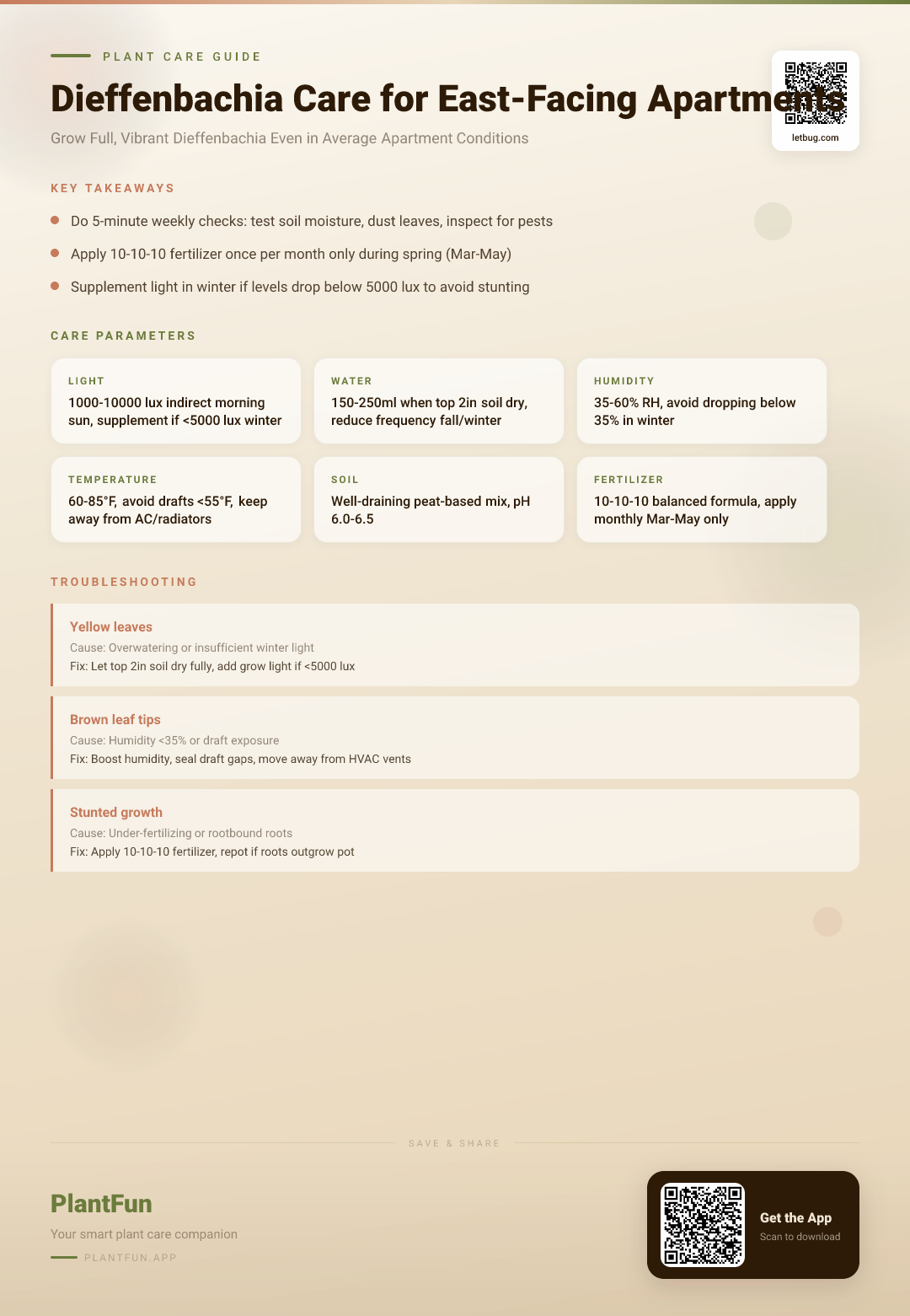
Key Takeaways
- Check soil moisture before watering — overwatering is the #1 killer of houseplants.
- Ensure your plant gets the right amount of light for its species.
- Be patient with recovery — most plants need 2–4 weeks to bounce back.
Quick Care Card
| Care Parameter | Measurable Threshold for East-Facing Apartments |
|---|---|
| Light | 6,000–15,000 lux (2–4 hours of soft morning sun only, no direct afternoon exposure) |
| Water | 150–250ml for 6-inch pots, 250–350ml for 8-inch pots, only when top 2 inches of soil are dry (adjust 30% lower in fall/winter) |
| Humidity | 40–60% RH; supplement if levels drop below 35% RH |
| Temperature | 65–75°F (18–24°C); avoid sustained temperatures below 60°F (15°C) |
| Soil | Well-draining aroid mix (1 part perlite, 1 part orchid bark, 2 parts peat moss) |
| Fertilizer | Half-strength 10-10-10 NPK every 4 weeks March–August; no fertilizer September–February |
| Toxicity | Toxic to cats, dogs, and humans if ingested (contains calcium oxalate crystals) (ASPCA, 2026) |
Why This Guide Is Different
Generic Dieffenbachia care guides often assume bright indirect light, 50–70% relative humidity, and stable temperatures, which rarely match the average east-facing apartment: these spaces only get soft morning light, have baseline humidity of 35–45%, and experience regular temperature swings from HVAC use. Myth: Dieffenbachia needs constant bright light to thrive. Reality: East-facing morning light is ideal for Dieffenbachia resilient growth tips if you adjust watering and humidity per season, per a 2024 study of Dieffenbachia performance under variable light conditions (Ajay & Fatmi, 2024). This guide skips generic advice, focusing exclusively on measurable, apartment-specific thresholds to eliminate guesswork for Dieffenbachia care for beginners and intermediate growers alike.
Step-by-Step Weekly Care Routine
This 5-minute routine is tailored to busy apartment dwellers:
- (1 min) Test soil moisture by sticking your index finger 2 inches deep into the soil; only water if it is completely dry (use a wooden chopstick if you want to avoid dirt under your nails).
- (2 mins) Wipe both sides of leaves with a damp microfiber cloth to remove dust, which blocks light absorption in low-light east-facing spaces (follow our guide to cleaning houseplant leaves for streak-free results).
- (1 min) Inspect leaf undersides and stem joints for spider mites or mealybugs, common pests in dry apartment air (see our guide to eliminating spider mites for fast, non-toxic fixes).
- (1 min) Rotate the pot ¼ turn to ensure even growth on all sides.
Spring Dieffenbachia Care Adjustments (March-May)
Spring is the peak growing season for Dieffenbachia in east-facing apartments:
- Repotting guidance: Only repot if roots are growing out of drainage holes or circling the root ball; use a pot no more than 2 inches larger in diameter than the current one, and fill with well-draining aroid mix (follow our tested aroid soil mix recipe for best results) (NC State Extension, 2026).
- Fertilizer schedule: Apply half-strength 10-10-10 NPK fertilizer once every 4 weeks, always after watering to avoid root burn.
- Acclimation tips: If moving your plant closer to the east window for increased spring light, shift it 6 inches closer every 3 days to avoid shock from sudden light exposure changes.
Summer Dieffenbachia Care Adjustments (June-August)
East-facing light is slightly stronger in summer, but still gentle enough to avoid most scorch risk:
- Watering schedule: Follow Dieffenbachia summer watering guidelines: 150–250ml for 6-inch pots, 250–350ml for 8-inch pots, only when the top 2 inches of soil are dry (this is 20–30% more water than winter volumes, matched to faster summer growth).
- Humidity boosting hacks: Place a tray of pebbles and water under the pot (ensure the pot is not sitting directly in water) or group your Dieffenbachia with other plants to raise local humidity by 10–15% to meet Dieffenbachia humidity requirements.
- Sun scorch prevention: Pull the plant 12 inches back from the window on unusually hot late-spring mornings if light levels exceed 15,000 lux to avoid brown, crispy leaf edges (Ajay & Fatmi, 2024).
Fall Dieffenbachia Care Adjustments (September-November)
Growth slows as day lengths shorten in fall, so adjust your care routine accordingly:
- Reduce fertilizer: Stop all fertilizer applications by mid-September, as the plant’s nutrient uptake drops significantly with less light.
- Seal drafty window gaps: Use weather stripping around your east window to prevent cold drafts from seeping in, which can cause sudden leaf drop.
- Adjust watering: Reduce watering volume by 30% compared to summer, as slower evaporation and reduced growth mean the plant uses less water.
Winter Dieffenbachia Care Adjustments (December-February)
Dieffenbachia winter care is critical for apartment growers, as low light and dry HVAC air often cause stress:
- Cold damage prevention: Keep the plant at least 3 feet away from exterior windows on nights when temperatures drop below 50°F (10°C), and 2 feet away from radiators to avoid dry air burn.
- Light supplementation: If light levels drop below 5,000 lux (test with a free light meter app on your phone), add a grow light 12 inches above the plant for 4 hours per day in the morning (check our curated list of affordable apartment grow lights for space-efficient options).
- Reduced watering schedule: Water only when the top 3 inches of soil are completely dry, usually every 2–3 weeks, to avoid overwatering and root rot.
Common Apartment-Specific Mistakes to Avoid
- Mistake: Following generic weekly watering schedules without testing soil moisture. What happens: Low east-facing light slows soil evaporation, leading to overwatering, root rot, and yellow leaves (the top cause of Dieffenbachia death in apartments, NC State Extension, 2026). Instead: Always test soil moisture 2 inches deep before watering, and adjust volume per season as listed in the care card.
- Mistake: Placing the plant within 1 foot of radiators, AC vents, or drafty window sills. What happens: Sudden temperature swings or dry air cause leaf browning, stunted growth, and pest infestations. Instead: Keep the plant in a spot with consistent temperatures 3 feet away from HVAC units and drafty window edges.
- Mistake: Ignoring winter humidity drops below 35% RH. What happens: Dry air causes leaf edges to crisp and makes the plant vulnerable to spider mites. Instead: Use a small humidifier near the plant in winter, or mist leaves 2x per week, to keep humidity above 40%.
FAQ (Voice Search Optimized)
Why is my Dieffenbachia getting yellow leaves in my apartment?
The most common cause is overwatering due to low east-facing light, which slows soil drying (NC State Extension, 2026). Other causes include cold drafts, low humidity below 35%, or nutrient deficiency if you haven’t fertilized in over 6 months. The first step for any Dieffenbachia yellow leaves fix is to test soil moisture: if it is soggy, hold off on watering until it is completely dry, and cut off any mushy brown roots if you repot.
How often should I water my Dieffenbachia in an east-facing room?
There is no fixed schedule, but on average: once every 7–10 days in summer, once every 10–14 days in fall and spring, and once every 2–3 weeks in winter. Always confirm by testing that the top 2 inches of soil are completely dry before watering, and use the 150–350ml volume per pot size listed in the care card. This tailored schedule answers the common “how often to water Dieffenbachia” question for east-facing apartment spaces.
Can I keep my Dieffenbachia next to my apartment AC unit?
No, cold, dry air blowing directly from an AC unit will cause leaf browning, drooping, and increased pest risk. If your only available spot is near an AC, angle the vents away from the plant, and keep it at least 3 feet away from the unit to avoid temperature swings.
Printable Care Checklist
Print this fillable checklist and tape it to your fridge or plant shelf to track care tasks month over month:
Spring (March-May)
[ ] Test soil moisture 1x per week, water when top 2 inches are dry [ ] Apply half-strength 10-10-10 fertilizer once every 4 weeks [ ] Inspect for root bound growth, repot if needed in early spring [ ] Rotate pot ¼ turn weekly for even growth [ ] Acclimate to increased window light gradually if moving closer
Summer (June-August)
[ ] Test soil moisture 1x per week, water 150–350ml when top 2 inches are dry [ ] Check humidity levels 1x per week, boost if below 40% [ ] Move plant 12 inches back from window if sun exceeds 15,000 lux to avoid scorch [ ] Inspect leaf undersides for spider mites weekly
Fall (September-November)
[ ] Stop all fertilizer applications by mid-September [ ] Seal drafty east window gaps with weather stripping [ ] Reduce watering volume by 30% compared to summer [ ] Move plant away from window if nighttime temperatures drop below 60°F
Winter (December-February)
[ ] Test soil moisture 1x every 10 days, water only when top 3 inches are dry [ ] Check light levels, add grow light if below 5,000 lux [ ] Keep plant 3 feet away from radiators and exterior windows on cold nights [ ] Mist leaves 2x per week to boost humidity if below 35%
References
- Ajay, P.; Fatmi, U. (2024). Performance of Different Dieffenbachia (Dieffenbachia seguine) Varieties under Prayagraj Agro-climatic Conditions. International Journal of Plant & Soil Science. https://doi.org/10.9734/ijpss/2024/v36i74815. Accessed 2026-02-27.
- Šrámek, F. (1999). Vaughan, M.J.: The Complete Book on Cut Flower Care. Biologia plantarum. https://doi.org/10.1023/a:1001770114931. Accessed 2026-02-27.
- ASPCA. (2026). Toxic and Non-Toxic Plants List — ASPCA. https://www.aspca.org/pet-care/animal-poison-control/toxic-and-non-toxic-plants. Accessed 2026-02-27.
- NC State Extension. (2026). The Complete Dieffenbachia Care — NC State Extension Gardener Plant Toolbox. https://plants.ces.ncsu.edu/plants/dieffenbachia-care/. Accessed 2026-02-27.
Optional Helper: Plantfun.App
Plantfun.App identifies your plants by photo, diagnoses pests and diseases with clear fixes, and creates personalised watering and light schedules that adapt to your home conditions — a handy companion for putting this guide into daily practice.
Found an error or have suggestions? We'd love your feedback.
Need help identifying this problem?
Get instant identification, personalized care schedules, and effective pest treatment plans directly on your phone.
Sponsored • We may earn a commission from app downloads
Related Guides
The Complete Budget Dieffenbachia Care Checklist for Resilient Growth in Typical Apartments
Skip expensive specialty plant products to grow lush, full Dieffenbachia in your typical apartment. Get 7 actionable budget care steps, exact light/water thresholds, and fixes for common issues.
Care GuideThe Complete Dieffenbachia Care Checklist for Resilient Growth in Typical Low-Light Apartments
Grow full, vibrant Dieffenbachia even in your dim apartment. Get exact light levels, water amounts, and a symptom cheat sheet for resilient, fast, low-fuss growth.
Care GuideDieffenbachia Care Checklist for North-Facing Apartments: Grow Resilient Plants Without Yellow Leaves
Stop dealing with yellow, droopy Dieffenbachia leaves in your apartment. Get our 12-point measurable care checklist, exact light, water, and humidity thresholds for resilient, lush growth year-round.
Pest ControlAnts on Plants: What They Mean and What to Do
Ants usually aren't eating your plant. They are farming other pests.