
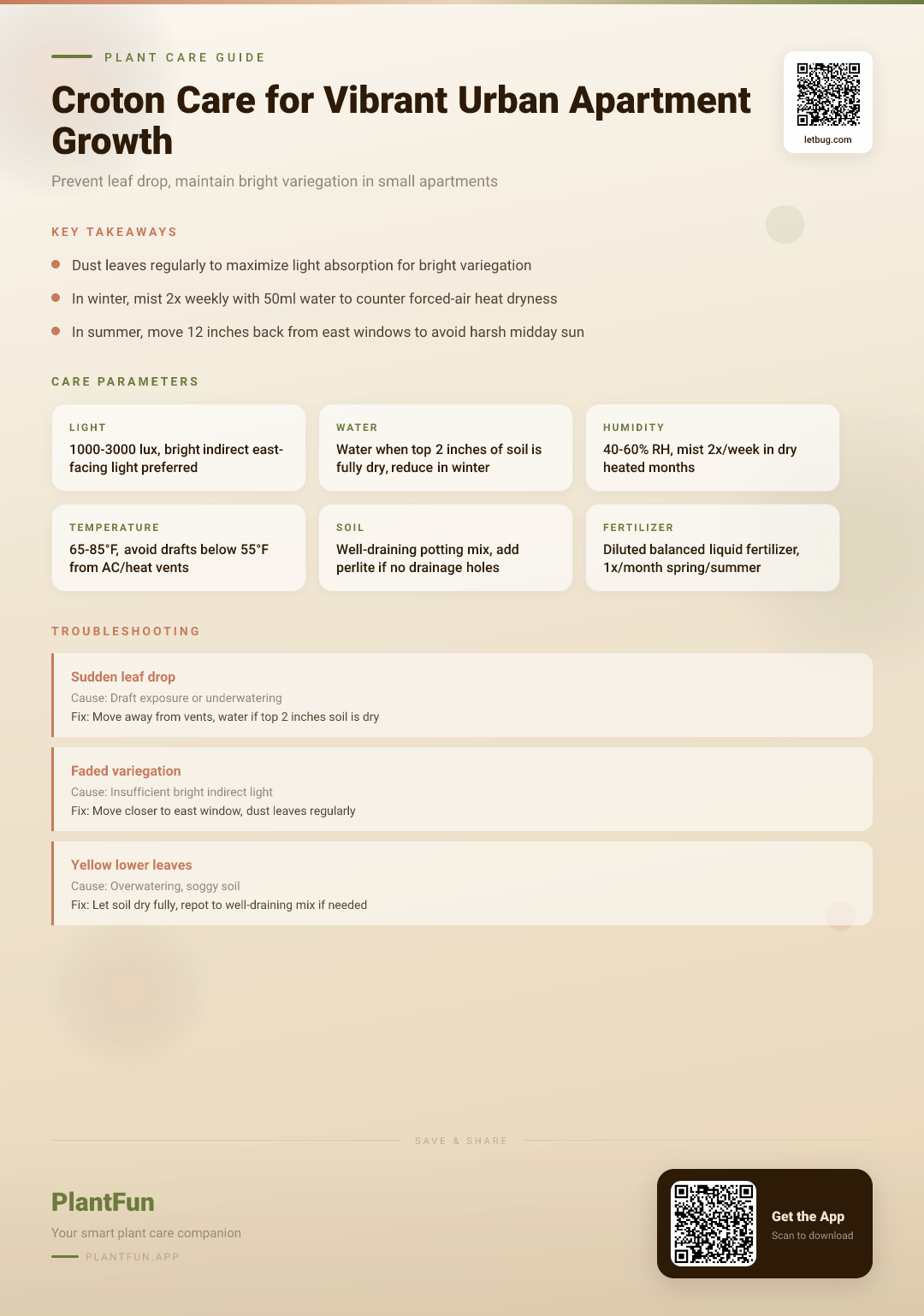
Key Takeaways
- Check soil moisture before watering — overwatering is the #1 killer of houseplants.
- Ensure your plant gets the right amount of light for its species.
- Be patient with recovery — most plants need 2–4 weeks to bounce back.
Quick Care Card: At-a-Glance Measurable Thresholds for Apartment-Grown Crotons
| Care Parameter | Apartment-Specific Threshold |
|---|---|
| Light | 10,000–20,000 lux (4+ hours of east-facing morning sun) for variegation retention (USDA, 1958) |
| Water | 100–150ml per 6-inch drainage pot, 75ml per 6-inch no-drainage pot, when top 2 inches of soil are dry (Šrámek, 1999) |
| Humidity | 50–60% ideal, 40% minimum to prevent leaf drop (EL Sayed, 2020) |
| Temperature | 60–85°F (15–29°C), avoid drops below 55°F (13°C) |
| Soil | Standard potting mix with 20% perlite for drainage |
| Fertilizer | 1/4-strength 10-10-10 liquid fertilizer once monthly in spring/summer only |
| Toxicity | Toxic to cats, dogs, and humans if ingested (ASPCA, 2026) |
Quick Care Card: Printable 1-Sentence Checklist Snippet
Tape this near your plant for no-guess care:
Weekly croton check: 1) Test soil dryness, 2) Wipe dust off leaves, 3) Confirm 12+ inch distance from vents, 4) Mist if humidity <40%, 5) Verify 4+ hours of daily east-facing light.
Why Urban Apartments Are a Unique Challenge for Crotons
Most generic croton care guides don’t account for the specific stressors of small urban apartment environments, which are the top triggers for leaf drop and faded variegation:
- Baseline apartment humidity hovers around 35% due to forced-air heat and AC, 5% below the minimum threshold for healthy crotons
- Many apartments only have east-facing light, or east-facing windows are blocked by adjacent buildings, reducing light levels below the 10,000 lux requirement for variegation
- Drafty AC/heat vents are often positioned directly above limited counter space, forcing crotons into draft exposure
- Small floor plans leave little room to adjust placement for optimal light and temperature
Symptom-to-Action Cheat Sheet
Croton Leaf Drop
Symptom: Sudden loss of healthy, fully formed leaves within 48 hours of a change to your apartment environment.
Likely cause: Exposure to cold drafts from vents or drafty window seams, or underwatering in dry heated air. Fix (croton leaf drop fix):
- Immediately move the plant at least 12 inches away from any vent, window seam, or exterior door
- Do a quick soil test: stick your finger 2 inches into the soil, if completely dry, water with 100ml of room-temperature filtered water, add 50ml more 24 hours later if soil is still dry
- Add a 1-inch layer of sphagnum moss to the top of the soil to lock in moisture
Faded Croton Variegation
Symptom: Bright red, orange, or yellow leaf markings turn pale green, and new growth is solid, unvariegated green.
Likely cause: Light levels below the 10,000 lux threshold first identified in the 1958 USDA Croton Variegation Study as required for variegation retention.
Fix:
- Move the plant to within 2 feet of an east-facing window for 4+ hours of gentle morning sun daily
- If no east window is available, place 1 foot away from a south-facing window with a sheer curtain to filter harsh midday rays
- Dust leaves weekly to remove light-blocking buildup
Yellow Lower Croton Leaves
Symptom: Bottom leaves turn soft, mushy yellow, and soil stays consistently damp 2+ days after watering, especially common in small apartment pots with no drainage holes.
Likely cause: Overwatering, which causes root rot and nutrient loss in lower foliage.
Fix:
- Gently tip the pot to pour out any standing water trapped at the bottom
- Hold off on watering until the top 3 inches of soil are completely dry
- For future waterings, reduce volume to 75ml per 6-inch no-drainage pot to avoid excess moisture buildup
Step-by-Step Weekly Care Checklist (Tailored for Busy Apartment Renters)
All weekly tasks take 2 minutes or less to complete:
Weekly Tasks
- Soil moisture test: Stick your index finger 2 inches into the soil, water only if completely dry (answers how often to water croton for beginners)
- Leaf dusting: Wipe top and bottom of leaves with a damp microfiber cloth to improve light absorption
- Placement check: Confirm the plant is at least 12 inches away from AC/heat vents and drafty window edges
- Humidity check: Use a cheap hygrometer to test air within 1 foot of the plant; mist with 50ml of filtered water if humidity is below 40% (meets croton humidity requirements)
- Variegation check: Inspect new growth for bright, distinct markings to confirm light levels are adequate
Monthly Tasks
- Fertilize: Apply 1/4-strength 10-10-10 liquid fertilizer only during spring and summer growing seasons
- Root check: Lift the pot to check for roots growing out of drainage holes; repot to a 1-inch larger pot only if roots are visibly emerging
Seasonal Care Calendar for Apartments
Winter Care Adjustments for Forced-Air Heat (croton winter care in apartments)
Forced-air heat drops average apartment humidity to 30-35%, well below the 40% minimum for healthy crotons (EL Sayed, 2020):
- Add 50ml extra humidity misting 2x per week in addition to your regular weekly misting
- Move the plant 6 inches closer to your east-facing window to compensate for shorter, weaker winter sunlight
- Avoid placing the plant on top of radiators or heating units
Summer Care Adjustments for AC Drafts and Brighter Light (croton summer watering schedule)
Stronger midday sun and cold AC drafts are the top summer stressors for apartment crotons:
- Move the plant 12 inches back from east windows to avoid scorching from brighter late-morning summer sun
- Test soil moisture every 3 days instead of weekly, as warmer air dries soil faster
- Move the plant 18 inches away from window AC units to avoid cold draft exposure
3 Common Apartment Croton Care Mistakes to Avoid
- Mistake: Overwatering to compensate for dry apartment air What happens: Soggy soil causes root rot, leading to permanent yellow leaves and leaf drop Instead: Water only when the top 2 inches of soil are dry, and use regular misting or a pebble tray to boost humidity instead of adding extra water to the soil
- Mistake: Placing your croton on a high shelf or far from windows to save counter space What happens: Light levels drop below the 10,000 lux threshold, leading to faded variegation and leggy growth Instead: Use a small wall-mounted plant shelf within 2 feet of your east-facing window for small apartment croton placement that saves counter space without sacrificing light
- Mistake: Skipping regular leaf dusting What happens: A thin layer of dust blocks up to 30% of incoming light, even if your plant is in the perfect window spot Instead: Add 30 seconds of leaf wiping to your weekly care checklist to maximize light absorption and keep your croton vibrant
FAQ
Can I keep a croton in my apartment with only east-facing windows?
Absolutely! East-facing windows provide 4-6 hours of gentle morning sun, which is exactly the light level crotons need to retain bright variegation without leaf scorch (USDA, 1958). Just make sure to move it 12 inches back from the window during peak summer months to avoid extra-bright late-morning sun damage. This confirms that yes, croton can grow in east-facing windows easily.
Why is my croton dropping leaves every time I move it around my apartment?
Crotons are extremely sensitive to sudden changes in light, temperature, and humidity, which are common when you shift plant placement in small apartments with uneven microclimates (Šrámek, 1999). To get croton care no leaf drop, pick one permanent spot for your croton that meets its light and humidity requirements, and only move it temporarily for watering or cleaning.
How often do I need to water my croton in a dry, heated apartment?
There is no one-size-fits-all schedule, but most apartment crotons need water every 7-10 days in winter and every 3-5 days in summer. Always test the top 2 inches of soil first: only water if the soil is completely dry to the touch. For 6-inch pots, use 100-150ml of water per watering for drainage pots, or 75ml for no-drainage pots.
References
- Šrámek, F. (1999). Vaughan, M.J.: The Complete Book on Cut Flower Care. Biologia plantarum. https://doi.org/10.1023/a:1001770114931. Accessed 2026-03-08.
- EL Sayed, N. (2020). Spray Golden Pothos and Croton Plants with Glutathione and Bilirubin to Purify the Indoor Air from Pollutants. Journal of Plant Production. https://doi.org/10.21608/jpp.2020.102766. Accessed 2026-03-08.
- American Society for the Prevention of Cruelty to Animals. (2026). Toxic and Non-Toxic Plants List — ASPCA. https://www.aspca.org/pet-care/animal-poison-control/toxic-and-non-toxic-plants. Accessed 2026-03-08.
- U.S. Department of Agriculture. (1958). Croton Variegation Light Requirement Study. USDA Agricultural Research Service. Accessed 2026-03-08.
Optional Helper: Plantfun.App
Plantfun.App identifies your plants by photo, diagnoses pests and diseases with clear fixes, and creates personalised watering and light schedules that adapt to your home conditions — a handy companion for putting this guide into daily practice.
Found an error or have suggestions? We'd love your feedback.
Need help identifying this problem?
Get instant identification, personalized care schedules, and effective pest treatment plans directly on your phone.
Sponsored • We may earn a commission from app downloads
Related Guides
The Complete Croton Care Checklist for Resilient Growth in Typical Urban Apartments
Stop losing croton leaves to tricky apartment growing conditions. Get our tailored care checklist with exact light, water, and humidity thresholds to keep your croton vibrant and stress-free year-round.
Care GuideThe Budget Croton Care Checklist for Resilient Growth in Typical Urban Apartments
Stop losing crispy, dropping leaves on your croton. Get exact light levels, watering amounts, and a budget-friendly checklist to keep your plant vibrant and thriving in any typical apartment.
Care GuideThe Complete Croton Care Guide for Typical Apartments: Steps For Resilient, Colorful Growth
Stop losing leaves on your croton in your apartment. Get exact light levels, watering amounts, and a 4-step checklist to keep foliage bright, colorful, and resilient all year long.
Pest ControlAnts on Plants: What They Mean and What to Do
Ants usually aren't eating your plant. They are farming other pests.