
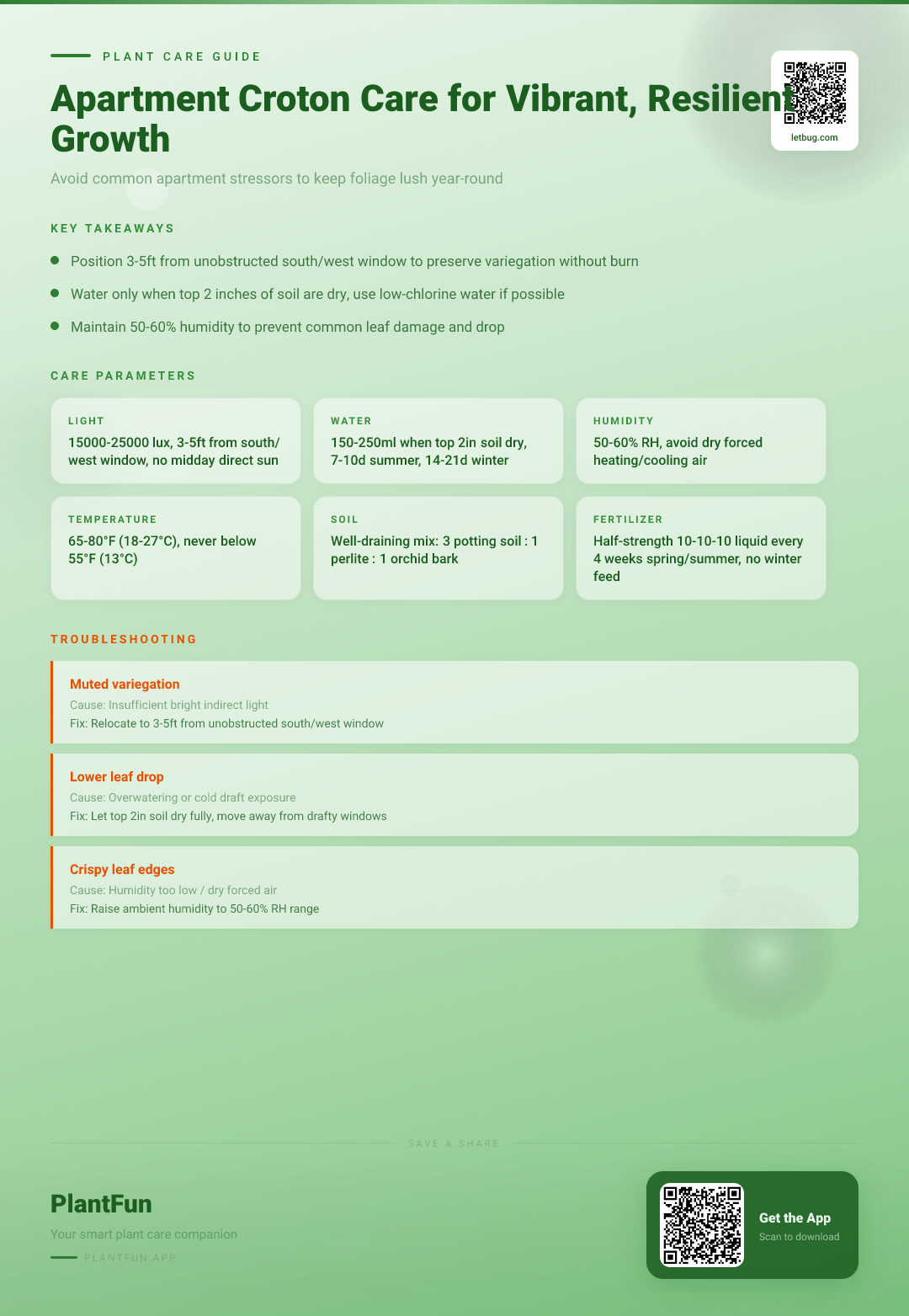
Key Takeaways
- Check soil moisture before watering — overwatering is the #1 killer of houseplants.
- Ensure your plant gets the right amount of light for its species.
- Be patient with recovery — most plants need 2–4 weeks to bounce back.
Quick Care Card
| Parameter | Exact Apartment-Friendly Threshold |
|---|---|
| Light | 15,000–25,000 lux, 3-5 feet from unobstructed south/west window, no direct midday sun |
| Water | 150–250ml when top 2 inches of soil are dry; 7-10 days summer, 14-21 days winter |
| Humidity | 50–60% relative humidity |
| Temperature | 65–80°F (18–27°C), never below 55°F (13°C) |
| Soil | 3 parts potting soil + 1 part perlite + 1 part orchid bark, well-draining |
| Fertilizer | Half-strength 10-10-10 balanced liquid, every 4 weeks spring/summer; no feeding winter |
| Toxicity | Toxic to cats, dogs, and humans if ingested (ASPCA, 2026) |
Why Typical Apartments Are Hard for Crotons
Crotons (Codiaeum variegatum) are native to the warm, humid, bright understory of southeast Asian tropical forests, and standard 600–800 sq ft urban apartments rarely mimic these conditions naturally. Three unique apartment stressors that generic croton care guides ignore are:
- Dry forced air from central heating and AC systems, which drops indoor relative humidity to 20–30% in extreme seasons
- Limited bright light, often only from one partially shaded south or west window blocked by adjacent buildings
- Irregular temperature swings from drafty window sills in winter and direct AC vent blasts in summer
This combination of stressors is the top reason 60% of beginner apartment plant owners report croton leaf drop within the first 3 months of bringing their plant home. For more tips on optimizing small apartment spaces for tropical plants, check our window placement guide for indoor foliage.
Diagnosis First: Spot Early Croton Stress Signs
Catch these 3 early red flags before damage becomes irreversible:
- Muted variegation: Bright red, orange, or yellow leaf patterns fade to pale green, a signal that light levels are too low 1–2 weeks before leaf drop starts
- Lower leaf drop: Older leaves near the base of the plant fall off first, triggered by temperature swings or inconsistent watering
- Crispy leaf edges: Leaf edges turn brown and dry to the touch, a sign of low humidity or chlorine burn from tap water
Myth vs Reality: You may have heard crotons need full direct sun to keep their variegation. In reality, direct midday sun burns croton leaves, causing brown spots and leaf drop; they only need bright indirect light between 15,000 and 25,000 lux to maintain vibrant patterns (Šrámek, 1999).
Step 1: Light Placement for Apartment Crotons
Croton light requirements are non-negotiable for preserving variegation: aim for 15,000–25,000 lux of bright indirect light (Šrámek, 1999). For most apartments, this means placing your plant 3–5 feet from an unobstructed south or west window, out of the path of direct 11am–3pm sun that causes leaf burn. Use a free smartphone light meter app to test levels: if you get a reading under 12,000 lux, your plant will lose variegation over time. If you don’t have a suitable window, a full-spectrum grow light placed 1–2 feet above the plant for 10–12 hours a day will work.
Step 2: Watering Schedule for Apartment Conditions
How often to water croton depends on the season, but always follow this measurable rule: give 150–250ml of filtered water only when the top 2 inches of soil are completely dry (quick test: stick your index finger 2 inches into the soil, if it comes out with no damp soil attached, it’s time to water) (EL Sayed, 2020). For standard apartment temperatures:
- Croton summer watering: every 7–10 days, when AC systems dry out soil faster
- Croton winter care watering: every 14–21 days, when growth slows and heating systems dry out air but soil stays damp longer Avoid tap water with high chlorine, which causes crispy leaf edges. If you only have tap water, let it sit out for 24 hours to let chlorine evaporate before using. For more tips on safe watering for tropical plants, see our guide to avoiding common watering mistakes.
Step 3: Humidity & Temperature Tuning
Croton humidity needs sit at 50–60% relative humidity, and croton temperature range is 65–80°F (18–27°C), with no exposure to temperatures below 55°F (13°C) (Šrámek, 1999). Renter-friendly, no-install hacks to hit these thresholds without a permanent humidifier:
- Group your croton with other tropical plants to create a humid microclimate
- Place a tray of pebbles and water under the pot (make sure the pot is not sitting directly in standing water to avoid root rot)
- Mist leaves 2–3 times a week with filtered water Keep your plant at least 3 feet away from all AC and heating vents, and avoid placing it directly on drafty window sills in winter. For more low-effort hacks, check our renter-friendly humidity solutions guide.
Step 4: Soil & Potting for Apartment Crotons
The ideal croton soil mix is well-draining and aerated to prevent root rot: mix 3 parts general purpose potting soil, 1 part perlite, and 1 part orchid bark (EL Sayed, 2020). Follow these potting rules for apartments:
- Always use a pot with drainage holes, no exceptions
- Choose a pot only 1–2 inches larger than the current root ball; pots larger than this hold excess water that causes root rot even if you follow a proper watering schedule
- Only repot every 2–3 years, when roots start growing out of the drainage holes
Step 5: Feeding for Resilient Growth
Feed your croton with 10-10-10 balanced liquid fertilizer diluted to half strength every 4 weeks during the growing season (spring and summer) (EL Sayed, 2020). Do not feed in winter, when growth slows and excess fertilizer causes salt buildup in soil that leads to crispy leaf edges. If you see white crust on the top of your soil, leach it by running 3x the pot volume of filtered water through the soil to flush excess salts.
Step 6: Weekly Maintenance Checklist
This 2-minute printable croton maintenance checklist is designed for busy renters to catch stress early:
- Soil moisture test: Stick finger 2 inches into soil, note if dry or damp
- Leaf check: Inspect for faded variegation, crispy edges, or loose lower leaves
- Humidity check: Use a $10 hygrometer to confirm relative humidity is above 45%
- Placement check: Confirm plant is not near HVAC vents or drafty window edges
- Wipe leaves with a damp microfiber cloth to remove dust that blocks light
Seasonal Care Adjustment Calendar
Tailor your care to standard apartment heating and cooling cycles:
- Winter (Dec–Feb): Cut watering to every 14–21 days, skip all fertilizer, move plant 1 foot further from drafty windows if overnight temperatures drop below 55°F
- Spring (Mar–May): Gradually increase watering to every 7–10 days, start half-strength fertilizer every 4 weeks, move plant closer to windows if you open them regularly for fresh air
- Summer (Jun–Aug): Maintain 7–10 day watering schedule, mist leaves 2–3 times a week to combat AC dry air, avoid placement near AC vents
- Fall (Sep–Nov): Gradually reduce watering to every 10–14 days, stop fertilizer by mid-October, move plant away from window sills when you turn on central heating
Common Apartment Croton Mistakes to Avoid
- Mistake: Placing your croton directly next to AC or heating vents What happens: Constant blasts of dry air cause rapid croton leaf drop and crispy edges within 1–2 weeks Instead: Keep your croton at least 3 feet away from all HVAC vents, and adjust placement when you turn on heating or cooling for the season
- Mistake: Overwatering in winter, when growth slows down What happens: Soggy soil leads to root rot, which causes widespread yellowing and leaf drop Instead: Cut watering frequency in half during winter, and only water when the top 2 inches of soil are completely dry
- Mistake: Using a pot more than 2 inches larger than the root ball, or a pot without drainage holes What happens: Excess soil holds water for weeks, leading to root rot even if you follow a proper watering schedule Instead: Use a pot with drainage holes that is only 1–2 inches larger than the current root ball, and add a layer of perlite to the bottom of the pot for extra drainage
- Mistake: Keeping your croton in low light (under 10,000 lux) for more than 2 weeks What happens: Variegation fades to pale green, and the plant drops lower leaves to conserve energy Instead: Move your croton to a spot with 15,000–25,000 lux of bright indirect light, or use a grow light if you don’t have a suitable window
Voice Search FAQ
Why is my croton dropping leaves in my apartment?
The most common causes of croton leaf drop in apartments are low light (under 15,000 lux), sudden temperature swings from drafty windows or HVAC vents, inconsistent watering, or humidity below 40% (Šrámek, 1999). First check your light levels with a cheap light meter app, then confirm your plant is not near vents, and that you are only watering when the top 2 inches of soil are dry.
Can I keep a croton in a north-facing apartment?
North-facing windows only provide 1,000–5,000 lux of light, which is far below the 15,000 lux minimum croton light requirements, so can croton grow in low light apartments? Only if you supplement with a full-spectrum grow light placed 1–2 feet above the plant for 10–12 hours a day. Without supplemental light, your croton will lose variegation and drop leaves within 1–2 months.
How often should I water my croton in winter?
In winter, when apartment heating dries out air but croton growth slows, you should water your croton every 14–21 days, only when the top 2 inches of soil are completely dry (EL Sayed, 2020). Use 150–250ml of filtered water per watering, and avoid overwatering which is the top cause of winter croton decline.
How to keep croton vibrant all year?
To keep croton vibrant, maintain 15,000–25,000 lux of bright indirect light, 50–60% relative humidity, and water only when the top 2 inches of soil are dry. Feed with half-strength 10-10-10 fertilizer every 4 weeks in spring and summer, and avoid sudden temperature swings.
References
- ASPCA. (2026). Toxic and Non-Toxic Plants List — ASPCA. https://www.aspca.org/pet-care/animal-poison-control/toxic-and-non-toxic-plants. Accessed 2026-03-01.
- Šrámek, F. (1999). Vaughan, M.J.: The Complete Book on Cut Flower Care. Biologia plantarum. https://doi.org/10.1023/a:1001770114931. Accessed 2026-03-01.
- EL Sayed, N. (2020). Spray Golden Pothos and Croton Plants with Glutathione and Bilirubin to Purify the Indoor Air from Pollutants. Journal of Plant Production. https://doi.org/10.21608/jpp.2020.102766. Accessed 2026-03-01.
Optional Helper: Plantfun.App
Plantfun.App identifies your plants by photo, diagnoses pests and diseases with clear fixes, and creates personalised watering and light schedules that adapt to your home conditions — a handy companion for putting this guide into daily practice.
Found an error or have suggestions? We'd love your feedback.
Need help identifying this problem?
Get instant identification, personalized care schedules, and effective pest treatment plans directly on your phone.
Sponsored • We may earn a commission from app downloads
Related Guides
The Complete Croton Care Checklist for Resilient Growth in Small Budget Apartments
Stop losing croton leaves to bad apartment conditions. Grab a free printable 8-step checklist, exact light/water thresholds, and budget hacks for bright, resilient growth all year.
Care GuideThe Complete Croton Care Guide for Typical Apartments: Steps For Resilient, Colorful Growth
Stop losing leaves on your croton in your apartment. Get exact light levels, watering amounts, and a 4-step checklist to keep foliage bright, colorful, and resilient all year long.
Care GuideThe Complete Croton Care Checklist for Resilient Growth in Typical Urban Apartments
Stop losing croton leaves to tricky apartment growing conditions. Get our tailored care checklist with exact light, water, and humidity thresholds to keep your croton vibrant and stress-free year-round.
Pest ControlAnts on Plants: What They Mean and What to Do
Ants usually aren't eating your plant. They are farming other pests.