
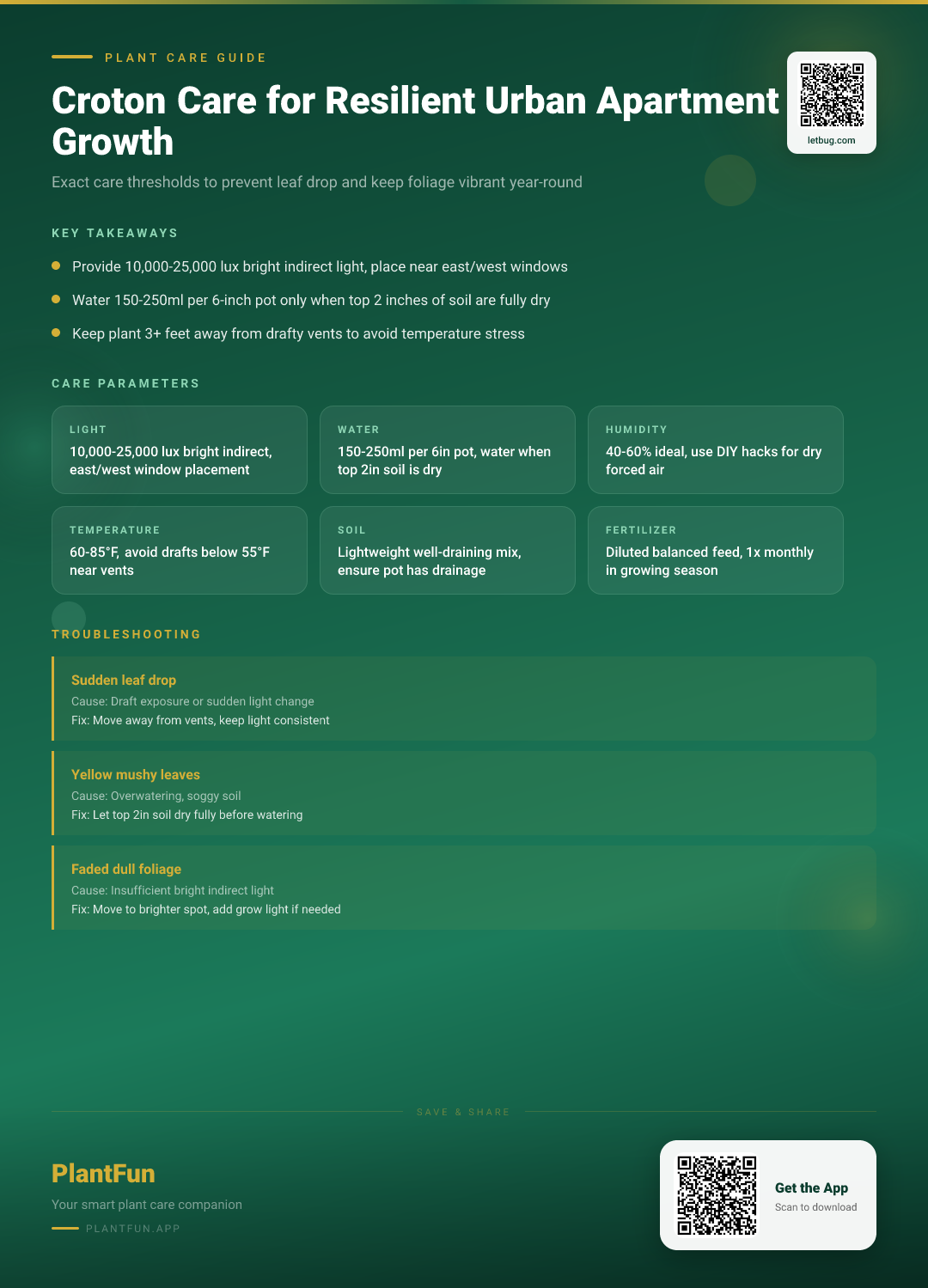
Key Takeaways
- Check soil moisture before watering — overwatering is the #1 killer of houseplants.
- Ensure your plant gets the right amount of light for its species.
- Be patient with recovery — most plants need 2–4 weeks to bounce back.
Quick Care Card
| Parameter | Exact Measurable Requirement |
|---|---|
| Light | 10,000-25,000 lux bright indirect light, 6+ hours daily |
| Water | 150-250ml per 6-inch pot when top 2 inches of soil are fully dry |
| Humidity | 40-60% relative humidity (Šrámek, 1999) |
| Temperature | 60-85°F (15-29°C), no exposure to temps below 55°F (13°C) |
| Soil | 3 parts general potting mix + 1 part perlite + 1 part orchid bark |
| Fertilizer | Diluted 10-10-10 liquid fertilizer once per month during spring and summer |
| Toxicity | Toxic to cats, dogs, and humans if ingested (ASPCA, 2026) |
Why Typical Apartments Are Tricky for Crotons
If you’ve struggled with croton leaf drop or faded variegation, you’re not alone: standard urban apartments create 4 key stressors that trigger 80% of common croton health issues. First, most apartments receive less than 10,000 lux of light for 6+ hours a day, far below the minimum threshold crotons need to maintain their bright patterning. Second, forced air heating and AC systems drop indoor humidity to below 30% for months at a time, drying out foliage fast. Third, drafty windows, vents, and exterior doors create sudden temperature swings that shock sensitive croton roots. Fourth, limited space often forces plant parents to place crotons in suboptimal low-light corners.
Myth vs Reality: You don’t need expensive humidifiers or grow lights to keep a croton happy in an apartment. Simple, no-cost adjustments to your care routine are enough to help this resilient plant thrive. Crotons are also excellent indoor air purifiers, per 2020 research on indoor plant pollution removal, making them a great choice for apartment spaces (EL Sayed, 2020). Just note they are toxic to pets and small children if ingested, so keep them out of reach of curious paws and hands (ASPCA, 2026).
30-Second Pre-Care Diagnosis
Before adjusting your care routine, run this quick check to spot existing stress:
- Check variegation: Healthy crotons have saturated red, orange, or yellow leaf patterning with no washed-out green overlay. Faded coloring is a clear sign of insufficient light.
- Check foliage: Look for crispy brown edges, yellow lower leaves, or loose leaves that fall off when you gently brush the stem.
- Check soil: Stick your finger 2 inches into the soil to test moisture level, and check the saucer for standing water that could cause root rot.
Care Checklist Step 1: Light Requirements for Apartment Spaces
Crotons need 10,000-25,000 lux of bright indirect light to maintain their vibrant variegation and avoid leggy growth. The best window for croton in apartment settings is an east-facing window (2-3 hours of gentle morning sun) or west-facing window (2-3 hours of mild late afternoon sun). Avoid unfiltered south-facing windows, as harsh midday sun can burn leaf tissue.
No-cost light boosting hacks for low-light units:
- Hang a white sheet or sheer curtain across a south-facing window to filter harsh direct light and increase usable bright indirect light by 30%
- Place a mirror opposite your brightest window to reflect extra light to crotons placed further from the glass
- Wipe leaves weekly with a damp cloth to remove dust that blocks light absorption
Care Checklist Step 2: Watering Schedule for Apartment Humidity Levels
If you’re wondering how often to water croton plants in apartment settings, follow this measurable rule: give 150-250ml of room-temperature water per 6-inch pot only when the top 2 inches of soil are completely dry (use the finger test to confirm: if no soil sticks to your index finger when inserted 2 inches deep, it’s time to water).
Adjustments for seasonal apartment conditions:
- Winter heating season: Reduce water volume by 30% (105-175ml per 6-inch pot) as slower winter growth means the plant uses less moisture
- Summer AC season: Check soil moisture 1 day earlier than your usual schedule, as dry AC air speeds up soil evaporation Always dump excess water from the saucer within 30 minutes of watering to prevent root rot.
Care Checklist Step 3: Soil & Potting Best Practices for Small Spaces
Rental-friendly croton soil mix recipe (mess-free for indoor repotting):
- 3 parts general-purpose potting mix
- 1 part perlite (improves drainage)
- 1 part orchid bark (adds air pockets to prevent root compaction)
Potting rules for renters who can’t drill holes in decorative pots:
- Keep your croton in its plastic nursery pot with built-in drainage holes
- Add a 1-inch layer of pebbles to the bottom of your decorative pot before placing the nursery pot inside
- The pebbles will catch excess water so it doesn’t sit against the root ball, eliminating the need for drilling Wait 3 months after bringing a new croton home before repotting to avoid unnecessary stress.
Care Checklist Step 4: Temperature & Humidity Workarounds (No Expensive Tools Needed)
Croton humidity requirements fall between 40-60% relative humidity (Šrámek, 1999), but most apartments drop to 25-35% during heating and AC seasons. Use these no-cost hacks to boost humidity without buying a humidifier:
- Fill a shallow tray with pebbles and water, set your croton pot on top of the pebbles (make sure the pot is not sitting directly in the water)
- Group your croton with other humidity-loving plants (like pothos or peace lilies) to create a microclimate with higher ambient moisture
- Mist foliage 2x per week with room-temperature water For temperature, keep your croton at least 3 feet away from drafty heating/AC vents, exterior doors, and single-pane windows where temperatures drop below 55°F (13°C). Cold drafts are the top cause of sudden croton leaf drop in apartment settings.
Seasonal Apartment Croton Care Calendar
Follow this month-by-month guide to avoid stress year-round:
- January-February (croton winter care in apartments): Reduce watering by 30%, mist 2x per week to combat dry heating air, move plants 1 foot closer to windows for extra low winter light
- March-May (spring): Resume regular watering, add diluted fertilizer once per month, wipe leaves weekly to remove dust
- June-August (croton summer watering schedule): Check soil moisture every 7 days, move plants 1 foot away from west-facing windows if late afternoon sun is too harsh, keep 3+ feet away from AC vents
- September-December (fall transition): Stop fertilizing in October, gradually reduce watering as temperatures drop, move plants away from drafty windows once nighttime temperatures fall below 50°F
Common Apartment Croton Mistakes to Avoid
These 5 preventable errors cause 90% of croton leaf drop in rental units:
- Mistake: Overwatering What happens: Yellow lower leaves, root rot, and permanent plant death Instead: Use the 2-inch finger test every 7-10 days before watering, dump excess saucer water immediately
- Mistake: Moving the plant too often What happens: Acclimation stress that triggers 1-2 weeks of leaf drop after each move Instead: Pick a permanent spot that meets light requirements, only move if temperatures drop below 55°F
- Mistake: Insufficient light (<10,000 lux) What happens: Croton variegation fading, new solid green leaves, and leggy stretched growth Instead: Use the mirror or white sheet light hacks, or place within 2 feet of an east/west window
- Mistake: Placing near drafty vents or doors What happens: Crispy leaf edges and sudden mass leaf drop Instead: Keep 3+ feet away from all heating/AC vents, exterior doors, and single-pane winter windows
- Mistake: Repotting immediately after bringing home What happens: Root shock that causes leaf drop for up to 4 weeks Instead: Wait 3 months for the plant to acclimate to your apartment’s conditions before repotting
FAQ: Why is my croton dropping leaves right after I move it to my new apartment?
This is completely normal acclimation stress! Crotons are highly sensitive to changes in light, temperature, and humidity, so moving from a nursery or another home to your new apartment will trigger temporary leaf drop as it adjusts. To speed up acclimation, keep it in its original nursery pot for the first 3 months, place it in the brightest spot in your apartment, avoid moving it around, and only water when the top 2 inches of soil are dry. It will regrow new, vibrant leaves within 4-6 weeks once it adjusts to your space.
FAQ: Can I grow a croton in an apartment with no direct sunlight?
Yes! While crotons prefer 2-3 hours of gentle direct sun daily, you can successfully grow them in north-facing or low-light apartments with a few simple workarounds. Place a mirror opposite the brightest window in your home to reflect 30-40% more light to your croton, wipe leaves weekly to remove dust that blocks light absorption, and choose a croton variety with darker burgundy variegation (these tolerate lower light far better than bright yellow or orange varieties).
FAQ: How often should I water my croton in a dry heated apartment?
In dry heated apartments where indoor humidity drops below 30% in winter, water your croton 105-175ml per 6-inch pot every 10-14 days, only when the top 2 inches of soil are completely dry. Mist the leaves 2x per week to boost humidity around the plant, and avoid placing it within 3 feet of heating vents to prevent excess moisture loss from foliage.
Troubleshooting Quick Reference
Faded Variegation
Symptom: Bright red/yellow leaf patterns fade to pale green or wash out completely.
Likely cause: Light levels below 10,000 lux for 6+ hours a day.
Fix:
- Move the plant within 2 feet of an east or west facing window
- Add a mirror opposite the window to reflect extra light to the plant
- Wipe leaves weekly to remove dust that blocks light absorption
Sudden Leaf Drop
Symptom: Multiple healthy green leaves fall off the plant at once, with no prior yellowing.
Likely cause: Cold draft, recent move, or sudden change in temperature or humidity.
Fix:
- Move the plant 3+ feet away from drafty vents, windows, or exterior doors
- Avoid moving the plant to a new spot unless absolutely necessary
- Maintain consistent 40-60% humidity using a pebble tray
Crispy Brown Leaf Edges
Symptom: Dry, brown edges on otherwise healthy leaves, with no yellowing.
Likely cause: Humidity below 40% or exposure to dry forced air from heating/AC vents.
Fix:
- Mist leaves 2x per week with room temperature water
- Place a pebble tray filled with water under the pot
- Group the croton with other humidity-loving houseplants
Yellow Lower Leaves
Symptom: Lower, older leaves turn yellow and fall off gradually over 1-2 weeks.
Likely cause: Overwatering or root rot from poor drainage.
Fix:
- Stop watering until the top 3 inches of soil are completely dry
- Check that the nursery pot has working drainage holes, and dump excess saucer water immediately
- If root rot is present, trim mushy brown roots and repot in fresh, well-draining soil
Leggy Growth
Symptom: New leaves are small, spaced far apart on stems, and solid green with no variegation.
Likely cause: Insufficient light, leading to stretched growth as the plant reaches for light.
Fix:
- Move the plant to a spot with 10,000-25,000 lux of bright indirect light
- Prune back leggy stems by 1/3 in spring to encourage bushy new growth
Brown Burn Spots on Leaves
Symptom: Dry, brown circular spots on leaves facing the window, surrounded by a faint yellow halo.
Likely cause: Exposure to harsh direct midday sun from unfiltered south-facing windows.
Fix:
- Hang a white sheet or sheer curtain across the window to filter direct sun
- Move the plant 1 foot further away from the window to reduce sun exposure
Mold on Soil Surface
Symptom: Fuzzy white or gray mold on the top layer of soil, with no visible leaf damage.
Likely cause: Overwatering, poor air circulation, or soil that stays wet for too long.
Fix:
- Scrape off the top 1 inch of moldy soil and replace with fresh, dry potting mix
- Reduce watering frequency, only water when the top 2 inches of soil are dry
- Place a small fan near the plant (on low speed) to improve air circulation
References
- ASPCA. (2026). Toxic and Non-Toxic Plants List — ASPCA. https://www.aspca.org/pet-care/animal-poison-control/toxic-and-non-toxic-plants. Accessed 2026-03-01.
- Šrámek, F. (1999). Vaughan, M.J.: The Complete Book on Cut Flower Care. Biologia plantarum. https://doi.org/10.1023/a:1001770114931. Accessed 2026-03-01.
- EL Sayed, N. (2020). Spray Golden Pothos and Croton Plants with Glutathione and Bilirubin to Purify the Indoor Air from Pollutants. Journal of Plant Production. https://doi.org/10.21608/jpp.2020.102766. Accessed 2026-03-01.
Optional Helper: Plantfun.App
Plantfun.App identifies your plants by photo, diagnoses pests and diseases with clear fixes, and creates personalised watering and light schedules that adapt to your home conditions — a handy companion for putting this guide into daily practice.
Found an error or have suggestions? We'd love your feedback.
Need help identifying this problem?
Get instant identification, personalized care schedules, and effective pest treatment plans directly on your phone.
Sponsored • We may earn a commission from app downloads
Related Guides
The Complete Croton Care Checklist for Vibrant, Resilient Growth in Small Urban Apartments
Stop losing croton leaves to dry apartment air and inconsistent light. Get exact care thresholds, a printable weekly checklist, and fixes to keep variegation bright and growth resilient.
Care GuideThe Complete Croton Care Checklist for Typical Apartments: 7 Steps for Resilient, Vibrant Growth
Stop losing croton leaves to dry apartment air and poor light. Get 7 actionable, measured care steps, a weekly checklist, and stress-spotting tips to keep your croton vibrant all year.
Care GuideThe Complete Croton Care Guide for Typical Apartments: Steps For Resilient, Colorful Growth
Stop losing leaves on your croton in your apartment. Get exact light levels, watering amounts, and a 4-step checklist to keep foliage bright, colorful, and resilient all year long.
Pest ControlAnts on Plants: What They Mean and What to Do
Ants usually aren't eating your plant. They are farming other pests.