
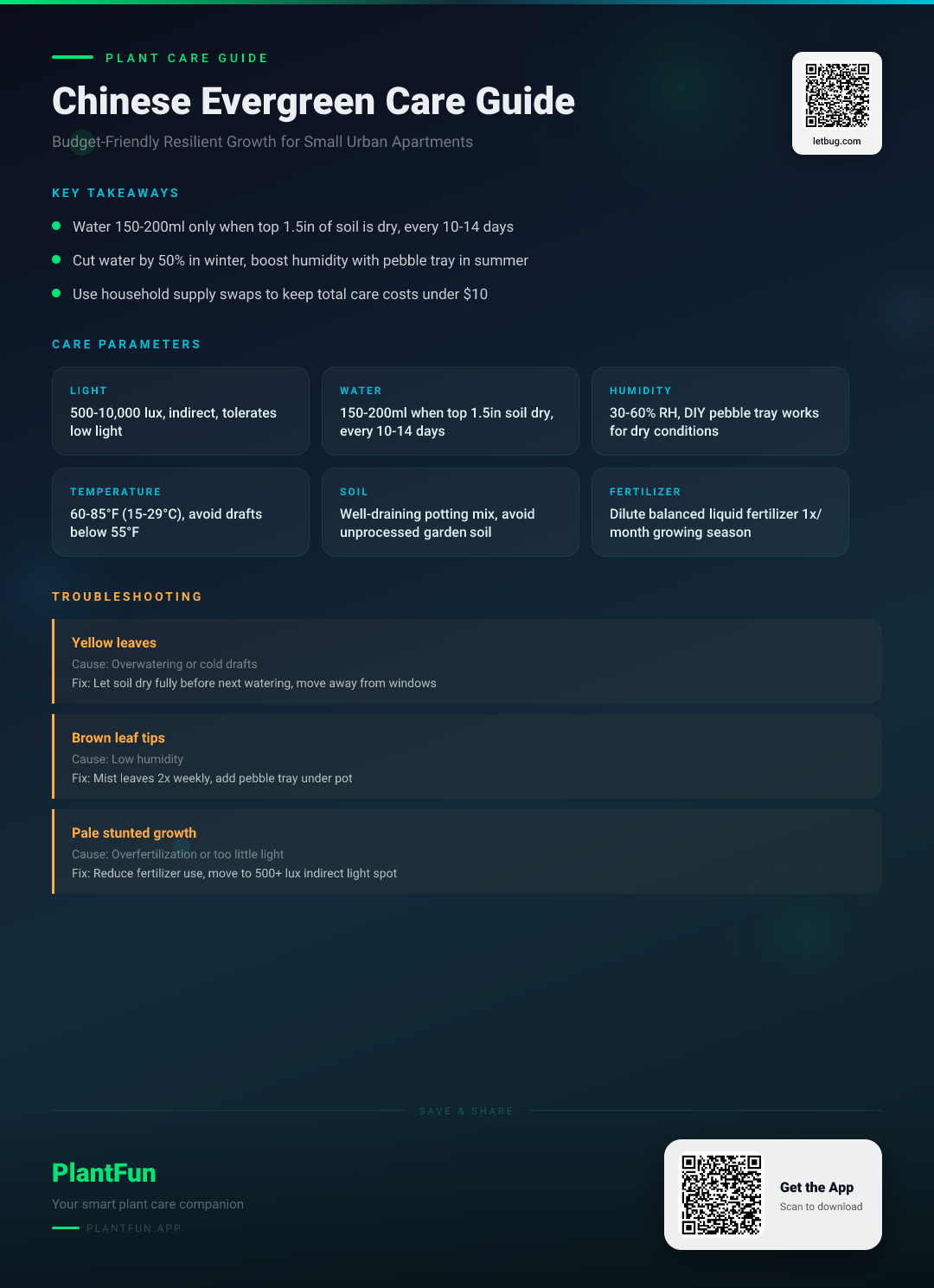
Key Takeaways
- Check soil moisture before watering — overwatering is the #1 killer of houseplants.
- Ensure your plant gets the right amount of light for its species.
- Be patient with recovery — most plants need 2–4 weeks to bounce back.
Quick Care Card
| Category | Measurable Threshold |
|---|---|
| Light | 500-10,000 lux (indirect light, faint shadow at midday) (NC State Extension, 2026) |
| Water | 150-200ml when top 1.5 inches of soil is dry, every 10-14 days (NC State Extension, 2026) |
| Humidity | 30-60% relative humidity, tolerates fluctuations as low as 20% short-term (Liu et al., 2013) |
| Temperature | 60-85°F (15-29°C), avoid exposure below 55°F (Du & Ma, 2013) |
| Soil | Low-cost all-purpose potting mix, no specialty aroid blend required |
| Fertilizer | Diluted all-purpose houseplant fertilizer (half strength) twice yearly, spring and fall |
| Toxicity | Toxic to cats, dogs, and humans if ingested (ASPCA, 2026) |
Why Chinese Evergreens Thrive in Typical Small Urban Apartments
Native to Southeast Asian tropical understory habitats, Aglaonema (Chinese Evergreen) evolved to grow under dense tree canopies with filtered light, variable humidity, and limited root space (Liu et al., 2013). These traits make them perfectly suited for 600-800 sq ft urban apartments: they tolerate the low north-facing light common in city units, handle fluctuating humidity from heaters and AC units, and only grow to a maximum 3ft height, so they fit on desks, shelves, and small corners without crowding your space. If you love low-fuss apartment plants, check out our roundup of the best low-light apartment plants for more options.
Budget Care Supply List (Under $10 Total)
No expensive specialty tools required: all supplies use household swaps or cheap dollar-store items for cheap Chinese Evergreen care tips that deliver results:
- Moisture tester swap (free): Use an old wooden chopstick or popsicle stick to check soil dryness, no $15 electronic moisture meter needed
- Soil ($2): 1lb bag of generic all-purpose potting mix from the dollar store, skip the $8 specialty aroid blends
- Pot (free): Reuse a plastic takeout container, mug, or old vase – just poke 3-4 ¼ inch drainage holes in the bottom with a nail you already own
- Humidity solution ($1): A handful of pebbles from your yard or dollar store, paired with an old cereal bowl for a DIY pebble tray (follow our DIY pebble tray guide for step-by-step instructions, no $20 humidifier needed)
- Fertilizer ($3): 1 bottle of generic all-purpose houseplant fertilizer, which lasts 3+ years, skip the $10 specialty Aglaonema formulas
- Pruning tool (free): A clean pair of household scissors, no $15 pruning shears required
Total cost: $6 max, all supplies reusable for other budget indoor plant care needs.
Step-by-Step Weekly Care Routine
All tasks take 2 minutes total, perfect for busy renters and Chinese Evergreen care for beginners:
- Light check: Hold your hand up at the plant’s location at midday. If you see a faint shadow, you have 500+ lux, perfect for Chinese Evergreen low light care (NC State Extension, 2026). If no shadow is visible, move the plant 1ft closer to a window.
- Moisture check: Stick your chopstick 1.5 inches into the soil. If it comes out completely dry, add 150-200ml of room-temperature tap water. If damp soil sticks to it, wait 2 more days. This answers how often to water Chinese Evergreen for most apartment environments.
- Dust wipe: Wipe the top and bottom of 3-4 leaves with a damp paper towel to remove dust that blocks light absorption (30 seconds total).
- Pest check: Inspect the undersides of 2-3 leaves for tiny brown or green bugs (mealybugs, aphids). If spotted, dab with a cotton swab dipped in rubbing alcohol you already have at home.
- Temperature check: Hold your hand near the plant for 10 seconds. If it feels colder than 60°F or hotter than 85°F, move it away from drafty windows or AC vents (Du & Ma, 2013).
12-Month Seasonal Care Calendar
Adjust your routine based on seasonal changes to avoid stress:
- Winter (November-February, Chinese Evergreen winter care): Reduce water by 50% (75-100ml only when the top 2 inches of soil is dry, every 21-28 days). Keep 3ft away from exterior windows to avoid cold drafts, and stop fertilizing completely.
- Spring (March-May): Resume fertilizing once, using half-strength diluted fertilizer only on damp soil. Increase water checks to every 7-10 days as temperatures rise.
- Summer (June-August, Chinese Evergreen summer watering): Check soil moisture every 7 days, as faster evaporation may mean more frequent watering. Set up your DIY pebble tray under the pot to meet Chinese Evergreen humidity requirements for free, and move 2ft away from AC vents to avoid dry air blasts.
- Fall (September-October): Apply your second and final yearly fertilizing dose, gradually reduce water frequency as temperatures drop.
Common Budget Mistakes That Kill Chinese Evergreens
Avoid these cost-cutting mistakes that lead to damaged or dead plants:
- Mistake: Using unprocessed garden soil dug up from your yard to save money What happens: Garden soil compacts easily in indoor pots, traps excess water, and causes root rot, one of the most common Chinese Evergreen overwatering signs Instead: Spend $2 on a sterilized all-purpose potting mix from the dollar store, which drains properly without compacting
- Mistake: Overfertilizing with full-strength formula every month to speed up growth What happens: Salt builds up in the soil, burns leaf tips, and stunts growth Instead: Only fertilize twice a year at half the recommended dose on the bottle
- Mistake: Repurposing non-draining pots (mugs, vases) without adding drainage holes What happens: Excess water has nowhere to escape, leading to root rot and yellow leaves (a top reason why is my Chinese Evergreen turning yellow queries come up) Instead: Poke 3-4 ¼ inch holes in the bottom of the pot using a nail and hammer you already own, no cost required
- Mistake: Buying a $20 grow light for dark rooms What happens: Wastes money, as Chinese Evergreens tolerate light as low as 500 lux, which is available in most apartment rooms with a window (NC State Extension, 2026) Instead: Move the plant 1ft closer to a north or east-facing window, or run a standard LED table lamp for 8 hours a day if you have no window access
Voice Search Optimized FAQ
Why is my Chinese Evergreen getting yellow leaves?
The most common cause is overwatering, the top Chinese Evergreen overwatering sign (NC State Extension, 2026). Check if the top 1.5 inches of soil is damp – if yes, stop watering until it is completely dry, and confirm your pot has drainage holes. Other causes include cold drafts from windows or extended exposure to direct sunlight.
Can I keep a Chinese Evergreen in my apartment bedroom with no windows?
While Chinese Evergreens are extremely low-light tolerant, they need a minimum of 500 lux to survive, which you cannot get without a light source (Liu et al., 2013). If you run a standard LED table lamp near the plant for 8 hours a day, it will thrive with no specialty grow light required, answering the common can Chinese Evergreen survive in dark apartments question.
How often do I need to water my Chinese Evergreen in the winter?
For Chinese Evergreen winter care, you only need to water once every 21-28 days, using 75-100ml of water, only when the top 2 inches of soil is completely dry (NC State Extension, 2026). Growth slows significantly in winter, so the plant uses far less water, and overwatering is the most common cause of winter death.
Free Printable Care Checklist Download
Get our no-cost, 1-page printable Chinese Evergreen care checklist to track watering dates, light checks, and fertilizing schedules for easy reference. No email sign-up required: https://letbug.com/chinese-evergreen-care-checklist. For more low-cost plant care hacks, check out our guide to budget indoor plant care.
Troubleshooting Quick Fix Guide
All fixes cost under $2 each:
Yellow Lower Leaves
Symptom: Older lower leaves turn pale yellow and fall off, while new growth remains green.
Likely cause: Overwatering leading to early root rot, the most common Chinese Evergreen overwatering sign.
Fix:
- Stop watering immediately until the top 2 inches of soil is completely dry
- Tip the pot slightly to drain any excess water sitting in the saucer
- If the issue persists, repot into fresh dry potting mix for $2 max
Brown Leaf Tips
Symptom: Tips of leaves turn crispy brown, while the rest of the leaf remains green and healthy.
Likely cause: Low humidity or salt buildup from overfertilizing, the most common issue requiring a Chinese Evergreen brown tips fix.
Fix:
- Trim off the brown tip with household scissors, cut at an angle to match the natural leaf shape
- Set up a DIY pebble tray under the pot to boost humidity by 10-15% for $1 max if you need to buy pebbles
- Flush the soil with 2 cups of tap water to wash away excess salt, repeat once after 10 minutes
Drooping Stems
Symptom: Stems feel soft and droop downward, and the soil is damp to the touch.
Likely cause: Advanced root rot from prolonged overwatering or a non-draining pot.
Fix:
- Remove the plant from its pot, cut away any mushy brown roots with clean scissors
- Repot into fresh, dry all-purpose potting mix in a pot with drainage holes
- Wait 7 days before watering again, use only 100ml of water
- For more detailed root rot repair steps, see our how to fix root rot guide
Pale Faded Leaves
Symptom: Leaves lose their dark green or variegated color, appear washed out, and may have brown scorch marks.
Likely cause: Extended exposure to direct sunlight over 10,000 lux.
Fix:
- Move the plant 3ft away from the window, or place it behind a sheer curtain to filter light
- Trim off any severely damaged leaves to encourage new, healthy growth
Free Chinese Evergreen Propagation Guide
Grow new plants for free using only household items:
- Use clean household scissors to cut a 4-6 inch stem cutting from the mother plant, just below a leaf node (the small bump on the stem where leaves grow out)
- Remove the bottom 2 leaves from the cutting, leaving 2-3 healthy leaves at the top
- Place the cutting in a glass of room-temperature tap water, making sure the bottom 1 inch of the stem is submerged, and no leaves are under water
- Set the glass on a shelf out of direct sunlight, change the water once every 7 days
- After 3-4 weeks, you will see 1-2 inch long white roots growing from the stem
- Plant the rooted cutting in a small pot with all-purpose potting mix, water with 100ml of water, and care for it as you would a mature plant
Long-Term Growth Tips for Lush Foliage Under $5 a Year
Keep your plant full and healthy for years with minimal cost:
- Fertilizing ($1 per year): A $3 bottle of generic all-purpose fertilizer lasts 3+ years, so you only spend $1 per year for twice-yearly feedings
- Repotting ($1 per year): Only repot once every 2-3 years, using $2 all-purpose potting mix, no specialty blends needed. You can reuse an old pot if it is 1 inch larger than the root ball
- Pruning (free): Trim back leggy stems or damaged leaves 2-3 times a year with household scissors to encourage bushier, fuller growth
- Rotation (free): Rotate the plant 90 degrees once a month so all sides get equal light exposure, leading to even, symmetrical growth
References
- NC State Extension. (2026). The Complete Chinese Evergreen — NC State Extension Gardener Plant Toolbox. https://plants.ces.ncsu.edu/plants/evergreen-care/. Accessed 2026-03-04.
- Liu, J.; Yang, Q.; Song, Q. (2013). Strategy of fine root expansion of Phyllostachys pubescens population into evergreen broad-leaved forest. Chinese Journal of Plant Ecology. https://doi.org/10.3724/sp.j.1258.2013.00023. Accessed 2026-03-04.
- Du, Y.; Ma, K. (2013). Temporal and spatial variation of seedfall in a broad-leaved evergreen forest in Gutianshan Nature Reserve of Zhejiang Province, China. Chinese Journal of Plant Ecology. https://doi.org/10.3724/sp.j.1258.2012.00717. Accessed 2026-03-04.
- ASPCA. (2026). Toxic and Non-Toxic Plants List — ASPCA. https://www.aspca.org/pet-care/animal-poison-control/toxic-and-non-toxic-plants. Accessed 2026-03-04.
Optional Helper: Plantfun.App
Plantfun.App identifies your plants by photo, diagnoses pests and diseases with clear fixes, and creates personalised watering and light schedules that adapt to your home conditions — a handy companion for putting this guide into daily practice.
Found an error or have suggestions? We'd love your feedback.
Need help identifying this problem?
Get instant identification, personalized care schedules, and effective pest treatment plans directly on your phone.
Sponsored • We may earn a commission from app downloads
Related Guides
Chinese Evergreen Care Checklist for Resilient Growth in Small Low-Light Apartments
Grow a lush, low-fuss Chinese Evergreen even in your tiny, dim apartment. Get 8 actionable checklist items, exact light/water thresholds, and space-saving hacks to keep your plant thriving year-round.
Care GuideThe Complete Chinese Evergreen Care Checklist for Resilient Growth in Typical Apartments
Grow a lush, hardy Chinese Evergreen even in a low-light city apartment. Get exact light levels, watering amounts, and a 4-season care routine to avoid yellow leaves and stunted growth.
Care GuideThe Complete Chinese Evergreen Care Checklist for Resilient Growth in Low-Light City Apartments
Grow lush, hardy Chinese Evergreens even in dark, dry apartments. Get exact light, water, humidity thresholds, a 12-point care checklist, and quick fixes for common leaf symptoms.
Pest ControlAnts on Plants: What They Mean and What to Do
Ants usually aren't eating your plant. They are farming other pests.