
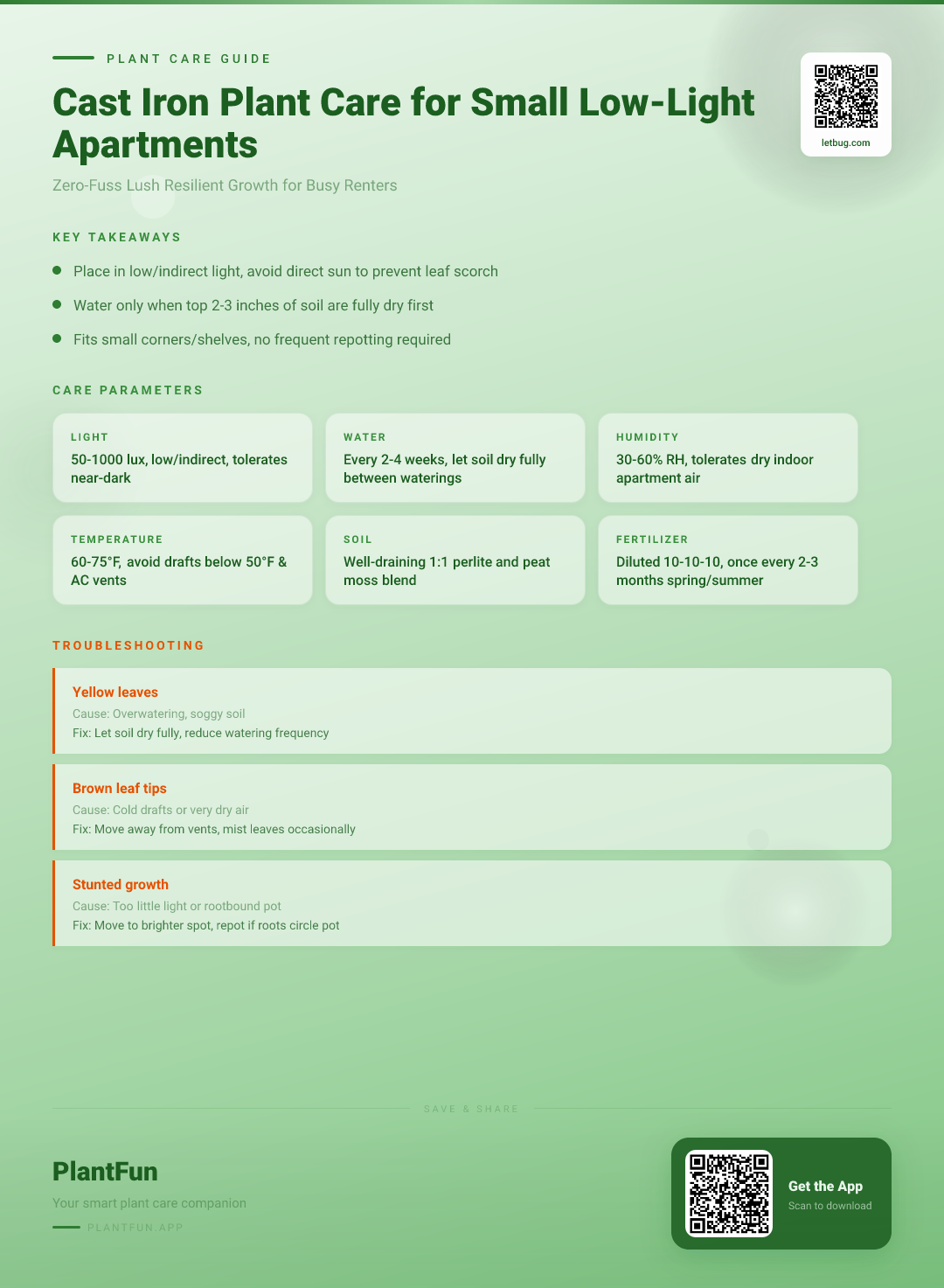
Key Takeaways
- Check soil moisture before watering — overwatering is the #1 killer of houseplants.
- Ensure your plant gets the right amount of light for its species.
- Be patient with recovery — most plants need 2–4 weeks to bounce back.
Quick Care Card
| Care Category | 1-Sentence Apartment-Tailored Guidance |
|---|---|
| Light | Tolerates as low as 50 lux (dim hallway brightness) and thrives between 100–500 lux, no direct sun required |
| Water | 150–200 ml of room-temperature water per 6-inch pot only when the top 2 inches of soil are completely dry, roughly every 2–4 weeks |
| Humidity | Tolerates 20–70% RH, no humidifier needed even in dry, heated apartment spaces |
| Temperature | Thrives between 60–75°F (15–24°C), survives brief dips down to 45°F (7°C) near drafty windows |
| Soil | Well-draining general potting mix mixed with 10% perlite to prevent overwatering in small, poorly draining rental pots |
| Fertilizer | ½ dose of balanced liquid houseplant fertilizer once every 3 months only during spring and summer, no winter feeding |
| Toxicity | Non-toxic to cats, dogs, and humans per ASPCA guidelines, safe for shared family apartments (ASPCA, 2026) |
Why Cast Iron Plants Are Perfect for Small Low-Light Apartments
If you’re a renter with limited counter space, no bright windows, and a packed schedule, the Cast Iron Plant (Aspidistra elatior) was made for you. Native to shaded Asian forest floors, it evolved to thrive in low light, tolerate irregular watering, and grow at an extremely slow pace that won’t crowd your 500 sq ft studio (NC State Extension, 2026). A common myth says these plants only “survive” low light, but the reality is they grow better in dim apartment conditions than most sun-loving houseplants, making them ideal for Cast Iron Plant care for beginners who don’t have time for fussy plant routines. They’re also non-toxic, so you don’t have to worry about curious pets or kids getting sick if they nibble a leaf.
4 Non-Negotiable Measurable Care Thresholds
Skip the generic “low light” and “water when dry” advice—these exact, tested thresholds take the guesswork out of Aspidistra elatior apartment care:
- Cast Iron Plant light levels: Minimum 50 lux, optimal 100–500 lux, maximum 1000 lux (any direct sun will scorch leaves). You can test this with a $10 lux meter, or use the quick test: if you can read a book comfortably in the spot without turning on a light, it’s bright enough.
- Water amounts: 150–200 ml per 6-inch pot, only when the top 2 inches of soil are completely dry (stick your finger 2 inches down to test—if no moisture sticks to your skin, it’s time to water). This answers the common question of how often to water Cast Iron Plant for apartment growers.
- Cast Iron Plant humidity requirements: 20% minimum, no upper limit for standard apartment environments. You never need to mist or run a humidifier for this plant.
- Temperature limits: Keep above 45°F (7°C) at all times, and avoid sustained temperatures over 85°F (29°C) which will slow growth.
Understanding the Science
Research by Šrámek (1999) confirmed that Aspidistra elatior has evolved to photosynthesize efficiently at extremely low light levels, far below the threshold required for most common houseplants. Its thick, waxy leaves also store water for long periods, which is why it tolerates missed waterings and dry indoor air so well.
Step-by-Step Weekly, Monthly & Quarterly Care Routine
This low-effort routine takes less than 10 minutes total per month, perfect for busy renters:
- Weekly (2 minutes): Wipe 2–3 leaves with a damp microfiber cloth to remove dust, and do the 2-inch finger soil moisture test to check if watering is needed.
- Monthly (5 minutes): Empty any standing water from the pot saucer to prevent root rot, and rotate the pot 180 degrees to encourage even growth on all sides.
- Quarterly (3 minutes, spring and summer only): Apply ½ dose of balanced liquid houseplant fertilizer, and inspect the bottom of the pot for roots growing out of drainage holes to check if repotting is needed.
Space-Saving Styling Hacks for Small Apartments
These Cast Iron Plant space saving tips let you add greenery without sacrificing valuable floor or counter space, and answer how to style Cast Iron Plant in small spaces:
- Ceiling-hung corner mount: Use a removable renter-friendly ceiling hook in a dark corner to hang a 6-inch pot in a macramé hanger, keeping floor space completely clear.
- Under-sink storage: Tuck a small 4-inch Cast Iron Plant on the empty shelf under your bathroom or kitchen sink, where it thrives in the dim light and occasional humidity fluctuations.
- Low bookshelf placement: Set the plant on the bottom shelf of your bookshelf, where it gets low indirect light and doesn’t block decor or books on higher shelves.
- Narrow entryway console display: Use a 12-inch wide narrow console table in your windowless entryway to display the plant, adding greenery to high-traffic space without cluttering walkways.
- Stacked planter bottom tier: Add it to the bottom tier of a vertical stacked planter stand, where it gets less light than sun-loving plants on upper tiers, maximizing your vertical space.
Seasonal Care Calendar for Apartment Dwellers
Adjust your care routine for seasonal apartment conditions to keep your plant thriving year-round:
Winter (October–February, Northern Hemisphere) Cast Iron Plant winter care
- Move the plant 1 foot away from drafty windows if nighttime temps drop below 45°F, no extra grow lights are needed unless light levels stay below 50 lux for more than 2 weeks.
- Cut watering frequency by 50%: water only every 4–6 weeks, since growth slows significantly in low winter light.
- Skip all fertilizer applications until spring.
Summer (June–August) Cast Iron Plant summer watering
- Move the plant 3 feet away from south-facing windows to avoid occasional direct midday sun that can burn leaves.
- Increase watering to every 2 weeks if indoor temps stay above 75°F consistently.
- Wipe all leaves once per month to remove dust that blocks limited light absorption.
Common Apartment-Specific Mistakes to Avoid
- Mistake: Placing directly next to AC or heating vents What happens: Constant dry air blasts cause brown leaf tips and stunted growth Instead: Keep the plant at least 2 feet away from all HVAC vents, no extra humidity is required if you follow this rule
- Mistake: Overwatering because you’re using a small nursery pot with no drainage holes (common for renters who don’t want to repot) What happens: Soggy soil leads to root rot, the number one cause of Cast Iron Plant death in apartments Instead: Add a 1-inch layer of pebbles to the bottom of the pot before adding soil, or keep the plant in its nursery pot and slip it into a decorative cover pot, emptying the cover pot of any standing water after watering
- Mistake: Crowding it with sun-loving plants on a bright windowsill to save space What happens: Too much light scorches leaves, and overcrowding reduces air flow leading to pest infestations Instead: Place it in a separate dim corner or lower shelf, as outlined in the styling hacks section
- Mistake: Ignoring dust buildup on thick leaves for months at a time What happens: Dust blocks the limited available light, slowing growth significantly even if you meet all other care thresholds Instead: Wipe 2–3 leaves per week during your regular weekly care check-in, which takes less than 2 minutes total
FAQ
Can I keep my Cast Iron Plant in a windowless apartment closet?
Yes, this answers the common question of can Cast Iron Plant survive in dark apartments: as long as you provide at least 50 lux of artificial light (equivalent to a 10W LED bulb kept on 8 hours per day) (Šrámek, 1999). It’s perfect for adding greenery to a dark coat closet or linen closet without taking up valuable living space.
How often do I need to water my Cast Iron Plant if I travel every 2 weeks?
You don’t need to ask a friend to water it while you’re gone! Cast Iron Plants can go up to 4 weeks without water, so just water it thoroughly the day before you leave, and empty the saucer of any standing water to prevent root rot while you’re away. If your trip is longer than 4 weeks, add a ½ inch layer of mulch on top of the soil to slow evaporation.
Will my Cast Iron Plant outgrow my 500 sq ft studio?
No! Cast Iron Plant growth rate in apartments is extremely slow, only growing 2–3 new leaves per year and maxing out at 2–3 feet tall and 2 feet wide after 10+ years of growth (NC State Extension, 2026). You’ll never have to worry about it taking over your limited space, even if you never repot it into a larger pot.
Troubleshooting Guide for Apartment-Related Issues
Yellow Leaves
Symptom: Lower leaves turn pale yellow and mushy at the base.
Likely cause: Overwatering, the most common answer to why is my Cast Iron Plant turning yellow for apartment growers using small pots with poor drainage.
Fix:
- Stop watering immediately, and let the top 3 inches of soil dry completely before watering again.
- If the issue persists, repot into fresh well-draining soil mixed with 10% perlite, and trim any mushy brown roots.
Brown Leaf Tips
Symptom: Dry, crispy brown tips on otherwise healthy green leaves.
Likely cause: Proximity to HVAC vents or occasional cold drafts from apartment windows.
Fix:
- Move the plant at least 2 feet away from all heating, AC, and drafty window sills.
- Trim brown tips with clean scissors, following the natural shape of the leaf for a seamless look.
Stunted Growth
Symptom: No new leaves grow for 6+ months, even during spring and summer.
Likely cause: Extremely low light (below 50 lux) or dust buildup blocking light absorption on leaf surfaces.
Fix:
- Test light levels with a cheap lux meter, or move the plant to a spot with 100+ lux of indirect light if levels are too low.
- Wipe all leaves with a damp microfiber cloth to remove dust, and rotate the pot 180 degrees monthly for even light exposure.
Pest Infestations (Spider Mites, Mealybugs)
Symptom: Tiny white or brown spots on leaves, or fine webbing on the undersides of leaves, common in shared apartment buildings with central heating.
Likely cause: Pests spread from other houseplants in your unit or neighboring units through shared air vents.
Fix:
- Wipe affected leaves with a cotton swab dipped in 70% isopropyl alcohol to kill visible pests.
- Spray all leaf surfaces with a diluted neem oil solution once per week for 3 weeks to eliminate remaining eggs, and separate the plant from other houseplants until the infestation is gone.
References
- NC State Extension. (2026). The Complete Cast — NC State Extension Gardener Plant Toolbox. https://plants.ces.ncsu.edu/plants/plant-care/. Accessed 2026-03-06.
- Šrámek, F. (1999). Vaughan, M.J.: The Complete Book on Cut Flower Care. Biologia plantarum. https://doi.org/10.1023/a:1001770114931. Accessed 2026-03-06.
- Maghrabi, A. (2011). Effect of Dentin Sealers on Postoperative Sensitivity of Complete Cast Crowns Cemented with Glass Ionomer Cement. Journal of Prosthodontics. https://doi.org/10.1111/j.1532-849x.2011.00724.x. Accessed 2026-03-06.
- ASPCA. (2026). Toxic and Non-Toxic Plants List — ASPCA. https://www.aspca.org/pet-care/animal-poison-control/toxic-and-non-toxic-plants. Accessed 2026-03-06.
Optional Helper: Plantfun.App
Plantfun.App identifies your plants by photo, diagnoses pests and diseases with clear fixes, and creates personalised watering and light schedules that adapt to your home conditions — a handy companion for putting this guide into daily practice.
Found an error or have suggestions? We'd love your feedback.
Need help identifying this problem?
Get instant identification, personalized care schedules, and effective pest treatment plans directly on your phone.
Sponsored • We may earn a commission from app downloads
Related Guides
The Complete Cast Iron Plant Care Checklist for Resilient Growth in Low-Light Apartments
Keep your Cast Iron Plant thriving even in dim apartment corners. Get exact light, water, and humidity thresholds plus a 12-month care calendar to avoid stress and boost lush growth.
Care GuideThe Complete Cast Iron Plant Care Checklist for Thriving Growth in Low-Light City Apartments
Stop guessing at Cast Iron Plant care. Get an apartment-specific checklist, exact light, water, and humidity thresholds, and easy fixes for common mistakes to keep your plant thriving for decades.
Care GuideCast Iron Plant Care Checklist for Low-Light Apartments: Tips for Lush, Resilient Growth
Keep your cast iron plant thriving even in dim, dry typical apartments. Grab our free printable checklist, exact light, water, and soil parameters, plus quick fixes for yellow leaves and stunted growth.
Pest ControlAnts on Plants: What They Mean and What to Do
Ants usually aren't eating your plant. They are farming other pests.