
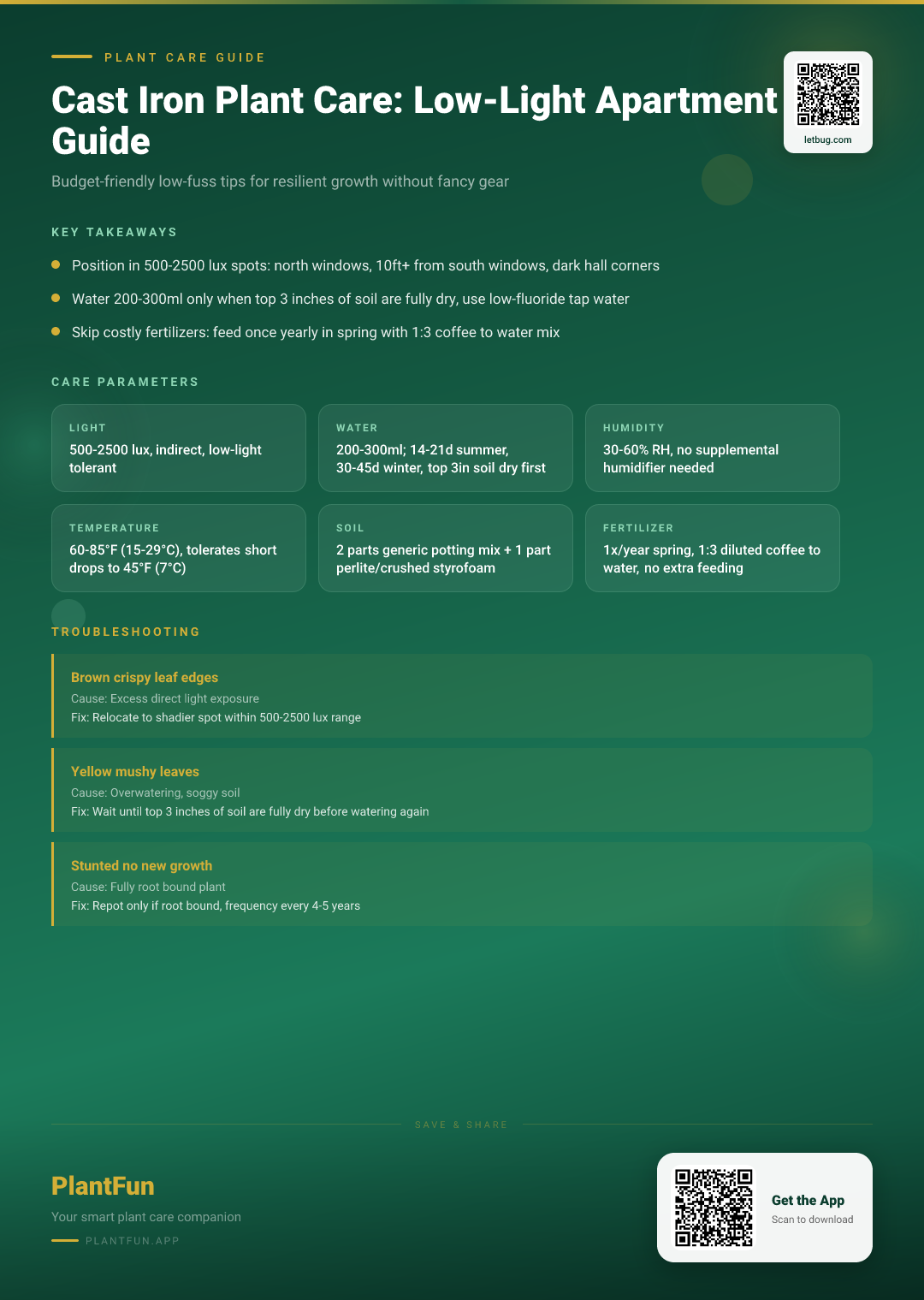
Key Takeaways
- Check soil moisture before watering — overwatering is the #1 killer of houseplants.
- Ensure your plant gets the right amount of light for its species.
- Be patient with recovery — most plants need 2–4 weeks to bounce back.
Quick Care Card
| Category | Threshold |
|---|---|
| Light | 500-2,500 lux (no direct sun) |
| Water | 200-300ml when top 3 inches of soil are fully dry; 14-21 days summer, 30-45 days winter |
| Humidity | 30-60% (no humidifier required) |
| Temperature | 60-85°F (15-29°C) ideal, tolerates down to 45°F (7°C) short-term |
| Soil | 2 parts generic potting mix + 1 part perlite (or crushed styrofoam) |
| Fertilizer | 1x per spring, diluted leftover coffee (1:3 coffee to water) |
| Toxicity | Non-toxic to cats, dogs, and humans (ASPCA, 2026) |
All these guidelines are compiled in our free Cast Iron Plant care checklist you can download, print, and stick to your fridge for 5-minute weekly check-ins.
Why This Guide Is Perfect For Apartment Renters
Urban apartments come with unique plant care challenges: low natural light, fluctuating heating and cooling, irregular schedules from work or travel, and limited budget for fancy plant gear. This guide is built exclusively for these constraints, with zero-cost Cast Iron Plant care for beginners that requires no specialty products or space modifications. Aspidistra elatior care is uniquely suited to apartment life, as it tolerates stressors that kill most common houseplants. If you’re looking for more tough plants for your space, check out our roundup of the best low-light apartment plants here.
Myth vs Reality: Myth: You need to spend $20+ on grow lights to keep plants alive in dark apartments. Reality: Cast Iron Plant low light apartment care requires zero additional lighting, as it tolerates light levels most other houseplants can’t survive (Šrámek, 1999).
Step 1: Light Placement For Low-Light Apartments
The verified Cast Iron Plant light level lux range is 500-2,500 lux (NC State Extension, 2026), which is far lower than the 10,000+ lux most tropical houseplants require. Ideal spots for your plant include:
- North-facing window sills
- 10ft or more away from south or west-facing windows
- Interior hallway corners
- Offices with only overhead fluorescent lighting
Signs of too much light include brown, crispy leaf edges or faded yellow patches on foliage. Quick test: If you can comfortably read a paperback book in the spot during midday without turning on a lamp, it has enough light for your Cast Iron Plant. If direct sun hits the leaves for more than 1 hour per day, move it to a shadier spot.
Step 2: Exact Watering Schedule For Irregular Routine
One of the most common questions new owners ask is how often to water Cast Iron Plant, and the rule is simple enough for even the most forgetful plant parent: Give 200-300ml of water only when the top 3 inches of soil are completely dry. In summer, this works out to every 14-21 days (this is your standard Cast Iron Plant summer watering schedule), while in winter, you can extend to every 30-45 days for Cast Iron Plant winter care (NC State Extension, 2026).
Low-fluoride tap water works perfectly, no need for expensive filtered or rainwater. Quick test: Stick your index finger all the way into the soil. If no soil sticks to the first 3 knuckles, it’s time to water. For more tips on checking soil moisture without a fancy meter, see our guide here. Note that this plant is far more tolerant of underwatering than overwatering, so if you forget to water for a week extra, it will be fine.
Step 3: Budget Soil & Potting Hack No One Talks About
The perfect Cast Iron Plant soil mix doesn’t require specialty orchid or cactus mix. Use 2 parts cheap generic potting mix (the $2 bag from your local grocery store works great) + 1 part perlite, or if you don’t have perlite, repurposed crushed styrofoam from delivery packaging for free drainage.
For the pot, any $5 plastic pot with drainage holes works perfectly. You don’t need a decorative cache pot: if you want it to look nicer, wrap the plastic pot in old fabric, newspaper, or a thrifted basket you already own. When you do need to repot, follow our step-by-step repotting guide for beginners here.
Step 4: Temperature & Humidity Tolerance For Unregulated Apartments
Cast Iron Plant humidity requirements are extremely low: 30-60% relative humidity, which is exactly the average range for most urban apartments, so you never need to buy a humidifier for this plant (NC State Extension, 2026). Temperature-wise, it thrives in 60-85°F (15-29°C), and tolerates short drops down to 45°F (7°C) without damage, making it perfect for drafty old apartments or spaces where you turn the heat down low when you’re at work.
Step 5: Zero-Cost Feeding Schedule
You never need to buy expensive liquid fertilizer for your Cast Iron Plant. Feed once a year in early spring with diluted leftover black coffee: mix 1 part coffee (no sugar, no cream) with 3 parts water, and pour it over the soil like you would regular water. That’s all the feeding it needs for the entire year. For more zero-cost fertilizer hacks for your houseplants, check out our list here.
12-Month Seasonal Care Checklist
This minimal schedule takes less than 5 minutes per week, and all tasks are included in our free Cast Iron Plant care checklist for easy reference:
- Spring (March-May): Feed once with diluted coffee, prune any fully dead brown or yellow leaves, check if the plant is root bound (only repot if roots are growing out the drainage holes, which happens every 4-5 years on average)
- Summer (June-August): Follow the 14-21 day watering schedule, wipe leaves with a damp old t-shirt once a month to remove dust that blocks photosynthesis
- Fall (September-November): Gradually extend time between waterings as temperatures drop, stop feeding, move the plant 3ft away from drafty windows if nighttime temps drop below 45°F
- Winter (December-February): Follow the 30-45 day watering schedule, no feeding or pruning unless leaves are fully dead and brown
Most Common Apartment Care Mistakes To Avoid
- Mistake: Overwatering (the number one killer of Cast Iron Plants) What happens: Soggy soil causes root rot, leading to mushy yellow leaves and eventual plant death Instead: Always confirm the top 3 inches of soil are 100% dry before watering, and err on the side of waiting an extra 3-5 days if you’re unsure
- Mistake: Placing the plant near heating or AC vents What happens: Forced air dries out leaves rapidly, causing brown crispy edges and stunted growth Instead: Keep the plant at least 3ft away from any forced air vents, radiators, or space heaters
- Mistake: Repotting too often What happens: Cast Iron Plants prefer to be root bound, so repotting before they’re ready causes root shock and slows growth for 6+ months Instead: Only repot every 4-5 years, when you can see roots growing out the bottom drainage holes of the pot
- Mistake: Using commercial leaf shine products What happens: These products clog the tiny pores on leaves, preventing photosynthesis and leading to brown leaf tips Instead: Wipe dust off leaves with a damp old t-shirt or paper towel for free, no products required
FAQ
Why is my Cast Iron Plant getting yellow leaves?
Yellowing leaves are almost always caused by overwatering (NC State Extension, 2026). First, stick your finger 3 inches into the soil: if it’s damp at all, hold off on watering for 2+ weeks. If the soil is soggy, tip the pot gently to drain any excess water sitting in the saucer, and check that the drainage holes are not clogged with soil. If you notice mushy brown roots when you tip the plant out, trim the rotten roots, repot into fresh dry soil mix, and hold off on watering for 10 days.
Can I keep my Cast Iron Plant in a windowless bathroom?
Yes! This is one of the most common questions we get about can Cast Iron Plant live in dark apartments, and the answer is a resounding yes, as long as your overhead LED lights provide at least 500 lux of light (you can test this for free with a light meter app on your phone). You can water slightly less often than the standard schedule: every 25-30 days in summer, and 40-50 days in winter, because the higher natural humidity from showers slows down soil drying.
How do I propagate my Cast Iron Plant for free?
Propagating Cast Iron Plants is extremely easy and requires no special tools. When you repot your plant every 4-5 years, gently pull apart the thick root clumps with your hands into sections, each with at least 3-4 healthy leaves and a portion of the root system attached. Pot each section into its own pot with the budget Cast Iron Plant soil mix, water once lightly, and you have a new plant perfect for gifting to roommates, family, or neighbors.
References
- ASPCA. (2026). Toxic and Non-Toxic Plants List — ASPCA. https://www.aspca.org/pet-care/animal-poison-control/toxic-and-non-toxic-plants. Accessed 2026-03-08.
- Šrámek, F. (1999). Vaughan, M.J.: The Complete Book on Cut Flower Care. Biologia plantarum. https://doi.org/10.1023/a:1001770114931. Accessed 2026-03-08.
- Maghrabi, A. (2011). Effect of Dentin Sealers on Postoperative Sensitivity of Complete Cast Crowns Cemented with Glass Ionomer Cement. Journal of Prosthodontics. https://doi.org/10.1111/j.1532-849x.2011.00724.x. Accessed 2026-03-08.
- NC State Extension. (2026). The Complete Cast — NC State Extension Gardener Plant Toolbox. https://plants.ces.ncsu.edu/plants/plant-care/. Accessed 2026-03-08.
Optional Helper: Plantfun.App
Plantfun.App identifies your plants by photo, diagnoses pests and diseases with clear fixes, and creates personalised watering and light schedules that adapt to your home conditions — a handy companion for putting this guide into daily practice.
Found an error or have suggestions? We'd love your feedback.
Need help identifying this problem?
Get instant identification, personalized care schedules, and effective pest treatment plans directly on your phone.
Sponsored • We may earn a commission from app downloads
Related Guides
The Complete Cast Iron Plant Care Checklist for Budget-Friendly Resilient Growth in Low-Light Apartments
Grow a lush Cast Iron Plant without spending extra on fancy supplies. Get our free printable checklist with exact light, water, and soil parameters made for typical low-light apartments.
Care GuideThe Complete Cast Iron Plant Care Checklist for Resilient Growth in Low-Light Apartments
Keep your Cast Iron Plant thriving even in dim apartment corners. Get exact light, water, and humidity thresholds plus a 12-month care calendar to avoid stress and boost lush growth.
Care GuideCast Iron Plant Care Checklist for Low-Light Apartments: Tips for Lush, Resilient Growth
Keep your cast iron plant thriving even in dim, dry typical apartments. Grab our free printable checklist, exact light, water, and soil parameters, plus quick fixes for yellow leaves and stunted growth.
Pest ControlAnts on Plants: What They Mean and What to Do
Ants usually aren't eating your plant. They are farming other pests.