
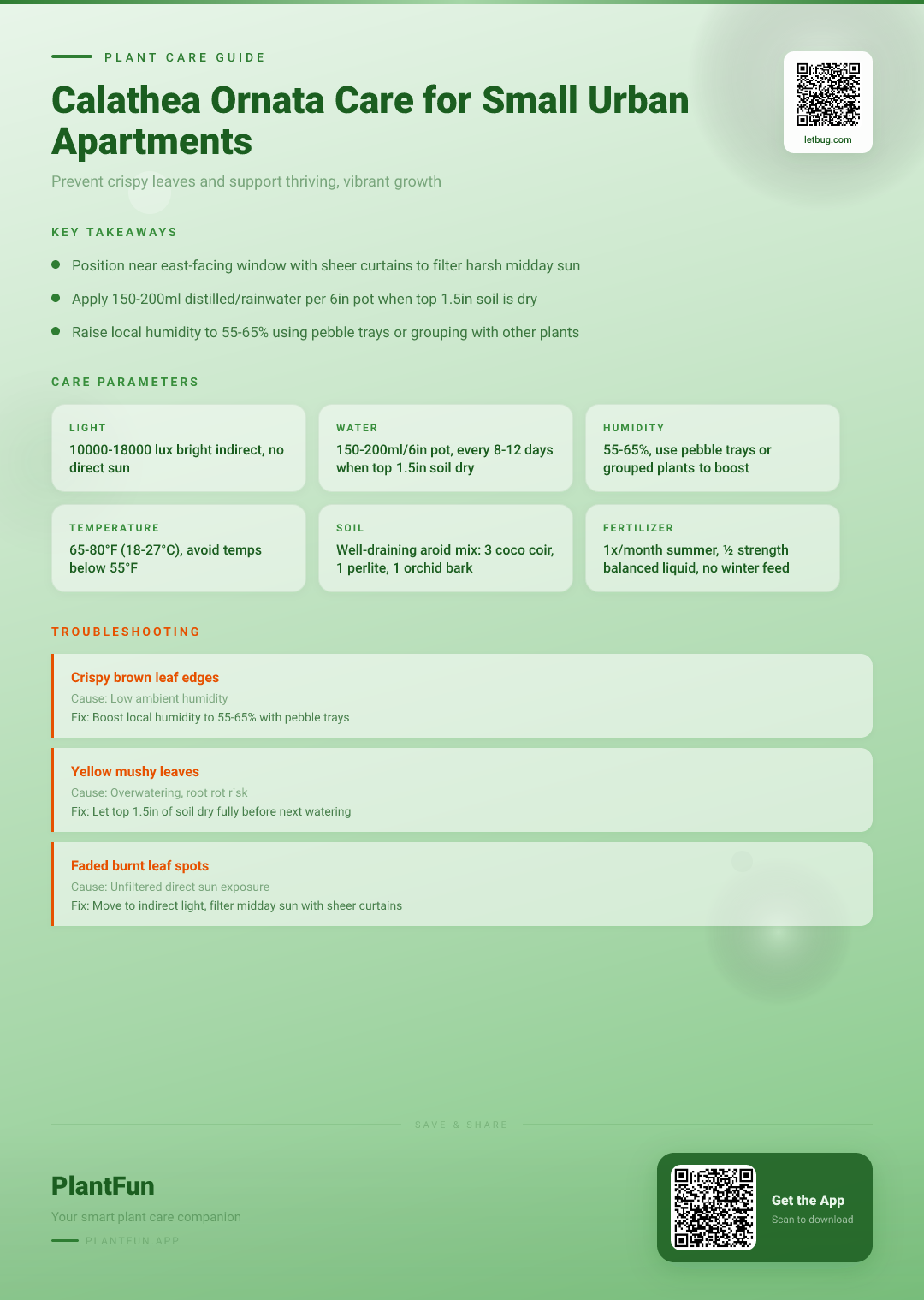
Key Takeaways
- Check soil moisture before watering — overwatering is the #1 killer of houseplants.
- Ensure your plant gets the right amount of light for its species.
- Be patient with recovery — most plants need 2–4 weeks to bounce back.
Quick Care Card
| Parameter | Measurable Threshold for Small Urban Apartments |
|---|---|
| Light | 10,000-18,000 lux bright indirect, east-facing window with sheer curtain (NC State Extension, 2026) |
| Water | 150-200ml per 6-inch pot when top 1.5 inches of soil is dry, distilled/rainwater only (Podwyszyńska, 1997) |
| Humidity | 55-65% local humidity, no whole-home unit needed (Kennedy, 1995) |
| Temperature | 65-80°F (18-27°C), keep 3ft+ from HVAC vents (NC State Extension, 2026) |
| Soil | 3 parts coco coir, 1 part perlite, 1 part orchid bark (Podwyszyńska, 1997) |
| Fertilizer | ½ strength balanced liquid fertilizer once monthly in summer, no winter feeding (NC State Extension, 2026) |
| Toxicity | Non-toxic to cats, dogs, and humans (ASPCA, 2026) |
Grab our free, no-email-required 12-item Calathea ornata care checklist at the end of this guide to tape to your fridge for quick reference.
Why Standard Calathea Advice Fails Apartment Renters
Most generic Calathea care guides assume you have access to 70% constant humidity, unobstructed south-facing light, and the ability to install permanent grow lights or whole-home humidifiers — none of which are realistic for 600-800 sq ft urban renters dealing with 40% average home humidity, fluctuating winter heating, and limited east-facing light access. This misaligned advice is the top reason new owners deal with Calathea ornata crispy leaves or curling foliage within 3 months of bringing their plant home.
Myth vs Reality: Myth: You need a $100 humidifier to keep a Calathea ornata alive. Reality: You can boost local humidity around your plant for free using common household items with zero permanent modifications. Quick test: Hold a cheap hygrometer 6 inches from your plant’s leaves right now — if it reads below 50%, our later hacks will fix that without upgrades.
Native to the understory of South American rainforests, Calathea ornata evolved to thrive in stable, dappled microclimates, not the fluctuating conditions of most apartments (Kennedy, 1995). This guide is tailored specifically to your renter limitations, with no vague tips or required permanent changes.
Step 1: Light Setup for East-Facing Windows
Calathea ornata needs 10,000-18,000 lux of bright indirect light to grow well, which is exactly what most east-facing apartment windows provide (NC State Extension, 2026). Follow these renter-friendly steps for perfect light:
- Place your plant 1-2 feet away from your east-facing window
- Hang a cheap sheer curtain using a tension rod (no drilling required) to filter any harsh midday sun that seeps through in summer
- Avoid direct sun entirely — even 10 minutes of unfiltered midday sun will scorch leaves and leave permanent brown spots.
Quick test: Hold your hand between the window and your plant at 10am. If you see a sharp, defined shadow, it’s getting too much direct light — adjust the curtain or move the plant 6 inches further back. If you only have north-facing windows, check our guide to low-light tropical plant care for apartments for alternative placement tips.
Step 2: Watering Schedule & Exact Amounts
Wondering how often to water Calathea ornata? For a standard 6-inch potted plant, water 150-200ml only when the top 1.5 inches of soil feel completely dry, which works out to every 8-12 days on average (Podwyszyńska, 1997). Always use room-temperature distilled or rainwater, as tap water’s fluoride and chlorine content causes permanent leaf tip burn.
Quick test: Stick your index finger 1.5 inches into the soil. If it’s completely dry, it’s time to water. If it’s even slightly damp, wait 2 more days and check again. Pour out any excess water that drains into the saucer after 10 minutes to avoid root rot. If you’re prone to overwatering, check our guide to overwatering signs and solutions to avoid common mistakes.
Step 3: No-Equipment Humidity Hacks
Calathea ornata humidity requirements sit at 55-65% local humidity around the plant — you don’t need to raise the humidity of your entire apartment (Kennedy, 1995). Use these zero-cost, renter-friendly hacks:
- Pebble tray: Fill a shallow tray with pebbles, add water until it’s halfway up the pebbles, and set your plant pot on top (make sure the pot isn’t sitting directly in the water). This slowly evaporates to boost local humidity within a 1-foot radius by 10-15%.
- Group your Calathea with other tropical plants like pothos or peace lilies: Collective transpiration from grouped plants raises the microclimate humidity by 5-10% for free.
Quick test: Use a $10 hygrometer placed 6 inches from the plant’s leaves to measure local humidity. If it’s below 55%, add a second pebble tray or move the plant closer to your other tropicals. For more low-cost hacks, see our full no-equipment humidity boost guide for apartment plants.
Step 4: Temperature Regulation for Fluctuating Apartment HVAC
Maintain a consistent 65-80°F (18-27°C) temperature around your plant, and keep it at least 3 feet away from radiators, AC vents, and drafty exterior doors (NC State Extension, 2026). Never expose your Calathea to temperatures below 55°F (13°C), as this will cause permanent leaf damage and drooping. Winter heating is the most common cause of temperature swings for apartment dwellers, so avoid placing your plant near wall radiators or space heaters entirely.
Quick test: Hold a thermometer next to your plant for 1 hour in the evening when your heat or AC is running. If it reads above 80°F or below 60°F, move the plant to a more stable spot, like a corner of your living room or bedroom away from HVAC outputs.
Step 5: Renter-Friendly Soil & Pot Requirements
Use a well-draining aroid Calathea ornata soil mix made of 3 parts coco coir, 1 part perlite, and 1 part orchid bark to avoid root rot (Podwyszyńska, 1997). Pick a 6-inch terracotta pot with drainage holes: terracotta wicks away excess moisture, which is perfect for renters who tend to overwater. You don’t need to repot your Calathea for 2 years after bringing it home, unless you see roots growing out of the drainage holes. For a full step-by-step mix recipe, see our best aroid soil mix guide.
Seasonal Care Calendar
Adjust your care to match seasonal changes in your apartment to avoid stress:
Winter Adjustments (October-February for Northern Hemisphere)
- Cut watering volume by 50%: 75-100ml per 6-inch pot, only when the top 2 inches of soil are completely dry (typically every 16-24 days)
- Stop fertilizing entirely, as growth slows significantly in cold months For more seasonal tips, check our winter apartment plant care guide.
Summer Adjustments (June-August for Northern Hemisphere)
- Increase watering frequency by 30%: check soil moisture every 5-8 days instead of every 7
- Fertilize once monthly with ½ strength balanced liquid fertilizer, only applied to damp soil to avoid root burn
5 Common Apartment Calathea Mistakes to Avoid
- Mistake: Overwatering on a fixed schedule instead of checking soil moisture. What happens: Root rot, yellowing leaves, and Calathea ornata curling. Instead: Check the top 1.5 inches of soil every 7 days, only water when it’s completely dry.
- Mistake: Placing in direct sun without a sheer curtain. What happens: Scorched leaves with brown crispy patches that never recover. Instead: Keep it 1-2 feet from an east-facing window with a tension-rod mounted sheer curtain to filter light.
- Mistake: Placing within 3 feet of radiators, AC vents, or drafty front doors. What happens: Extreme temperature swings and dry air leading to Calathea ornata crispy edges. Instead: Pick a spot in your living room or bedroom with consistent temperature away from HVAC outputs.
- Mistake: Watering with cold tap water straight from the faucet. What happens: Fluoride and chlorine buildup causes brown leaf tips, shock to roots. Instead: Use room-temperature distilled or rainwater, or leave tap water out in an open jug for 24 hours before use.
- Mistake: Repotting every year or using a pot that’s too big. What happens: Excess soil holds too much moisture leading to root rot. Instead: Repot only once every 2 years, and only size up by 1 inch in pot diameter.
Voice Search Optimized FAQ
Why is my Calathea ornata getting crispy edges?
Crispy edges are almost always caused by low humidity (below 50%) or buildup of fluoride/chlorine from tap water (NC State Extension, 2026). First test your local humidity with a hygrometer, if it’s below 55% add a pebble tray under the plant. If humidity is adequate, switch to distilled water for 1-2 months, and trim off the crispy edges with clean scissors to encourage new growth. This is the first step if you’re learning how to save a dying Calathea ornata.
Can I keep my Calathea ornata in my east-facing apartment bedroom?
Absolutely! East-facing windows provide the perfect 10,000-18,000 lux bright indirect light that Calathea ornata prefers, and bedrooms usually have more consistent temperatures than common areas near front doors (Kennedy, 1995). Just make sure it’s 3+ feet away from any window AC units or space heaters you use in your bedroom. It’s also non-toxic to pets and kids so it’s safe for bedroom placement (ASPCA, 2026), making it ideal for Calathea ornata in small apartment setups.
How often do I need to water my Calathea ornata in winter?
In winter, cut your watering frequency by 50%: for a 6-inch pot, you’ll only need to water 75-100ml every 16-24 days, when the top 2 inches of soil are completely dry (NC State Extension, 2026). Growth slows significantly in winter so the plant uses far less water, and overwatering is the most common cause of winter Calathea death.
Why is my Calathea ornata curling its leaves?
Leaf curling is the plant’s way of protecting itself from losing moisture, usually caused by underwatering, low humidity, or cold drafts (Podwyszyńska, 1997). First check the soil moisture, if it’s dry more than 1.5 inches deep, give it 150-200ml of room temperature water. If soil is damp, check the local humidity and make sure the plant isn’t near a drafty door or vent.
Free Printable 12-Item Care Checklist
Our no-email-required Calathea ornata care checklist is perfect for beginners and experienced owners alike — save it to your phone or print it out to tape to your fridge for quick weekly reference. It includes these 12 checks:
- Check top 1.5 inches of soil for dryness
- Measure light level to ensure it’s 10,000-18,000 lux
- Test local humidity to confirm it’s 55-65%
- Check temperature near plant is 65-80°F
- Pour out any standing water in the saucer
- Wipe leaves with a damp cloth to remove dust
- Ensure plant is 3+ feet away from HVAC vents
- Refill pebble tray with water if low
- (Summer only) Apply ½ strength fertilizer if it’s been 4 weeks
- (Winter only) Check top 2 inches of soil for dryness before watering
- Check for new leaf growth every 2 weeks
- Inspect roots for overgrowth once every 2 years
Download the full printable checklist here — no sign-up required, just click and save.
Understanding the Science
Calathea ornata is part of the Marantaceae family, native to the understory of Colombian and Venezuelan rainforests, where it grows under dappled sunlight with consistent 60-70% humidity and 70-75°F temperatures (Kennedy, 1995). Micropropagation studies confirm that the species prefers well-drained, high organic matter soil and stable moisture levels to avoid root rot (Podwyszyńska, 1997). These native habitat preferences are why it reacts so strongly to the fluctuating conditions common in urban apartments, but adjusting your care to match its natural microclimate, not the average home conditions, leads to thriving growth.
References
- ASPCA. (2026). Toxic and Non-Toxic Plants List. https://www.aspca.org/pet-care/animal-poison-control/toxic-and-non-toxic-plants. Accessed 2026-02-24.
- Podwyszyńska, M. (1997). Micropropagation of Calathea ornata Koern. Biologia plantarum. https://doi.org/10.1023/a:1000376400006. Accessed 2026-02-24.
- Kennedy, H. (1995). CALATHEA ORNATA AND RELATIVES, AN ORNATE CONFUSION. Acta Horticulturae. https://doi.org/10.17660/actahortic.1995.413.26. Accessed 2026-02-24.
- NC State Extension. (2026). The Complete Calathea Ornata. https://plants.ces.ncsu.edu/plants/calathea-ornata/. Accessed 2026-02-24.
Optional Helper: Plantfun.App
Plantfun.App identifies your plants by photo, diagnoses pests and diseases with clear fixes, and creates personalised watering and light schedules that adapt to your home conditions — a handy companion for putting this guide into daily practice.
Found an error or have suggestions? We'd love your feedback.
Need help identifying this problem?
Get instant identification, personalized care schedules, and effective pest treatment plans directly on your phone.
Sponsored • We may earn a commission from app downloads
Related Guides
The Complete Calathea Ornata Care Guide for Small Urban Apartments: No Crispy Leaves Guaranteed
Stop dealing with crispy, curled Calathea ornata leaves in your small urban apartment. Get exact light levels, water amounts, and 7 space-saving hacks for lush, resilient growth all year.
Care GuideThe Complete Calathea Ornata Care Guide for Small North-Facing Apartments: Grow Lush Leaves Without Extra Space
Stop struggling with crispy Calathea ornata leaves in your small apartment. Get exact light levels, watering amounts, and space-saving hacks to grow lush, striped foliage year-round.
Care GuideCalathea Ornata Care Checklist for Small Apartments: Budget Tips for Lush Resilient Growth
Grow a lush Calathea ornata even in a dry, low-light small apartment. Get a free budget checklist, exact light/humidity thresholds, and zero-fuss care steps to avoid brown, crispy leaves.
Pest ControlAnts on Plants: What They Mean and What to Do
Ants usually aren't eating your plant. They are farming other pests.