
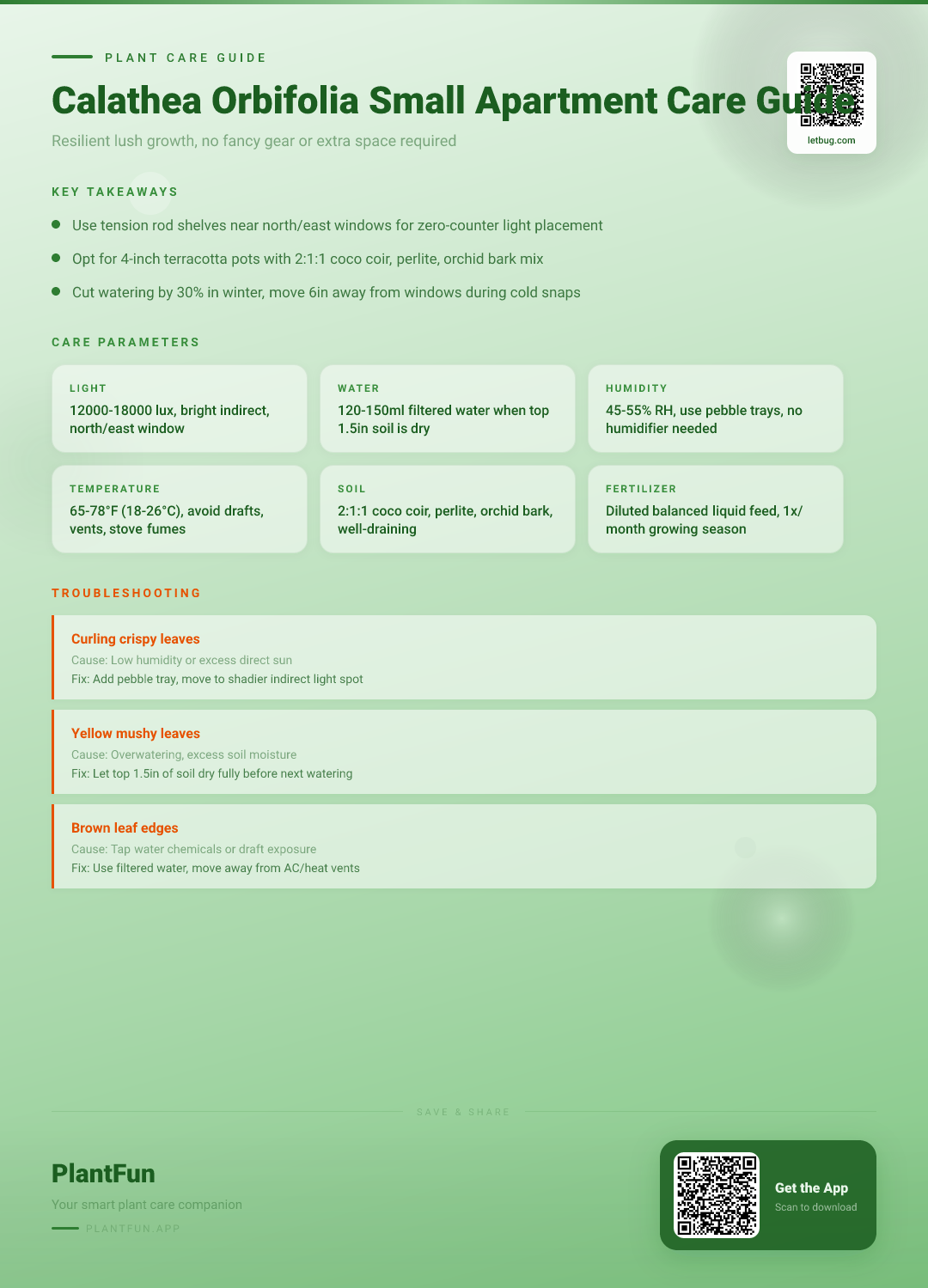
Key Takeaways
- Check soil moisture before watering — overwatering is the #1 killer of houseplants.
- Ensure your plant gets the right amount of light for its species.
- Be patient with recovery — most plants need 2–4 weeks to bounce back.
Quick Care Card
| Parameter | Small-Apartment Optimized Threshold |
|---|---|
| Light | 12,000–18,000 lux bright indirect (no direct sun) |
| Water | 120–150ml room-temperature filtered water when top 1.5 inches of soil are dry (for 4-inch pots) |
| Humidity | 45–55% relative humidity |
| Temperature | 65–78°F (18–26°C) |
| Soil | 2:1:1 mix of coco coir, perlite, orchid bark |
| Fertilizer | ¼ strength balanced liquid fertilizer once every 2 months (spring and summer only) |
| Toxicity | Non-toxic to cats, dogs, and humans (ASPCA, 2026) |
Why This Guide Is Different
Standard Calathea orbifolia care advice is built for homeowners with extra square footage, dedicated plant shelves, and budget for bulky equipment — not for renters in 600 sq ft urban studios with limited counter space, no drilling permission, and fixed, dry heating/cooling systems. Generic tips like “buy a large humidifier” or “use a 10-inch planter for growth” simply don’t work for small spaces, and lead to frustrated plant owners dealing with curling leaves, overwatering, and dead plants before they even get the hang of care. Myth: You need specialty, space-hogging gear to keep a Calathea alive in an apartment. Reality: All the hacks in this guide use items you probably already have at home, and fit on even the narrowest windowsill. This guide is perfect for Calathea orbifolia care for beginners who want to skip trial and error, and learn how to keep Calathea alive in apartments without breaking their lease or their budget.
Step 1: Light Setup for Tight Spaces
Calathea orbifolia light requirements sit at exactly 12,000–18,000 lux of bright indirect light (NC State Extension, 2026) — enough light to read a book comfortably without squinting, but no direct midday sun that will burn its delicate striped leaves. For small spaces, skip bulky countertop plant stands entirely: use a tension rod shelf installed inside your north or east facing window frame, which takes zero counter or floor space and fits 2-3 4-inch pots easily. If you don’t have a suitable window, use a small clip-on LED grow light that clamps to your window frame or desk edge (no drilling required) set to run 10 hours a day. Quick test: Hold your hand at the plant’s planned spot at midday. If you see a faint, soft shadow, the light level is perfect. For more low-effort lighting hacks, check out our No-Drill Grow Light Hacks for Renters guide.
Step 2: Exact Watering Routine for Apartments
Overwatering is the #1 cause of Calathea death in small apartments, so we’ve calibrated this routine specifically for 4-inch pots, the perfect size for tight spaces. Water with 120–150ml of room-temperature filtered water only when the top 1.5 inches of soil feel completely dry (NC State Extension, 2026). Quick test: Stick your index finger into the soil up to your second knuckle. If the soil is dry at that depth, it’s time to water. For most dry studio apartments, this works out to every 7–10 days in the growing season, and every 10–14 days in winter. If you’re confused about how often to water Calathea orbifolia, skip app reminders entirely and rely on the finger test first — apartment humidity and temperature vary wildly, so a one-size-fits-all schedule rarely works. If you do accidentally overwater and notice mushy roots, follow our Step-by-Step Root Rot Fix Guide to save your plant before it’s too late.
Step 3: No-Humidifier Humidity Hacks
Calathea orbifolia humidity requirements are 45–55% relative humidity (Yang & Yeh, 2008) — a level most dry studio apartments fall well below in winter, but you don’t need a bulky, space-hogging humidifier to hit this target. These Calathea no humidifier care hacks take zero extra counter space:
- Use a 4-inch under-saucer pebble tray: Fill the saucer with small pebbles, add water just below the top of the pebbles, and set your pot on top. The evaporating water boosts local humidity by 5–10% directly around the plant, without risking root rot from standing water.
- Group your Calathea with 1–2 other small pet-safe houseplants (like pothos or spider plants) to create a small, humid microclimate. For more plant pairing ideas, see our Best Small Space Pet-Safe Houseplants for Studios list. These Calathea low humidity care tips are enough to prevent brown leaf edges and curling, no extra gear required.
Step 4: Temperature Maintenance for Renters
Keep your Calathea orbifolia in temperatures between 65–78°F (18–26°C) (NC State Extension, 2026). In small open-concept studios, it’s easy to accidentally place your plant near harsh temperature swings that cause stress: avoid spots within 1 foot of AC vents, space heaters, kitchen stoves, and external entry doors. Quick test: Hold your hand at the plant’s spot for 30 seconds. If you feel a hot or cold draft, move the plant at least 1 foot away.
Step 5: Small-Space Soil & Potting Tips
For Calathea small space potting tips, stick to a 4-inch terracotta pot with a drainage hole — it fits on even the narrowest windowsill, and the porous terracotta wicks away excess moisture to prevent root rot (Khuna et al, 2025). Use a 2:1:1 mix of coco coir, perlite, and orchid bark: this mix drains fast, holds just enough moisture, and prevents fungal growth that can damage your plant. Skip oversized 6+ inch pots entirely: they take up 2x more counter space, and hold excess moisture that leads to root rot long before your plant is big enough to use the extra soil. You only need to repot once every 2 years, when you see roots growing out of the drainage hole.
Seasonal Care Calendar for Small Apartments
Adjust your care routine with the seasons to keep your Calathea thriving year-round:
- Winter (Calathea orbifolia winter care): Cut your watering frequency by 30% (dry air doesn’t mean dry soil!), and move your plant 6 inches away from windows during cold snaps to avoid frost damage. You can skip the pebble tray if your apartment humidity stays above 45% naturally.
- Summer (Calathea orbifolia summer watering): Check soil moisture 2 days earlier than your usual schedule, as hot dry air will dry out soil faster. Skip extra humidity steps if your apartment’s relative humidity is already above 50% during humid summer months.
Common Small-Apartment Care Mistakes to Avoid
- Mistake: Using an 8+ inch oversized pot to avoid repotting often What happens: Takes up 2x more counter space, holds excess moisture that causes root rot and fungal leaf disease (Khuna et al, 2025) Instead: Stick to a 4-inch terracotta pot, repot only once every 2 years when roots grow out the drainage hole
- Mistake: Overwatering to compensate for dry apartment air What happens: Roots rot, leaves turn yellow and fall off faster than low humidity damage Instead: Use the pebble tray hack and only water when the top 1.5 inches of soil are completely dry
- Mistake: Placing your Calathea near the front entryway for decor What happens: Cold winter drafts and hot summer air blasts shock the plant, leading to curling leaves Instead: Place it on a window tension rod shelf at least 3 feet away from external doors
- Mistake: Drilling permanent grow light mounts into walls or ceiling What happens: You lose your security deposit, and most renters aren’t allowed to make permanent modifications Instead: Use clip-on grow lights that attach to window frames or tension rods, no drilling required
Voice Search Optimized FAQ
Can I keep my Calathea orbifolia on my apartment desk?
Yes, as long as your desk is within 3 feet of a north or east facing window that gets bright indirect light (12,000–18,000 lux) (NC State Extension, 2026). If your desk is in a low-light area, add a small clip-on grow light clamped to the edge of your desk for 10 hours a day. It’s also non-toxic to pets, so it’s safe to keep near pet beds or play areas (ASPCA, 2026).
Why is my Calathea orbifolia leaves curling in my studio apartment?
The most common cause is either low humidity below 40% or cold drafts from vents or entryways (Yang & Yeh, 2008). First, check the soil moisture to rule out underwatering, then move the plant away from any drafty spots and add a pebble tray under the pot to boost local humidity.
How often do I water my Calathea in a dry apartment?
For a 4-inch potted Calathea orbifolia in a dry apartment (RH below 45%), you’ll usually water every 7–10 days in the growing season (spring to fall) and every 10–14 days in winter. Always test the top 1.5 inches of soil first, only water when it’s completely dry.
Can I keep Calathea in a studio apartment?
Absolutely! This entire Calathea orbifolia small apartment care guide is optimized for 600 sq ft studio apartments, with zero-drill hacks and small-space solutions that don’t take up valuable counter or floor space. Calathea orbifolia is a perfect low-footprint, pet-safe houseplant for urban renters.
Free Printable 1-Page Care Checklist
Grab our free, downloadable Calathea care checklist that fits on a single 4x6 inch card, perfect for small spaces. It includes all the measurable thresholds from the quick care card, plus seasonal reminders and common mistake warnings. You can print it at home for free, tape it to your fridge, tuck it inside a cabinet door, or even keep it in your wallet for quick reference when you’re picking up plant supplies. No bulky plant journals required. Download the free checklist here
References
- NC State Extension. (2026). The Complete Calathea Orbifolia — NC State Extension Gardener Plant Toolbox. https://plants.ces.ncsu.edu/plants/calathea-orbifolia/. Accessed 2026-02-26.
- Yang, S.; Yeh, D. (2008). In vitro leaf anatomy, ex vitro photosynthetic behaviors and growth of Calathea orbifolia (Linden) Kennedy plants obtained from semi-solid medium and temporary immersion systems. Plant Cell, Tissue and Organ Culture. https://doi.org/10.1007/s11240-008-9363-3. Accessed 2026-02-26.
- Khuna, S.; Hongsanan, S.; Thitla, T. (2025). First Report of Leaf Anthracnose Caused by <i>Colletotrichum fructicola</i> on <i>Calathea orbifolia</i> in China. Plant Disease. https://doi.org/10.1094/pdis-03-25-0501-pdn. Accessed 2026-02-26.
- ASPCA. (2026). Toxic and Non-Toxic Plants List — ASPCA. https://www.aspca.org/pet-care/animal-poison-control/toxic-and-non-toxic-plants. Accessed 2026-02-26.
Optional Helper: Plantfun.App
Plantfun.App identifies your plants by photo, diagnoses pests and diseases with clear fixes, and creates personalised watering and light schedules that adapt to your home conditions — a handy companion for putting this guide into daily practice.
Found an error or have suggestions? We'd love your feedback.
Need help identifying this problem?
Get instant identification, personalized care schedules, and effective pest treatment plans directly on your phone.
Sponsored • We may earn a commission from app downloads
Related Guides
The Complete Calathea Orbifolia Care Checklist for Resilient Growth in Typical Central AC Apartments
Skip expensive plant gadgets to grow a lush Calathea orbifolia. Get exact light levels, watering amounts, and a free printable checklist for resilient growth in your typical apartment.
Care GuideThe Complete Calathea Orbifolia Care Checklist for Resilient Growth in 1-Bed City Apartments
Grow a lush, crisp Calathea orbifolia even in dry city apartments. Get exact light levels, humidity targets, and a seasonal care checklist for year-round resilient, pest-free growth.
Care GuideCalathea Orbifolia in Typical Apartments: The Only Resilient Growth Checklist You Need
Stop losing your Calathea orbifolia to crispy leaves or persistent droop. Get exact light, humidity, and watering thresholds plus a 5-step weekly checklist to keep it thriving in your apartment.
Pest ControlAnts on Plants: What They Mean and What to Do
Ants usually aren't eating your plant. They are farming other pests.