
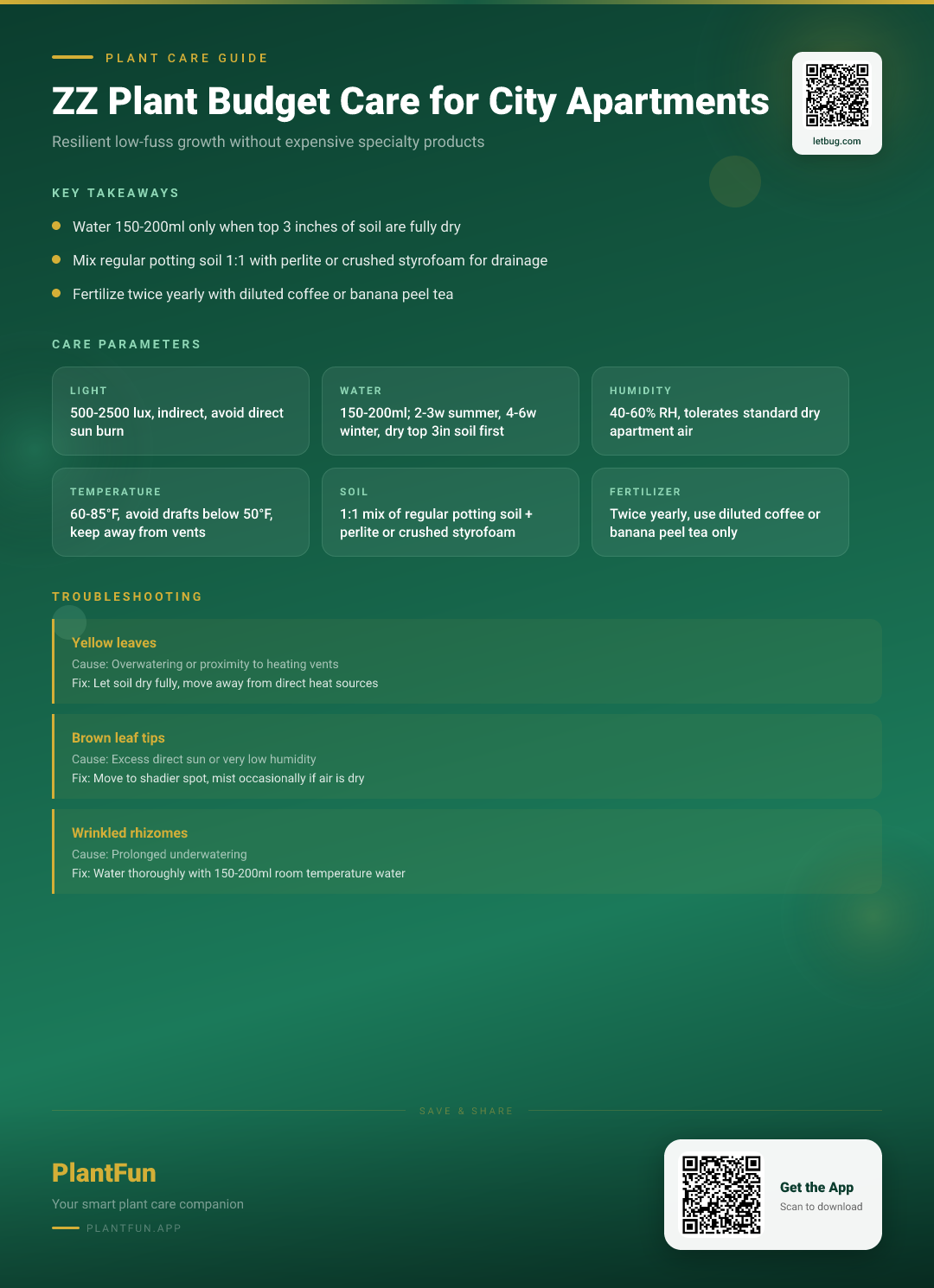
Key Takeaways
- Check soil moisture before watering — overwatering is the #1 killer of houseplants.
- Ensure your plant gets the right amount of light for its species.
- Be patient with recovery — most plants need 2–4 weeks to bounce back.
Quick Care Card
| Care Parameter | Exact Measurable Threshold |
|---|---|
| Light | 500-2500 lux, no direct midday sun (Miramirkhani, 2021) |
| Water | 150-200ml only when top 3 inches of soil are fully dry; 2-3 weeks summer, 4-6 weeks winter |
| Humidity | 20-50% (compatible with standard heated apartment air) |
| Temperature | 60-85°F (15-29°C) |
| Soil | 1:1 regular potting soil + crushed styrofoam/perlite for drainage |
| Fertilizer | Twice yearly (spring + mid-summer) with diluted leftover coffee or banana peel tea |
| Toxicity | Toxic to cats, dogs, and humans if ingested (ASPCA, 2026) |
Why ZZ Plants Are Ideal for Typical Apartments
ZZ plants (Zamioculcas zamiifolia) are the ultimate apartment houseplant for busy renters, and ZZ plant for beginners is one of our top recommended picks for first-time plant owners. Native to drought-prone East African grasslands, they store water in thick, bulbous underground rhizomes and have waxy leaves that reduce moisture loss, making them uniquely adapted to the three biggest stressors of city apartment life: low north-facing light, forced-air heating that drops humidity to 30% or lower, and irregular watering from 9-5 schedules (Šrámek, 1999).
Myth vs reality: Contrary to generic plant advice, you do not need high humidity, specialty grow lights, or expensive aroid mixes to grow a lush ZZ plant. They thrive in the exact conditions most renters already have, with zero extra spending required. If you’re looking for more low-fuss plant picks, check out our beginner’s guide to low-maintenance indoor plants for more rental-friendly options.
Zero-Budget Prep Checklist
You don’t need any fancy specialty plant products to follow this ZZ plant care checklist. Grab these common household items you already own to get started:
- Chopstick or wooden skewer (to test soil moisture instead of a $15 moisture meter)
- Crushed styrofoam packaging from your last online order (free alternative to perlite for drainage)
- Leftover black coffee or banana peels (free fertilizer, no commercial mixes needed)
- Any measuring cup from your kitchen (to measure exact water amounts)
- Free lux meter app on your smartphone (to test light levels instead of a $30 light meter)
- Old plastic pot with drainage holes (drill a hole with a nail and hammer if yours doesn’t have one, no need for decorative self-watering pots)
Step 1: Light Placement Guide
ZZ plant low light care is simpler than you think, with an exact measurable requirement of 500-2500 lux of indirect light (Miramirkhani, 2021). Follow these placement tips for your apartment’s window orientation:
- North-facing windows: Place 1-3 feet from the window for perfect consistent light, no direct sun risk
- East-facing windows: Place 3-5 feet from the window to avoid harsh 1-2 hour morning direct sun in summer, or filter light with a sheer curtain you already own
- West-facing windows: Place 5+ feet from the window to avoid midday/afternoon direct sun that causes leaf burn
Quick test: Hold your hand 1 foot above the plant’s leaves during the brightest part of the day. If you see a faint, soft shadow, light levels are ideal. If you see a sharp dark shadow, it’s too bright; if you see no shadow at all, it’s too dark.
Step 2: Exact Watering Routine
Wondering how often to water ZZ plant? Follow these measurable rules to avoid overwatering, the number one cause of ZZ plant death:
- Only water when the top 3 inches of soil are completely dry. Test by sticking your chopstick 3 inches deep into the soil — if it comes out completely clean with no soil stuck, it’s time to water.
- Pour exactly 150-200ml of tap water (let it sit 24 hours first if you have heavily chlorinated water, no filtered water needed) directly onto the soil, avoiding the leaves.
- For ZZ plant summer watering, this works out to every 2-3 weeks. For ZZ plant winter care, stretch watering to every 4-6 weeks, as forced-air heating dries air but not deep soil, and ZZs go semi-dormant in cold months.
For more tips on avoiding overwatering, check out our no-cost soil moisture test guide for houseplants.
Step 3: Soil & Potting Rules
No fancy aroid mixes are required for the perfect ZZ plant soil mix. Follow these zero-cost rules:
- Mix regular potting soil (even cheap dollar store bags work) 1:1 with crushed styrofoam packaging or leftover perlite to create fast drainage that prevents rhizome rot
- Make sure your pot has at least one ¼-inch drainage hole. If it doesn’t, drill one with a nail and hammer you already own instead of buying expensive drainage inserts
- Don’t repot more than once every 2-3 years: ZZs thrive when slightly root bound, and extra large pots hold excess moisture that causes rot
Step 4: Budget Fertilizing Routine
These ZZ plant fertilizer tips require zero commercial products, and only take 2 minutes twice a year:
- Only feed your ZZ plant twice per year: once in early spring (March) and once in mid-summer (July)
- Option 1: Dilute leftover black coffee 1:3 with water (1 part coffee, 3 parts water) and pour 100ml of the mix around the base of the plant
- Option 2: Soak 1-2 banana peels in 1 liter of tap water for 3 days, strain, and pour 150ml of the banana peel tea around the base of the plant
- Never fertilize in fall or winter, as ZZs are semi-dormant and will not absorb extra nutrients
Seasonal Care Calendar
All tasks take 10 minutes or less per month, calibrated for apartment heating and cooling cycles:
- Spring (March-May): March: Test light levels, adjust placement if needed, apply first fertilizer dose; April: Test soil moisture, water if needed, wipe leaves with a damp cloth to remove dust; May: Check for root bound growth (roots coming out of drainage holes) if it’s been 2+ years, repot if needed
- Summer (June-August): June: Check for sun scorch on leaves, move further from windows if needed; July: Water every 2-3 weeks as needed, apply second fertilizer dose; August: Wipe leaves if dust builds up
- Fall (September-November): September: Gradually stretch watering intervals to 3-4 weeks; October: Move away from drafty windows as temperatures drop; November: Move at least 3 feet away from heating vents before you turn your heat on for the season
- Winter (December-February): December: Water only once every 4-6 weeks, no fertilizer; January: Wipe leaves to remove dust from recirculating heating air; February: Check for new leaf growth to prepare for spring feeding
For more season-specific tips, read our complete guide to winter houseplant care for apartments.
5 Common Apartment ZZ Plant Mistakes to Avoid
These common ZZ plant mistakes are easy to fix with zero extra cost:
- Mistake: Watering once a week on a fixed schedule regardless of soil moisture What happens: Overwatering causes rhizome rot, leading to ZZ plant yellow leaves and eventual plant death Instead: Only water when the top 3 inches of soil are completely dry, following the 150-200ml measurement rule
- Mistake: Placing the plant within 1 foot of a forced-air heating or AC vent What happens: Fast-moving dry air pulls moisture from leaf tips, causing crispy brown edges Instead: Move the plant at least 3 feet away from vents, or place a shallow tray of tap water between the vent and plant to add small amounts of humidity for free
- Mistake: Repotting every year into a pot 3+ inches wider than the current one What happens: Excess unused soil holds stagnant moisture, leading to root rot and stunted growth Instead: Repot only once every 2-3 years, into a pot only 1-2 inches wider than the current container
- Mistake: Leaving the plant in direct midday sun for more than 1 hour What happens: Sun scorch causes pale brown bleached spots on leaves that never heal Instead: Move the plant further from west/south-facing windows, or filter light with a sheer curtain you already own
- Mistake: Fertilizing once a month with commercial liquid plant food What happens: Salt build up in soil burns leaf tips and stunts growth Instead: Use free diluted coffee or banana peel tea only twice a year in spring and summer
FAQ: Can I keep my ZZ plant in a dark apartment corner with no windows?
When asking can ZZ plants grow in dark apartments, the short answer is no, but they can survive for 2-3 months in light levels below 500 lux without dying. For long-term growth, if you have no windows, place a standard LED desk lamp you already own 1 foot above the plant, turned on for 8 hours per day, to hit the 500 lux minimum requirement. No specialty grow lights are needed.
FAQ: Why is my ZZ plant getting yellow leaves even when I barely water it?
First, check if you are watering tiny amounts too frequently: even small amounts of water will cause rot if the top 3 inches of soil never fully dry out. Second, check if your pot has no drainage hole, so water pools at the bottom of the pot even if the top feels dry. Third, check if the plant is near a cold draft from a window in winter. All fixes are zero cost: adjust your watering schedule, drill a drainage hole, or move the plant away from drafts.
FAQ: How do I make my ZZ plant grow faster for free?
Three zero-cost steps will boost growth significantly: First, move the plant to a spot that gets 1500-2500 lux of bright indirect light (test with a free phone lux app) — light is the biggest driver of ZZ growth. Second, wipe the leaves with a damp cloth once a month to remove dust that blocks light absorption. Third, apply the free banana peel or coffee fertilizer twice a year in spring and mid-summer to provide essential nutrients.
Troubleshooting Quick Reference
Yellow Leaves
Symptom: Soft, mushy yellow lower leaves, often with a faint rotten smell near the soil line.
Likely cause: Overwatering leading to rhizome rot (Šrámek, 1999).
Fix:
- Stop watering immediately, let the top 4 inches of soil dry completely for 2-3 weeks
- If rot is severe, remove the plant from the pot, cut off mushy rotten rhizomes with a clean kitchen knife, and repot in fresh dry 1:1 potting soil and crushed styrofoam mix
Brown Leaf Tips
Symptom: Crispy, dry brown edges on the ends of otherwise healthy green leaves.
Likely cause: Proximity to forced-air vents or salt build up from over fertilization.
Fix:
- Move the plant at least 3 feet away from heating or AC vents
- Flush soil with 3 cups of tap water once to leach out excess salt, letting all water drain completely out of the pot hole
Wrinkled Rhizomes & Shriveled Leaves
Symptom: Bulbous rhizomes at the base of the plant look wrinkled, leaves feel limp and shriveled.
Likely cause: Severe underwatering, where rhizomes have used up all their stored moisture.
Fix:
- Give 200ml of water immediately, wait 2 days, give another 150ml if the top 3 inches of soil are still dry
- Stick to the regular watering schedule going forward to avoid repeat dehydration
Stunted No New Growth
Symptom: No new leaf growth for 6+ months, even during spring and summer growing season.
Likely cause: Light levels below 500 lux, or a severely root bound plant with no room to grow.
Fix:
- Test light levels with a free phone lux app, move to a brighter spot that hits 1000-2500 lux if needed
- If it’s been 3+ years since repotting, check if roots are growing out of the drainage hole, repot into a 1-2 inch wider pot with free drainage soil mix
References
- ASPCA. (2026). Toxic and Non-Toxic Plants List — ASPCA. https://www.aspca.org/pet-care/animal-poison-control/toxic-and-non-toxic-plants. Accessed 2026-03-09.
- Šrámek, F. (1999). Vaughan, M.J.: The Complete Book on Cut Flower Care. Biologia plantarum. https://doi.org/10.1023/a:1001770114931. Accessed 2026-03-09.
- Miramirkhani, F. (2021). A Path Loss Model for Link Budget Analysis of Indoor Visible Light Communications. ELECTRICA. https://doi.org/10.5152/electrica.2021.20072. Accessed 2026-03-09.
Optional Helper: Plantfun.App
Plantfun.App identifies your plants by photo, diagnoses pests and diseases with clear fixes, and creates personalised watering and light schedules that adapt to your home conditions — a handy companion for putting this guide into daily practice.
Found an error or have suggestions? We'd love your feedback.
Need help identifying this problem?
Get instant identification, personalized care schedules, and effective pest treatment plans directly on your phone.
Sponsored • We may earn a commission from app downloads
Related Guides
ZZ Plant Care Checklist for Urban Apartments: 7 Tips for Resilient, Lush Growth
Stop guessing at ZZ Plant care. Grab our apartment-specific checklist with exact light, water, and soil parameters to avoid yellow leaves and grow lush, resilient fronds year-round.
Care GuideZZ Plant Care Checklist for North-Facing Apartments: Get Lush Resilient Growth Year-Round
Stop letting your ZZ plant turn yellow or grow leggy in your dim north-facing apartment. Get exact light levels, water amounts, and a seasonal calendar for lush, resilient growth all year.
Care GuideThe Complete ZZ Plant Care Checklist for Resilient Growth in Typical Urban Apartments
Grab our no-fuss ZZ Plant care checklist tailored for typical apartments. Get exact light, water, and soil thresholds to boost growth, avoid yellow leaves, and keep your plant thriving for years.
Pest ControlAnts on Plants: What They Mean and What to Do
Ants usually aren't eating your plant. They are farming other pests.