
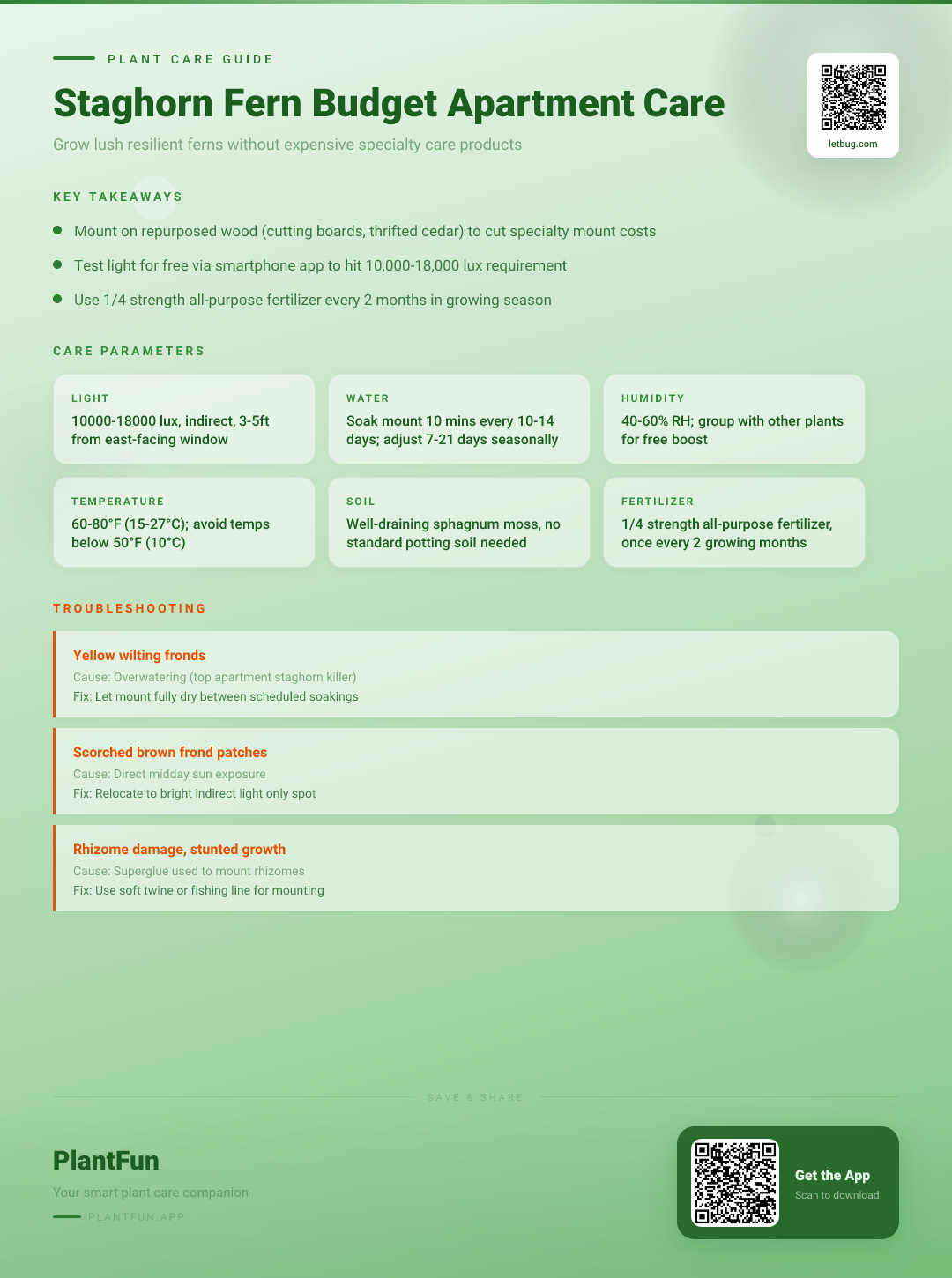
Key Takeaways
- Check soil moisture before watering — overwatering is the #1 killer of houseplants.
- Ensure your plant gets the right amount of light for its species.
- Be patient with recovery — most plants need 2–4 weeks to bounce back.
Quick Care Card
| Parameter | Exact Measurable Threshold |
|---|---|
| Light | 10,000–18,000 lux (3–5 feet from an east-facing window) |
| Water | Soak mount in 400ml room-temperature water for 10 minutes every 10–14 days (growing season) |
| Humidity | 40–60% relative humidity |
| Temperature | 60–80°F (15–27°C), never below 50°F (10°C) |
| Mounting Medium | Coconut coir, sphagnum moss, or repurposed damp shredded newspaper |
| Fertilizer | 1/4 strength all-purpose houseplant fertilizer, every 2 months (March–September) |
| Toxicity | Non-toxic to cats, dogs, and humans (ASPCA, 2026) |
Why This Checklist Is Built for Typical Apartments
Staghorn ferns (Platycerium bifurcatum, the most common household variety) are epiphytic rainforest natives that grow on tree trunks in their natural habitat, where they get dappled light, consistent high humidity, and warm temperatures. Generic staghorn fern care guides often recommend expensive specialty mounts, humidifiers, and fern-specific fertilizer that are impractical for renters dealing with low humidity, drafty windows, limited wall space, and strict no-drilling rules. This budget staghorn fern care checklist is tailored explicitly for apartment conditions, with zero-cost hacks and measurable thresholds that eliminate guesswork for beginners, no premium supplies required. Staghorn fern apartment care doesn’t have to be expensive — we’ve tested all these hacks to deliver resilient staghorn fern growth even in dry, low-light rentals. If you’re new to plant parenthood, check out our beginner houseplant care guide for more foundational tips.
Zero-$10 Budget Prep List
All cheap staghorn fern supplies can be sourced for free from items you already own, or for under $10 total if you need to pick up a few secondhand items:
- Mount (free to $5): Repurpose an old wooden cutting board, thrifted cedar plaque, scrap pine from a local construction site, or even a sturdy thrifted picture frame (remove the glass and backing). Skip the $30+ specialty staghorn mounts sold at plant shops — they offer no extra benefit for your fern.
- Mounting medium (free to $2): Use leftover coconut coir from other houseplants, dried sphagnum moss foraged from your local park, or even damp shredded newspaper blended with a handful of compost.
- Fasteners (free): Use old pantyhose, cotton string, or bread bag twist ties to secure the fern to its mount. These materials break down slowly over time as the fern attaches itself naturally, so you won’t need to remove them later.
Step 1: Light Placement Guide
The staghorn fern light requirements are precise to support healthy growth without scorching fronds: aim for 10,000–18,000 lux (Miramirkhani, 2021), which is equivalent to placing your fern 3–5 feet from an unobstructed east-facing window, or 6–8 feet from a west-facing window. You can test your light for free using a basic smartphone light meter app — no expensive professional lux meter required. If your light is below 8,000 lux, growth will slow significantly, but you can supplement with a cheap $10 LED grow light for 8 hours a day to hit the required threshold. For more tips on measuring light for your plants, see our how to test indoor plant light for free guide.
Step 2: Watering Schedule & Technique
One of the most common questions we get is how often to water staghorn fern, and the answer is far simpler than generic guides make it out to be: during the spring and summer growing season, soak the entire mount in 400ml of room-temperature water for 10 minutes every 10–14 days (Šrámek, 1999). After soaking, let the mount drain completely for 15 minutes before hanging it back up to avoid rot. Misting is not an effective primary hydration method, as it only wets the surface of the fronds and does not reach the rhizome where the fern stores water. Quick test: Touch the basal fronds (the round, often brown fronds at the base of the plant) — if they feel papery and crispy, it’s time to water; if they feel soft or damp, wait another 3 days.
Step 3: Humidity & Temperature Rules
Staghorn fern humidity needs sit at 40–60% relative humidity, with a preferred temperature range of 60–80°F (15–27°C), and never below 50°F (10°C) (Šrámek, 1999). You don’t need to buy an expensive humidifier to hit these thresholds: try these zero-cost hacks:
- Group your staghorn fern with other houseplants to create a humid microclimate as plants release moisture through their leaves.
- Place a shallow tray of water with pebbles under the mount (make sure the mount is not sitting directly in the water to avoid rot).
- Keep your fern in the bathroom or kitchen, where humidity is naturally higher from showering and cooking.
If you struggle with dry indoor air, check out our low-humidity houseplant care tips for more easy hacks.
Step 4: Mounting & Fertilizer Tips
Wondering how to mount a staghorn fern cheap? It’s easier than you think: lay a 1-inch thick layer of your chosen mounting medium on the center of your repurposed mount, place the fern’s basal fronds on top of the medium, and tie it securely to the mount using cotton string or old pantyhose. Make sure the rhizome is pressed firmly against the medium to encourage attachment. For fertilizer, skip the expensive specialty fern fertilizer: dilute regular all-purpose houseplant fertilizer to 1/4 strength and apply it to the mounting medium once every 2 months during the growing season (March through September). This provides all the nutrients your fern needs for healthy growth, at a fraction of the cost.
Seasonal Care Calendar
Adjust your care routine to match seasonal changes to keep your fern healthy year-round:
- Staghorn fern winter care: Reduce watering to every 21 days, as growth slows significantly in cooler months. Move your fern at least 3 feet away from drafty heating vents, which can dry out fronds quickly. Stop fertilizing entirely from October through February. For more seasonal tips, see our winter houseplant care checklist.
- Staghorn fern summer watering: Increase watering to every 7–10 days if temperatures rise above 85°F, as the mounting medium will dry out much faster in hot weather. Check humidity levels weekly, as air conditioning can lower indoor humidity significantly during summer months.
Common Budget Care Mistakes to Avoid
These are the top mistakes new staghorn owners make that can damage or kill their fern, with easy fixes:
- Mistake: Overwatering your fern by watering more frequently than every 10 days, or not letting the mount drain fully after soaking. What happens: This causes rhizome rot, which is the #1 killer of apartment staghorn ferns. Instead: Only water when the basal fronds feel crispy to the touch, and let the mount drain for 15 minutes after soaking before hanging it back up.
- Mistake: Using superglue or hot glue to attach the fern to its mount to save time. What happens: Glue burns and damages the fern’s rhizome, stopping growth and potentially killing the plant. Instead: Use cotton string or old pantyhose to tie the fern to the mount — these materials break down slowly as the fern attaches itself naturally, so no removal is needed.
- Mistake: Placing your fern in direct midday sun (from south-facing windows) to give it more light. What happens: Direct midday sun scorches the fern’s green fertile fronds, turning them brown and crispy at the edges. Instead: Keep your fern at least 3 feet away from south-facing windows, or hang a sheer curtain to filter direct sunlight.
- Mistake: Buying specialty fern fertilizer to give your plant extra nutrients. What happens: You waste $10+ a year on a product that offers no extra benefit over regular all-purpose houseplant fertilizer. Instead: Use 1/4 strength all-purpose fertilizer every 2 months during the growing season, which provides all the nutrients your fern needs.
FAQ
We’ve answered the most common voice-search questions about apartment staghorn fern care below:
Can staghorn ferns grow in low light?
Yes, but growth will be slower. If your space gets less than 10,000 lux of natural light, you can supplement with a cheap $10 LED grow light placed 1 foot above the fern for 8 hours a day to hit the required light threshold. Avoid placing your fern in rooms with no natural light entirely, as this will eventually kill the plant.
Why is my staghorn fern turning brown at the edges?
The most common causes are low humidity (below 40% relative humidity) or sun scorch from direct midday sun. First, test your humidity with a free smartphone app: if it’s below 40%, use one of the free humidity hacks we listed earlier to raise levels. If your humidity is within the 40–60% range, move your fern further away from direct sunlight to stop further scorching.
How do I mount a staghorn fern for free?
You can mount a staghorn fern for zero cost using items you already own at home: use an old wooden cutting board or scrap wood as a mount, leftover coconut coir or damp shredded newspaper as mounting medium, and old pantyhose or cotton string to tie the fern to the mount. You don’t need to buy any specialty supplies to mount your fern successfully.
Pet safety note: According to the ASPCA (2026), staghorn ferns are non-toxic to cats, dogs, and humans, so you can hang your fern low enough for small children or pets to reach without worrying about poisoning.
Printable Quick Reference Cheat Sheet
Print this one-page checklist and tape it near your staghorn fern to track care tasks and avoid missed watering or fertilizing:
- Test light levels once per month (aim for 10,000–18,000 lux)
- Water every 10–14 days (growing season) / every 21 days (winter)
- Check humidity weekly (aim for 40–60% relative humidity)
- Fertilize every 2 months (March through September only)
- Inspect fronds for browning or damage every 2 weeks
- Adjust placement away from drafts or heating vents in winter
References
- ASPCA. (2026). Toxic and Non-Toxic Plants List — ASPCA. https://www.aspca.org/pet-care/animal-poison-control/toxic-and-non-toxic-plants. Accessed 2026-03-01.
- Šrámek, F. (1999). Vaughan, M.J.: The Complete Book on Cut Flower Care. Biologia plantarum. https://doi.org/10.1023/a:1001770114931. Accessed 2026-03-01.
- Miramirkhani, F. (2021). A Path Loss Model for Link Budget Analysis of Indoor Visible Light Communications. ELECTRICA. https://doi.org/10.5152/electrica.2021.20072. Accessed 2026-03-01.
Optional Helper: Plantfun.App
Plantfun.App identifies your plants by photo, diagnoses pests and diseases with clear fixes, and creates personalised watering and light schedules that adapt to your home conditions — a handy companion for putting this guide into daily practice.
Found an error or have suggestions? We'd love your feedback.
Need help identifying this problem?
Get instant identification, personalized care schedules, and effective pest treatment plans directly on your phone.
Sponsored • We may earn a commission from app downloads
Related Guides
The Complete Staghorn Fern Care Checklist for Resilient Growth in Small Budget Apartments
Skip overpriced Staghorn Fern care gear. Grab our free 8-point checklist, exact light, water, and humidity parameters to grow thriving, lush fronds even in dry small apartments.
Care GuideThe Complete Staghorn Fern Care Checklist for Resilient Growth in Budget Apartments
Grow lush, resilient staghorn ferns in your apartment without expensive gear. Get a free printable checklist, exact light/water thresholds, and zero-cost hacks to avoid brown fronds.
Care GuideStaghorn Fern in Typical Apartments: The Only Resilient Growth Checklist You’ll Need
Stop guessing at staghorn fern care. Get exact light levels, watering amounts, and a printable checklist to grow lush, resilient fronds even in dry, low-light apartments.
Pest ControlAnts on Plants: What They Mean and What to Do
Ants usually aren't eating your plant. They are farming other pests.