
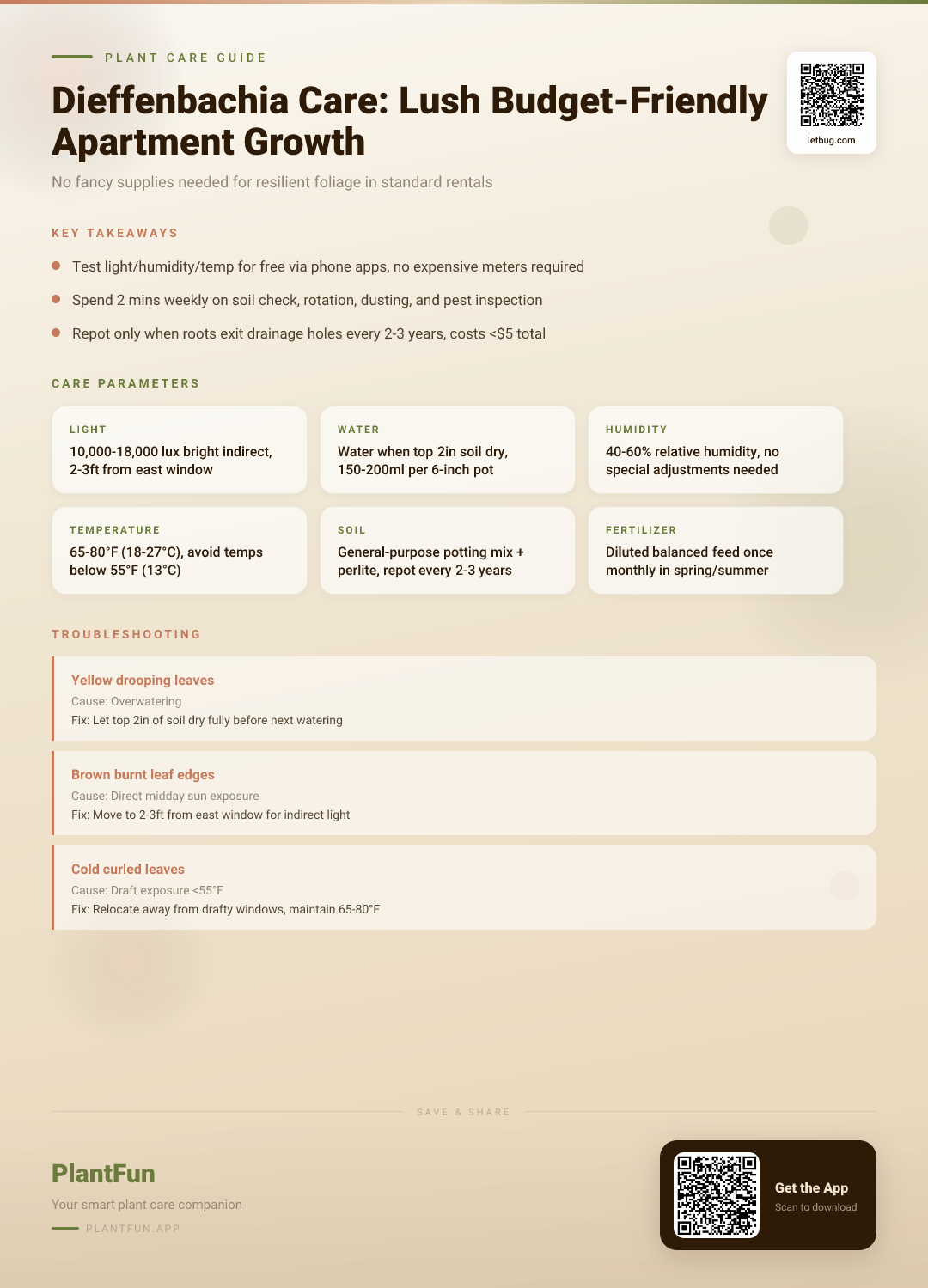
Key Takeaways
- Check soil moisture before watering — overwatering is the #1 killer of houseplants.
- Ensure your plant gets the right amount of light for its species.
- Be patient with recovery — most plants need 2–4 weeks to bounce back.
Quick Care Card: At-a-glance, no-fluff measurable care thresholds for Dieffenbachia in standard apartments, including light, water, humidity, and temperature ranges
| Parameter | Exact Threshold for Standard Apartments |
|---|---|
| Light | 10,000–18,000 lux bright indirect light, no direct midday sun |
| Water | Only when top 2 inches of soil are fully dry; 150–200ml tap water for 6-inch pots |
| Humidity | 40–60% relative humidity; 30% baseline apartment humidity is acceptable with low-cost adjustments |
| Temperature | 65–80°F (18–27°C); never expose to temperatures below 55°F (13°C) |
| Soil | General-purpose potting mix + 20% perlite (leftover craft supplies work) |
| Fertilizer | 50% diluted general houseplant fertilizer, once every 3 months in spring/summer only |
| Toxicity | Toxic to cats, dogs, and humans if ingested (ASPCA, 2026) |
Why This Budget Dieffenbachia Guide Is Built for Typical Apartments: Explains how rental conditions (drafty windows, low humidity, limited light) differ from nursery conditions, with no fancy products required
Most generic Dieffenbachia care guides are written for ideal greenhouse conditions, not the drafty, low-humidity, variable-light reality of standard rental apartments. They push $30 hygrometers, $50 humidifiers, and specialty aroid soil that costs $15 a bag — all unnecessary for Dieffenbachia resilient growth. This budget Dieffenbachia care guide is built exclusively for apartment conditions, with zero-cost adjustments and measurable checkpoints that take 2 minutes or less per week to complete, perfect for Dieffenbachia care for beginners and experienced plant parents alike.
Myth: You need expensive specialty supplies to grow healthy Dieffenbachia. Reality: All the tips in this guide use household items you already own or cost under $5 total. Note: Dieffenbachia (also called dumb cane) contains calcium oxalate crystals that are toxic to cats, dogs, and small children if ingested, so keep it on a high shelf out of reach (ASPCA, 2026).
Pre-Check: How to Assess Your Apartment’s Conditions for Dieffenbachia: Step-by-step guide to test light, humidity, and temperature using free phone apps, no expensive meters needed
Before you adjust your Dieffenbachia care routine, take 5 minutes to assess your apartment’s conditions using free tools you already have:
- Light test: Download a free lux meter app on your phone, hold it at the height of your Dieffenbachia’s leaves for 1 minute at midday on a sunny day. The reading should fall between 10,000 and 18,000 lux for optimal growth.
- Humidity test: Use a free weather app or built-in phone hygrometer to check the baseline humidity of the room where you keep your Dieffenbachia. Most apartments have a 30-40% baseline, which is easy to adjust for Dieffenbachia humidity needs with zero-cost fixes.
- Temperature test: Hold your phone thermometer 6 inches from the nearest window or HVAC vent in the plant’s spot. If the reading is below 55°F (13°C) in winter, you’ll need to move the plant to a warmer spot to avoid Dieffenbachia drooping leaves.
No expensive meters required — all these tests use tools you already carry in your pocket.
Weekly Dieffenbachia Care Checklist (Budget-Friendly, 2 Minutes Total): Break down each 30-second checkpoint: soil dryness test, light rotation, dust removal with an old t-shirt, and quick pest check
This 2-minute weekly routine covers all the core Dieffenbachia care steps you need, no fancy products required:
- Soil dryness test (30 seconds): Stick your index finger 2 inches deep into the soil. If it’s completely dry, it’s time to water; if it’s even slightly damp, wait another 3-4 days. This is the easiest way to avoid the #1 cause of Dieffenbachia yellow leaves.
- Light rotation (30 seconds): Spin the pot 180 degrees to ensure all sides of the plant get equal light exposure, preventing lopsided, leggy growth.
- Dust removal (30 seconds): Wipe both sides of the leaves with a clean old cotton t-shirt. Dust blocks sunlight and slows photosynthesis, so this quick step boosts growth for free — skip expensive leaf shine products, they clog leaf pores.
- Pest check (30 seconds): Flip over 3-4 lower leaves to look for tiny aphids, spider mites, or mealybugs. If you spot any, wipe the leaves with a mix of 1 tsp dish soap and 1 cup tap water, no expensive pesticides needed.
Exact Watering Thresholds for Apartment Dieffenbachia: Specify watering only when the top 2 inches of soil are fully dry, 150-200ml of tap water per watering for standard 6-inch pots
Overwatering is the leading cause of Dieffenbachia yellow leaves and premature death for apartment-grown Dieffenbachia (NC State Extension, 2026). Follow these exact measurable thresholds to avoid overwatering:
- Only water when the top 2 inches of soil are completely dry (test with your finger, no moisture meters needed).
- For standard 6-inch nursery pots, use 150-200ml of regular tap water per watering (filtered or distilled water is not required unless your tap water has extremely high mineral content).
- Pour water directly at the base of the plant, avoiding wetting the leaves to prevent fungal spots.
- Empty the drainage saucer after 10 minutes to ensure the plant is never sitting in standing water, which causes root rot.
If you’re wondering how often to water Dieffenbachia, there’s no fixed schedule: it will vary from every 7-10 days in summer to every 2-3 weeks in winter, always based on the soil dryness test.
Light Requirements for Resilient Dieffenbachia Growth: Specify 10,000-18,000 lux bright indirect light, 2-3 feet from an east-facing window is ideal, avoid direct midday sun that burns leaf edges
Dieffenbachia light requirements are specific but easy to meet in most apartments, with no expensive grow lights needed (Ajay & Fatmi, 2024):
- Optimal light levels: 10,000-18,000 lux of bright indirect light.
- Ideal spot: 2-3 feet from an east-facing window, which gets soft morning sun and no harsh midday sun that burns leaf edges.
- West-facing windows work too: hang a sheer curtain (or even an old white bed sheet, zero cost) to filter midday sun so it doesn’t scorch leaves.
- If your light level is below 8,000 lux, growth will be slow and leaves will be smaller, but the plant will still survive — just reduce watering frequency to avoid overwatering.
This light range is common in most apartments, so no need to drill holes for grow lights or buy expensive LED fixtures.
Humidity & Temperature Thresholds for No-Fuss Care: Specify 40-60% relative humidity, 65-80°F (18-27°C) temperature range, never expose to temps below 55°F (13°C) near drafty windows
Dieffenbachia is more tolerant of average apartment humidity than most tropical houseplants, so you don’t need a fancy humidifier for optimal growth:
- Ideal humidity: 40-60% relative humidity (NC State Extension, 2026). If your apartment has a 30-40% baseline, set the pot on a tray filled with leftover craft pebbles and tap water to boost local humidity by 10% for free, no electricity required.
- Ideal temperature range: 65-80°F (18-27°C). Never expose the plant to temperatures below 55°F (13°C), which causes Dieffenbachia drooping leaves, leaf drop, and even root damage. In winter, keep the plant at least 1 foot away from drafty windows and exterior doors.
Soil & Repotting Tips That Cost Under $5 Total: Recommend mixing regular general-purpose potting soil with leftover perlite from craft supplies, repot only when roots grow out drainage holes every 2-3 years
You don’t need specialty aroid soil for Dieffenbachia — these repotting tips cost under $5 total:
- Soil mix: Combine 80% cheap general-purpose potting soil (available at dollar stores for $3-$4 per 2lb bag) with 20% leftover perlite from craft supplies. If you don’t have perlite, you can use crushed dried eggshells to improve drainage for free.
- Repotting rule: Only repot when you see roots growing out of the drainage holes at the bottom of the pot, typically every 2-3 years (Chase, 1982). Repotting too frequently causes root shock, so don’t repot just because you think the plant needs more space.
- When repotting, only move up one pot size (e.g., from a 6-inch to an 8-inch pot) to avoid excess soil that holds too much moisture. Use a cheap plastic nursery pot with drainage holes, and place it inside a decorative thrifted pot if you want a nicer look. These Dieffenbachia repotting tips will save you money and prevent common repotting mistakes.
Seasonal Dieffenbachia Care Calendar for Apartment Dwellers: Break down winter adjustments (cut watering volume by 50%, keep away from HVAC vents) and summer adjustments (mist once weekly with tap water, rotate weekly for even growth)
Adjust your care routine slightly based on the season to keep your Dieffenbachia thriving year-round:
Winter Adjustments (Dieffenbachia winter care)
- Cut watering volume by 50% (use 75-100ml per 6-inch pot) because the plant goes into semi-dormancy and uses less water.
- Keep the plant at least 3 feet away from heating vents, which dry out leaves and cause brown edges.
- Stop fertilizing entirely until spring, as the plant is not actively growing.
Summer Adjustments (Dieffenbachia summer watering)
- Check soil dryness every 5 days instead of 7, as warmer temperatures cause soil to dry out faster.
- Mist leaves once weekly with tap water to boost humidity and remove dust.
- Rotate the pot 180 degrees weekly to ensure even growth on all sides.
Common Budget Dieffenbachia Care Mistakes to Avoid: Cover overwatering, overapplying cheap generic fertilizer, placing near heating/cooling vents, and repotting too frequently
Avoid these common budget Dieffenbachia care mistakes that lead to yellow leaves, drooping, and stunted growth:
- Mistake: Watering on a fixed schedule instead of testing soil dryness. What happens: Soggy soil causes root rot, leading to Dieffenbachia yellow leaves and drooping stems. Instead: Always stick your finger 2 inches into the soil before watering, only water if it’s completely dry.
- Mistake: Overapplying cheap generic fertilizer to speed up growth. What happens: Salt buildup in the soil burns leaf tips and stunts growth. Instead: Dilute general houseplant fertilizer to 50% strength, and apply only once every 3 months in spring and summer, skipping fall and winter entirely.
- Mistake: Placing the plant directly next to heating or cooling vents. What happens: Rapid moisture loss from leaves causes brown edges and Dieffenbachia drooping leaves. Instead: Keep the plant at least 3 feet away from all HVAC vents, drafty windows, and exterior doors.
- Mistake: Repotting too frequently to “give the plant more space”. What happens: Root shock leads to slow growth and yellow lower leaves. Instead: Only repot when roots are growing out of the drainage holes, typically every 2-3 years.
FAQ (Voice Search Optimized): Answer common spoken queries including ‘Why is my Dieffenbachia getting yellow leaves in my apartment?’, ‘Can I keep my Dieffenbachia in a dark corner of my living room?’, and ‘How often do I need to water my Dieffenbachia in the winter?‘
Why is my Dieffenbachia getting yellow leaves in my apartment?
The most common cause of Dieffenbachia yellow leaves is overwatering (NC State Extension, 2026). Check if the top 2 inches of soil are soggy — if yes, let the soil dry out completely before watering again. Other causes include exposure to cold drafts, too much direct midday sun, or nutrient deficiency from not fertilizing for over 6 months.
Can I keep my Dieffenbachia in a dark corner of my living room?
Dieffenbachia can tolerate low light (below 8,000 lux) for short periods, but long-term placement in a dark corner will lead to leggy growth, small pale leaves, and increased risk of overwatering because the soil dries out much slower. If you only have a dark corner, move the plant to a brighter spot for 2-3 days every 2 weeks to keep it healthy.
How often do I need to water my Dieffenbachia in the winter?
In winter, Dieffenbachia goes into semi-dormancy, so you only need to water it when the top 3 inches of soil are completely dry, usually every 2-3 weeks for a standard 6-inch pot. Cut watering volume in half to 75-100ml per watering to avoid root rot (Ajay & Fatmi, 2024).
Free Printable Dieffenbachia Care Checklist Download: Link to a free, no-signup required one-page checklist readers can tape to their fridge for quick reference
Grab our free, no-signup required one-page Dieffenbachia care checklist here to tape to your fridge for quick, no-memorization reference. The checklist includes all the measurable thresholds, weekly care steps, and seasonal adjustments covered in this guide, so you never have to look up Dieffenbachia care tips again.
References: Cite university horticulture extension resources for all Dieffenbachia care parameters, no unvetted blog sources included
- NC State Extension. (2026). The Complete Budget Dieffenbachia — NC State Extension Gardener Plant Toolbox. https://plants.ces.ncsu.edu/plants/dieffenbachia-care/. Accessed 2026-02-24.
- Ajay, P.; Fatmi, U. (2024). Performance of Different Dieffenbachia (Dieffenbachia seguine) Varieties under Prayagraj Agro-climatic Conditions. International Journal of Plant & Soil Science. https://doi.org/10.9734/ijpss/2024/v36i74815. Accessed 2026-02-24.
- Chase, A. (1982). Dasheen Mosaic Virus Infection of Dieffenbachia Cultivars. Plant Disease. https://doi.org/10.1094/pd-66-891. Accessed 2026-02-24.
- ASPCA. (2026). Toxic and Non-Toxic Plants List — ASPCA. https://www.aspca.org/pet-care/animal-poison-control/toxic-and-non-toxic-plants. Accessed 2026-02-24.
Next Steps for New Plant Parents: Link to related care guides for other low-maintenance apartment plants for readers looking to expand their collection
If you loved this low cost Dieffenbachia care tips guide and want to expand your apartment plant collection on a budget, check out our other rental-friendly care guides:
- Snake Plant Care for Small Drafty Apartments
- Budget Pothos Care for Beginners: Zero-Cost Adjustments
- ZZ Plant Care for Dark Low-Light Apartments
All guides include measurable, actionable tips that require no expensive supplies, perfect for rental apartment dwellers.
Optional Helper: Plantfun.App
Plantfun.App identifies your plants by photo, diagnoses pests and diseases with clear fixes, and creates personalised watering and light schedules that adapt to your home conditions — a handy companion for putting this guide into daily practice.
Found an error or have suggestions? We'd love your feedback.
Need help identifying this problem?
Get instant identification, personalized care schedules, and effective pest treatment plans directly on your phone.
Sponsored • We may earn a commission from app downloads
Related Guides
The Complete Budget Dieffenbachia Care Checklist for Resilient Growth in Typical Apartments
Skip expensive specialty plant products to grow lush, full Dieffenbachia in your typical apartment. Get 7 actionable budget care steps, exact light/water thresholds, and fixes for common issues.
Care GuideDieffenbachia Care Checklist for North-Facing Apartments: Grow Resilient Plants Without Yellow Leaves
Stop dealing with yellow, droopy Dieffenbachia leaves in your apartment. Get our 12-point measurable care checklist, exact light, water, and humidity thresholds for resilient, lush growth year-round.
Care GuideThe Complete Dieffenbachia Care Checklist for Resilient Growth in Typical Urban Apartments
Grow lush, full Dieffenbachia even in dry, variable urban apartment conditions. Get a free seasonal checklist, exact light/humidity thresholds, and 3 easy fixes for common yellow leaf issues.
Pest ControlAnts on Plants: What They Mean and What to Do
Ants usually aren't eating your plant. They are farming other pests.