
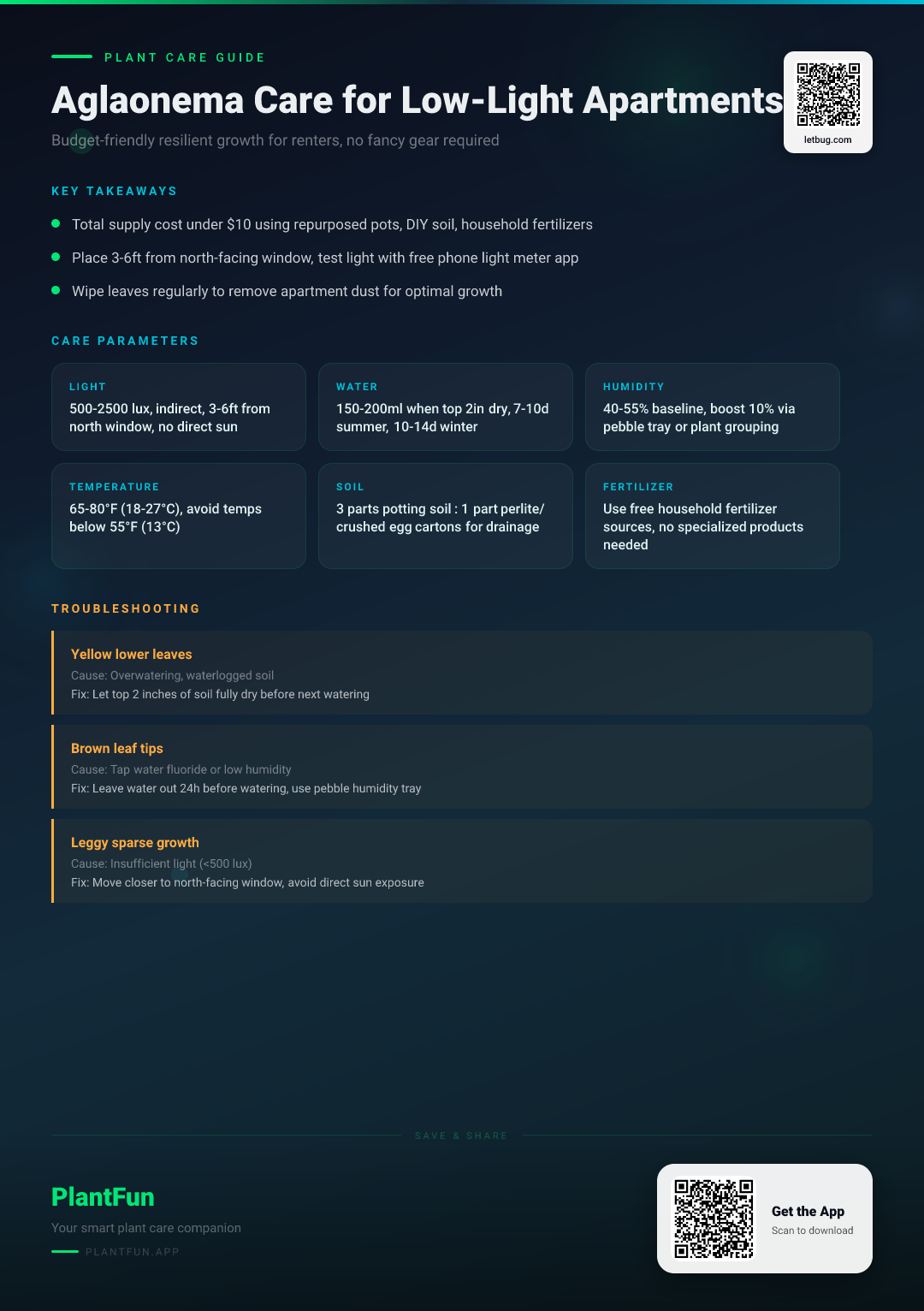
Key Takeaways
- Check soil moisture before watering — overwatering is the #1 killer of houseplants.
- Ensure your plant gets the right amount of light for its species.
- Be patient with recovery — most plants need 2–4 weeks to bounce back.
If you’re a renter in a low-light apartment tired of wasting money on fussy plants that die within months, Aglaonema (also called Chinese evergreen) is your new favorite low-effort houseplant. This budget Aglaonema care guide is tailored exclusively for standard 500-1500 sq ft apartments, uses zero-cost or under-$10 supplies, and skips the fancy grow lights and humidifiers most generic guides push. Grab our free printable Aglaonema care checklist to keep on your fridge for fast reference.
Quick Care Card
| Parameter | Measurable Threshold | Quick Renter Tip |
|---|---|---|
| Light | 500-2500 lux, no direct sun | Place 3-6 feet from a north-facing window |
| Water | 150-200 ml when top 2 inches of soil are dry | 7-10 days summer, 10-14 days winter |
| Humidity | 40-55% | Use shower steam or pebble tray for free boosts |
| Temperature | 65-80°F (18-27°C), no lower than 55°F (13°C) | Keep away from drafty AC/heating vents |
| Soil | 3:1 potting soil to drainage amendment (perlite/egg cartons) | No need for specialized houseplant soil |
| Fertilizer | Twice yearly (spring + fall) | Use free used coffee grounds, no commercial products needed |
| Toxicity | Toxic to cats, dogs, and humans if ingested | Keep out of reach of small kids and pets (ASPCA, 2026) |
Why This Guide Works for Your Low-Light Apartment
Aglaonema is native to the dim understory of Southeast Asian rainforests, so it’s perfectly adapted to the low light, 40-45% baseline humidity, and consistent temperatures of most standard apartments (S & Fatmi, 2024). Unlike fussy plants like fiddle-leaf figs that require custom light and humidity setups, Aglaonema thrives in the exact conditions most renters already have, no modifications required.
Myth: You need bright indirect light or grow lights for Aglaonema to grow. Reality: NC State Extension (2026) confirms Aglaonema tolerates light levels as low as 500 lux, which is typical for rooms with north-facing windows or even windowless rooms with standard overhead lighting. This guide is built exclusively for renters who can’t install permanent gear or modify their apartment layout, with all cheap Aglaonema care tips using items you likely already own.
Budget Aglaonema Supply List (All <$10 Total)
You won’t need any specialized gear for Aglaonema care for beginners. All supplies cost under $10 total, and most can be repurposed from household items:
- Repurposed drainage pot: Old plastic food container with 2-3 ¼-inch holes poked in the bottom (free)
- DIY soil mix: 3 parts regular all-purpose potting soil ($5 for a 2-quart bag, free if you already have leftover soil) + 1 part crushed dry egg cartons or perlite ($3 for a small bag of perlite, free if using egg cartons)
- Fertilizer: Used, cooled coffee grounds or banana peels (free)
- Humidity boost tray: Old takeout container + pebbles collected from outside or purchased at a dollar store ($2, if you buy pebbles)
Step 1: Light Placement for Apartments
Aglaonema light levels for apartments fall between 500 and 2500 lux, which is equivalent to placement 3-6 feet from a north-facing window, with no direct sun exposure (Ghate, 2016). Direct sun will scorch Aglaonema leaves, so avoid placing it directly on window sills.
Quick test hack: Download any free light meter app on your phone, hold it at the height of your Aglaonema’s leaves for 1 minute, and check the reading. If it falls between 500 and 2500 lux, the spot is perfect. This is ideal for Aglaonema low light apartment care, no expensive light meters required.
Step 2: Exact Watering Schedule for Apartment Humidity
Wondering how often to water Aglaonema? The exact schedule depends on your apartment’s temperature and humidity, but follow these measurable rules:
- Water only when the top 2 inches of soil are completely dry: Stick your index finger 2 inches into the soil, if no moisture sticks to your finger, it’s time to water
- Use 150-200 ml of water per watering (about ⅔ of a standard cup) to avoid overwatering
- Summer Aglaonema summer watering schedule: Every 7-10 days
- Winter Aglaonema winter care schedule: Every 10-14 days, when indoor heating lowers humidity
- Avoid fluoride damage from tap water by leaving water in an open jug for 24 hours before watering, so chlorine and fluoride evaporate for free
Overwatering is the #1 cause of Aglaonema death, so err on the side of underwatering (NC State Extension, 2026).
Step 3: Soil & Repotting on a Budget
For a low-cost, well-draining Aglaonema soil mix DIY, use a 3:1 ratio of regular all-purpose potting soil to drainage amendment. Drainage amendments can be perlite, or free crushed dry egg cartons, which work just as well to prevent root rot (S & Fatmi, 2024).
You only need to repot your Aglaonema once every 2-3 years, when you see roots growing out of the drainage holes in the bottom of the pot. Repotting yearly is unnecessary and wastes money, as Aglaonema grows slowly and prefers to be slightly root-bound.
Step 4: Temperature & Humidity Hacks for Renters
Aglaonema humidity requirements are low: The standard 40-45% indoor humidity of most apartments is perfectly sufficient for healthy growth (NC State Extension, 2026). If you notice brown leaf tips, you can boost humidity by 10% for free using one of these hacks:
- Place the pot on a tray of pebbles and water, making sure the bottom of the pot is not sitting directly in the water
- Group your Aglaonema with other houseplants, which release moisture into the air as they transpire
- Move your Aglaonema into the bathroom while you shower to absorb steam
Keep temperatures between 65-80°F (18-27°C), and never let the temperature drop below 55°F (13°C), which can cause permanent leaf damage.
Seasonal Care Calendar for Apartments
Adjust your care routine slightly by season to keep your Aglaonema lush year-round:
- Winter (December-February): Water every 10-14 days, skip fertilizing, wipe leaves once a month with a damp cloth to remove apartment dust buildup, keep at least 3 feet away from heating vents
- Spring (March-May): Gradually increase watering to every 7-10 days, sprinkle 1 teaspoon of used coffee grounds on the top of the soil once in April for free fertilizer, wipe leaves every 2 weeks
- Summer (June-August): Stick to the 7-10 day watering schedule, keep at least 3 feet away from AC vents, wipe leaves every 2 weeks to remove dust that blocks light absorption
- Fall (September-November): Reduce watering back to every 10-14 days, sprinkle 1 teaspoon of used coffee grounds on the top of the soil once in October, move away from drafty windows as outdoor temperatures drop
Common Budget Care Mistakes to Avoid
- Mistake: Overwatering your Aglaonema on a fixed schedule without checking soil moisture What happens: Root rot, the #1 Aglaonema killer (NC State Extension, 2026) Instead: Stick your finger 2 inches into the soil before every watering, only water if the soil is completely dry
- Mistake: Wasting money on specialized Aglaonema fertilizer or plant food What happens: Unnecessary expense, overfertilization causes brown leaf tips and stunted growth Instead: Use free used coffee grounds twice a year, which provides all the nitrogen and potassium your Aglaonema needs
- Mistake: Placing your Aglaonema near drafty AC/heating vents or directly on a sunny window sill What happens: Leaf burn, drooping stems, and yellow leaves Instead: Place your Aglaonema 3-6 feet from a north-facing window, away from all draft sources
Voice Search FAQ
Can I keep my Aglaonema in a windowless apartment room?
Yes, Aglaonema can survive in a windowless room as long as you have standard overhead fluorescent or LED lighting that provides 500+ lux for 8 hours per day (NC State Extension, 2026). Test the light level with your free phone light meter app at plant height to confirm it meets the minimum threshold.
Why is my Aglaonema getting yellow leaves even if I water it regularly?
The most common cause is overwatering, which leads to root rot, or fluoride buildup from unconditioned tap water (S & Fatmi, 2024). Check if the top 2 inches of soil are soggy, and make sure you leave tap water out for 24 hours before watering to let fluoride evaporate. If only older lower leaves are yellow, this is normal natural shedding, and you can pluck them off to encourage new growth.
How often do I need to fertilize my Aglaonema if I’m on a budget?
You only need to fertilize your Aglaonema twice a year: once in spring (April) and once in fall (October). Sprinkle 1 teaspoon of cooled, used coffee grounds on the top of the soil, or water with water that has been infused with banana peels for 24 hours. No commercial fertilizer is needed, and this provides all the nutrients your Aglaonema needs for healthy growth (NC State Extension, 2026).
Troubleshooting Quick Fixes
Yellow Lower Leaves
Symptom: Older lower leaves turn pale yellow and fall off, while new growth is green and healthy.
Likely cause: Overwatering or natural leaf shedding.
Fix:
- Check the top 2 inches of soil, if it is soggy, hold off watering for 7 days
- If the soil is dry, pluck the yellow leaves, this is normal aging and no further action is required
Brown Leaf Tips
Symptom: Tips of leaves turn crispy brown, while the rest of the leaf remains green and firm.
Likely cause: Fluoride buildup from tap water or low humidity.
Fix:
- Leave tap water out in an open jug for 24 hours before watering to let fluoride evaporate
- Place your Aglaonema on a pebble tray of water to boost humidity by 10% for free
Drooping Stems
Symptom: Stems feel soft and droop, leaves are wilted and limp.
Likely cause: Underwatering or exposure to cold drafts.
Fix:
- Stick your finger 2 inches into the soil, if it is completely dry, water with 150-200 ml of conditioned water
- Check if the plant is near a drafty window or AC/heating vent, move it to a warmer spot 3-6 feet from a north-facing window
References
- NC State Extension. (2026). The Complete Budget Aglaonema — NC State Extension Gardener Plant Toolbox. https://plants.ces.ncsu.edu/plants/aglaonema-care/. Accessed 2026-03-03.
- Ghate, S. (2016). Assessment of Phytoremediating Potential of Aglaonema commutatum Schott for Indoor Pollutants. INTERNATIONAL JOURNAL OF PLANT AND ENVIRONMENT. https://doi.org/10.18811/ijpen.v2i1-2.6622. Accessed 2026-03-03.
- S, A.; Fatmi, U. (2024). Performance of Different Aglaonema (Aglaonema commutatum) Varieties under Prayagraj Agro-climatic Conditions. International Journal of Plant & Soil Science. https://doi.org/10.9734/ijpss/2024/v36i84833. Accessed 2026-03-03.
- ASPCA. (2026). Toxic and Non-Toxic Plants List — ASPCA. https://www.aspca.org/pet-care/animal-poison-control/toxic-and-non-toxic-plants. Accessed 2026-03-03.
Optional Helper: Plantfun.App
Plantfun.App identifies your plants by photo, diagnoses pests and diseases with clear fixes, and creates personalised watering and light schedules that adapt to your home conditions — a handy companion for putting this guide into daily practice.
Found an error or have suggestions? We'd love your feedback.
Need help identifying this problem?
Get instant identification, personalized care schedules, and effective pest treatment plans directly on your phone.
Sponsored • We may earn a commission from app downloads
Related Guides
The Complete Aglaonema Care Checklist for Resilient Growth in Typical Low-Light Apartments
Grow a lush, low-fuss Aglaonema even in your dark, dry rental apartment. Get exact light levels, watering amounts, and a 12-point checklist to prevent yellow leaves and boost resilient growth.
Care GuideThe Complete Aglaonema Care Checklist for East-Facing Studio Apartments to Boost Resilient Lush Growth
Stop guessing your Aglaonema care routine. Get exact light, water, and budget hack steps to boost resilient growth in your east-facing studio apartment with no fancy supplies required.
Care GuideThe Complete Aglaonema Care Checklist for Budget-Friendly Resilient Growth in Small Urban Apartments
Grow a lush, thriving Aglaonema even in a tiny, low-light urban apartment without expensive gear. Get our free science-backed checklist with exact water, light, and soil parameters for zero-fuss resilient growth.
Pest ControlAnts on Plants: What They Mean and What to Do
Ants usually aren't eating your plant. They are farming other pests.