
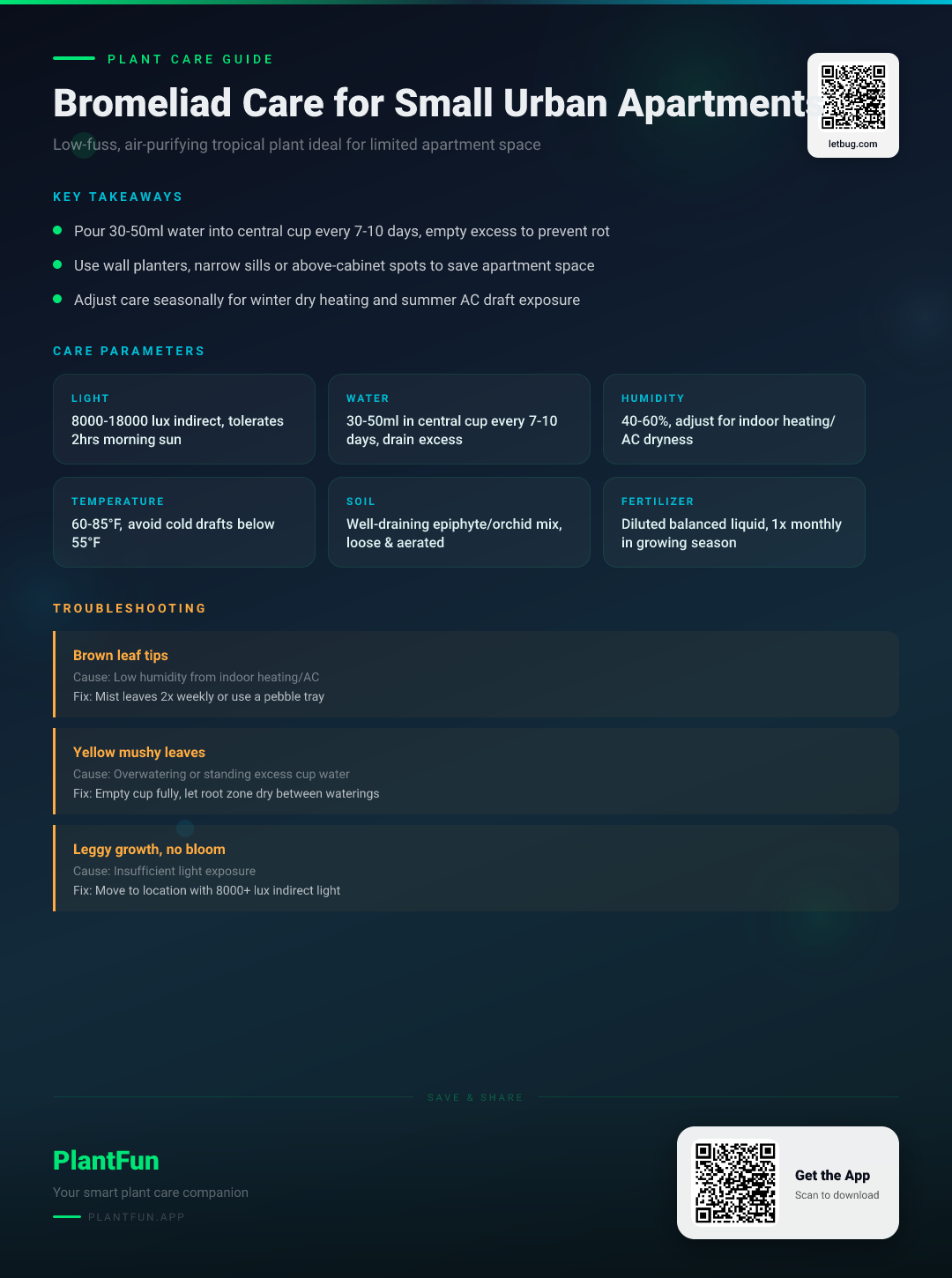
Key Takeaways
- Check soil moisture before watering — overwatering is the #1 killer of houseplants.
- Ensure your plant gets the right amount of light for its species.
- Be patient with recovery — most plants need 2–4 weeks to bounce back.
Quick Care Card
| Category | Measurable Apartment-Specific Specs |
|---|---|
| Light | 8,000-18,000 lux (2-4 hours of bright indirect sun daily) |
| Water | 30-50ml of filtered water in the central cup every 7-10 days; water soil only when top 2 inches are completely dry |
| Humidity | 40-60% |
| Temperature | 60-85°F (15-29°C) |
| Soil | Well-draining orchid/epiphyte mix |
| Fertilizer | 1/4 strength balanced liquid fertilizer, applied to soil once every 2-3 months (spring/summer only) |
| Toxicity | Non-toxic to cats, dogs, and humans (ASPCA, 2026) |
Why Bromeliads Are Ideal for Small Apartments
Bromeliads are made for compact 500-700 sq ft urban living. Most varieties stay 6-18 inches tall at maturity, so they never take up valuable floor space or overwhelm small surfaces. Their epiphytic natural adaptation (they grow on tree bark in the wild, not deep soil) means they tolerate fluctuating apartment conditions far better than finicky tropical plants like ferns or calatheas. They also filter common indoor air pollutants, and are safe for pets and kids (ASPCA, 2026). Myth vs reality: You don’t need a humidifier or greenhouse to grow bromeliads — they thrive in standard apartment microclimates with minimal effort, making them perfect for bromeliad care for beginners.
Small Space Placement Hacks
These small space bromeliad placement ideas use unused vertical or underutilized spots, so you don’t sacrifice counter or shelf space:
- Wall-mounted planters: Install 6-12 inches from east-facing windows for 10,000-15,000 lux (ideal for consistent growth). Use slim, low-profile planters that stick out less than 4 inches from the wall to avoid crowding walkways.
- Narrow window sills: Fit 4-inch potted bromeliads on east or south-facing sills (8,000-18,000 lux). Add a 3-inch clear plastic tray under the pot to catch spills without taking extra space.
- Above kitchen or bathroom cabinets: These high, out-of-the-way spots get 8,000-12,000 lux if within 3 feet of a window, and bathroom humidity naturally meets bromeliad humidity needs.
- Tiered hanging shelves: Place bromeliads on the top tier for unobstructed light, with smaller trailing plants on lower tiers to maximize vertical space.
Key Care Thresholds for Apartment Conditions
These 4 non-negotiable parameters are tailored specifically to the fluctuating heating/AC cycles of urban apartments, so you never have to guess about bromeliad care apartment requirements:
- Light: 8,000-18,000 lux: This is bright indirect light, equivalent to standing 3 feet from a south-facing window. Midday direct sun above 20,000 lux will scorch leaves, while light below 8,000 lux prevents blooming (Šrámek, 1999). You can test light levels with a free phone lux meter app if you’re unsure.
- Humidity: 40-60%: Most apartments stay in this range naturally, but heating in winter or AC in summer can drop levels to 30% or lower. No expensive humidifier is needed — a simple pebble tray will raise local humidity enough for your plant.
- Temperature: 60-85°F: Standard apartment temperatures fall perfectly in this range, but avoid exposing your plant to temps below 55°F, which causes leaf damage.
- Water: 30-50ml in central cup every 7-10 days: This is the answer to how often to water bromeliad in apartments. Dump old stagnant water first before adding fresh to prevent rot, and only water the soil if the top 2 inches are completely dry when you stick your finger in.
Step-by-Step 5-Minute Weekly Care Routine
This fast routine fits even the busiest apartment dweller’s schedule:
- (10 secs) Tip your bromeliad slightly over a sink to pour out any stagnant water from the central cup.
- (20 secs) Add 30-50ml of filtered or rain water to the central cup.
- (30 secs) Stick your finger 2 inches into the soil: if completely dry, add 20ml of water to the soil; if damp, skip.
- (1 min) Wipe leaves with a damp microfiber cloth to remove dust that blocks light absorption.
- (1 min) Check for light stress: if leaves are pale green, move the plant 12 inches closer to a window; if there are brown scorch marks, move it 12 inches further away.
- (1 min) Optional: Mist leaves lightly if your indoor humidity is below 40%.
Seasonal Care Calendar
Adjust your care for apartment-specific seasonal conditions:
- Winter (dry heating season, bromeliad winter care): Water the central cup every 7 days instead of 10, as heating dries out water faster. Move your bromeliad 6 inches closer to windows to compensate for shorter, dimmer days, and keep it at least 3 feet away from radiators. To get blooms, make sure it gets 12,000 lux for 4 hours a day for 6 weeks — it will bloom in 2-3 months.
- Summer (AC season, bromeliad summer watering): Water the central cup every 10 days, as AC reduces evaporation. Move your plant 6 inches away from south-facing windows to avoid midday sun scorch, and keep it away from direct AC vent drafts.
Common Small-Apartment Care Mistakes to Avoid
- Mistake: Placing bromeliads directly in front of drafty AC or heating vents What happens: Rapid humidity loss causes brown leaf tips and stunted growth Instead: Keep plants at least 3 feet away from all vents, or hang a small fabric draft blocker between the vent and your plant
- Mistake: Overcrowding bromeliads on shelves with other plants, blocking 50% or more of incoming light What happens: Insufficient light leads to no blooms, leggy growth, and yellow leaves Instead: Give each bromeliad at least 6 inches of space on all sides, or place it on a higher shelf with unobstructed light access
- Mistake: Forgetting to drain stagnant water from the central cup between waterings What happens: Crown rot and bacterial growth that can kill your plant in 2-3 weeks Instead: Drain old water every 7-10 days before adding fresh water, and never leave standing water in the cup for more than 10 days
- Mistake: Using full-strength fertilizer on small 4-inch potted bromeliads What happens: Salt burn on leaf tips and root damage Instead: Dilute fertilizer to 1/4 strength, and only apply it to the soil (never the central cup) once every 3 months in spring and summer
FAQ
Can I keep my bromeliad on a small apartment windowsill that only gets 2 hours of morning sun?
Yes! 2 hours of gentle morning sun delivers 8,000-10,000 lux, which meets the minimum bromeliad light requirements (Šrámek, 1999). This answers the common question: can bromeliads live in low light apartments? If you want to encourage blooming, add a cheap clip-on grow light 12 inches above the plant for 2 extra hours a day, or move it to a brighter west-facing spot for 2 days a week.
Why is my apartment bromeliad turning brown at the tips even when I water it regularly?
This is almost always caused by low humidity from dry heating or AC, which drops levels below the 40% minimum bromeliad humidity needs. Quick fix: Fill a shallow tray with pebbles and water, set your pot on top of the pebbles (make sure the pot is not sitting directly in water) to raise local humidity by 10-15%. You can also mist the leaves 2-3 times a week for fast relief.
How often do I need to fertilize my bromeliad if it’s in a tiny 4-inch pot in my apartment?
Bromeliads are extremely light feeders, especially in compact small pots. Use a balanced liquid fertilizer diluted to 1/4 strength, applied directly to the soil once every 2-3 months during spring and summer only. Skip fertilizing entirely in fall and winter, when growth slows. Never add fertilizer to the central cup, as it will burn tender new growth.
Bonus: How to Propagate Bromeliad Pups in Small Spaces
This bromeliad pup propagation for small spaces method requires no extra floor space or large pots:
- Wait until the pup (baby bromeliad growing from the base of the mother plant) is 1/3 the size of the mother plant, which takes 2-4 months after the mother finishes blooming (Diesel, 1992).
- Use a clean, sharp knife to cut the pup away from the mother, making sure to include a small section of the root base.
- Let the cut end dry for 24 hours to prevent rot.
- Plant the pup in a 3-inch pot with well-draining orchid mix, and water the soil lightly once every 10 days until it establishes roots (4-6 weeks).
- Place the small pot on a narrow window sill or wall-mounted planter — no extra floor space needed.
References
- ASPCA. (2026). Toxic and Non-Toxic Plants List — ASPCA. https://www.aspca.org/pet-care/animal-poison-control/toxic-and-non-toxic-plants. Accessed 2026-03-05.
- Šrámek, F. (1999). Vaughan, M.J.: The Complete Book on Cut Flower Care. Biologia plantarum. https://doi.org/10.1023/a:1001770114931. Accessed 2026-03-05.
- Diesel, R. (1992). Managing the offspring environment: brood care in the bromeliad crab, Metopaulias depressus. Behavioral Ecology and Sociobiology. https://doi.org/10.1007/bf00173948. Accessed 2026-03-05.
Optional Helper: Plantfun.App
Plantfun.App identifies your plants by photo, diagnoses pests and diseases with clear fixes, and creates personalised watering and light schedules that adapt to your home conditions — a handy companion for putting this guide into daily practice.
Found an error or have suggestions? We'd love your feedback.
Need help identifying this problem?
Get instant identification, personalized care schedules, and effective pest treatment plans directly on your phone.
Sponsored • We may earn a commission from app downloads
Related Guides
Guzmania Bromeliad Care Guide for Typical Apartments: 8 Steps for Resilient, Long-Blooming Growth
Stop watching your apartment bromeliad wilt after blooming. Get 8 actionable care steps, exact measurable thresholds, and a free printable checklist for resilient, year-round growth.
Care GuideGuzmania Bromeliads in Low-Humidity Apartments: A Simple Care Guide for Lasting Blooms
Revive your fading Bromeliad with our precise tank-watering method. Learn the exact light and humidity needs to keep your Guzmania vibrant in any apartment.
Care GuideGuzmania Bromeliad in a Low-Light Apartment: The Complete Care Guide for Resilient Growth
Master your Guzmania bromeliad care with this budget-friendly guide. Learn the exact 50ml tank-filling method and light tricks to keep your plant thriving for years.
Pest ControlAnts on Plants: What They Mean and What to Do
Ants usually aren't eating your plant. They are farming other pests.