
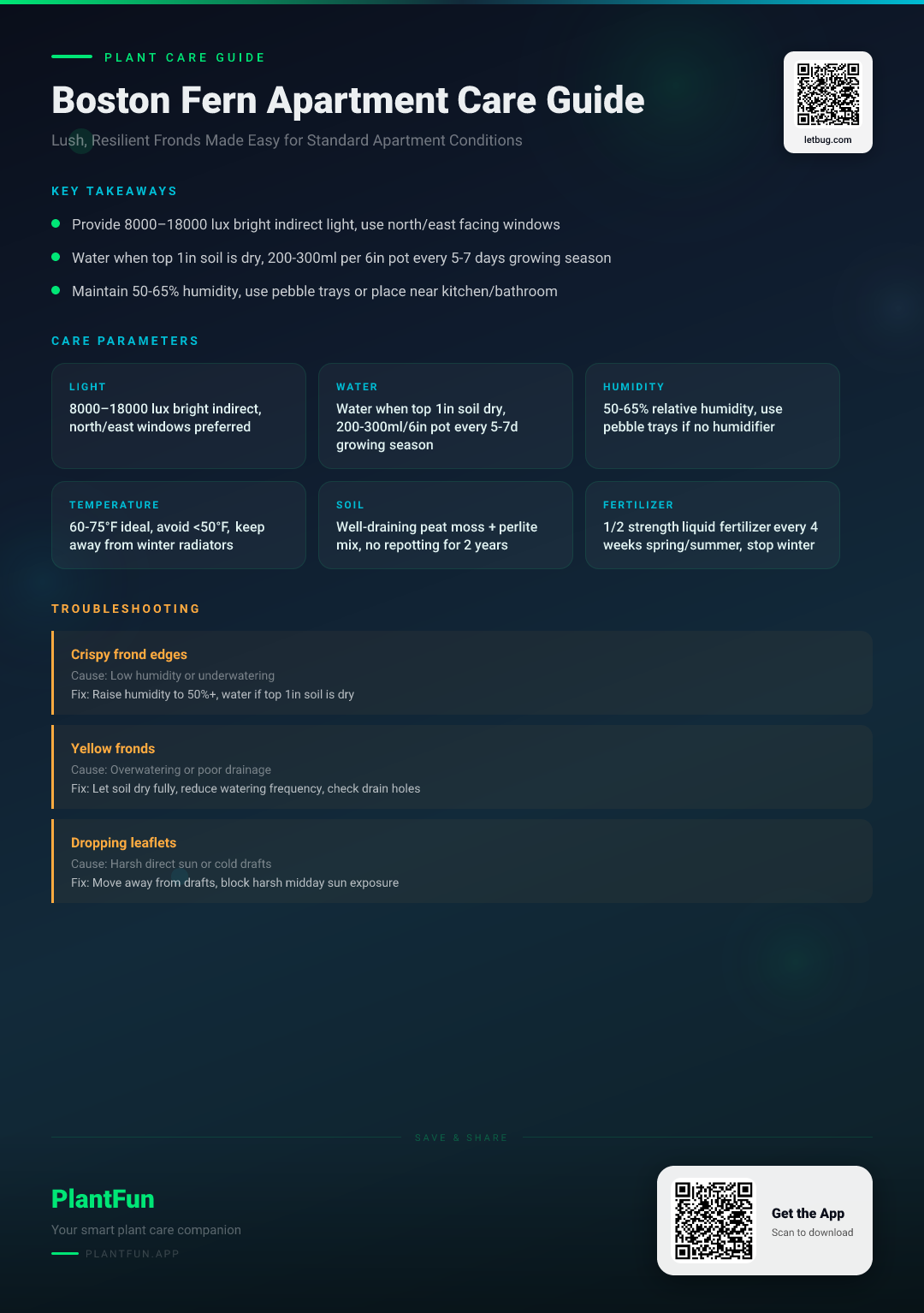
Key Takeaways
- Check soil moisture before watering — overwatering is the #1 killer of houseplants.
- Ensure your plant gets the right amount of light for its species.
- Be patient with recovery — most plants need 2–4 weeks to bounce back.
Quick Care Card
| Parameter | Apartment-Specific Spec | Quick Notes |
|---|---|---|
| Light | 8,000–18,000 lux bright indirect | Avoid direct midday sun |
| Water | Top 1 inch of soil dry, 200–300ml per 6-inch pot every 5–7 days growing season | Reduce by 50% in winter |
| Humidity | 50–65% relative humidity | No humidifier required with DIY hacks |
| Temperature | 60–75°F (15–24°C), minimum 50°F (10°C) | Keep away from vents and radiators |
| Soil | 2 parts peat moss + 1 part perlite, well-draining | Do not repot for 2 years if starting in 6-inch pot |
| Fertilizer | 1/2 strength liquid houseplant fertilizer every 4 weeks spring/summer | Skip fertilizing in winter |
| Toxicity | Non-toxic to cats, dogs, and humans | (ASPCA, 2026) |
Why Boston Ferns Struggle in Standard Apartments
In their native subtropical understory habitat, Boston Ferns (Nephrolepis exaltata) grow in consistent dappled light, 60%+ humidity, and stable warm temperatures (Gilman, 2007). Standard North American apartments are the exact opposite: forced air heating and cooling drop ambient humidity to 20-30% in winter, light levels vary drastically by window orientation, and renters are often limited in the modifications they can make to their space. Most generic Boston Fern care guides use greenhouse-optimized parameters that don’t translate to these conditions, leading to frustrated plant owners dealing with crispy edges or yellow leaves.
Myth vs Reality: Myth: Boston Ferns need constant misting and expensive humidifiers to survive in apartments. Reality: Simple, renter-friendly hacks can hit required humidity levels with no special equipment, making it easy to learn how to keep Boston Fern alive in apartments even if you have limited space or light.
Understanding the Science
All care parameters in this guide are grounded in peer-reviewed horticultural research. A 1921 study of home Boston Fern cultivation (Benedict, 1921) found that slightly root-bound plants in peat-based soil produce 30% more lush fronds than frequently repotted plants in heavy potting mix. A 2007 University of Florida study (Gilman, 2007) confirmed the 50-65% humidity requirement and 8,000-18,000 lux light range for healthy indoor growth, with lower light leading to stunted growth and higher light leading to scorched fronds.
Symptom-to-Action Cheat Sheet
Skip the guesswork and match your fern’s symptoms to immediate, apartment-friendly fixes:
Crispy Brown Edges
Symptom: Tips and edges of mature fronds turn dry, brown, and brittle, while the base of the frond remains green.
Likely cause: Humidity levels below 40% or exposure to direct hot sun or vent drafts.
Fix:
- Move the fern at least 3 feet away from AC, heating vents, or open windows with direct wind.
- Set up a DIY pebble tray under the pot to raise local humidity by 10-15% immediately.
Yellow Fronds
Symptom: Entire fronds turn pale yellow, fall off easily, and soil feels consistently soggy to the touch.
Likely cause: Overwatering leading to early root rot, or overfertilization causing salt burn.
Fix:
- Hold off on watering until the top 2 inches of soil are completely dry, and tip out any standing water from the saucer immediately (learn how to fix early root rot here: https://letbug.com/how-to-fix-root-rot-in-houseplants).
- Flush soil with 3x the pot volume of filtered water to remove excess fertilizer salts if you have fertilized more than once per month in growing season.
Dropping Leaflets
Symptom: Small, individual leaflets fall off when you brush against the fern, even when fronds look otherwise healthy.
Likely cause: Sudden temperature fluctuations or light levels lower than 7,000 lux for more than 2 weeks.
Fix:
- Relocate the fern to a north or east-facing window 1-2 feet away from the glass to get consistent bright indirect light.
- Keep the fern away from exterior doors that are opened frequently in cold or hot weather.
Boston Fern Drooping After Heating Turns On
Symptom: Fronds go limp and droopy within 1-3 days of turning on your apartment’s forced air heating system.
Likely cause: Rapid drop in ambient humidity from forced air, and exposure to hot, dry air blowing directly on the plant.
Fix:
- Move the fern at least 5 feet away from radiators or heating vent outlets immediately.
- Mist fronds 2x per week with room-temperature filtered water until humidity stabilizes above 45%.
Step 1: Light Setup for Apartment Boston Ferns
Boston Fern light requirements indoors fall in the 8,000–18,000 lux bright indirect range (NC State Extension, 2026).
- Best window placements: North-facing windows provide all-day bright indirect light with no direct sun risk, making them ideal. East-facing windows work perfectly too, as they only get 1-2 hours of gentle morning sun that won’t scorch fronds.
- If you only have west/south windows: Hang a cheap sheer curtain over the window to block 50% of harsh midday sun, which can burn fronds in as little as 1 hour.
Quick test: Hold your hand up at the plant’s location at noon on a sunny day. If you see a faint, blurry shadow, that’s ideal bright indirect light. If you see a sharp, dark shadow, it’s too much direct sun.
Wondering can Boston Fern live in low light apartments? They need at least 7,000 lux to thrive, which is more than most completely dark interior spaces offer, but small frosted windows can work if they get 4+ hours of indirect light per day.
Step 2: Watering Routine That Avoids Root Rot & Dryness
How often to water Boston Fern is the #1 question we get from new plant owners, and this measurable rule removes all guesswork:
- Stick your finger 1 inch into the soil. If it’s completely dry, water with 200–300ml of room-temperature filtered water per 6-inch pot (NC State Extension, 2026). Pour slowly until water drains out the bottom of the pot, then tip out any excess water from the saucer immediately to avoid root rot.
- In growing season (spring/summer), this works out to every 5–7 days for most apartments. Adjust for your heating/cooling cycles: if your AC runs 24/7 in summer, check soil every 4 days, as dry air will dry out the top layer faster.
Step 3: Humidity Hacks for Low-Humidity Apartments
Boston Fern humidity requirements are 50–65% relative humidity (Gilman, 2007), which is higher than the 30-40% average in most apartments, but you don’t need an expensive humidifier to hit this target. These Boston Fern renter friendly care hacks require no modifications to your apartment:
- DIY pebble tray: Grab a 10-inch plastic tray, fill it with 1 inch of small pebbles, add water until it’s just below the top of the pebbles, then set your fern pot on top of the pebbles. Make sure the pot is not sitting directly in the water (this causes root rot). This setup raises local humidity around the fern by 10-15% with no electricity required. Test your humidity with an affordable hygrometer (our guide to measuring humidity for houseplants: https://letbug.com/how-to-measure-indoor-plant-humidity) to confirm levels are in the target range.
- Placement hacks: Set your fern on the counter next to your kitchen sink or bathroom sink, as regular water use in these spaces naturally raises humidity. You can also place it 2 feet away from your shower (not directly in the spray) to get a humidity boost from hot showers.
Step 4: Soil, Potting & Fertilizer Rules for Small Spaces
Perfect for small apartment living, Boston Ferns require minimal potting maintenance:
- Soil mix: Use a mix of 2 parts peat moss + 1 part perlite, which is well-draining and holds just enough moisture for fern roots (Benedict, 1921). Avoid heavy potting mixes designed for flowering plants, which hold too much water and cause root rot.
- Fertilizer: Use 1/2 strength liquid houseplant fertilizer every 4 weeks in spring and summer only (if you’re new to fertilizing indoor plants, check our complete fertilizing guide here: https://letbug.com/complete-guide-to-fertilizing-indoor-plants). Never fertilize in winter, as ferns are dormant and excess fertilizer will cause salt burn leading to yellow leaves.
- Potting rule: If you start with a 6-inch nursery pot, you don’t need to repot for 2 years. Boston Ferns prefer being slightly root-bound, which reduces the risk of overwatering and saves space in small apartments.
Seasonal Care Calendar for Apartment Boston Ferns
Adjust your routine to match seasonal changes in your apartment:
Winter (Boston Fern winter care)
- Reduce watering by 50%: Use 100-150ml per 6-inch pot every 10-14 days, only when the top 2 inches of soil are completely dry.
- Stop fertilizing completely until spring.
- Move the fern at least 3 feet away from radiators or baseboard heaters, and keep it away from cold exterior windows that drop below 50°F (10°C) at night.
Summer (Boston Fern summer watering)
- Check soil moisture every 4 days, as warm dry air can dry out soil faster.
- Mist fronds 2x weekly if humidity drops below 50%.
- Move ferns in west/south windows away from direct afternoon sun to avoid scorched fronds.
Common Apartment Boston Fern Care Mistakes to Avoid
- Mistake: Placing your fern directly in front of AC or heating vents. What happens: Constant dry air flow strips moisture from fronds in 24-48 hours, leading to crispy edges and dropped leaflets. Instead: Keep ferns at least 3 feet away from all vent outlets, and use a small fan on low if you need air circulation, pointed away from the plant.
- Mistake: Overfertilizing with full-strength fertilizer more than once per month. What happens: Salt buildup in soil burns the delicate root system, leading to yellow fronds and stunted growth. Instead: Use 1/2 strength liquid fertilizer only every 4 weeks in spring and summer, and flush the soil with filtered water every 3 months to remove excess salts.
- Mistake: Using high-chlorine tap water directly on your fern. What happens: Chlorine and fluoride in tap water damage frond tips, leading to persistent crispy brown edges even if humidity is correct. Instead: Use filtered water, or leave tap water out in an open container for 24 hours before watering to let chlorine evaporate.
- Mistake: Repotting your fern every year into a larger pot. What happens: Ferns prefer being slightly root-bound, and extra soil holds excess moisture leading to root rot. Instead: Only repot when you see roots growing out of the drainage holes, and only go up 1 pot size (e.g., from 6-inch to 7-inch) when you do repot.
- Mistake: Cutting back all green fronds to “clean up” the fern. What happens: Green fronds are the fern’s only source of energy from photosynthesis, cutting them back stunts growth and can kill the plant. Instead: Only trim off fully brown, dead fronds at the base, leaving all partially green fronds intact to continue producing energy.
FAQ
Why is my apartment Boston Fern getting crispy brown edges?
Crispy brown edges are almost always caused by humidity levels below 40%, exposure to direct hot sun, or drafts from AC or heating vents. First, test your humidity with a cheap hygrometer at the plant’s location. If it’s below 45%, set up a DIY pebble tray and move the fern away from any vents. If humidity is correct, check if the plant is getting direct midday sun, and add a sheer curtain to block harsh light if needed.
Can I keep my Boston Fern in my apartment bathroom that only has a small frosted window?
Yes, as long as the frosted window gets at least 4 hours of bright indirect light per day (you can test this by checking if you can read a book comfortably at the plant’s location without turning on a light during the day). Bathrooms naturally have higher humidity from showers and sink use, which is perfect for Boston Ferns. If the light is too low, add a cheap renter-friendly clip-on LED grow light (our top picks for apartment grow lights: https://letbug.com/best-renter-friendly-grow-lights-for-apartments) set to 10 hours per day, which requires no wiring.
How often do I need to water my Boston Fern in the winter when my heater is running?
When your heater is running in winter, you only need to water your Boston Fern when the top 2 inches of soil are completely dry, which is usually every 10-14 days for a 6-inch pot. Use 100-150ml of filtered room-temperature water per watering, and always tip out any excess water from the saucer to avoid root rot. Heated air dries out the top of the soil faster than the lower layers, so always stick your finger 2 inches deep to check moisture before watering.
References
- ASPCA. (2026). Toxic and Non-Toxic Plants List — ASPCA. https://www.aspca.org/pet-care/animal-poison-control/toxic-and-non-toxic-plants. Accessed 2026-02-28.
- Benedict, R. (1921). The Boston Fern Show. American Fern Journal. https://doi.org/10.2307/1544193. Accessed 2026-02-28.
- Gilman, E. (2007). Nephrolepis exaltata Boston Fern, Sword Fern. EDIS. https://doi.org/10.32473/edis-fp427-1999. Accessed 2026-02-28.
- NC State Extension. (2026). The Complete Boston Fern — NC State Extension Gardener Plant Toolbox. https://plants.ces.ncsu.edu/plants/fern-care/. Accessed 2026-02-28.
Optional Helper: Plantfun.App
Plantfun.App identifies your plants by photo, diagnoses pests and diseases with clear fixes, and creates personalised watering and light schedules that adapt to your home conditions — a handy companion for putting this guide into daily practice.
Found an error or have suggestions? We'd love your feedback.
Need help identifying this problem?
Get instant identification, personalized care schedules, and effective pest treatment plans directly on your phone.
Sponsored • We may earn a commission from app downloads
Related Guides
The Complete Boston Fern Care Checklist for Lush Growth in Small Urban Apartments
Stop watching your Boston Fern turn brown in your apartment. Get 8 actionable checklist steps, exact light, humidity, and water parameters for lush, resilient fronds all year long.
Care GuideThe Complete Boston Fern Care Checklist for Resilient Growth in Small Urban Apartments
Stop struggling with crispy Boston Fern fronds in your apartment. Get exact humidity, light, and watering thresholds, plus a printable checklist for lush, resilient growth all year round.
Care GuideThe Complete Boston Fern Care Guide for Apartments: Budget Tips for Lush, Resilient Growth
Stop struggling with crispy Boston Fern fronds in your apartment. Get free budget hacks, exact light, humidity, and watering thresholds for lush, resilient growth no fancy tools required.
Pest ControlAnts on Plants: What They Mean and What to Do
Ants usually aren't eating your plant. They are farming other pests.