
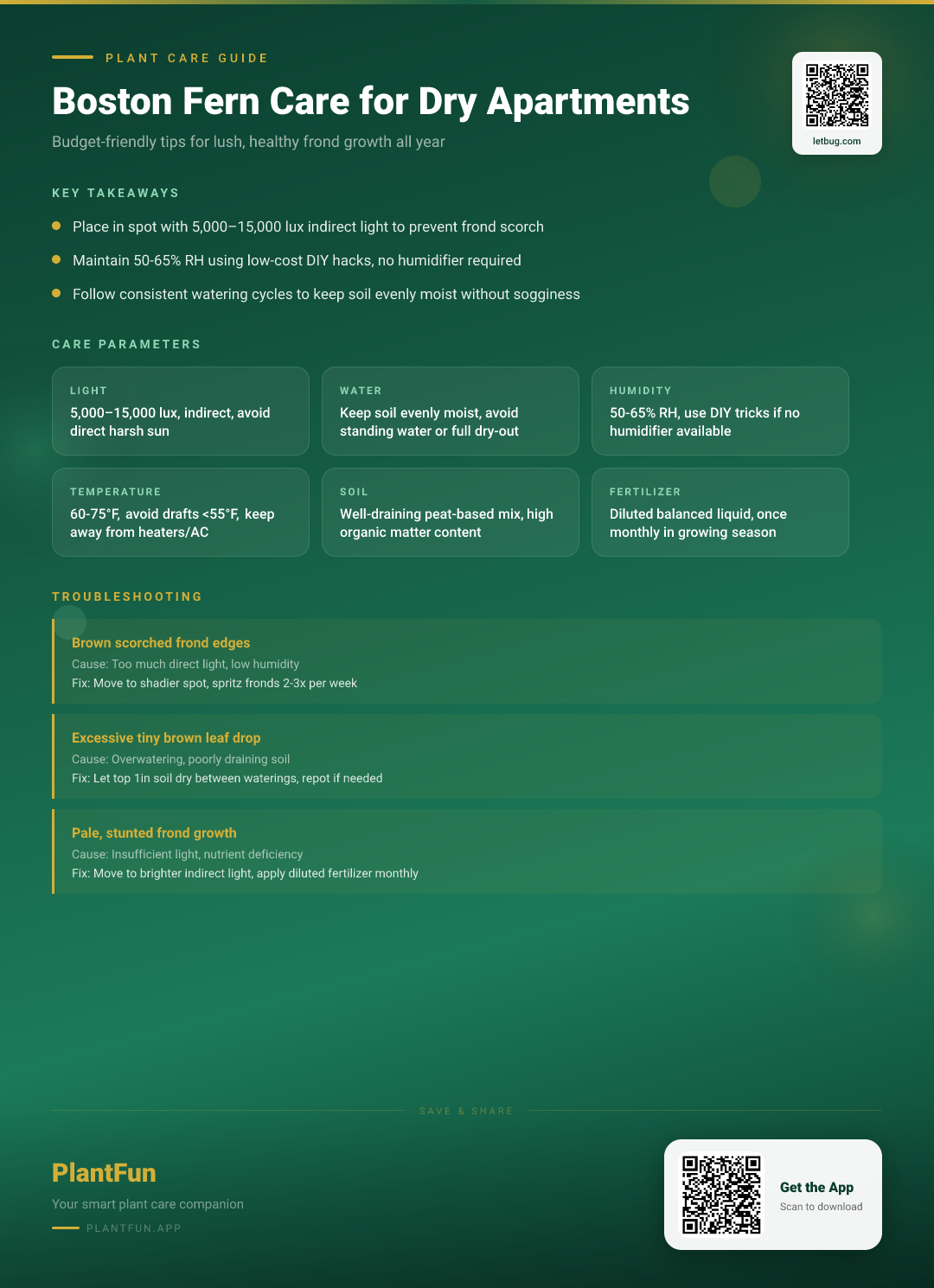
Key Takeaways
- Check soil moisture before watering — overwatering is the #1 killer of houseplants.
- Ensure your plant gets the right amount of light for its species.
- Be patient with recovery — most plants need 2–4 weeks to bounce back.
Quick Care Card: Essential Thresholds for Thriving Ferns
| Feature | Requirement |
|---|---|
| Light | Bright, indirect (5,000–15,000 lux) |
| Water | Keep soil consistently moist; never allow to dry out |
| Humidity | 50%–65% RH (Relative Humidity) |
| Temperature | 60°F–75°F (15°C–24°C) |
| Soil | Peat-based, well-draining, slightly acidic |
| Fertilizer | Balanced liquid feed, monthly (spring-summer) |
| Toxicity | Non-toxic to cats and dogs (ASPCA, 2026) |
TL;DR: The 30-Second Boston Fern Apartment Strategy
To keep your Nephrolepis exaltata happy, prioritize consistent moisture. Place it in a spot with bright, indirect light, keep the soil damp like a wrung-out sponge, and boost local humidity using a pebble tray. Avoid direct sun and cold drafts, which cause rapid frond dehydration (Gilman, 2007).
Why Your Boston Fern Struggles in Modern Apartments
When I first got my Boston Fern, I made the mistake of placing it directly above a radiator. Within two weeks, the lush green fronds turned into a crispy, brown mess. The issue? Modern apartments often have low relative humidity (often dropping below 30%) and inconsistent temperature fluctuations, which are the antithesis of the fern’s native humid, shaded forest floor habitat.
Decoding Light: Positioning for 5,000–15,000 Lux Without Scorching
Ferns are champions of the understory. They thrive in dappled light rather than intense, direct sun. Aim for a spot near a north or east-facing window. If you are using a light meter, aim for 5,000–15,000 lux. Anything higher, specifically direct sunlight, will scorch the delicate pinnae (leaflets) (NC State Extension, 2026).
The Budget Hydration System: Water Cycles and Soil Moisture Retention
Watering is where most beginners fail. Forget a fixed schedule; use the ‘finger test’ instead. Insert your finger two inches into the soil—if it feels barely dry, it is time to water.
- The Technique: Water thoroughly until moisture drains from the bottom, then discard the excess from the saucer to prevent root rot.
- Retention: Mix a small amount of sphagnum peat moss into your potting mix to improve water retention without sacrificing aeration (NC State Extension, 2026).
Humidity Hacks: Reaching 50-65% RH Without a Humidifier
You do not need expensive gear to mimic a rainforest.
- The Pebble Tray: Place your pot on a tray filled with pebbles and enough water to reach just below the pot base. As the water evaporates, it creates a localized microclimate.
- Group Clustering: Grouping your ferns with other moisture-loving plants creates a transpiration cycle that raises the ambient humidity around the group.
- Bathroom Placement: If your bathroom has a window, it is the best place to increase humidity for ferns naturally.
Seasonal Care Calendar: Navigating Winter Heating and Summer Cooling
- Spring/Summer: This is the active growing season. Increase feeding to once a month and ensure the soil never dries completely. Keep away from air conditioning vents.
- Autumn/Winter: Growth slows down. Reduce fertilization. Keep plants away from heaters to prevent the ‘crispy leaf’ syndrome common in winter (Gilman, 2007).
FAQ: Why is my Boston Fern shedding tiny brown leaves everywhere?
This is typically a sign of low humidity or underwatering. The plant is essentially ‘sacrificing’ its outer fronds to conserve moisture. Check the soil moisture immediately (NC State Extension, 2026).
FAQ: Can I keep my Boston Fern in a windowless bathroom?
While ferns handle lower light, they still need light for photosynthesis. If your bathroom has no windows, the plant will eventually decline. I recommend rotating it with a spot near a window every few days.
Common Mistakes: Stop These 3 Habits That Kill Ferns Fast
- Mistake: Letting the root ball dry out completely. What happens: The fronds turn brown and brittle. Instead: Check soil moisture every 3 days.
- Mistake: Over-fertilizing. What happens: Fertilizer burn on the roots and yellowing foliage. Instead: Use a half-strength liquid fertilizer during active growth (Benedict, 1921).
- Mistake: Placing the plant near a drafty window. What happens: Cold stress causes leaf drop. Instead: Keep the plant in a stable temperature zone (60°F–75°F).
Troubleshooting Guide: Identifying Pest Infestations Early
[Scale Insects]
Symptom: Small, brown, bump-like protrusions on the stems or undersides of leaves.
Likely cause: Pests introduced from nearby infected plants.
Fix:
- Wipe the stems with a cotton swab dipped in 70% isopropyl alcohol.
- Isolate the plant to prevent spread.
[Spider Mites]
Symptom: Fine, silken webs appearing between the fronds.
Likely cause: Extremely dry indoor air.
Fix:
- Increase humidity via a pebble tray.
- Gently rinse the fronds with tepid water to dislodge mites.
References and Botanical Resources
- Benedict, R. (1921). The Boston Fern Show. American Fern Journal. https://doi.org/10.2307/1544193. Accessed 2026-03-17.
- Gilman, E. (2007). Nephrolepis exaltata Boston Fern, Sword Fern. EDIS. https://doi.org/10.32473/edis-fp427-1999. Accessed 2026-03-17.
- ASPCA. (2026). Toxic and Non-Toxic Plants List — ASPCA. https://www.aspca.org/pet-care/animal-poison-control/toxic-and-non-toxic-plants. Accessed 2026-03-17.
- NC State Extension. (2026). The Complete Boston Fern — NC State Extension Gardener Plant Toolbox. https://plants.ces.ncsu.edu/plants/fern-care/. Accessed 2026-03-17.
Optional Helper: Plantfun.App
Plantfun.App identifies your plants by photo, diagnoses pests and diseases with clear fixes, and creates personalised watering and light schedules that adapt to your home conditions — a handy companion for putting this guide into daily practice.
Found an error or have suggestions? We'd love your feedback.
Need help identifying this problem?
Get instant identification, personalized care schedules, and effective pest treatment plans directly on your phone.
Sponsored • We may earn a commission from app downloads
Related Guides
Boston Fern in a Low-Humidity Apartment: The Ultimate Care Guide for Resilient Growth
Stop your Boston Fern from shedding brown needles. Learn the exact 50-60% humidity hacks, watering schedules, and light levels for a lush, thriving apartment.
Care GuideBoston Ferns in Dry Apartments: A 5-Step Rescue Plan for Lush, Frond-Filled Growth
Transform your crisping Boston Fern into a lush centerpiece. Master the 4 key humidity and light variables that keep fronds vibrant in any dry apartment.
Care GuideBoston Fern in a Dry Apartment: The 5-Step Rescue Plan for Lush, Frondy Growth
Stop dealing with brown, crunchy fronds. Follow our 5-step Boston Fern care guide to master humidity, light, and watering for a lush, thriving indoor fern today.
Pest ControlAnts on Plants: What They Mean and What to Do
Ants usually aren't eating your plant. They are farming other pests.