
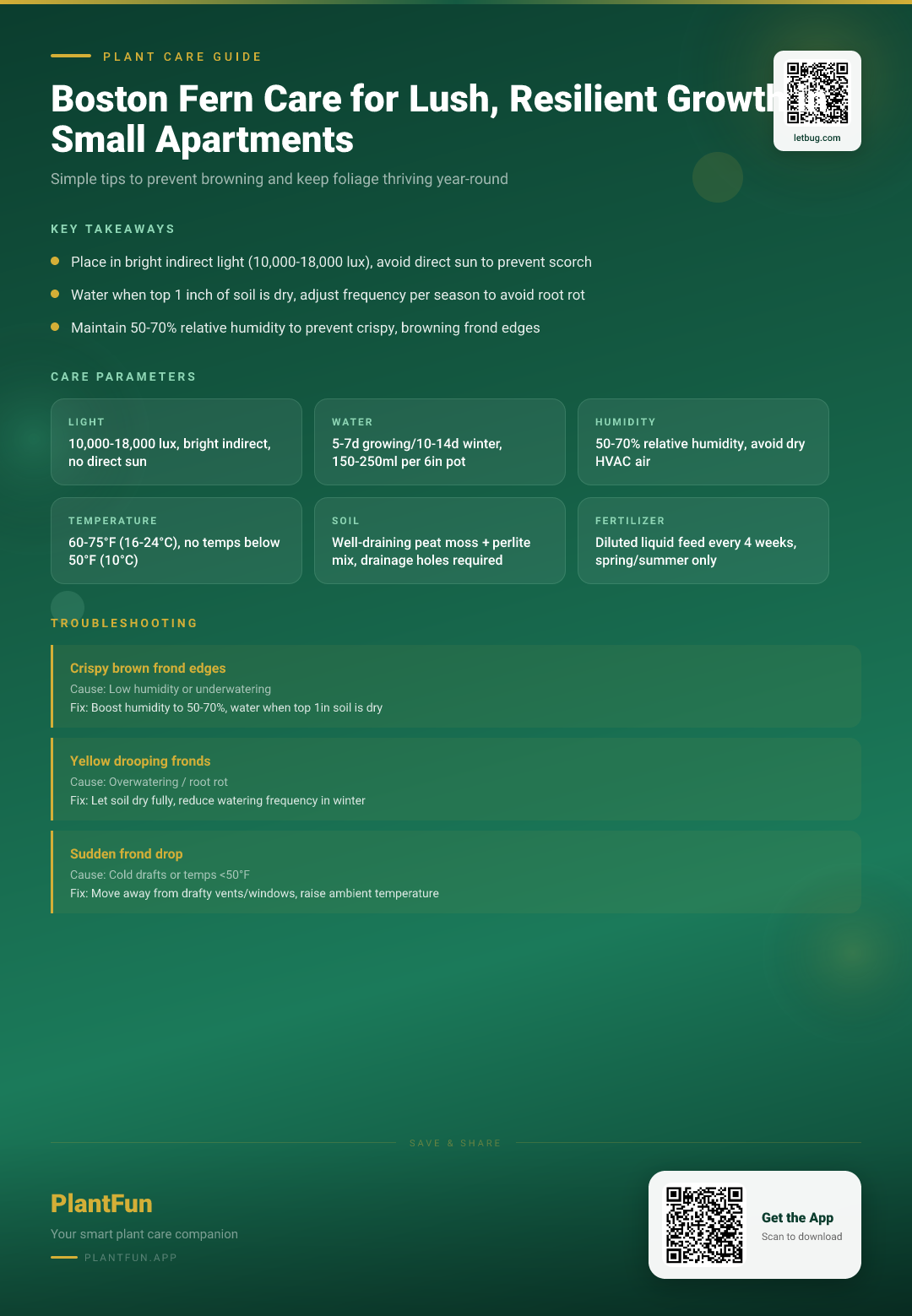
Key Takeaways
- Check soil moisture before watering — overwatering is the #1 killer of houseplants.
- Ensure your plant gets the right amount of light for its species.
- Be patient with recovery — most plants need 2–4 weeks to bounce back.
Quick Care Card
| Care Parameter | Threshold | Notes |
|---|---|---|
| Light | 10,000–18,000 lux (bright indirect) | No more than 1 hour of direct morning sun |
| Water | 150–250ml per 6-inch pot, when top 1 inch of soil is dry | 5–7 days growing season, 10–14 days winter |
| Humidity | 50–70% relative humidity | Pebble trays work as well as humidifiers for small spaces |
| Temperature | 60–75°F (16–24°C) | Avoid temps below 50°F (10°C) |
| Soil | 2 parts peat moss + 1 part perlite | Well-draining, slightly acidic |
| Fertilizer | 50% diluted liquid houseplant fertilizer, every 4 weeks spring/summer only | No winter fertilization |
| Toxicity | Non-toxic to cats, dogs, and humans | Safe for bedrooms and play areas (ASPCA, 2026) |
Why Boston Ferns Struggle in Typical Apartments
Native to humid, shaded tropical forest floors, Boston Ferns (Nephrolepis exaltata) evolved for stable, consistent conditions that rarely exist in small apartments (NC State Extension, 2026). The three most damaging apartment-specific stressors are:
- Dry forced air from HVAC systems: Heating and AC drop ambient humidity to 20–30%, well below the fern’s required range, desiccating fronds in days
- Inconsistent light: Small apartment windows often deliver either too much direct midday sun (causing scorch) or too little dim light (stopping new growth)
- Drafty spots: Cold air from window gaps or AC vents, or hot air from radiators, cause sudden frond drop even if the rest of the apartment is within temperature range
Your 10-Point Boston Fern Resilience Checklist
Follow these steps on day one to set your fern up for long-term success in your small apartment:
- Test light levels at your desired placement with a free phone lux meter app, confirming 10,000–18,000 lux at midday
- Select a 6–8 inch hanging or narrow shelf pot with drainage holes to save floor space
- Fill the pot with a mix of 2 parts sphagnum peat moss and 1 part perlite for fast drainage
- Place the fern 2–3 feet away from south or east-facing windows to avoid direct sun scorch
- Position the pot at least 3 feet away from radiators, AC vents, exterior doors, and drafty window sills
- Water with 200ml of room-temperature filtered water, making sure excess water runs out the drainage hole
- Set the pot on a pebble tray filled halfway with water (ensure the pot sits on pebbles, not in standing water) to boost local humidity
- Trim any fully brown or damaged fronds at the base with clean, sharp scissors to redirect energy to new growth
- Mark your calendar for your first fertilizer application 4 weeks after potting, using 50% diluted liquid houseplant fertilizer
- Set a weekly reminder to check the top 1 inch of soil for dryness, and a monthly reminder to test ambient humidity near the fern
Exact Light Requirements for Apartment Boston Ferns
Boston Ferns need bright indirect light of 10,000–18,000 lux to produce full, green fronds (NC State Extension, 2026). This is roughly the light level 2–3 feet away from an unobstructed south or east-facing window behind a sheer curtain.
They can tolerate light as low as 8,000 lux for short periods, but growth will slow and fronds will thin over time. Any light above 20,000 lux (direct midday sun) will cause brown, crispy scorch marks on frond edges within 24 hours.
Quick test: Hold your hand 6 inches above the fern fronds at midday. If you see a sharp, dark shadow, the light is too strong—add a sheer curtain or move the fern 1 foot further from the window.
Watering Rules That Prevent Root Rot and Crispy Fronds
Overwatering and underwatering are equally common issues for apartment Boston Ferns, but following these science-backed rules eliminates guesswork (Gilman, 2007):
- Frequency: Water every 5–7 days in the spring/summer growing season, and every 10–14 days in fall/winter. Adjust for heating use: if your heater runs 24/7 in winter, you may need to water every 8–10 days.
- Amount: Pour 150–250ml of water per 6-inch pot, until water runs freely out the drainage hole. Empty all excess water from the saucer within 10 minutes to avoid root rot.
- Golden rule: Always test soil moisture before watering. Stick your index finger 1 inch into the soil: if it is completely dry, water; if it is even slightly damp, wait 2 days and test again.
Myth vs Reality: Myth: You need to mist your fern daily to keep it healthy. Reality: Misting only raises humidity for 10–15 minutes, and excess moisture on fronds can cause fungal spots. Pebble trays are far more effective for long-term humidity boosts.
Humidity & Temperature Thresholds for Apartment Living
Boston Ferns require 50–70% relative humidity to thrive (Benedict, 1921). Most small apartments sit at 30–40% humidity when HVAC is running, so small adjustments are needed to hit the ideal range.
Temperature requirements are more flexible: ferns grow best between 60–75°F (16–24°C), and will drop fronds rapidly if exposed to temperatures below 50°F (10°C) for more than 2 hours (NC State Extension, 2026).
Quick humidity fix for small apartments: Group your fern with 2–3 other leafy houseplants to create a shared microclimate that raises local humidity by 10–15% with no extra equipment needed.
Soil, Potting, and Fertilization Tips for Small Spaces
Small apartment layouts require space-efficient potting choices that still support healthy fern growth:
- Soil mix: Use 2 parts sphagnum peat moss + 1 part perlite, with an optional 10% worm castings for slow-release nutrients. This mix drains fast while holding enough moisture to prevent frond drying.
- Pot selection: Choose 6–8 inch hanging pots or narrow, low-profile shelf pots to avoid taking up valuable floor space. Always pick pots with drainage holes to reduce root rot risk.
- Fertilization: Use a 50% diluted liquid houseplant fertilizer every 4 weeks only in spring and summer. Skip all fertilization in fall and winter, when ferns enter a dormant growth phase (Gilman, 2007). Overfertilizing is a top cause of brown frond tips, so less is always more.
Seasonal Care Calendar for Apartment Boston Ferns
Apartment conditions shift dramatically with seasons, so adjust your care routine accordingly:
- January–February (Winter): Water every 10–14 days, move ferns at least 3 feet away from radiators, skip fertilization, and only mist if humidity drops below 40%
- March–April (Early Spring): Resume watering every 7 days, apply first 50% diluted fertilizer, and trim all dead winter fronds at the base
- May–August (Summer): Water every 5–7 days, refresh pebble tray water weekly, keep ferns away from AC vents, and fertilize every 4 weeks
- September–October (Fall): Reduce watering to every 7–10 days, stop fertilization, and move ferns away from drafty windows as outdoor temperatures drop
- November–December (Late Fall/Winter): Water every 10–14 days, keep ferns away from exterior doors and heat sources, and avoid repotting until spring
7 Most Common Boston Fern Apartment Care Mistakes (And How to Fix Them)
- Mistake: Misting fronds daily to raise humidity What happens: Misting only provides temporary humidity, and excess moisture on fronds causes fungal leaf spot Instead: Use a pebble tray under the pot to raise local humidity consistently, with no misting required
- Mistake: Placing the fern within 2 feet of radiators or baseboard heat What happens: Dry hot air desiccates fronds in 2–3 days, causing widespread browning and frond drop Instead: Move the fern to a spot at least 3 feet away from all heat sources, or place a thin wooden heat shield between the radiator and fern
- Mistake: Fertilizing in winter to boost growth What happens: Salt buildup in soil burns root tips, leading to brown frond edges and stunted growth Instead: Skip all fertilization from October to March, and leach soil once a year by running 3x the pot volume of filtered water through the soil to flush excess salts
- Mistake: Using hard tap water with high chlorine or fluoride What happens: Mineral buildup damages frond tips, causing permanent brown discoloration Instead: Use filtered, rain, or distilled water, or leave tap water out in an open container for 24 hours before watering to let chlorine evaporate
- Mistake: Placing the fern directly on a drafty window sill What happens: Cold drafts below 50°F cause sudden frond drop, even if the rest of the apartment is warm Instead: Place the fern 2–3 feet away from windows, or add window insulation film in winter to block cold drafts
- Mistake: Letting the fern sit in standing water in the saucer What happens: Saturated soil causes root rot, which leads to yellowing fronds and mushy stems Instead: Empty the saucer of all excess water 10 minutes after every watering
- Mistake: Only trimming brown frond tips instead of the entire frond What happens: The cut edge will turn brown again, and the damaged frond wastes energy the plant could use for new growth Instead: Trim fully brown or 70% brown fronds at the base of the stem with clean, sharp scissors to encourage new, healthy frond growth
Voice Search FAQ
Why is my Boston Fern turning brown at the tips even when I water it regularly?
The most common cause is low humidity from dry apartment HVAC air, or salt buildup from overfertilizing or hard tap water (NC State Extension, 2026). First test your humidity with a hygrometer: if it is below 50%, add a pebble tray under the pot. If humidity is within the ideal range, leach the soil by running 3x the pot volume of filtered water through it to flush excess salts.
Can I keep my Boston Fern in my apartment bedroom without a humidifier?
Yes! Boston Fern care without a humidifier is totally possible with simple, low-effort hacks. Group it with other leafy plants to create a high-humidity microclimate, or place it on a pebble tray filled with water to boost ambient humidity by 10–15% (Benedict, 1921). Bonus: Boston Ferns are non-toxic to cats, dogs, and humans per the ASPCA (2026), so they are a safe, air-purifying bedroom addition.
How often do I need to water my Boston Fern in the winter when my heat is on?
When your apartment heat is running in winter, you will typically need to water your Boston Fern every 10–14 days, but always test the soil first: water only when the top 1 inch of soil is completely dry (Gilman, 2007). If your heater runs 24/7, you may need to water every 8–10 days, so always test soil moisture instead of sticking to a strict schedule.
References
- Benedict, R. (1921). The Boston Fern Show. American Fern Journal. https://doi.org/10.2307/1544193. Accessed 2026-03-01.
- Gilman, E. (2007). Nephrolepis exaltata Boston Fern, Sword Fern. EDIS. https://doi.org/10.32473/edis-fp427-1999. Accessed 2026-03-01.
- ASPCA. (2026). Toxic and Non-Toxic Plants List — ASPCA. https://www.aspca.org/pet-care/animal-poison-control/toxic-and-non-toxic-plants. Accessed 2026-03-01.
- NC State Extension. (2026). The Complete Boston Fern — NC State Extension Gardener Plant Toolbox. https://plants.ces.ncsu.edu/plants/fern-care/. Accessed 2026-03-01.
Optional Helper: Plantfun.App
Plantfun.App identifies your plants by photo, diagnoses pests and diseases with clear fixes, and creates personalised watering and light schedules that adapt to your home conditions — a handy companion for putting this guide into daily practice.
Found an error or have suggestions? We'd love your feedback.
Need help identifying this problem?
Get instant identification, personalized care schedules, and effective pest treatment plans directly on your phone.
Sponsored • We may earn a commission from app downloads
Related Guides
The Complete Boston Fern Care Checklist for Resilient Growth in Small Urban Apartments
Stop struggling with crispy Boston Fern fronds in your apartment. Get exact humidity, light, and watering thresholds, plus a printable checklist for lush, resilient growth all year round.
Care GuideThe Complete Boston Fern Care Checklist for Lush Growth in Small Urban Apartments
Stop watching your Boston Fern turn brown in your apartment. Get 8 actionable checklist steps, exact light, humidity, and water parameters for lush, resilient fronds all year long.
Care GuideThe Complete Boston Fern Care Guide for Apartments: Budget Tips for Lush, Resilient Growth
Stop struggling with crispy Boston Fern fronds in your apartment. Get free budget hacks, exact light, humidity, and watering thresholds for lush, resilient growth no fancy tools required.
Pest ControlAnts on Plants: What They Mean and What to Do
Ants usually aren't eating your plant. They are farming other pests.