
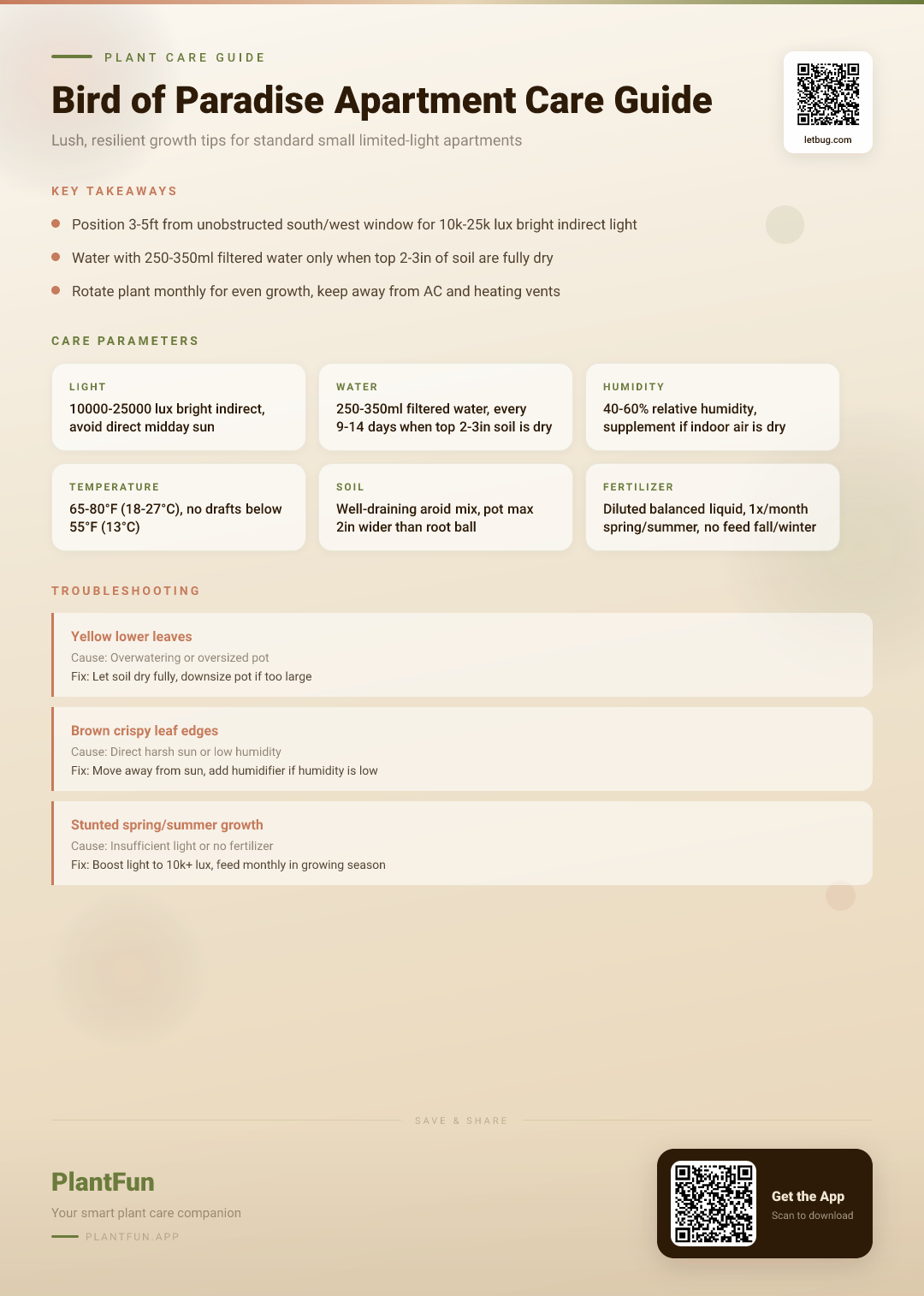
Key Takeaways
- Check soil moisture before watering — overwatering is the #1 killer of houseplants.
- Ensure your plant gets the right amount of light for its species.
- Be patient with recovery — most plants need 2–4 weeks to bounce back.
Quick Care Card
| Care Factor | Exact Threshold | Quick Notes |
|---|---|---|
| Light | 10,000-25,000 lux bright indirect | 3-5ft from unobstructed south/west window |
| Water | 250-350ml filtered water | Only when top 2-3 inches of soil are completely dry |
| Humidity | 40-60% relative humidity | Works with standard 30-40% apartment humidity with small adjustments |
| Temperature | 65-80°F (18-27°C) | No drafts below 55°F (13°C) |
| Soil | Well-draining aroid mix | 1 part perlite, 1 part orchid bark, 1 part potting soil for DIY |
| Fertilizer | Diluted balanced liquid (10-10-10) | Once monthly spring/summer, skip fall/winter |
| Toxicity | Toxic to cats, dogs, and horses | Mild mouth and stomach irritation if ingested (ASPCA, 2026) |
Why This Guide Is Different
Most generic Bird of Paradise care advice is written for ideal home or greenhouse conditions, not the 600-1200 sq ft standard urban apartment with limited southern light, 30-40% average indoor humidity, and drafty entryways or AC vents. This guide uses a diagnosis-first framing to help you spot and fix issues before they stunt growth, with 100% measurable thresholds that require no specialized equipment to follow. Myth vs reality: Myth: Bird of Paradise needs full sun and 70% humidity to thrive indoors. Reality: Strelitzia nicolai adapts exceptionally well to standard apartment conditions if you follow the evidence-based parameters outlined below (NC State Extension, 2026). This guide is perfect for Bird of Paradise care for beginners and intermediate plant owners alike.
Understanding the Science
Strelitzia nicolai (the giant white Bird of Paradise most commonly grown indoors) is native to coastal South Africa, where it evolved to tolerate bright filtered light, periodic dry spells, and moderate humidity. Peer-reviewed horticultural research confirms it is far more resilient to lower humidity and fluctuating temperatures than many popular tropical houseplants (Dunn & Cockburn, 1996; Šrámek, 1999), making it ideal for apartment settings when cared for correctly.
Step 1: Light Setup for Apartment Bird of Paradise
The most critical factor for resilient growth is meeting Bird of Paradise light requirements indoors: 10,000-25,000 lux of bright indirect light (NC State Extension, 2026).
- Place your plant 3-5 feet from an unobstructed south or west-facing window. This position filters harsh midday sun that would scorch leaves while delivering enough light for new growth.
- Quick test: Hold your hand at the plant’s height at noon on a sunny day. A soft, blurred shadow means you’re in the ideal light range; a sharp, dark shadow means too much direct sun, and no visible shadow means not enough light.
- If you only have east-facing windows, place the plant 2-3 feet from the glass to get gentle morning sun, which is safe and meets the minimum lux requirement.
Step 2: Exact Watering Schedule for Apartment Conditions
Wondering how often to water Bird of Paradise in an apartment? Follow this no-guesswork routine:
- Water with 250-350 ml of filtered, rain, or distilled water only when the top 2-3 inches of soil are completely dry.
- Quick test: Stick your index finger 2 inches into the soil. If no moisture sticks to your skin, it’s time to water; if it feels even slightly damp, wait 2-3 days and test again.
- Frequency will vary by season: Follow the Bird of Paradise summer watering schedule of every 9-11 days in warm, bright months, and stretch to every 12-14 days in cooler, darker months. Underwatering is always safer than overwatering, which is the #1 cause of death for indoor Birds of Paradise.
Step 3: Humidity & Temperature Adjustments
Bird of Paradise humidity levels of 40-60% are ideal, but the plant will tolerate the standard 30-40% humidity of most apartments with small, low-effort adjustments:
- Group your Bird of Paradise with other tropical plants to raise ambient humidity by 5-10% naturally, no humidifier required.
- Maintain temperatures between 65-80°F (18-27°C) year round. Never place the plant within 3 feet of AC vents, heating vents, or apartment entryways where it can be exposed to drafts below 55°F (13°C), which causes leaf drop and stunted growth (NC State Extension, 2026).
Step 4: Soil & Potting Requirements for Small Apartment Spaces
Use a well-draining aroid mix for your Bird of Paradise potting mix for apartments, either store-bought or a DIY mix of 1 part potting soil, 1 part orchid bark, and 1 part perlite to prevent waterlogged soil.
- Choose a pot only 2 inches wider than the plant’s root ball, with drainage holes at the bottom. Extra-large pots hold excess soil that retains standing water, leading to root rot before you notice visible symptoms.
- Floor placement near windows is ideal, as the plant can grow 5-8 feet tall indoors without taking up valuable counter or shelf space in small apartments.
Step 5: Fertilizing Routine for Resilient Growth
Want to know how to make Bird of Paradise grow faster indoors? Follow this simple fertilizing routine to support lush, resilient growth without causing salt buildup:
- Use a balanced 10-10-10 liquid fertilizer diluted to half strength, applied once per month only during the spring and summer growing season.
- Skip fertilizing entirely in fall and winter, when the plant is dormant and cannot absorb extra nutrients. Overfertilizing causes brown leaf edges and stunts growth, so less is always more.
Seasonal Care Calendar for Apartment Bird of Paradise
Adjust your routine based on the season to avoid common mistakes, especially for Bird of Paradise winter care apartment settings:
| Season | Watering Frequency | Fertilizer | Light Adjustments |
|---|---|---|---|
| Spring/Summer (March-August) | Every 9-11 days | Once monthly, diluted half strength | Rotate 1/4 turn every 2 weeks for even growth |
| Fall/Winter (September-February) | Every 12-14 days | No fertilizer | Move 1 foot closer to the window if light levels drop below 8,000 lux |
Common Apartment-Specific Mistakes to Avoid
- Mistake: Placing your plant near heating or AC vents. What happens: Forced air dries out leaves and soil rapidly, causing widespread brown edges and leaf drop. Instead: Keep the plant at least 3 feet away from all forced air sources, radiators, and cold entryways.
- Mistake: Overpotting to “save space” and avoid repotting for years. What happens: Excess soil holds standing water that rots roots before you see above-ground symptoms. Instead: Only repot when roots are growing out of the drainage holes, into a pot max 2 inches wider than the current root ball.
- Mistake: Forgetting to rotate the plant for even growth. What happens: The plant leans heavily toward the window, developing lopsided growth that is hard to correct. Instead: Rotate the plant 1/4 turn every time you water, so you don’t have to remember a separate schedule.
- Mistake: Using tap water with high fluoride or chlorine. What happens: Salt buildup in the soil causes permanent brown leaf tips and edges that will not heal. Instead: Use filtered, rain, or distilled water, or leave tap water out in an open container for 24 hours before watering to let chlorine evaporate.
2-Minute Diagnosis Checklist for Common Issues
Yellow Leaves
Symptom: Lower leaves turn pale yellow and mushy, or yellow with dark brown spots.
Likely cause: Overwatering, the most common issue for apartment Birds of Paradise (NC State Extension, 2026).
Fix:
- Stop watering immediately until the top 3 inches of soil are completely dry
- If soil stays soggy for more than 2 weeks, repot into fresh, dry aroid mix to save remaining healthy roots
Brown Edges on Leaves
Symptom: Crispy, tan edges on otherwise healthy green leaves, no spots or widespread yellowing.
Likely cause: Low humidity, fluoride buildup from tap water, or exposure to cold drafts.
Fix:
- Trim brown edges with clean, sharp scissors following the natural shape of the leaf for a neat appearance
- Switch to filtered water and group your plant with other tropicals to raise ambient humidity by 5-10%
Stunted Growth
Symptom: New leaves are significantly smaller than older leaves, or grow in deformed with small tears.
Likely cause: Insufficient light below the 10,000 lux minimum, or lack of fertilizer during the growing season.
Fix:
- Move the plant 1-2 feet closer to a south or west-facing window to meet the minimum light requirement
- Apply diluted balanced fertilizer once per month during spring and summer to support new growth
No New Leaves
Symptom: No new growth for 6+ months during the spring and summer growing season.
Likely cause: Root bound, or light levels far below the 10,000 lux minimum threshold.
Fix:
- Check for roots growing out of the drainage holes; repot into a 2-inch wider pot if the root ball is tightly packed
- Use a free phone lux meter app to test light levels; add a full-spectrum grow light 1 foot above the plant running 12 hours a day if natural light is too low
FAQ
Why is my Bird of Paradise getting brown edges in my apartment?
Brown edges are almost always caused by one of three apartment-specific issues: 30% or lower indoor humidity, fluoride and chlorine buildup from tap water, or exposure to cold drafts from AC vents or entryways. Trim the damaged edges, switch to filtered water, and group your plant with other tropicals to raise ambient humidity naturally.
Can I keep a Bird of Paradise in a north-facing apartment?
North-facing apartments typically only deliver 2,000-5,000 lux of natural light, which is far below the 10,000 lux minimum for Strelitzia nicolai indoor care. You can successfully grow a Bird of Paradise in a north-facing space if you add a full-spectrum grow light placed 1 foot above the plant, running 12 hours a day during the spring and summer growing season.
How often should I fertilize my apartment Bird of Paradise?
You only need to fertilize your apartment Bird of Paradise once per month during the spring and summer growing season, using a balanced liquid fertilizer diluted to half strength. Skip fertilizing entirely in fall and winter when the plant is dormant, as excess nutrients will cause salt buildup that damages roots and leads to brown leaf edges.
Is Bird of Paradise safe for my cats and dogs?
According to the ASPCA, Bird of Paradise is toxic to cats, dogs, and horses if ingested, causing mild mouth irritation, vomiting, and diarrhea (ASPCA, 2026). Keep the plant on a high floor stand out of reach of curious pets and small children.
Final Quick Reference Cheat Sheet
Print this 3-step weekly check-in to keep your Bird of Paradise thriving with less than 2 minutes of effort per week:
- Soil check: Stick your finger 2 inches into the soil; water with 300ml filtered water only if completely dry
- Light check: Confirm the plant is getting soft, diffused light at noon, with no sharp direct sun hitting the leaves
- Rotate: Turn the plant 1/4 turn to encourage even, upright growth and prevent leaning
References
- NC State Extension. (2026). The Complete Bird — NC State Extension Gardener Plant Toolbox. https://plants.ces.ncsu.edu/plants/paradise-care/. Accessed 2026-03-07.
- Dunn, P.; Cockburn, A. (1996). Evolution of Male Parental Care in a Bird with Almost Complete Cuckoldry. Evolution. https://doi.org/10.2307/2410724. Accessed 2026-03-07.
- Šrámek, F. (1999). Vaughan, M.J.: The Complete Book on Cut Flower Care. Biologia plantarum. https://doi.org/10.1023/a:1001770114931. Accessed 2026-03-07.
- ASPCA. (2026). Toxic and Non-Toxic Plants List — ASPCA. https://www.aspca.org/pet-care/animal-poison-control/toxic-and-non-toxic-plants. Accessed 2026-03-07.
Optional Helper: Plantfun.App
Plantfun.App identifies your plants by photo, diagnoses pests and diseases with clear fixes, and creates personalised watering and light schedules that adapt to your home conditions — a handy companion for putting this guide into daily practice.
Found an error or have suggestions? We'd love your feedback.
Need help identifying this problem?
Get instant identification, personalized care schedules, and effective pest treatment plans directly on your phone.
Sponsored • We may earn a commission from app downloads
Related Guides
The Complete Bird of Paradise Care Guide for Typical Apartments: Resilient Growth Tips That Work
Keep your Bird of Paradise thriving in even the dimmest typical apartment. Get exact light levels, water amounts, and a 2-minute weekly check to avoid yellow leaves and boost resilient growth.
Care GuideBird of Paradise in Small Urban Apartments: The Only Resilient Growth Checklist You’ll Need
Stop stressing over yellowing Bird of Paradise leaves in your small apartment. Get exact light, water, and humidity thresholds plus a printable checklist to grow lush, resilient foliage year-round.
Care GuideGiant Bird of Paradise in Typical Apartments: The Only Care Guide You’ll Ever Need
Grow a lush, towering Giant Bird of Paradise in your apartment with our seasonal care checklist, exact light, water, and humidity thresholds, and simple tips to keep growth strong year-round.
Pest ControlAnts on Plants: What They Mean and What to Do
Ants usually aren't eating your plant. They are farming other pests.