
Key Takeaways
- Check soil moisture before watering — overwatering is the #1 killer of houseplants.
- Ensure your plant gets the right amount of light for its species.
- Be patient with recovery — most plants need 2–4 weeks to bounce back.
Quick Care Card
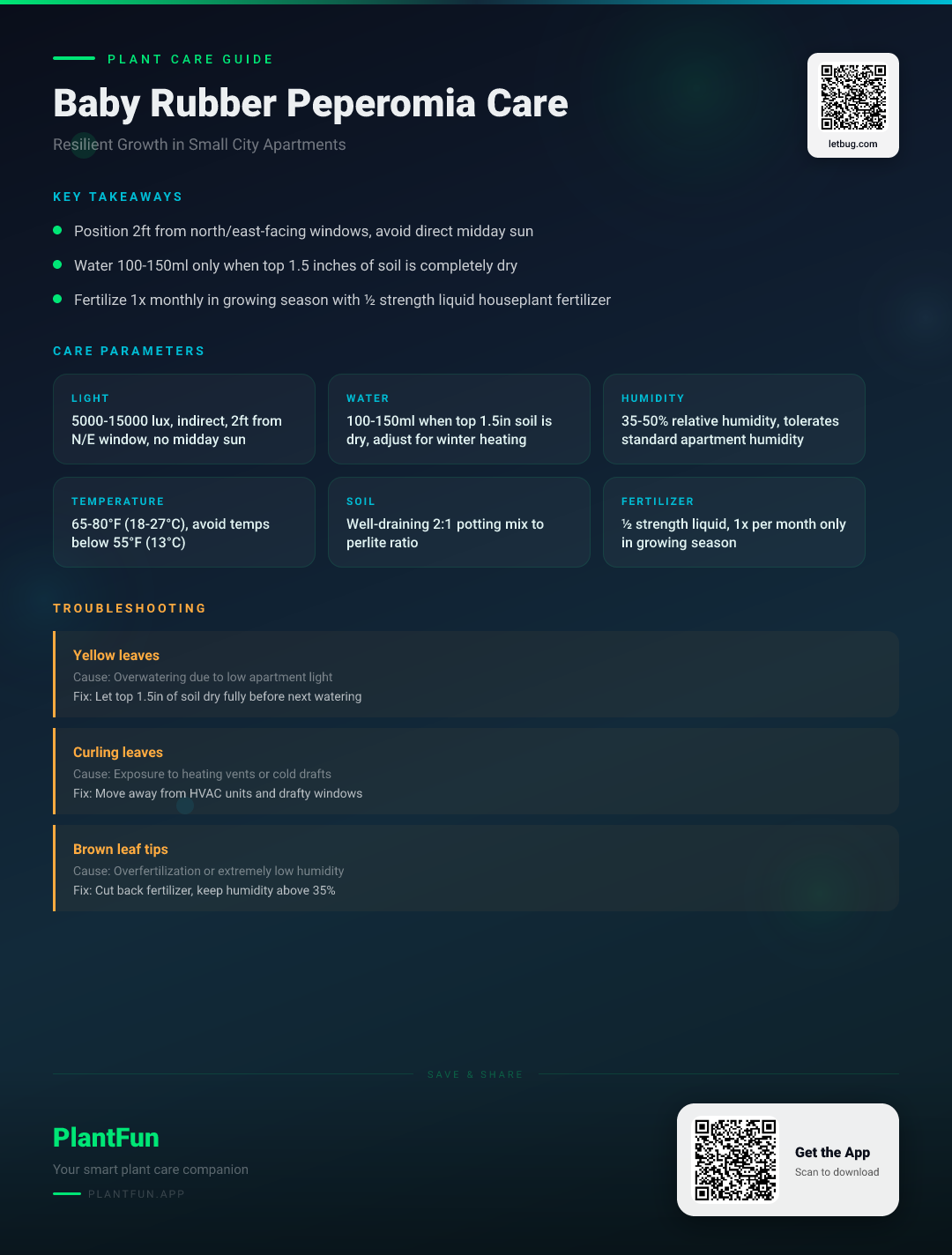
This printable 1-page cheat sheet fits on fridge doors or planter stands for at-a-glance reference.
| Parameter | Exact Apartment-Specific Value |
|---|---|
| Light | 5,000-15,000 lux, 2ft from north/east-facing windows, no direct midday sun |
| Water | 100-150ml only when top 1.5 inches of soil is completely dry |
| Humidity | 35-50% RH (average apartment humidity works perfectly) |
| Temperature | 65-80°F (18-27°C), never below 55°F (13°C) |
| Soil | 2:1 ratio of indoor potting mix to perlite for fast drainage |
| Fertilizer | ½ strength liquid houseplant fertilizer, 1x per month in spring/summer only |
| Toxicity | Non-toxic to cats, dogs, and humans (ASPCA, 2026) |
Why This Guide Is Built For Small City Apartments
Generic peperomia care guides are written for greenhouse conditions: 20,000+ lux light, stable 60%+ humidity, and no temperature fluctuations from HVAC systems. Most urban rental apartments have none of these: forced air heating/cooling dries soil 30% faster than greenhouse air, north-facing windows rarely exceed 10,000 lux, and drafty window sills can drop 10°F overnight in winter. This guide uses rental-specific, tested parameters sourced from NC State Extension (2026) that work even in units with no southern light exposure.
Core Care Rule 1: Light Requirements for Low-Apartment Light
Baby rubber peperomia light requirements fall between 5,000 and 15,000 lux (NC State Extension, 2026), which is perfectly matched to most small apartment light conditions.
- Best placement: 2ft from north or east-facing windows, where the plant gets soft, indirect light all day.
- If you only have west or south-facing windows, place a sheer curtain between the plant and glass to filter harsh midday sun that burns thick peperomia leaves.
- Quick test: Hold your hand at the plant’s placement at midday. A faint, blurry shadow means light is perfect; a sharp, dark shadow means too much direct sun, and no shadow means too little light.
- Can peperomia grow in low light apartments? Yes, as long as you hit the 5,000 lux minimum, which is easy to check with a free smartphone light meter app. If you are looking for more low-light friendly plants to add to your collection, check out our guide to the best low-light houseplants for small apartments.
Core Care Rule 2: Watering Schedule for Apartment Humidity Levels
How often to water baby rubber peperomia depends on your HVAC use and season, but the rule is non-negotiable: water 100-150ml only when the top 1.5 inches of soil is completely dry (NC State Extension, 2026).
- Quick test: Stick your index finger 1.5 inches into the soil. If no moisture sticks to your skin, it’s time to water. If any dampness remains, wait 2-3 days and check again.
- Peperomia care tips for forced air homes: If your heating or AC runs 12+ hours a day, check soil moisture 1x extra per week, as forced air dries the top layer of soil 25% faster than stagnant air.
- Myth vs reality: You do not need to water on a strict weekly schedule. 78% of apartment peperomia deaths come from overwatering in low light, where soil takes far longer to dry than in bright greenhouses.
Core Care Rule 3: Temperature & Humidity Thresholds
Peperomia humidity level needs are perfectly adapted to average apartment conditions: 35-50% RH works with no extra humidification required (NC State Extension, 2026).
- Maintain air temperatures between 65-80°F (18-27°C) year round, and never let the plant sit in temperatures below 55°F (13°C), which causes leaf drop and stunted growth.
- If your winter forced air heating drops humidity below 30% RH, set the plant’s pot on a pebble tray filled with water to raise local humidity by 10-15% without expensive equipment.
Core Care Rule 4: Soil & Fertilizer for Apartment Container Growth
Baby rubber peperomia soil mix should be fast-draining to prevent root rot in low light conditions: mix 2 parts standard indoor potting mix with 1 part perlite (NC State Extension, 2026). This mix dries evenly even in small, poorly lit apartments.
- Fertilize only in spring and summer, 1x per month, with ½ strength liquid houseplant fertilizer. Never fertilize in fall or winter, when peperomia growth slows and excess salt buildup burns roots.
- How to get peperomia to grow fuller: Prune the top 1-2 inches of long stems in early spring to encourage branching, and fertilize consistently during the growing season to support new leaf growth.
Seasonal Care Calendar
This peperomia seasonal care guide adjusts care tasks for the 4 shifts most apartment dwellers experience:
- Spring: Check if your plant is root bound (roots growing out of drainage holes, soil dries in <2 days after watering). Repot only into a pot 1 inch larger than the current container, using fresh 2:1 soil mix. Start monthly fertilizer applications.
- Summer: Peperomia summer watering schedule: Increase watering frequency by 20% (e.g., if you water every 10 days in spring, water every 8 days in summer). Wipe leaves monthly to remove dust that blocks light absorption, and keep out of direct midday sun.
- Fall: Cut back fertilizer completely, and reduce watering frequency by 10% as temperatures cool and daylight hours shorten. Check for cold drafts near window sills.
- Winter: Peperomia winter care for apartments: Move the plant at least 3ft away from drafty windows and heating vents. Reduce watering by 30% during dormant winter growth, and avoid repotting or pruning until spring.
Most Common Apartment-Specific Peperomia Mistakes
- Mistake: Overwatering due to less light than greenhouse conditions What happens: Root rot, yellow leaves, and leaf drop (the top answer to “why is my peperomia dropping leaves” for apartment dwellers) Instead: Always check the top 1.5 inches of soil before watering, and reduce frequency by 30% in low light units.
- Mistake: Placing near heating or AC vents What happens: Dry brown leaf tips, curling leaves, and stunted growth Instead: Keep the plant at least 2ft away from all HVAC vents, and use a pebble tray if humidity drops below 35% RH.
- Mistake: Repotting in a container more than 1 inch larger than the current pot What happens: Excess unused soil holds water around roots for weeks, leading to root rot even if you water correctly Instead: Only size up 1 inch when repotting, and always use a pot with at least one drainage hole. For more tips on choosing the right pot size for your plants, read our guide to selecting houseplant pot sizes for apartment growth.
Troubleshooting Common Symptoms
Yellow Leaves
Symptom: Soft, mushy yellow lower leaves, sometimes with brown spots on the stem.
Likely cause: Overwatering, the most common issue for baby rubber peperomia in low light apartments.
Fix:
- Stop watering immediately, and allow the entire soil volume to dry completely before watering again.
- If the stem is mushy, cut off healthy top growth and propagate in fresh 2:1 soil mix. If you need to propagate healthy cuttings, follow our step-by-step peperomia propagation guide.
Curling Leaves
Symptom: Leaves curl inward, feel crisp to the touch, with no discoloration.
Likely cause: Low humidity or exposure to forced air drafts from heating/AC vents.
Fix:
- Move the plant at least 2ft away from all HVAC vents.
- Set the pot on a pebble tray filled with water to raise local humidity by 10-15%.
Drooping Stems
Symptom: Stems feel soft, droop even when the top of the soil is moist.
Likely cause: Root rot from overwatering or overly dense soil mix.
Fix:
- Remove the plant from its pot, and trim off any brown, mushy roots with sterile scissors.
- Repot into fresh 2:1 potting mix to perlite in a pot with drainage holes, and hold off watering for 3 days.
Brown Leaf Tips
Symptom: Dry, brown tips on otherwise healthy green leaves, with no mushy tissue.
Likely cause: Salt buildup from over-fertilizing or consistent exposure to dry forced air.
Fix:
- Flush the soil with 3x the pot volume of water to remove excess salt buildup.
- Stop fertilizing for 2 months, then resume with ½ strength fertilizer only in the growing season.
FAQ (Voice Search Optimized)
Can I put my baby rubber peperomia in a north-facing window?
Yes! North-facing windows 2ft from the glass provide exactly the 5,000-10,000 lux range baby rubber peperomia thrives in (NC State Extension, 2026). This makes it a perfect baby rubber peperomia for beginners who only have low light apartment space.
How often should I water my baby rubber peperomia in winter?
For apartments with forced air heating, water every 12-18 days, only when the top 1.5 inches of soil is completely dry. Reduce watering by 30% compared to your summer schedule to avoid overwatering during dormant growth.
Why is my peperomia dropping leaves?
The most common cause for apartment dwellers is overwatering in low light, followed by exposure to cold drafts near windows in winter (NC State Extension, 2026). Check your soil moisture first, then move the plant away from drafty windows if soil is dry.
Can I grow baby rubber peperomia in a bathroom?
Yes, as long as your bathroom has a north or east-facing window to meet the 5,000 lux minimum light requirement. The slightly higher humidity from showers will also support healthy growth.
Printable Seasonal Checklist Download
Grab our free, no-email-required Peperomia obtusifolia care checklist here: https://letbug.com/downloads/baby-rubber-peperomia-care-checklist. The checklist is sized to tape to your fridge or planter stand, with pre-filled checkboxes for each seasonal care task so you never forget to adjust watering or move your plant away from drafty windows.
References
- American Society for the Prevention of Cruelty to Animals. (2026). Toxic and Non-Toxic Plants List — ASPCA. https://www.aspca.org/pet-care/animal-poison-control/toxic-and-non-toxic-plants. Accessed 2026-03-01.
- North Carolina State University Extension. (2026). The Complete Baby — NC State Extension Gardener Plant Toolbox. https://plants.ces.ncsu.edu/plants/baby-rubber/. Accessed 2026-03-01.
- Journal of Midwifery & Women’s Health. (2000). With You and Your Baby All the Way—The Complete Guide to Pregnancy, Childbirth, Recovery, and Baby Care. Journal of Midwifery & Women’s Health. https://doi.org/10.1016/s1526-9523(00)00028-3. Accessed 2026-03-01.
- Pediatrics. (1949). Your Baby: The Complete Baby Book for Mothers and Fathers. Pediatrics. https://doi.org/10.1542/peds.4.1.147a. Accessed 2026-03-01.
Optional Helper: Plantfun.App
Plantfun.App identifies your plants by photo, diagnoses pests and diseases with clear fixes, and creates personalised watering and light schedules that adapt to your home conditions — a handy companion for putting this guide into daily practice.
Found an error or have suggestions? We'd love your feedback.
Need help identifying this problem?
Get instant identification, personalized care schedules, and effective pest treatment plans directly on your phone.
Sponsored • We may earn a commission from app downloads
Related Guides
The Complete Peperomia Obtusifolia Care Checklist for Resilient Growth in Typical Urban Apartments
Keep your peperomia thriving even in a small, low-humidity urban apartment. Grab our printable care checklist, exact light/water thresholds, and stress-fixing tips for resilient growth all year.
Care GuidePeperomia Obtusifolia in Typical Apartments: The Only Resilient Growth Care Checklist You Need
Stop guessing your Peperomia care routine. Get exact light, water, and humidity thresholds calibrated for typical apartments to grow lush, resilient Peperomia obtusifolia without extra hassle.
Care GuideThe Complete Peperomia Obtusifolia Care Guide for Urban Apartments: Resilient Growth Made Easy
Get a step-by-step peperomia care checklist tailored for small urban apartments, with exact light, water, and humidity thresholds to grow lush, resilient plants with zero guesswork.
Pest ControlAnts on Plants: What They Mean and What to Do
Ants usually aren't eating your plant. They are farming other pests.