
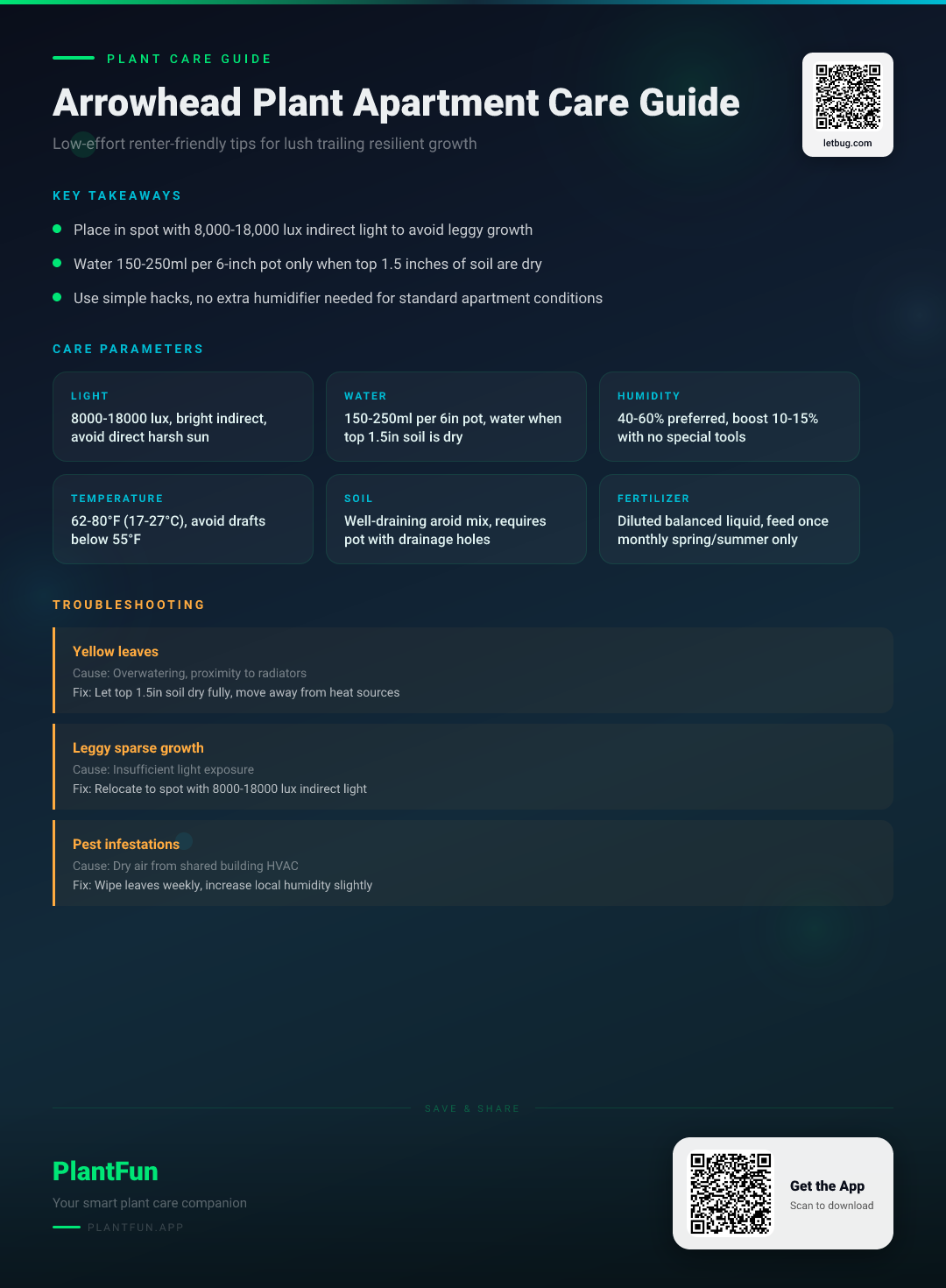
Key Takeaways
- Check soil moisture before watering — overwatering is the #1 killer of houseplants.
- Ensure your plant gets the right amount of light for its species.
- Be patient with recovery — most plants need 2–4 weeks to bounce back.
Quick Care Card
| Care Factor | Measurable Threshold |
|---|---|
| Light | 8,000-18,000 lux (bright indirect light, no direct midday sun) |
| Water | 150-250ml per 6-inch pot, when top 1.5 inches of soil are completely dry |
| Humidity | 40-55% (average apartment humidity is sufficient, no humidifier required) |
| Temperature | 62-80°F (17-27°C), avoid drafts and direct proximity to HVAC vents |
| Soil | 2 parts standard indoor potting mix + 1 part perlite |
| Fertilizer | Diluted 50% strength indoor plant food, once every 2 months spring and summer only |
| Toxicity | Toxic to cats, dogs, and small children if ingested (ASPCA, 2026) |
Why Arrowhead Plants Thrive in Typical Apartments
Native to the tropical understory of Central and South America, Syngonium podophyllum evolved to thrive in dappled, low light and consistent warm temperatures, conditions that almost perfectly match the average urban apartment (NC State Extension, 2026). A common myth is that arrowhead plants need high, greenhouse-level humidity to survive, but their natural habitat experiences regular humidity fluctuations, making them highly tolerant of the 40-45% humidity found in most apartments. Note that this plant is toxic to pets and small children if ingested (ASPCA, 2026), so place it on a high shelf or hanging planter if you have curious household members. This guide is tailored specifically for arrowhead plant care for beginners and busy renters who cannot modify their apartment’s HVAC or layout.
Step 1: Light Placement for Your Apartment
The ideal arrowhead plant light requirement is 8,000-18,000 lux, a range proven to support healthy, compact growth for indoor ornamental species (Gautam et al, 2021). To test if a spot is suitable, hold your hand at plant height at noon: if you see a soft, fuzzy shadow, the light is perfect. A hard, sharp shadow means too much direct sun (which burns leaves), while no shadow means the light is too low, leading to leggy growth. Best window spots:
- 3-5 feet from an east-facing window (ideal, gets gentle morning sun)
- 5-8 feet from a south or west-facing window (avoid direct midday sun) Adjustments for limited window options:
- North-facing only: Place directly on the north windowsill, no curtain needed
- West-facing only: Hang a sheer curtain to filter harsh midday sun, keep 4 feet back from the window
Step 2: Exact Watering Routine by Apartment Conditions
If you’ve ever wondered how often to water arrowhead plant, the rule is simple: only water when the top 1.5 inches of soil are completely dry (NC State Extension, 2026). Test this by sticking your index finger into the soil up to your second knuckle: if no soil sticks to your finger, it’s time to water. For a standard 6-inch nursery pot, use 150-250ml of room-temperature water, poured slowly until you see 2-3 drops escape the drainage hole. Adjust for HVAC use:
- If you run AC constantly in summer, add 50ml extra per watering
- If you run heat in winter, wait 3 extra days before watering to avoid overwatering
Step 3: Low-Effort Soil & Pot Setup for Renters
You don’t need fancy soil amendments for successful Syngonium care for apartments. Use this no-fuss mix:
- 2 parts standard indoor potting mix
- 1 part perlite (improves drainage to prevent root rot) Always use a nursery pot with drainage holes to avoid overwatering. Rental-friendly decorative pot hack: Add a 2-inch layer of pebbles to the bottom of your unmodified decorative pot before setting the nursery pot inside. The pebbles catch excess water so you don’t damage rental countertops or floors, no drilling required.
Step 4: Humidity & Temperature Adjustments That Don’t Require a Humidifier
If you’ve asked do arrowhead plants need humidity, the answer is that average apartment 40-45% humidity is completely sufficient for healthy growth (NC State Extension, 2026). If you want to boost humidity by 10-15% for lusher, larger leaves, use these no-tool tricks:
- Group your arrowhead plant with other houseplants (they release moisture into the air through transpiration)
- Add water to the pebble tray under your nursery pot, making sure the pot base is not sitting in water
- Mist leaves once every 3 days during dry winter or high-AC summer months The safe temperature range for arrowhead plants is 62-80°F (17-27°C). Keep them away from drafty windows and direct proximity to HVAC vents to avoid stress.
Seasonal Care Calendar
This arrowhead plant seasonal care calendar eliminates guesswork, with tasks tailored to average apartment conditions:
Spring (March-May)
- Prune back leggy stems by 1/3 (cut just above a leaf node) to learn how to make arrowhead plant bushier
- Apply 1 dose of 50% diluted indoor plant food
- Move plants out of drafty winter spots to their regular light location
- Check for new growth; if stems are stretching, move 2 feet closer to a window
Summer (June-August)
- Water every 7-10 days, following the 1.5-inch dry soil rule (this is your standard arrowhead plant summer watering schedule)
- Wipe leaves with a damp cloth once a month to remove dust and improve light absorption
- If you have a west-facing window, hang a sheer curtain to filter harsh midday sun
- Keep 3 feet away from AC vents to avoid cold drafts
Fall (September-November)
- Extend watering intervals to every 10-14 days as temperatures drop
- Stop fertilizing entirely, as new growth slows for the dormant season
- Move plants away from windows if nightly temperatures drop below 60°F (15°C)
Winter (December-February)
- Water every 14-21 days, checking soil moisture carefully to avoid overwatering (this is the core of low-fuss arrowhead plant winter care)
- Keep at least 3 feet away from radiators, baseboard heaters, and heating vents
- Avoid pruning during dormancy, as new growth will be weak and leggy
Common Apartment-Specific Mistakes to Avoid
- Mistake: Placing your arrowhead plant 10+ feet away from any window for decor purposes, with no supplemental light. What happens: Stretched, leggy growth with pale, small leaves, as the plant expends energy reaching for light. Instead: Keep plants within 8 feet of a window, or add 12-14 hours of daily LED overhead light for dark corners for a reliable arrowhead plant leggy growth fix.
- Mistake: Watering on a fixed weekly schedule, regardless of temperature or HVAC use. What happens: Overwatering leads to root rot and yellow leaves, while underwatering causes crispy leaf edges. Instead: Check the top 1.5 inches of soil every 7 days, and only water when it’s completely dry.
- Mistake: Placing the plant directly on or next to a radiator in winter. What happens: Rapid moisture loss from leaves leads to sudden yellowing and leaf drop, one of the top answers to why is my arrowhead plant turning yellow in cold months. Instead: Keep all plants 3 feet away from heating and cooling sources, and use a pebble tray to boost local humidity.
- Mistake: Not checking for pests after bringing new plants into your apartment building. What happens: Spider mites and mealybugs spread easily through shared building HVAC systems, and can quickly infest your arrowhead plant. Instead: Wipe down new plant leaves with a 50/50 rubbing alcohol and water solution before bringing them inside, and check your arrowhead plant’s leaf undersides monthly for signs of pests.
FAQ 1: Why is my arrowhead plant getting yellow leaves after I turn my heater on in winter?
Heaters drastically reduce indoor humidity, and if your plant is placed too close to a vent, it can lose moisture from its leaves faster than it can replace it, leading to yellow, drooping foliage. If you’re still watering on your summer schedule, cooler winter temperatures mean the soil stays wet longer, leading to root rot, another common cause of yellow leaves (NC State Extension, 2026). First, move the plant 3 feet away from all heat sources, then check the soil moisture: if the top 1.5 inches are still wet, wait 3-5 days to water. Add a pebble tray under the pot to boost local humidity by 10-15% without a humidifier.
FAQ 2: Can I keep my arrowhead plant in my apartment’s dark corner with only artificial overhead light?
Yes, arrowhead plants are highly tolerant of low light conditions, as long as the overhead light is on for 12-14 hours per day, and the light source is within 3 feet of the plant (Gautam et al, 2021). If you notice stems stretching more than 1 inch between new leaves, add a low-wattage clip-on LED bulb positioned 1 foot above the plant to increase light levels. This makes arrowhead plant low light care extremely accessible for renters with limited window space.
FAQ 3: How often do I need to repot my arrowhead plant if I live in a small apartment?
You only need to repot your arrowhead plant every 2-3 years, when you see roots growing out of the drainage holes of the nursery pot. If you want to keep your plant small to save space, you can trim 1/3 of the root ball with clean scissors and repot it back into the same size nursery pot with fresh soil, no need to size up to a larger pot if you don’t have space.
Troubleshooting Quick Reference
Yellow Lower Leaves
Symptom: Soft, yellow lower leaves that fall off easily, with no crispy brown edges.
Likely cause: Overwatering, often made worse by cold temperatures or the pot sitting in standing water.
Fix:
- Tip out any excess water from the decorative pot’s pebble tray immediately
- Wait to water until the top 2 inches of soil are completely dry, 3-5 days longer than your usual schedule
Leggy Stretched Growth
Symptom: Long, thin stems with 1+ inches between new leaves, and pale, small new foliage.
Likely cause: Too little light, common in north-facing apartments or dark corners with no supplemental light.
Fix:
- Move the plant 2-3 feet closer to the nearest window, or place it directly on a north-facing windowsill
- Prune back the longest stems by 1/3 just above a leaf node to encourage bushier, fuller growth
Crispy Brown Leaf Edges
Symptom: Dry, brown edges on otherwise green, healthy leaves, with no widespread yellowing.
Likely cause: Low humidity from running HVAC, or mild underwatering.
Fix:
- Add water to your pebble tray so it reaches halfway up the pebbles, making sure the base of the nursery pot is not sitting in water
- Check soil moisture: if the top 2 inches are dry, water with 200ml of room-temperature water
References
- NC State Extension. (2026). The Complete Arrowhead Plant — NC State Extension Gardener Plant Toolbox. https://plants.ces.ncsu.edu/plants/arrowhead-plant/. Accessed 2026-03-01.
- Gautam, B.; Dubey, R.; Kaur, N. (2021). GROWTH RESPONSE OF INDOOR ORNAMENTAL PLANT SPECIES TO VARIOUS ARTIFICIAL LIGHT INTENSITIES (LED) IN AN INDOOR VERTICAL GARDEN. PLANT ARCHIVES. https://doi.org/10.51470/plantarchives.2021.v21.no1.096. Accessed 2026-03-01.
- ASPCA. (2026). Toxic and Non-Toxic Plants List — ASPCA. https://www.aspca.org/pet-care/animal-poison-control/toxic-and-non-toxic-plants. Accessed 2026-03-01.
- Šrámek, F. (1999). Vaughan, M.J.: The Complete Book on Cut Flower Care. Biologia plantarum. https://doi.org/10.1023/a:1001770114931. Accessed 2026-03-01.
Optional Helper: Plantfun.App
Plantfun.App identifies your plants by photo, diagnoses pests and diseases with clear fixes, and creates personalised watering and light schedules that adapt to your home conditions — a handy companion for putting this guide into daily practice.
Found an error or have suggestions? We'd love your feedback.
Need help identifying this problem?
Get instant identification, personalized care schedules, and effective pest treatment plans directly on your phone.
Sponsored • We may earn a commission from app downloads
Related Guides
The Complete Arrowhead Plant Care Checklist for Resilient Growth in Typical Apartments
Stop guessing at Arrowhead Plant care. Get a tailored checklist, exact light, water, and humidity parameters to grow lush, resilient vines even in typical low-light city apartments.
Care GuideThe Budget Arrowhead Plant Care Checklist for Resilient Growth in Typical Urban Apartments
Grow a lush arrowhead plant on a tight budget in your apartment. Get exact light, water, and humidity thresholds plus a free printable checklist for resilient, pest-free growth all year.
Care GuideThe Complete Arrowhead Plant Care Checklist for Thriving Growth in Small Urban Apartments
Grow a lush arrowhead plant even in a cramped apartment. Get exact light, water, and humidity thresholds, plus space-saving hacks and a free printable care checklist you can reference fast.
Pest ControlAnts on Plants: What They Mean and What to Do
Ants usually aren't eating your plant. They are farming other pests.